One of the most memorable warnings in Middle-earth is also one of the easiest to misunderstand.
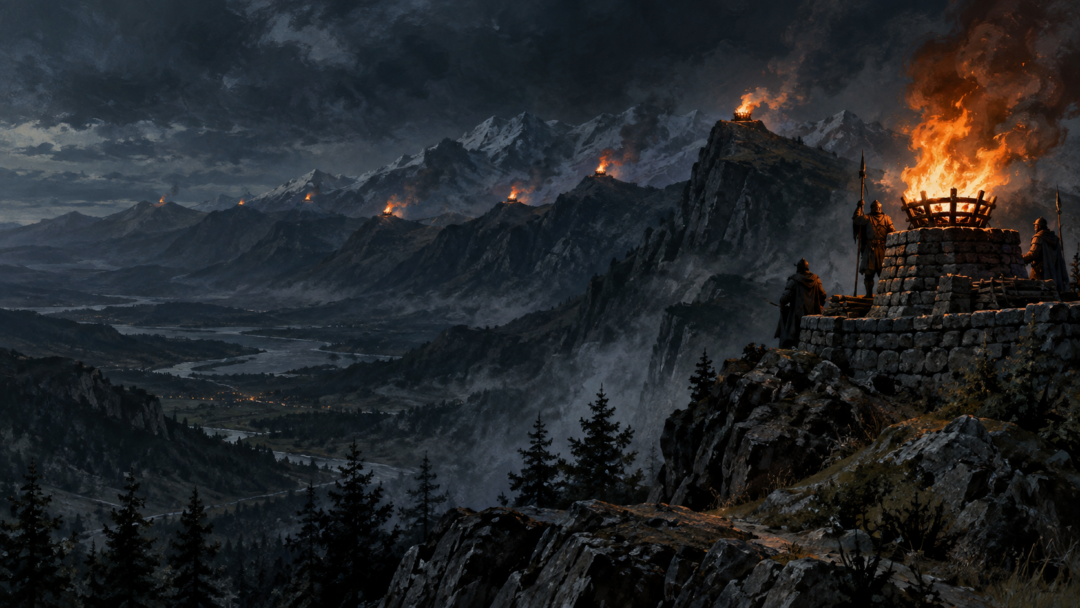
As Gandalf and Pippin race through Anórien toward Minas Tirith, fires leap from hill to hill along the White Mountains: Amon Dîn, Eilenach, Nardol, Erelas, Min-Rimmon, Calenhad, and finally Halifirien on the border of Rohan. Gondor is sounding the alarm. Maestros del Saber
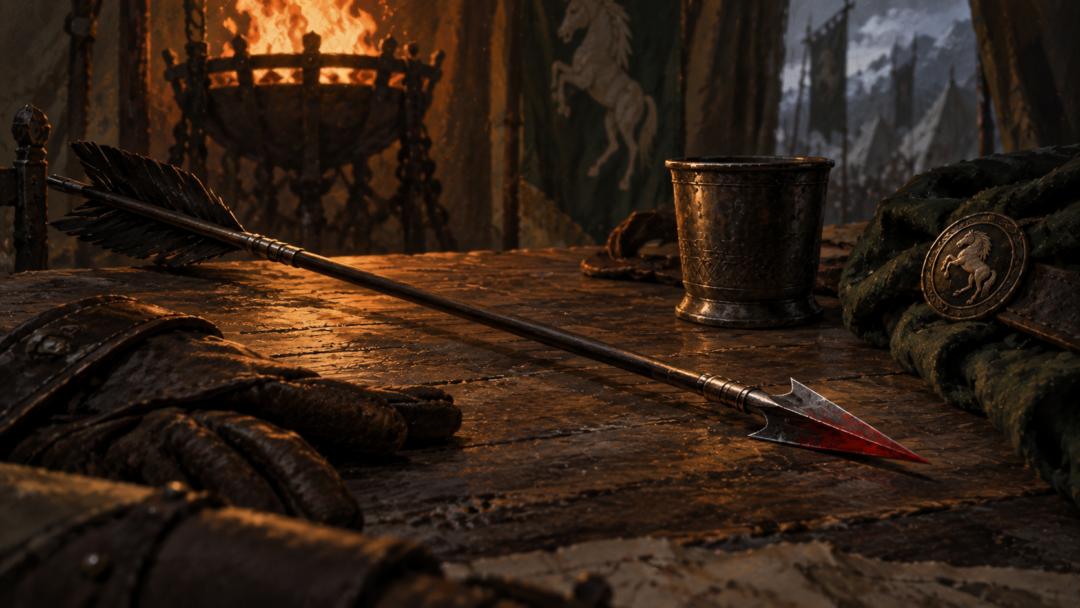
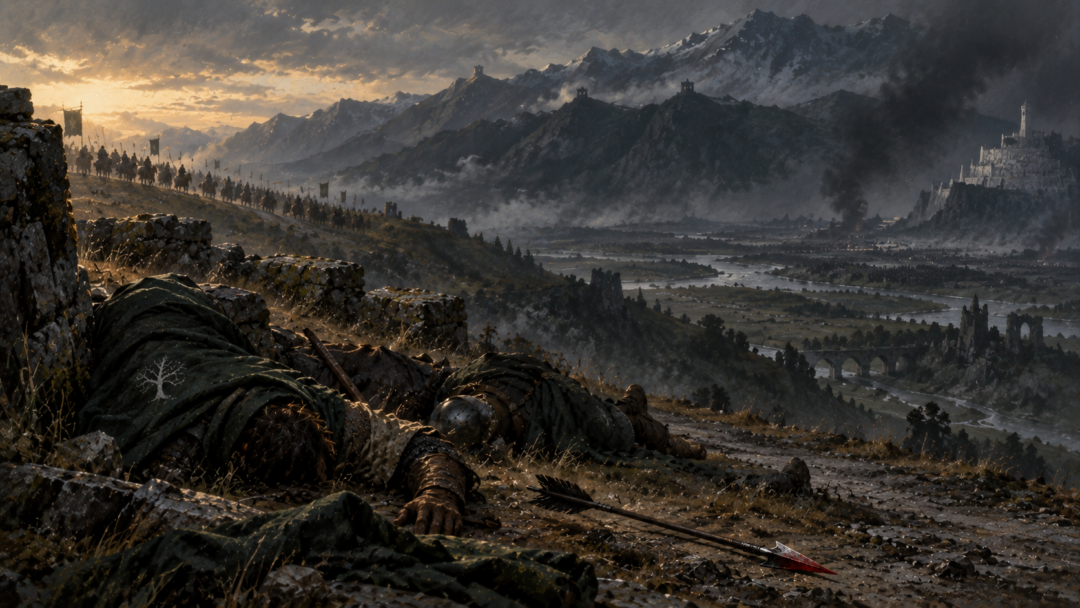
Yet when Théoden later commits Rohan to Gondor’s defence, another signal appears: a single black-feathered arrow, steel-barbed, its point painted red, carried personally by Denethor’s errand-rider Hirgon. Maestros del Saber
These are sometimes treated as two versions of the same thing. The text suggests something more interesting. The beacons and the Red Arrow belonged to the same emergency communication network, but they operated differently. The fires spread alarm across enormous distances; the messenger carried a specific appeal from one ruler to another.
That distinction reveals how Gondor prepared for war—and why the final mobilization of Rohan required more than a distant flame.
The Beacons Were a Warning Network
Gondor’s beacons were not merely ceremonial bonfires. They formed part of an organized communications system maintained by the Lord of Minas Tirith.
The northern line followed the White Mountains westward through seven named stations: Amon Dîn, Eilenach, Nardol, Erelas, Min-Rimmon, Calenhad, and Halifirien. Gondor also maintained beacon arrangements toward its southern regions, while horses were kept ready at beacon posts for mounted messengers travelling toward Rohan or Belfalas.
This matters because the system combined two forms of communication.
Fire could transmit a simple warning extremely quickly across country. Riders could carry information that fire could not: instructions, reports, requests, and details about the military situation.
The beacons therefore excelled at answering one urgent question:
Has the crisis begun?
They could not easily answer the questions that followed. How large was the enemy? Where were reinforcements required? How quickly must they arrive? What forces should be sent?
For those questions, Gondor still needed men on horseback.
What the Fires Meant During the War of the Ring
When Pippin sees the fires during the journey to Minas Tirith, Gandalf immediately understands their seriousness: Gondor is calling for aid and war has begun.
Later, Beregond gives Pippin more context. He believes the immediate cause of the beacon-lighting was news arriving from Lebennin, where the threat from the Corsairs had become grave.
That detail changes the scale of the scene.
Gondor was not facing only the army gathering before Minas Tirith. Its southern lands were threatened as well. Enemy pressure was spreading across the kingdom, and Denethor needed the realm’s military machinery moving before the siege closed around his capital.
The beacon chain was perfectly suited to this first stage.
A signal could race west without requiring one horse to cover the entire distance. Each station transformed what it saw into a new fire, extending the warning onward.
The flames therefore represented mobilization at the level of alarm: Gondor was entering a state of open war, and distant allies and regions needed to know that the emergency was no longer theoretical.
But knowing that Gondor was in danger was not the same as knowing precisely what Gondor required from Rohan.
For that, Denethor sent Hirgon.
The Red Arrow Was a Direct Summons
Hirgon’s arrival in Rohan is deliberately personal.
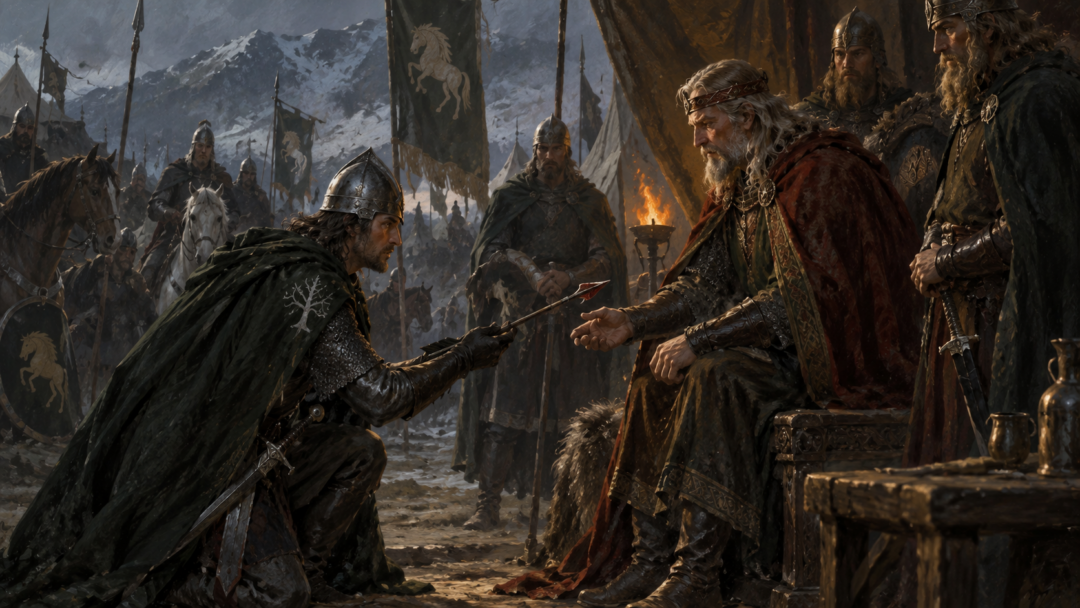
He does not simply announce that the beacons have been lit. He comes before Théoden as Denethor’s representative and presents the Red Arrow, a black-feathered, steel-barbed arrow with its point painted red. It is explicitly called a token of war.
American High School
Théoden’s reaction shows how extraordinary the token is.
He recognizes it immediately, but says that it has never been seen in the Mark during his lifetime. The summons was therefore familiar enough to belong to the political and military understanding between the realms, yet exceptional enough that Théoden had never personally received it.
And Hirgon brings more than symbolism.
Denethor asks for Rohan’s strength and speed. Hirgon explains the expected strategic problem: Minas Tirith may soon be surrounded, and Rohan may need sufficient force to help break a siege.
American High School
A beacon cannot convey that.
The Red Arrow arrives with a human voice capable of describing the crisis and receiving an answer.
This is the second stage of mobilization: not simply alarm, but a direct commitment of allied military power.
Théoden Still Had to Decide What Rohan Could Send
The distinction becomes even clearer when Théoden questions Hirgon.
Rohan’s king does not respond as though a fire on the horizon has automatically dictated every military detail. He asks what Denethor means by demanding all Rohan’s strength and speed.
There is a practical reason.
The Rohirrim are scattered across their land, and gathering mounted forces takes time. Rohan has also just fought its own war against Saruman. Théoden must calculate what can actually be assembled and how quickly it can reach Gondor.
The Red Arrow therefore does not magically produce an army.
It turns an existing emergency into a concrete exchange between sovereign allies.
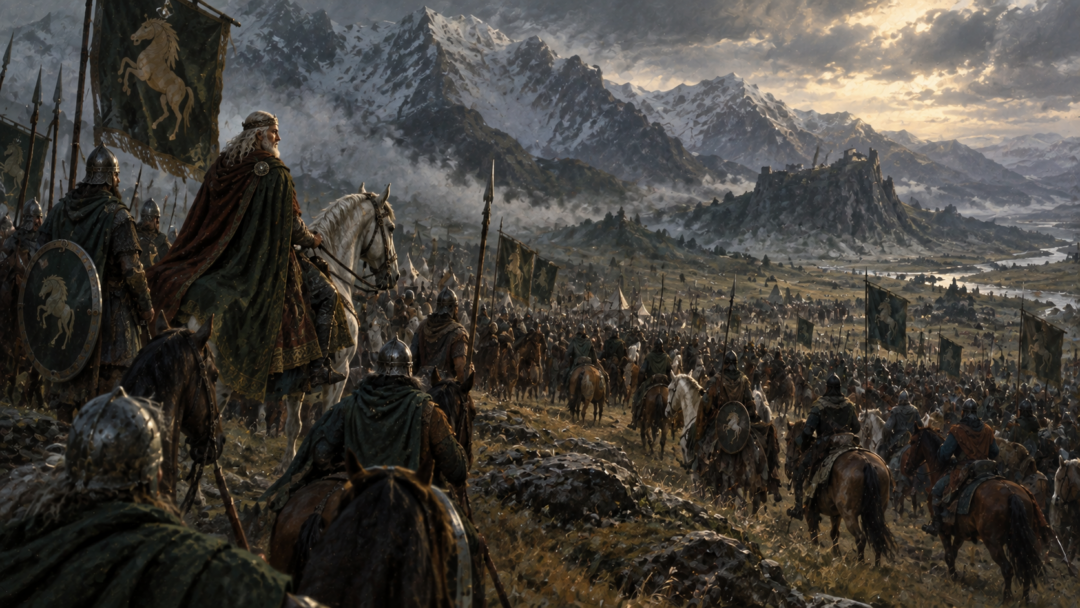
Théoden mustered his Riders, and ultimately six thousand spears rode east with him toward the war. The journey itself took five days and nights from the departure recorded in the song of Théoden’s ride. Ae Lib
The military reality behind the famous charge on the Pelennor Fields was therefore a chain of preparation: warning, gathering, decision, march, and finally battle.
Why Gondor Needed Both Systems
It is tempting to ask which signal was the “real” call for Rohan.
The better reading is that Gondor’s communications were layered.
The beacons were extraordinarily efficient at transmitting urgency across distance. Their weakness was informational simplicity.
A messenger was slower and vulnerable, but he could carry detailed instructions and a recognized physical token authenticating the seriousness of his mission.
Gondor maintained both because each solved a different problem.
The beacon says, in effect: the emergency is here.
The messenger can say: this is what the Steward asks you to do about it.
That difference becomes especially important during the War of the Ring because events are moving faster than armies can travel. By the time one message reaches its destination, the battlefield may already have changed.
Gondor therefore needs the speed of light signals and the precision of mounted couriers.
The System Was Older Than the Final War
The beacon network also reflects Gondor’s long history of decline and adaptation.
Material associated with the history of Gondor describes Amon Dîn, Eilenach, and Min-Rimmon as early beacon sites connected with the defence of Anórien, while the later political geography created by the establishment of Rohan changed the western end of the system. Halifirien, formerly Amon Anwar, eventually stood at the border between the allied realms.
This makes the network more than an emergency invention of Denethor’s day.
It belonged to a kingdom that had learned to compensate for distance, shrinking population, threatened frontiers, and the need to coordinate allies beyond Minas Tirith.
By the late Third Age, Gondor could not simply summon overwhelming forces from its own heartlands. Communication itself had become part of survival.
The beacon hills embodied that reality.
Each flame crossed a gap that Gondor could no longer afford to leave silent.
The Cruel Weakness of the Messenger System
There is one final contrast between fire and messenger.
A beacon only has to be seen.
A messenger has to survive.
Hirgon successfully reaches Théoden and delivers the Red Arrow. But he does not successfully return to Minas Tirith. He and his companion are later found dead near the road, and the Red Arrow is discovered with them.
The failure of that return journey has consequences.
Denethor has sent his appeal, but he has not received Théoden’s answer. As Minas Tirith approaches destruction, the Steward therefore lacks confirmation that Rohan is actually coming.
This is one of the quiet tragedies behind the siege.
Rohan has answered.
Théoden is riding.
Thousands of horsemen are already moving east.
But Gondor does not know it.
The same communication system that successfully transmitted the plea cannot guarantee that the reply will return.
From Fire to Arrow to Spears
The defence of Minas Tirith did not begin when the Rohirrim appeared on the Pelennor.
It began much earlier, in signals moving across the landscape.
First came warning: fires blazing from hill to hill, telling distant lands that Gondor had entered its hour of war.
Then came the Red Arrow: a physical token carried by Hirgon into the presence of Théoden, transforming general alarm into a direct request for military aid.
Then came the muster: Riders gathering from a scattered kingdom.
And finally came movement itself—the long ride east, six thousand spears approaching a city that could not know with certainty whether they would arrive.
That is what makes the beacon system and the Red Arrow more interesting when kept separate rather than merged into one signal.
One spread the crisis across the map.
The other placed the crisis in Théoden’s hand.
And only after both came the hardest stage of mobilization: men choosing to ride toward a battle from which many of them would never return.
Sources & Notes
- Tolkien Gateway — Warning beacons of Gondor https://tolkiengateway.net/wiki/Warning_beacons_of_Gondor
- Tolkien Gateway — Red Arrow https://tolkiengateway.net/wiki/Red_Arrow
- Tolkien Gateway — War of the Ring https://tolkiengateway.net/wiki/War_of_the_Ring
- Tolkien Gateway — Battle of the Pelennor Fields https://tolkiengateway.net/wiki/Battle_of_the_Pelennor_Fields
These reference entries document Gondor's beacons, the Red Arrow summons, and the resulting campaign chronology. The article's distinction between warning, mustering, and formal allied mobilization is its synthesis of those events.