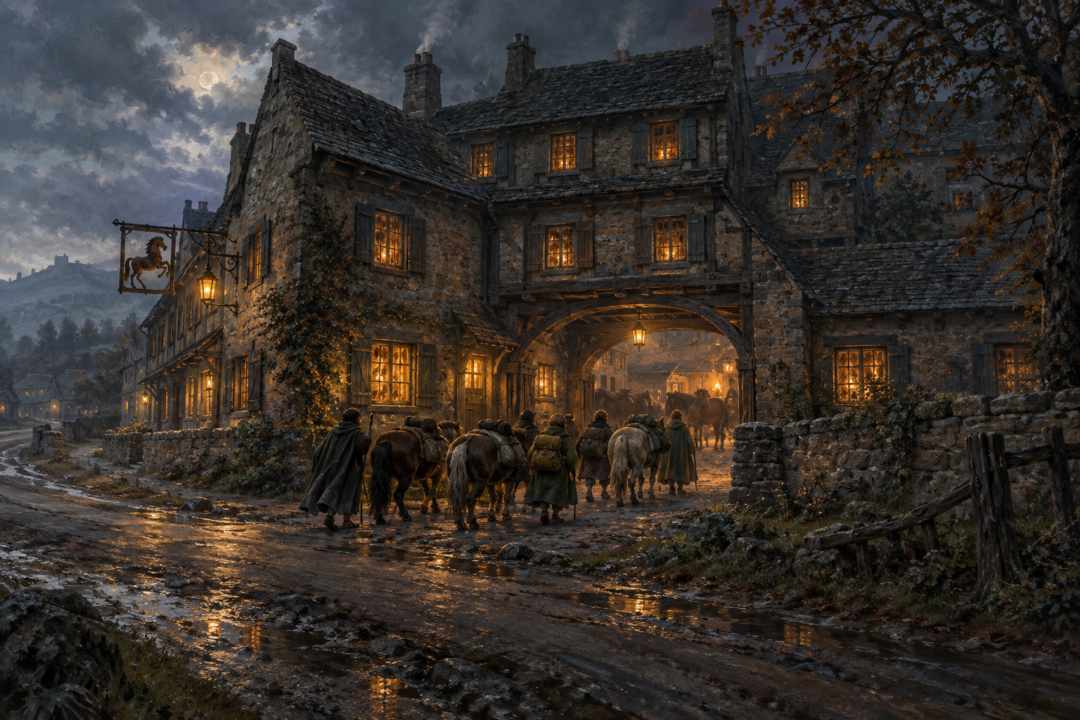
When Frodo, Sam, Merry, and Pippin first see the Prancing Pony, the building is almost intimidating. Sam looks up at its three storeys and many windows; after the Shire, the houses of Men seem enormous. Yet within minutes the same inn gives the travellers something unexpectedly familiar: Hobbit-sized rooms on the ground floor, round windows, low comfortable chairs, a private parlour, food that could have come from home, and stabling for their ponies.
That contrast is easy to overlook.
The Prancing Pony is not simply a large human inn in which Hobbits happen to be accommodated. Its architecture reflects the unusual society of Bree itself: a place where Men and Hobbits have lived side by side for generations, while Dwarves, Rangers, merchants, refugees, animals, rumours, and dangerous strangers continue to pass through.
Its rooms do more than shelter travellers. They sort different bodies, different levels of privacy, and different kinds of information.
And on the night Frodo arrives, that system almost works too well.
An Inn Built for a Busier World
Bree stands at an old meeting of roads. The East Road runs through the village, while the ancient North Road crosses nearby. By the end of the Third Age the northern lands have become sparsely inhabited and the North Road has become the grass-grown Greenway, but the Prancing Pony survives from an earlier period when considerably more traffic moved through the region.
That history is literally built into the inn.
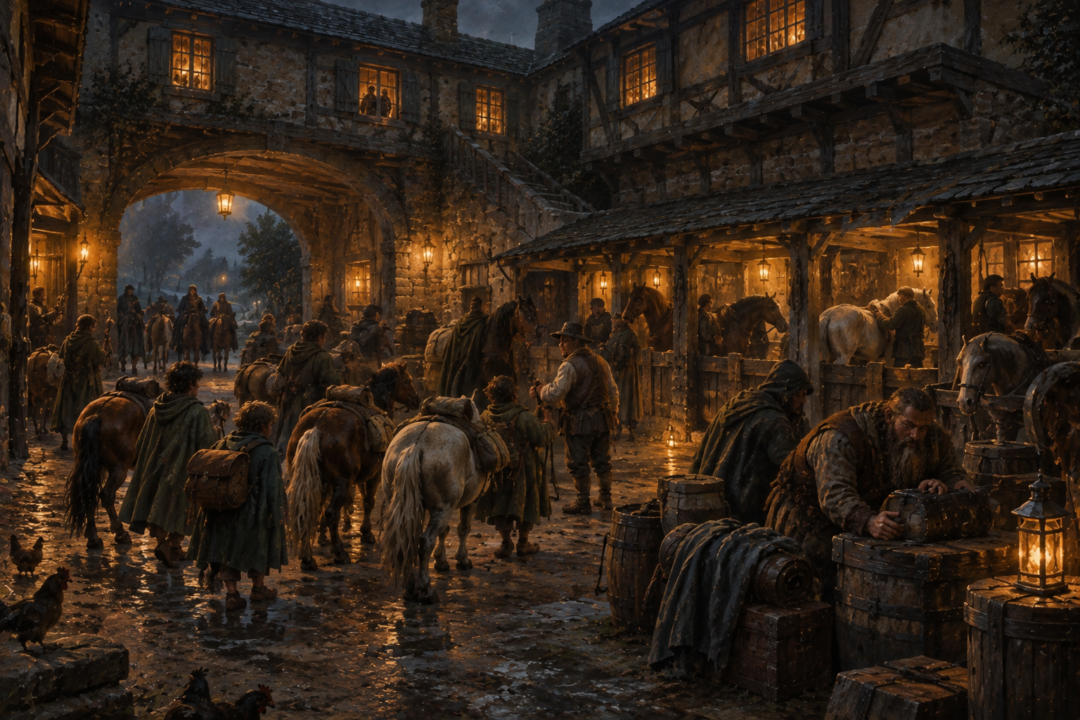
The building fronts the Road, while two wings extend backward into land partly cut from the lower slope of Bree-hill. Because of that slope, the second-floor windows at the rear are roughly level with the ground. Between the wings lies a courtyard reached through a broad arch.
This is a substantial building adapted to terrain rather than imposed upon it.
More importantly, its scale preserves the memory of an older transportation network. The traffic has declined, but the infrastructure remains.
That makes the Pony unusually capable when the outside world suddenly begins moving again.
On Frodo’s night there, Butterbur is overwhelmed by an uncommon concentration of guests: travellers have arrived from the South by the Greenway, Dwarves are travelling west, and four unexpected Shire-hobbits appear needing beds and accommodation for five ponies.
The inn is old enough—and large enough—to absorb them all.
Barely.
One Building for Big Folk and Little Folk
Bree-land is remarkable because Men and Hobbits live together in the same small country. The arrangement is presented as unusual, and the Prancing Pony embodies it more clearly than almost anywhere else.
Butterbur does not improvise Hobbit accommodation when Frodo arrives.
It already exists.
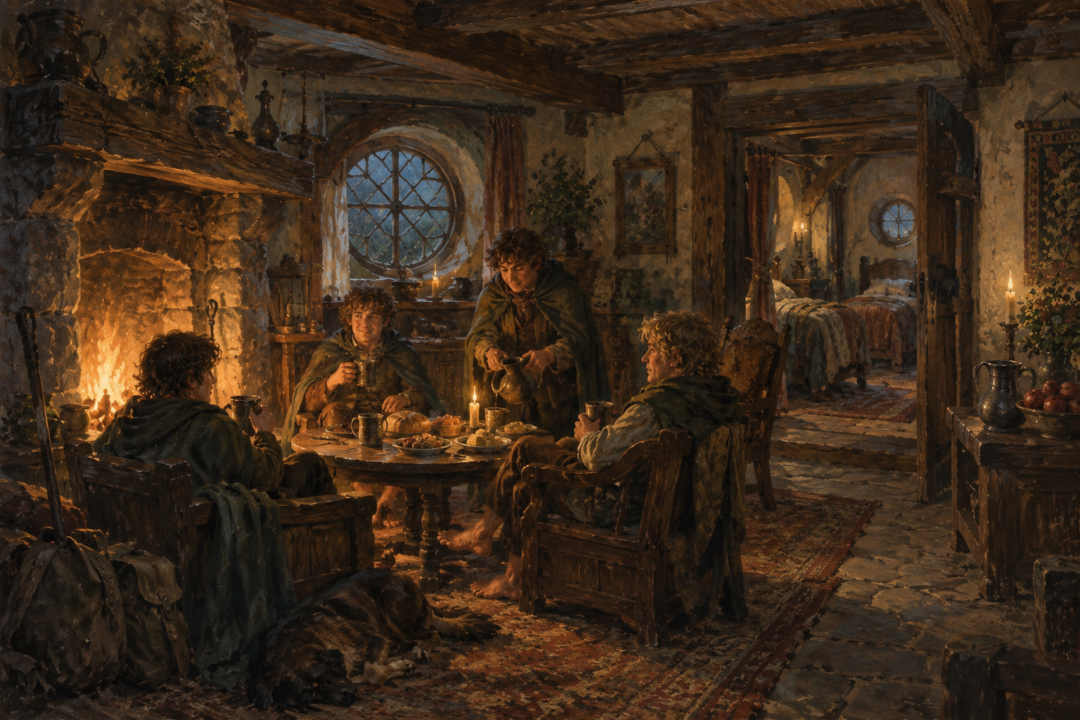
He explains that there are rooms in the north wing made specifically for Hobbits when the inn was built. They are on the ground floor, as Hobbits generally prefer, and have round windows.
That detail is enormously revealing.
The builders expected Little Folk as normal customers. Hobbit guests were not an afterthought requiring stools, temporary bedding, or awkward adaptation of human-sized chambers. The building itself contains spaces designed around them.
The distinction is not complete segregation, either.
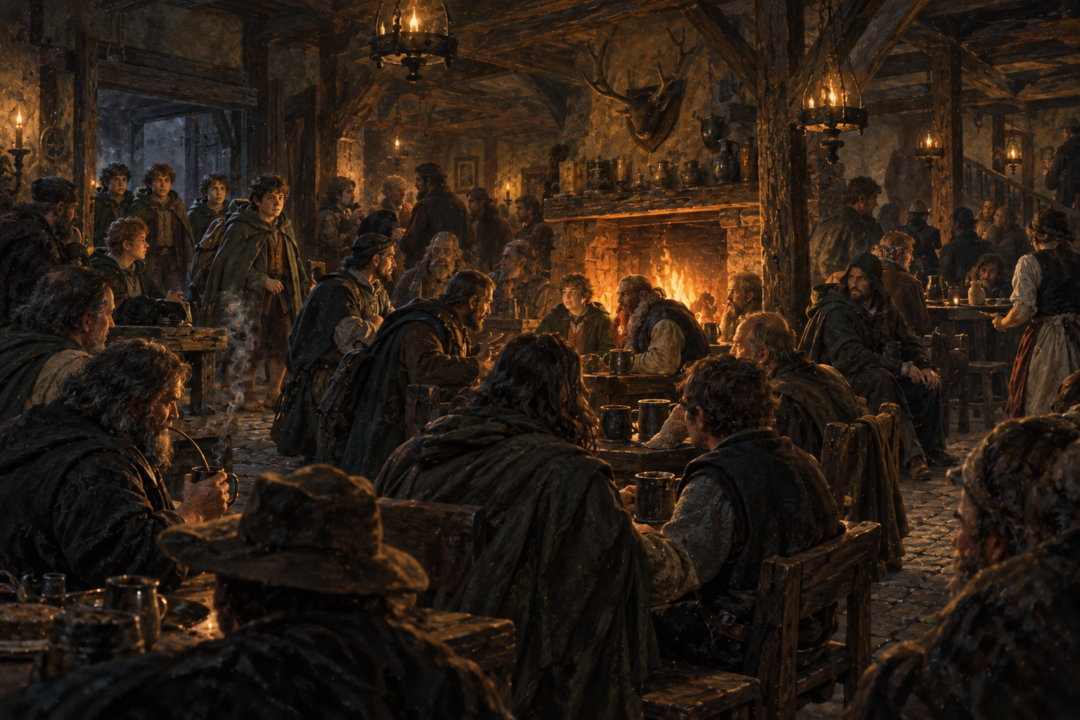
The Hobbits have appropriately proportioned private accommodation, but the common-room brings populations together. Men of Bree, local Hobbits, Dwarves, southern travellers, and shadowy strangers all occupy the same social interior.
The architecture therefore does two apparently contradictory things.
It acknowledges physical difference in private space while encouraging social mixture in public space.
A Hobbit does not have to sleep in a room designed for a Man in order to drink beside one.
The Courtyard Is the Inn’s Transport Hub
The broad arch and enclosed courtyard matter for another reason: travellers in Middle-earth often arrive with animals.
Frodo’s company does not simply need four beds. They need stabling for five ponies.
The Hobbits lead the animals beneath the arch and leave them in the yard while they enter the inn. Butterbur immediately sends for Bob and orders him to find stable room somehow.
The text does not provide a complete architectural plan of the stables, so it would be unsafe to invent one. What is clear is that animal accommodation belongs to the normal operation of the establishment.
This makes the Pony more than a tavern or lodging house. It is part of the transport infrastructure of the Road.
A traveller arrives, animal and baggage included, passes into the courtyard, and can transfer responsibility for the beast to the inn’s staff.
That system becomes strategically important when the stables are attacked.
During the night, horses and ponies are stolen, driven away, or frightened into flight. The next morning the loss changes Frodo’s entire journey. Aragorn had intended to take the Hobbits by routes where speed on ponies would offer little advantage, but they still need an animal to carry baggage.
The disappearance of the stable animals therefore creates hours of delay and forces the purchase of Bill Ferny’s miserable pony.
A seemingly mundane part of the inn has become a point of vulnerability.
Attack the animals, and you hinder the travellers.
Private Rooms Control Exposure
The Prancing Pony also offers something essential to travellers carrying secrets: layers of privacy.
Frodo and his companions receive a small private parlour. It has a fire, low chairs, a round table, and a hand-bell for summoning assistance. They can eat there without entering the common-room at all.
Butterbur explicitly leaves the choice to them.
They may go to bed, remain private, or join the company.
This matters because the common-room is not merely where people drink. It is where information circulates.
The moment Frodo enters it, questions begin.
The Bree-hobbits want to know about the Shire. Frodo’s false surname, Underhill, unexpectedly connects him with local Underhills, who immediately treat him as a possible relative. His invented explanation—that he is gathering information about Hobbits outside the Shire—produces an avalanche of volunteered knowledge.
Meanwhile Men and Dwarves discuss events farther away, including disturbances in the South and people moving north in search of peace.
The room functions almost like a living map.
Every traveller brings another fragment of the outside world.
The Common-Room Turns Travellers Into News
This is why Bree has an old reputation for strange tidings.
The saying about “News from Bree” survives from the days when information from north, south, and east could be heard at the inn and Shire-hobbits travelled there more frequently to hear it.
The roads may have declined, but the mechanism remains intact.
Travellers converge at the Pony. Locals gather around them. Butterbur knows people from different groups and introduces newcomers. Stories are exchanged. Questions are asked. News is repeated.
There is no formal news service. The inn itself is the network.
Its architecture assists that process by concentrating movement.
Road traffic enters Bree. Travellers enter the inn. Animals and baggage remain connected to the courtyard and stables while people move toward parlours, bedrooms, and especially the common-room.
Information that arrived separately now occupies one physical space.
That is extraordinarily useful when the news is harmless.
It is dangerous when someone wishes to remain unknown.
Hospitality and Surveillance Use the Same Architecture
Frodo’s problem is not that the Prancing Pony fails as an inn.
His problem is that it succeeds.
The building is designed socially to receive strangers, introduce them, feed them, and bring them into contact with local people. Frodo, however, needs hospitality without attention.
Those goals are difficult to reconcile.
His appearance is already notable because Shire-hobbits rarely come to Bree now. In the common-room he becomes more conspicuous still. Pippin begins talking about Bilbo’s birthday party. Frodo tries to divert attention with a song, falls, accidentally puts on the Ring, and vanishes before the entire company.
The information network instantly becomes a security threat.
Strider understands this far better than the Hobbits do. What seems to ordinary guests like friendly curiosity can become intelligence for an enemy.
Even Butterbur demonstrates the weakness of a human information system. Gandalf had left him a letter for Frodo months earlier, but Butterbur forgot to arrange its delivery.
The inn is excellent at circulating conversation and much less reliable at transmitting one crucial private message.
That failure nearly has catastrophic consequences.
Even Bedrooms Cannot Guarantee Safety
After Frodo’s disappearance, the private side of the inn becomes more important.
Strider warns the Hobbits against sleeping in their assigned bedrooms. Instead, Nob is used to make the beds appear occupied while the travellers remain elsewhere.
The deception proves necessary.
During the night, the apparent sleeping places are attacked and the beds are slashed.
Here the architecture reveals its limit.
Walls, rooms, curtains, gates, and stables can organize ordinary movement, but they cannot guarantee protection once the servants of the Enemy have penetrated the social world around them.
The Pony can separate public from private space.
It cannot make private space invulnerable.
Security ultimately depends on knowledge: Strider recognizes the danger that the others do not.
By Morning, the Inn Has Produced a Legend
After the night’s violence, the Prancing Pony performs its oldest function once again.
It turns events into news.
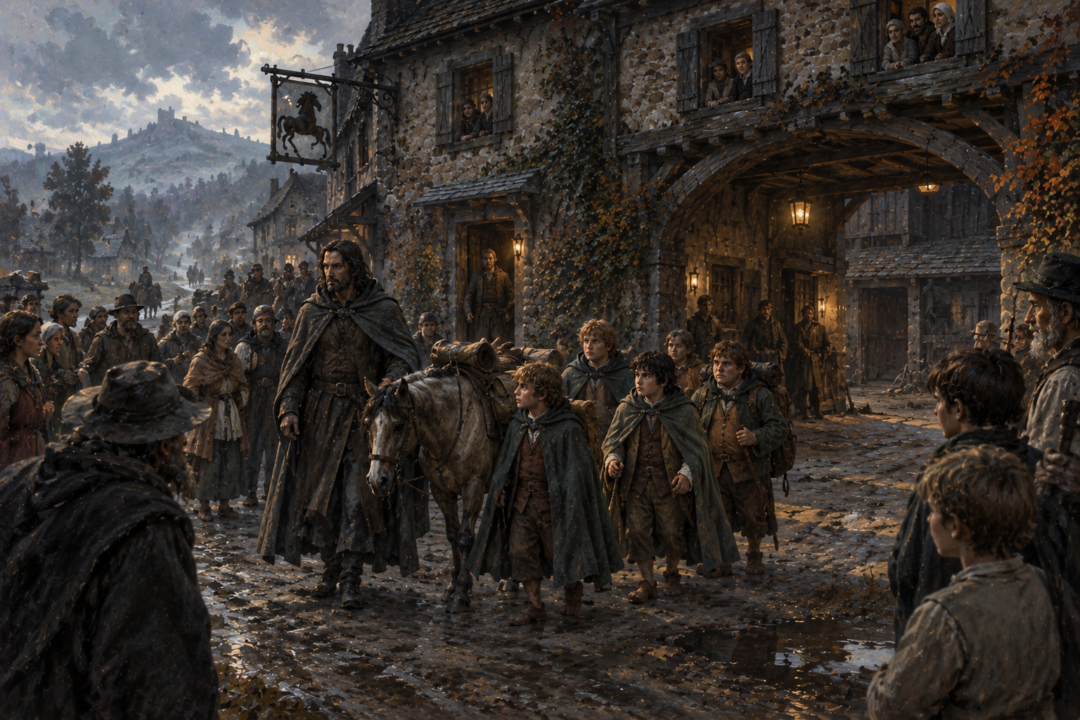
By the time Frodo’s party finally leaves, Bree is buzzing with stories: the mysterious disappearance in the common-room, Black Riders, the raid on the stables, and Strider departing with the strange Hobbits.
People from Bree and Staddle crowd the road, while others have come from Combe and Archet. Guests watch from doors and windows.
The building that received travellers has transformed them into a public event.
This is perhaps the most interesting thing about the Prancing Pony’s architecture.
It manages several kinds of traffic simultaneously.
Bodies move from Road to courtyard, from courtyard to room. Animals are transferred into the care of stable hands. Hobbits and Men can occupy spaces suited to their different physical needs. Guests can retreat into parlours or expose themselves to the common-room. And stories move through all of it, passing from travellers to locals and back onto the Road.
The Pony is therefore not merely where Frodo meets Aragorn.
It is one of the surviving communication hubs of a fragmented world.
Its Hobbit rooms preserve the memory of regular contact between communities that now rarely visit one another. Its oversized capacity recalls roads that once carried greater traffic. Its courtyard serves travellers whose journeys depend on animals. Its common-room gathers fragments of distant events before anyone in Bree understands how those events fit together.
And that is the quiet irony of Frodo’s night there.
He enters the Prancing Pony hoping to disappear into an ordinary inn.
Instead, he has walked into a building designed for centuries to make strangers comfortable—and to make strangers news.
Sources & Notes
- Tolkien Gateway — “The Prancing Pony”: reference overview of the inn’s three-storey form, wings and courtyard, purpose-built ground-floor Hobbit rooms, common-room, crossroads location, and role as a center of news. https://tolkiengateway.net/wiki/The_Prancing_Pony
- Tolkien Gateway — “Bree”: reference account of Bree at the East Road–Greenway crossing, where Men and Hobbits lived together and travelers gathered at the Prancing Pony. https://tolkiengateway.net/wiki/Bree
- Tolkien Gateway — “At the Sign of the Prancing Pony”: chapter synopsis covering the Hobbits’ arrival through the courtyard, accommodation for their ponies, private rooms and common-room encounters, and the exchange of news among Men, Dwarves, and Hobbits. https://tolkiengateway.net/wiki/At_the_Sign_of_the_Prancing_Pony
Sources document the Prancing Pony’s mixed-scale architecture, Bree’s shared Mannish-Hobbit society and road junction, and the inn’s role in accommodating animals while circulating travelers and news.