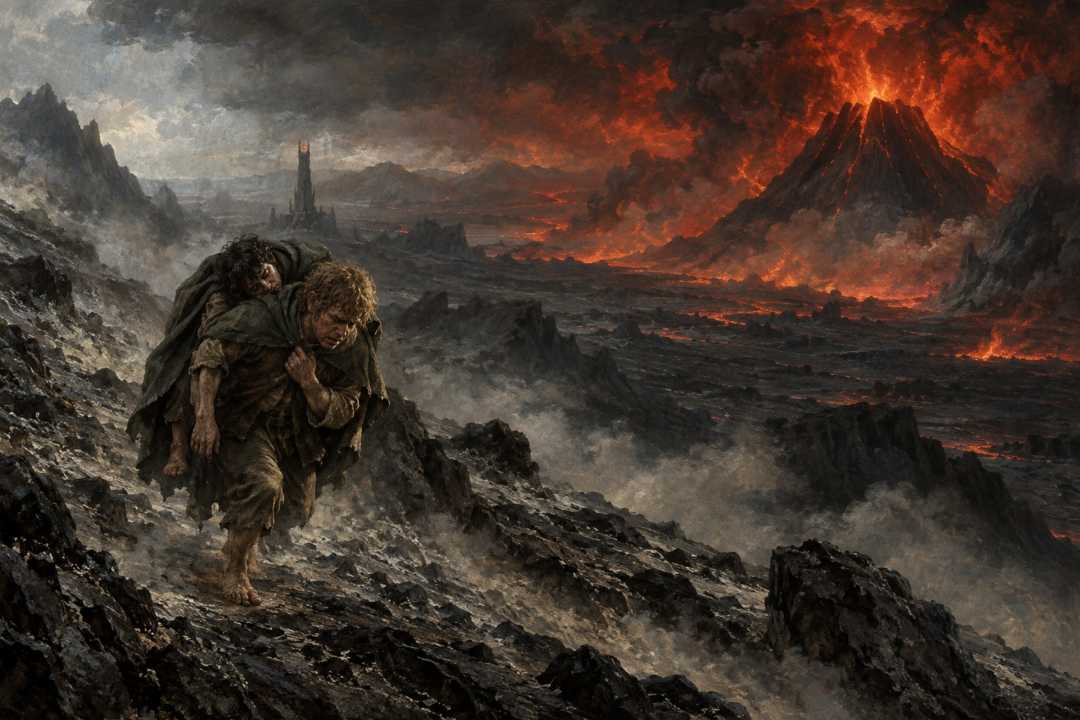
Near the end of the road to Mount Doom, Samwise Gamgee faces a problem that strength alone cannot solve.
Frodo is collapsing. The One Ring has become an almost unbearable burden to him, not simply because he is exhausted, but because he has carried it through fear, wounds, temptation, and the growing pressure of Sauron’s realm. Sam wants to help in the most obvious way: take the Ring himself.
But Frodo cannot surrender it.
Soon afterward, Sam does something apparently paradoxical. If he cannot take Frodo’s burden, he takes Frodo.
The famous idea is often remembered through the film line, “I can’t carry it for you… but I can carry you.” Those exact words are an adaptation rather than a quotation from the novel. Yet the underlying moment is deeply rooted in the text of The Return of the King. In the book, Sam decides that he will carry Frodo himself, and Tolkien makes a remarkable distinction between bearing another person’s evil burden and bearing the person who suffers beneath it.
That distinction reaches to the heart of the Ring, Frodo’s tragedy, and Sam’s particular kind of heroism.
Sam Has Already Carried the Ring
The crucial point is that Sam is not afraid to touch the Ring because he knows nothing about it.
He has already been a Ring-bearer.
After Shelob attacks Frodo outside Cirith Ungol, Sam believes his master is dead. Faced with the apparent failure of the Quest, he concludes that someone must continue. In “The Choices of Master Samwise,” he reluctantly takes the Ring from Frodo and carries it.
For a short time, therefore, the burden actually becomes Sam’s.
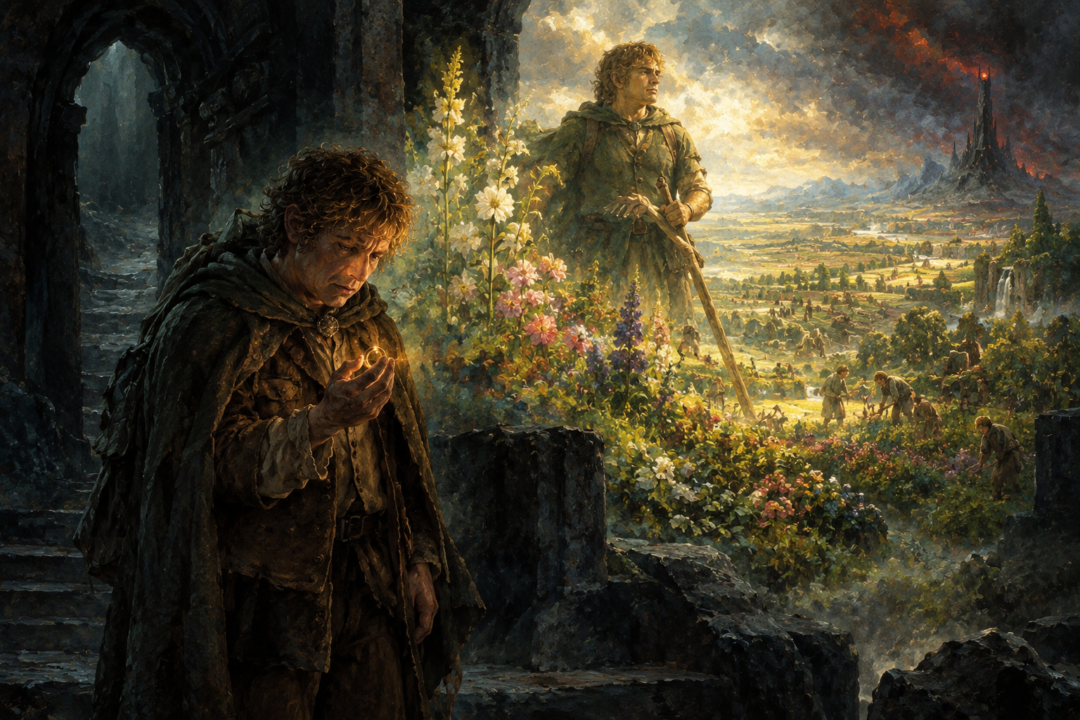
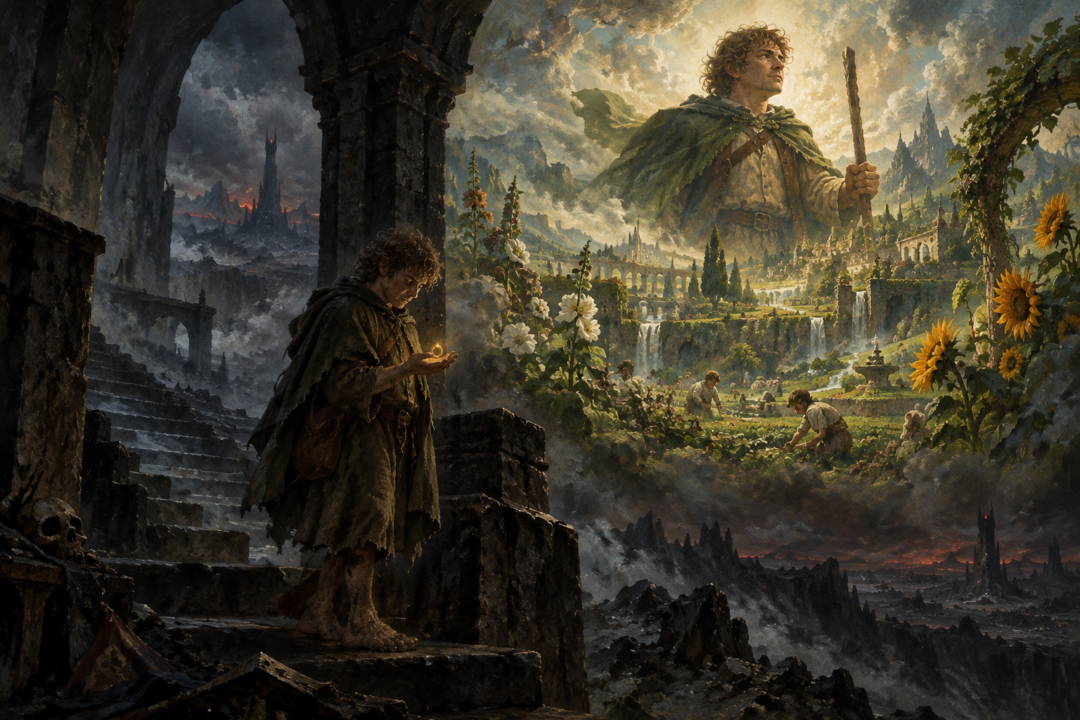
Inside Mordor, the Ring begins working upon him. In “The Tower of Cirith Ungol,” it offers him visions suited specifically to his nature: Samwise the Strong, a heroic commander who could defeat Sauron and transform the barren land into a vast garden.
The temptation is absurdly disproportionate to Sam’s real circumstances, but that is part of the Ring’s deceit. It takes something genuine in its bearer and magnifies it toward domination. Sam loves growing things; the Ring turns cultivation into the fantasy of remaking an entire land according to his will.
Sam rejects the vision. His plain sense and his understanding of himself help him see through it. He knows that one small garden tended by his own hands is more fitting to him than a realm created through power.
But resisting the Ring once does not mean Sam is immune to it.
That matters enormously when Frodo later refuses his help.
Why Frodo Cannot Simply Hand the Ring to Sam
After Sam rescues Frodo from the Tower of Cirith Ungol, he willingly returns the Ring.
This is one of Sam’s greatest acts, because he has possessed the Ring and nevertheless gives it up. But the exchange is not emotionally effortless. The Ring has already begun creating possessiveness even in him, and Frodo’s response shows how much more deeply its hold has grown upon the long-term Ring-bearer.
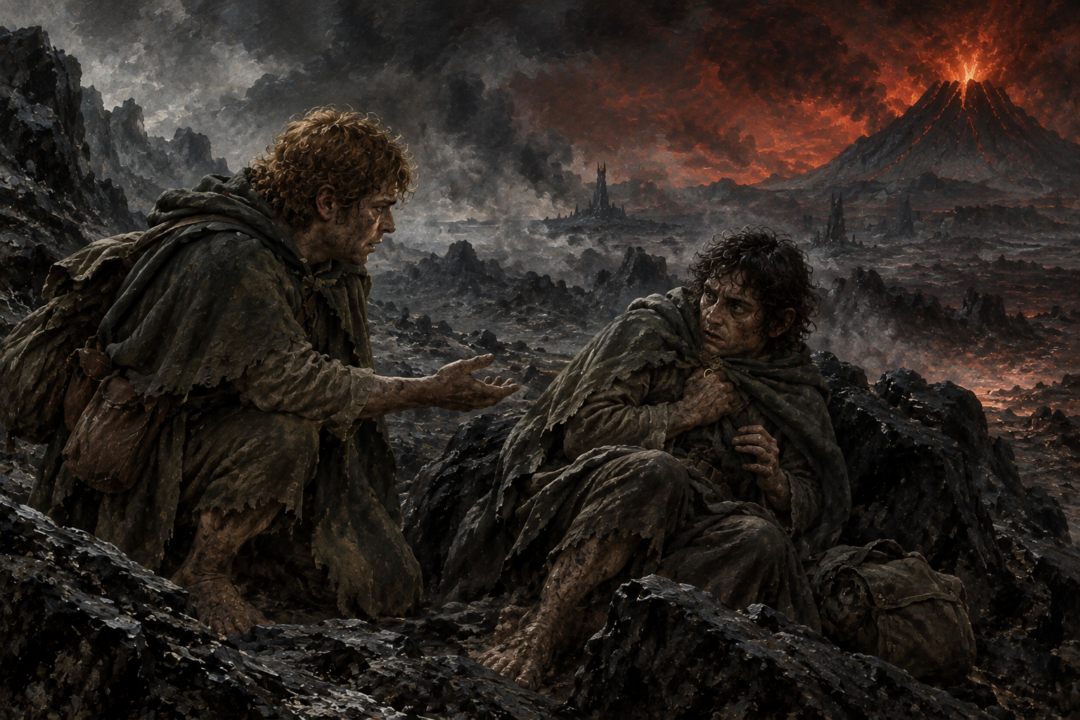
Later, as Frodo weakens during the journey across Mordor, Sam offers to carry the Ring for a while.
Frodo reacts with alarm and suspicion. For an instant, Sam appears to him almost as a threat trying to steal the Ring.
This is not evidence that Frodo has ceased loving Sam. It shows how deeply the Ring has invaded Frodo’s relationship with possession. Frodo has borne it from the Shire through Rivendell, Moria, the breaking of the Fellowship, the Dead Marshes, Ithilien, Shelob’s attack, imprisonment, and finally Mordor itself.
Near the place where the Ring was made, its pressure is becoming overwhelming.
Sam therefore confronts a limit to what friendship can do.
He can offer to take the Ring.
He cannot make Frodo surrender it.
And taking it against Frodo’s will would mean attacking the very person he is trying to save while placing himself directly under the Ring’s temptation.
The Burden Is More Than Physical Weight
The language of burden can make the Ring sound like an unusually heavy object. But Frodo’s suffering cannot be reduced to pounds or ounces.
The Ring works upon desire and will. Its danger lies in possession, temptation, domination, and the increasing difficulty of surrendering it. The nearer Frodo comes to the place of its forging, the more terrible that struggle becomes.
This explains why Sam’s eventual solution is so important.
He does not solve Frodo’s spiritual burden by transferring ownership of it.
Instead, he supports the bearer.
Sam can give Frodo water. He can ration their food. He can keep watch. He can guide him when his strength fails. He can protect him from enemies. He can encourage him when hope has nearly disappeared.
And finally, he can carry Frodo’s body.
The distinction is subtle but essential: Sam cannot make Frodo’s choice for him, but he can help Frodo reach the place where that choice must be faced.
Sam Carries Frodo — and the Ring Comes Too
The book makes the scene even more interesting than the simplified idea that Sam cannot physically carry the Ring.
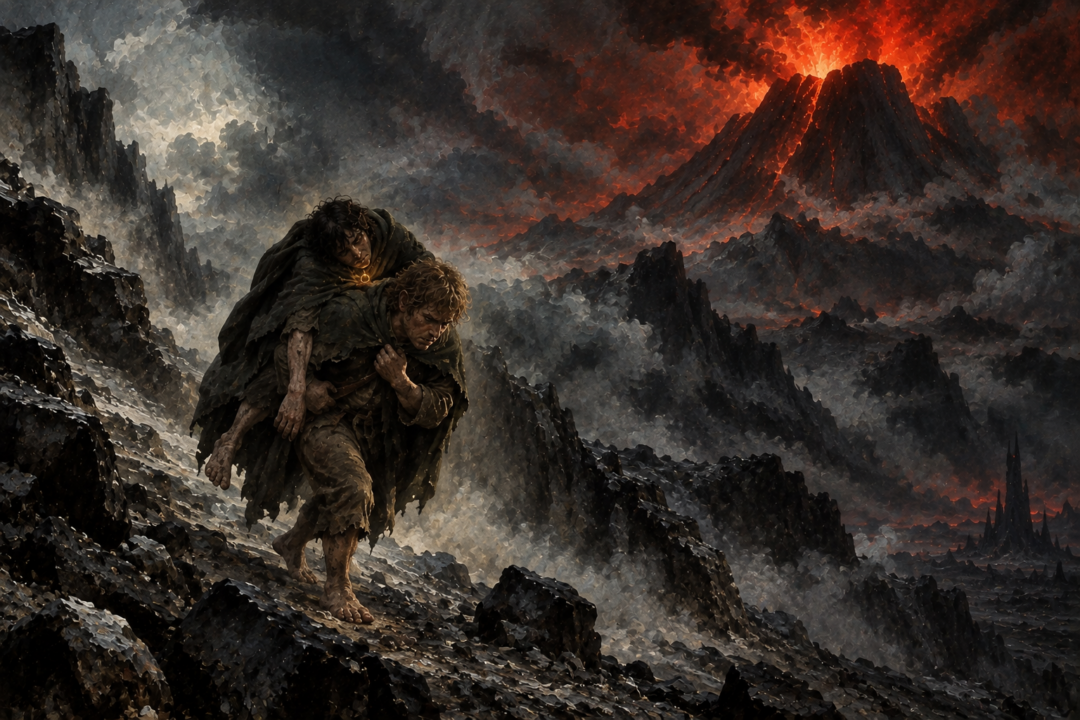
When Frodo collapses on the slopes of Orodruin, Sam resolves to carry him.
He expects this to be almost impossible. Frodo is exhausted, but Sam assumes that the Ring’s terrible burden will somehow make carrying him even worse.
Instead, Sam discovers that Frodo is surprisingly light upon his back.
The narrator offers possibilities rather than a single mechanical explanation: Frodo has been terribly reduced by wounds, poison, hunger, fear, grief, and wandering, or perhaps Sam receives some final gift of strength. The text does not establish a precise supernatural rule about the Ring’s physical mass.
This means Sam is, in the literal sense, carrying both Frodo and the Ring.
What he is not doing is becoming its bearer in the deeper sense.
Frodo still possesses it.
Frodo remains the one psychologically bound to it.
Sam carries the man without claiming the burden as his own.
That is why the scene works so powerfully.
The Quest Requires Help Without Possession
The Ring repeatedly turns good intentions toward the desire to control.
Boromir wants power sufficient to defend his people. Galadriel imagines what accepting the Ring would make of her. Gandalf refuses it because he understands that his desire to do good would become dangerous through such power.
Sam faces a much smaller but related temptation.
He genuinely wants to help Frodo. Yet if helping meant taking control of the Ring, the act would expose him to the same fundamental danger that surrounds everyone who tries to use or possess it.
His greatest contribution is therefore not to replace Frodo.
It is to remain Sam.
He serves without needing to become master of the Quest. He repeatedly performs practical acts that appear small beside armies, kings, Wizards, and Ringwraiths, yet those acts keep the mission alive.
He cooks. He watches. He carries supplies. He finds water. He protects Frodo while he sleeps. He follows him into danger. He rescues him from Cirith Ungol.
And when Frodo can no longer walk, Sam becomes the strength beneath him.
Frodo Still Has to Reach the Crack of Doom
There is another reason Sam cannot simply solve Frodo’s burden for him: the story never treats the Quest as something another character can casually complete in Frodo’s place.
Frodo has been appointed Ring-bearer and has accepted the task of taking the Ring toward destruction. Others can accompany him, defend him, advise him, and sacrifice themselves to give him a chance.
But the final confrontation with the Ring remains intensely personal.
And Frodo ultimately fails to surrender it voluntarily at the Crack of Doom.
At the final moment he claims the Ring.
That failure does not make Sam’s help meaningless. Quite the opposite. Sam’s loyalty is one of the reasons Frodo reaches the Sammath Naur at all. But Sam cannot remove the final struggle from Frodo’s will.
Nor, importantly, does the Ring’s destruction occur because Sam proves morally stronger and takes over.
It happens through the extraordinary chain of events involving Gollum, whom Frodo and later Sam had spared. Gollum seizes the Ring and falls into the fire with it.
The Quest succeeds through courage, endurance, mercy, and circumstances no one at the Council of Elrond could have planned.
Sam’s Strength Is Knowing What He Can Do
Sam’s heroism on Mount Doom is powerful precisely because it has limits.
He cannot destroy Frodo’s temptation.
He cannot erase Frodo’s wounds.
He cannot restore the strength that Mordor has consumed.
He cannot simply take possession of the Ring without consequences.
But there remains something he can do.
He can place Frodo on his back and climb.
That is one of the deepest patterns in The Lord of the Rings. The greatest victories are rarely achieved by possessing enough power to control everything. Again and again, salvation depends upon loyalty, pity, endurance, humility, and choices whose consequences reach farther than the person making them can foresee.
Sam does not become Frodo.
He does not conquer Frodo’s inner struggle.
He refuses to abandon him inside it.
And so, on the final road beneath Mount Doom, the gardener from the Shire performs an act perfectly suited to him. He does not seize the burden in order to master it.
He carries his friend.
Sometimes that is the difference between sharing another person’s suffering and trying to possess it. Sam cannot walk Frodo’s inward road for him.
But when Frodo’s legs can carry him no farther, Sam can make sure he does not walk the last miles alone.
Sources & Notes
- Tolkien Gateway — Samwise Gamgee https://tolkiengateway.net/wiki/Samwise_Gamgee
- Tolkien Gateway — One Ring https://tolkiengateway.net/wiki/One_Ring
- Tolkien Gateway — The Choices of Master Samwise https://tolkiengateway.net/wiki/The_Choices_of_Master_Samwise
These references document Sam’s brief possession and surrender of the Ring, the Ring’s corrupting pressure, and his final support of Frodo. The article’s distinction between carrying the burden and carrying its bearer is interpretive synthesis.