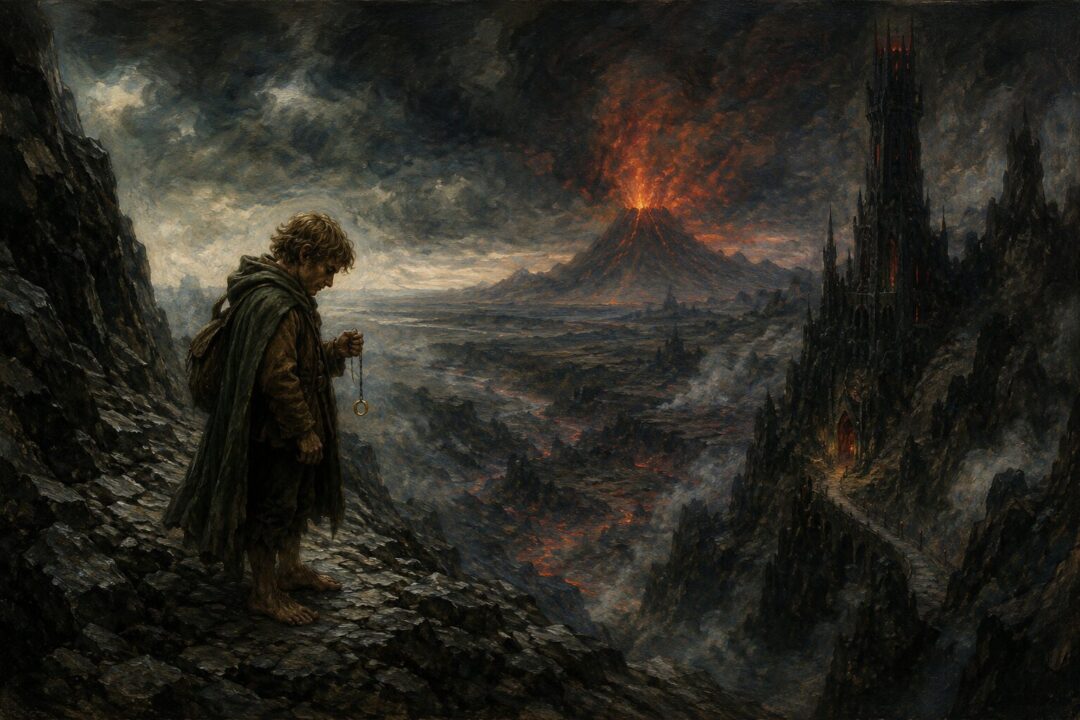
Most people remember Samwise Gamgee as the loyal friend who carried Frodo up Mount Doom.
That memory is true.
But it can also make us forget something much stranger.
For a short time, Sam carried the One Ring himself.
After Shelob struck Frodo in the pass of Cirith Ungol, Sam believed his master was dead. The quest seemed to have failed. The road into Mordor still lay ahead, and the Ring could not be left for Orcs to find.
So Sam took it.
He did not take it out of desire. He did not take it as a prize. He took it in grief, terror, and duty. But once the Ring was in his keeping, that distinction did not make him safe.
The Ring noticed him.
And for one of the smallest figures in the story, the temptation that followed reveals one of the deepest truths about the Ring’s power.
Sam did not avoid becoming another Gollum because he was magically immune.
He avoided it because the Ring could not easily turn his deepest desires into a lasting hunger for domination.
That difference matters.
Sam Was Not Immune to the Ring
The first mistake is to imagine that Sam was simply too good, too innocent, or too pure to be touched by the Ring.
The text does not support that.
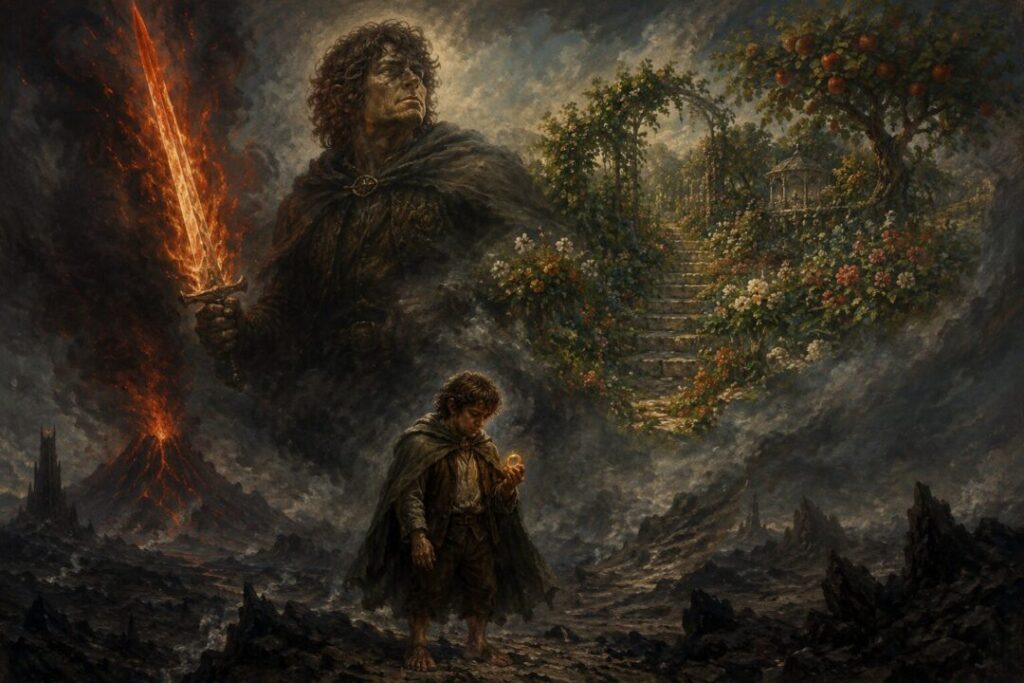
When Sam crosses into Mordor, the Ring becomes a real burden to him. Near the land where it was made, its power grows more dangerous. Sam becomes aware of its weight in a new way. It presses on him. It tempts him. It begins to work upon his imagination.
He sees himself enlarged into something vast and terrible.
In that vision, he is no longer only Sam Gamgee of the Shire. He becomes “Samwise the Strong,” a hero of the age, armed with power, marching against the Dark Tower, overthrowing Sauron, and transforming the wasted lands of Mordor into a garden.
That vision is not random.
The Ring does not offer Sam the same dream it might offer a king or a warrior-lord. It reaches for what is already inside him. Sam loves growing things. He loves the Shire. He loves gardens, trees, simple work, and living things that can flourish under patient hands.
So the Ring turns that love into something enormous.
Not one garden.
A realm.
Not his own hands at work.
The hands of others under command.
This is the first clue to why Sam survives the temptation. The Ring does reach him. It does find material to use. But when it magnifies Sam’s desire, the result becomes too large for Sam’s own heart to accept.
The Ring Tempts Through What Is Already There
The One Ring is not merely a golden object that makes people cruel in the same way.
Its danger is more personal than that.
It works through desire, fear, pride, pity, ambition, and need. It offers power in a form the bearer can understand. That is why different characters respond to it differently.
Boromir sees it as a weapon that could save Gondor.
Galadriel imagines the terrible beauty of rule.
Frodo increasingly feels its pressure as a burden he cannot escape.
Gollum calls it his Precious and is consumed by possession.
Sam’s temptation is smaller on the surface, but not less dangerous.
A garden is not evil.
That is why the vision is so subtle. The Ring does not begin by showing Sam cruelty. It begins by corrupting a good desire. It takes his love of green growing things and inflates it into a fantasy of mastery.
This is the Ring’s method.
It does not always create evil from nothing. More often, it bends something real.
Sam’s love of gardening is real. His hatred of Mordor’s barrenness is real. His longing to see life restored is real. But the Ring turns restoration into command. It offers him a world remade according to his will.
And that is where Sam’s plain sense saves him.
Sam Knows He Is Not Meant to Rule
Sam’s resistance is not dramatic.
He does not defeat the Ring in some grand spiritual contest. He does not proclaim himself beyond temptation. He simply recognizes that the vision is false.
Deep down, Sam knows that he is not large enough for such a burden.
That is not self-hatred. It is wisdom.
Sam does not want a garden swollen into a realm. He wants one small garden of his own, freely tended. He does not want armies flocking to his command. He wants to use his own hands, not the hands of others.
This is one of the clearest differences between Sam and those more vulnerable to the Ring’s promise.
The Ring offers mastery.
Sam’s deepest self is not built around mastery.
He can be proud. He can be stubborn. He can be suspicious, especially of Gollum. He is not flawless. But his center is not domination. His center is service, loyalty, home, and the work of caring for living things.
The Ring tries to make those things imperial.
Sam instinctively recoils from the distortion.
That is why he does not become Gollum.
Not because nothing in him can be tempted, but because the temptation cannot easily become his identity.
Gollum’s Beginning Was Different
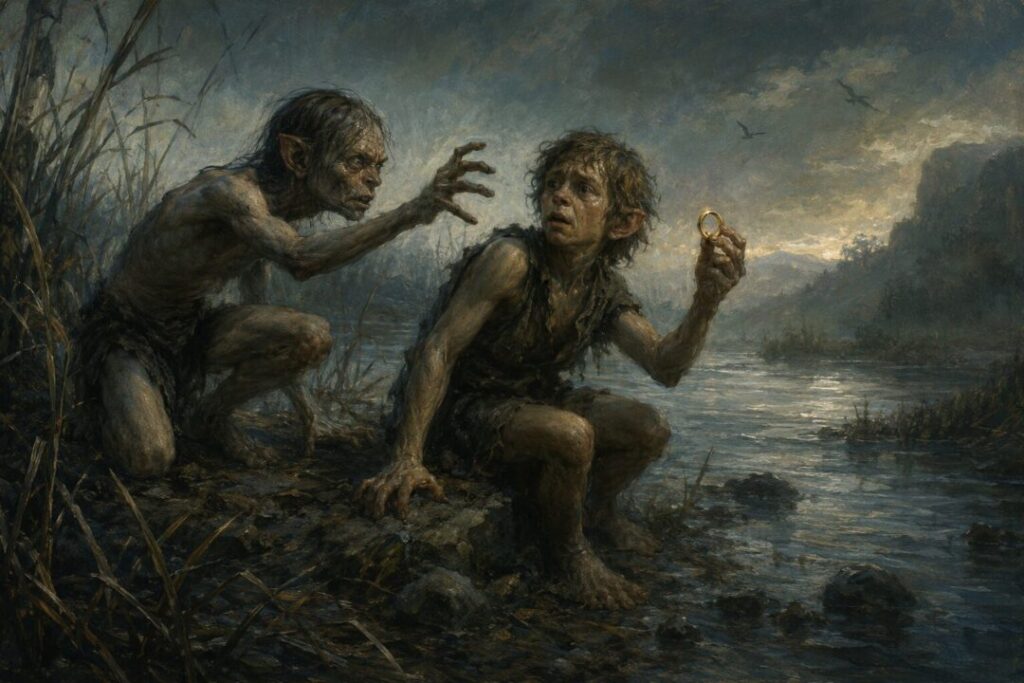
Sméagol’s fall begins in a darker way.
Déagol finds the Ring in the river. Sméagol sees it, desires it, demands it, and kills Déagol when he refuses to give it up. The Ring enters Sméagol’s life through envy, violence, secrecy, and possession.
That beginning matters.
It does not mean Sméagol was born monstrous. The story of Gollum is tragic precisely because he was once something far smaller, more ordinary, and more pitiable than the creature he became. But his first response to the Ring is grasping.
He wants it because it is bright and beautiful.
He demands it as his own.
He murders for it.
From there, the Ring becomes not merely an object he carries, but the center of his life. He hides with it. He uses it. He is driven out. He retreats into darkness beneath the Misty Mountains and keeps it for centuries.
This is crucial.
Sam bears the Ring briefly and under terrible necessity.
Gollum possesses it for hundreds of years after murder, isolation, and repeated use.
The difference is not only moral. It is also temporal. The Ring had time to hollow Gollum out. It had time to become the axis of his thoughts, his speech, his memory, and his need.
Sam never reaches that stage.
Sam Took the Ring to Continue the Quest
Sam’s possession of the Ring begins with loss.
He thinks Frodo is dead. He believes the quest has fallen to him. He is not dreaming of ownership. He is trying to prevent disaster.
That does not make him untouched, but it does shape the struggle.
Sam’s first instinct is not “How can this be mine?”
It is “What must be done now?”
Even when he considers going on alone, the thought comes from duty, not ambition. He does not imagine using the Ring for private pleasure. He thinks in terms of finishing the task Frodo can no longer finish.
This is why the Ring must tempt him by transforming duty into heroism.
It offers him the role of savior. It shows him a version of himself mighty enough to do what no small hobbit should be able to do. It takes his loyalty and tries to bend it into pride.
But Sam’s loyalty remains anchored in Frodo.
When he hears signs that Frodo may still be alive, everything changes. His love for Frodo rises above other thoughts, and the Ring’s vision loses ground.
That love is not abstract virtue. It is specific, personal, and immediate.
Frodo is alive.
Sam must go to him.
The Ring cannot compete with that for long.
Returning the Ring Was Still Hard
It is important not to make Sam’s victory too easy.
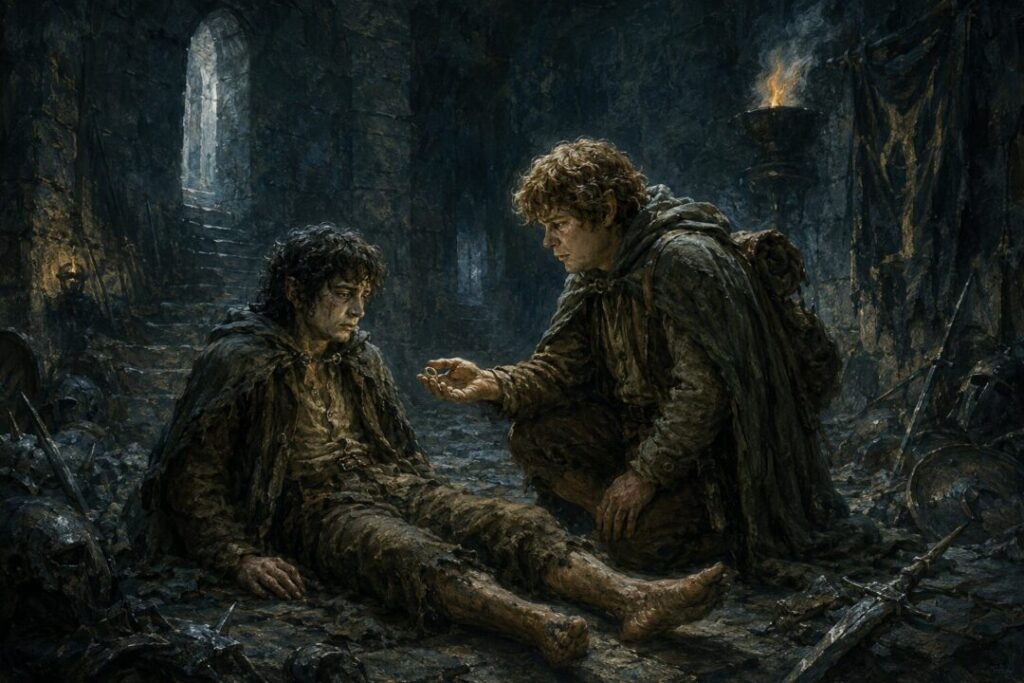
When Sam finally finds Frodo alive in the Tower of Cirith Ungol, he gives the Ring back. That act is extraordinary. Very few people willingly surrender the Ring after bearing it.
But even Sam feels the pull.
The moment is tense because Frodo, already worn down by the burden, reacts fiercely. Sam has only carried the Ring briefly, yet even he feels how difficult it is to part with it.
This detail matters because it prevents a false reading.
Sam does not give up the Ring because it means nothing to him. He gives it up despite the fact that it has begun to mean something.
That is the real triumph.
His surrender is not effortless innocence. It is an act of love and obedience to the purpose of the quest. He knows Frodo is the appointed Ring-bearer. He knows the Ring is not his. He knows the burden must return to the one who had carried it so far.
So he lets it go.
Gollum could not.
Time, Use, and Isolation Changed Everything
Gollum’s corruption cannot be reduced to a single moment.
The murder of Déagol is the beginning, but the centuries that follow deepen the ruin. Gollum becomes isolated. He lives under mountains. He speaks to himself and to the Ring. He forgets sunlight, kinship, and ordinary life.
The Ring becomes his companion, his treasure, his identity.
Sam never experiences that long erosion.
He remains bound to Frodo, even when Frodo seems dead. He remains bound to the Shire, to memory, to food, gardens, songs, and plain speech. He is afraid, exhausted, and tempted, but not cut off from all living ties.
This is not a small difference.
The Ring thrives on possession. Isolation strengthens possession. The more the bearer turns inward around the Ring, the more the Ring can become the center of the self.
Sam’s self is still turned outward.
Toward Frodo.
Toward the quest.
Toward home.
Toward the hope of things growing again.
That outward love does not make him invincible.
But it gives the Ring less room to become everything.
Sam’s Humility Is Practical, Not Sentimental
Sam’s humility is often misunderstood as simple sweetness.
It is stronger than that.
Sam knows what he is good at. He can cook, climb, fight when cornered, carry burdens, and endure more than anyone expects. He is not weak. By the end of the journey, he becomes one of the most resilient figures in the story.
But he does not confuse endurance with entitlement.
That is the key.
The Ring offers him greatness, and Sam does not believe greatness is his due. He does not want to be a lord of others. He does not hunger to be seen as mighty. Even when the vision calls him “Samwise the Strong,” something in him recognizes the trap.
A free gardener is not the same as a ruler of gardens.
That distinction is easy to miss, but it is central to Sam’s resistance.
The Ring can turn love into control.
Sam’s humility keeps love from becoming control.
Why Sam Was Not Another Gollum
Sam and Gollum are connected in more ways than Sam would like.
Both are small.
Both are overlooked.
Both know hunger, fear, and darkness.
Both carry the Ring in desperate places.
And near the end, Sam’s experience as a Ring-bearer affects how he sees Gollum. He has felt, however briefly, the pressure of that burden. He understands enough to pity him at the crucial moment, and that pity becomes part of the chain of events that leads to the Ring’s destruction.
But Sam does not become Gollum because the Ring never becomes his story.
For Gollum, the Ring becomes the center.
For Sam, Frodo remains the center.
For Gollum, possession begins in murder.
For Sam, possession begins in sacrifice.
For Gollum, centuries of secrecy deepen the wound.
For Sam, the Ring is borne briefly, painfully, and then surrendered.
The difference is not that Sam is untouched by evil.
The difference is that when the Ring reaches into Sam, it finds desires that still have boundaries.
A garden, not a kingdom.
Service, not mastery.
Love, not ownership.
The Quiet Strength of Samwise Gamgee
Sam’s greatness is not that he could carry the Ring without danger.
No one should think that.
His greatness is that he carried it in danger and still let it go.
He felt the temptation. He saw the enlarged shadow of himself. He imagined power, victory, and a world remade. But at the center of him there remained a small, stubborn truth: he did not want to rule the world.
He wanted Frodo back.
He wanted the quest fulfilled.
He wanted the Shire alive again.
And he wanted, if any peace remained after all the darkness, one small garden where his own hands could work freely.
That is why Sam could carry the Ring without becoming another Gollum.
Not because he was beyond corruption.
Because the best things in him were too humble, too loyal, and too rooted in love to be easily transformed into the Ring’s kind of power.
Sources & Notes
- J.R.R. Tolkien, The Lord of the Rings, Book IV, Chapter 10, “The Choices of Master Samwise” — Sam takes the Ring after believing Frodo dead, out of grief and duty rather than ownership.
- J.R.R. Tolkien, The Lord of the Rings, Book VI, Chapter 1, “The Tower of Cirith Ungol” — the Ring tempts Sam with the vision of “Samwise the Strong” and a transformed Mordor-garden, but he rejects the fantasy as too large for him.
- J.R.R. Tolkien, The Lord of the Rings, Book VI, Chapter 1, “The Tower of Cirith Ungol” — Sam gives the Ring back to Frodo, showing both the Ring’s pull and Sam’s willingness to surrender it.
- J.R.R. Tolkien, The Lord of the Rings, Book I, Chapter 2, “The Shadow of the Past” — Gandalf recounts Sméagol’s murder of Déagol, long possession of the Ring, and transformation into Gollum.
- J.R.R. Tolkien, The Lord of the Rings, Book VI, Chapter 3, “Mount Doom” — Sam’s brief experience as a Ring-bearer deepens his pity for Gollum near the end of the quest.