When Aragorn first enters the story at Bree, there is little about the weather-beaten Ranger called Strider that suggests Rivendell. He carries no visible Elvish title. He does not present himself as a prince raised in the household of Elrond. He looks instead like what decades of wandering have made him: one of the Dúnedain of the North, guarding lands whose inhabitants scarcely remember that his people exist.
Yet Rivendell is central to understanding him.
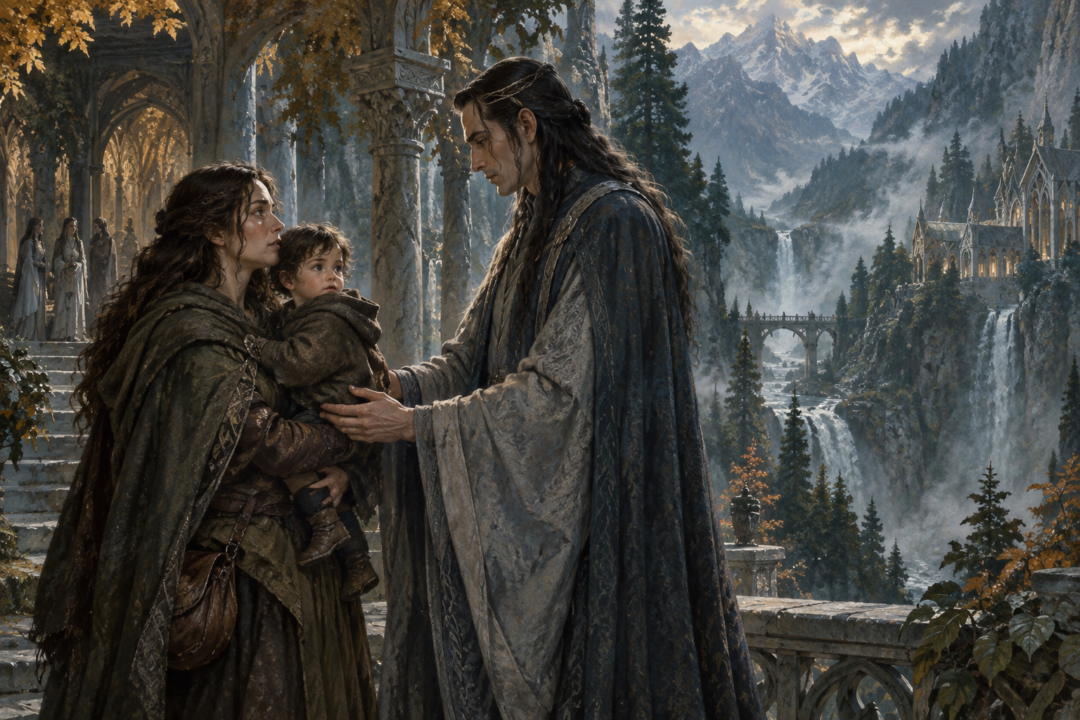
After the death of Aragorn’s father, Arathorn II, the young heir was brought by his mother Gilraen to the house of Elrond. There he was concealed under the name Estel, “Hope,” and Elrond came to love him as a son.
That relationship can easily be misunderstood. Aragorn was raised by one of the greatest surviving Eldar, became “elven-wise,” loved Elrond’s daughter, and eventually carried forward a history stretching back into the Elder Days. But fosterage did not transform Aragorn into an Elf, nor did it replace his human family.
Instead, Rivendell preserved him until he could fully become what he already was: Aragorn son of Arathorn, Chieftain of the Dúnedain, Heir of Isildur, and ultimately a king among Men.
The Child Who Could Not Safely Bear His Own Name
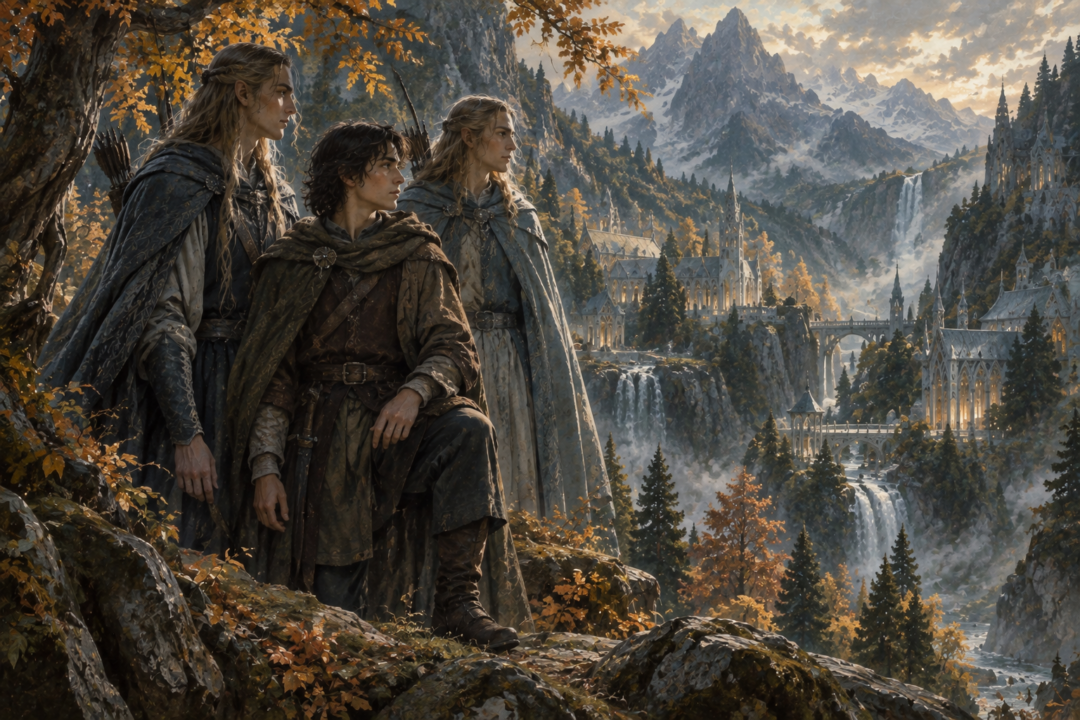
Aragorn was born in the year 2931 of the Third Age, the son of Arathorn II and Gilraen. His father was Chieftain of the Dúnedain of the North, heir to a royal line that survived long after the destruction of the northern Dúnedain kingdoms.
Arathorn did not live long enough to raise his son. When Aragorn was only two, his father was slain while fighting Orcs.
That made the child something far more dangerous than an ordinary orphan.
He was now the Heir of Isildur.
The northern kingdom had disappeared centuries earlier, but its royal line had not. The descendants of Isildur continued through the Chieftains of the Dúnedain. Aragorn therefore inherited not a functioning throne but an ancient lineage preserved among a diminished and secretive people.
His survival mattered.
Appendix A explains that Gilraen took him to Rivendell, where Elrond took the place of his father and loved him as a son. His identity was concealed because the Wise knew that the Enemy was searching for the surviving Heir of Isildur.
The boy therefore grew up as Estel.
This concealment is important. His fosterage begins not as an attempt to make Aragorn something different, but as an attempt to prevent Sauron from destroying what he already is.
Elrond Does Not Replace Aragorn’s Father
The description of Elrond taking the place of Aragorn’s father is emotionally powerful, but the narrative carefully preserves Aragorn’s actual ancestry.
Arathorn is never erased.
Gilraen is not removed from Aragorn’s upbringing either. She accompanies her son to Rivendell and remains an important figure in his life. When the truth is eventually revealed, Aragorn does not receive a new lineage from Elrond. He receives knowledge of his existing one.
That distinction defines the relationship.
Elrond functions as foster-father, protector, teacher, and guardian. Aragorn’s biological and dynastic identity remains Mannish: he is the son of Arathorn and Gilraen and the heir of the northern Dúnedain.
The household of Elrond protects that inheritance rather than absorbing it.
This is especially significant because Aragorn’s story could easily have been written as one in which an extraordinary human hero becomes great because he is separated from ordinary Men and made almost Elvish. The texts do something subtler.
Aragorn gains wisdom from the Eldar while remaining unmistakably one of the Dúnedain.
Rivendell Had Protected Isildur’s Line Before
There is also a much older historical pattern behind Aragorn’s childhood.
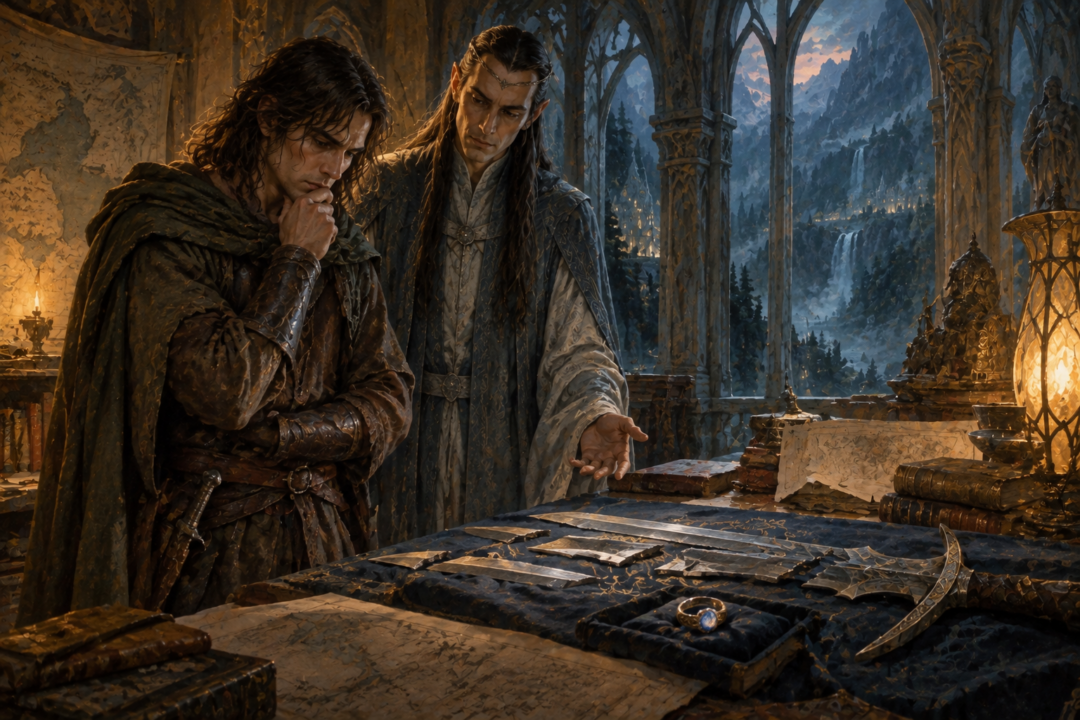
After Isildur was killed at the Disaster of the Gladden Fields, his youngest son Valandil survived because he had remained in Rivendell. From Valandil descended the Kings of Arnor and, eventually, the Chieftains of the Dúnedain.
Much later, after the fall of Arthedain, the heirs of the northern line were again associated with Rivendell. Appendix A states that the sons of the Chieftains were fostered in Elrond’s house, while important heirlooms of their people were kept there.
Aragorn is therefore not an isolated case.
His upbringing belongs to a longstanding relationship between Elrond’s household and the heirs of Isildur.
That changes the meaning of Rivendell. It is not simply an Elvish refuge into which Aragorn happens to be admitted. For the northern Dúnedain, it has become something like a sanctuary of continuity.
Their kingdoms have vanished. Their numbers have dwindled. Their chieftains wander without crowns.
But their memory has not vanished.
Rivendell helps preserve what history has almost destroyed.
The Moment Estel Becomes Aragorn Again
The decisive moment comes when Aragorn reaches manhood.
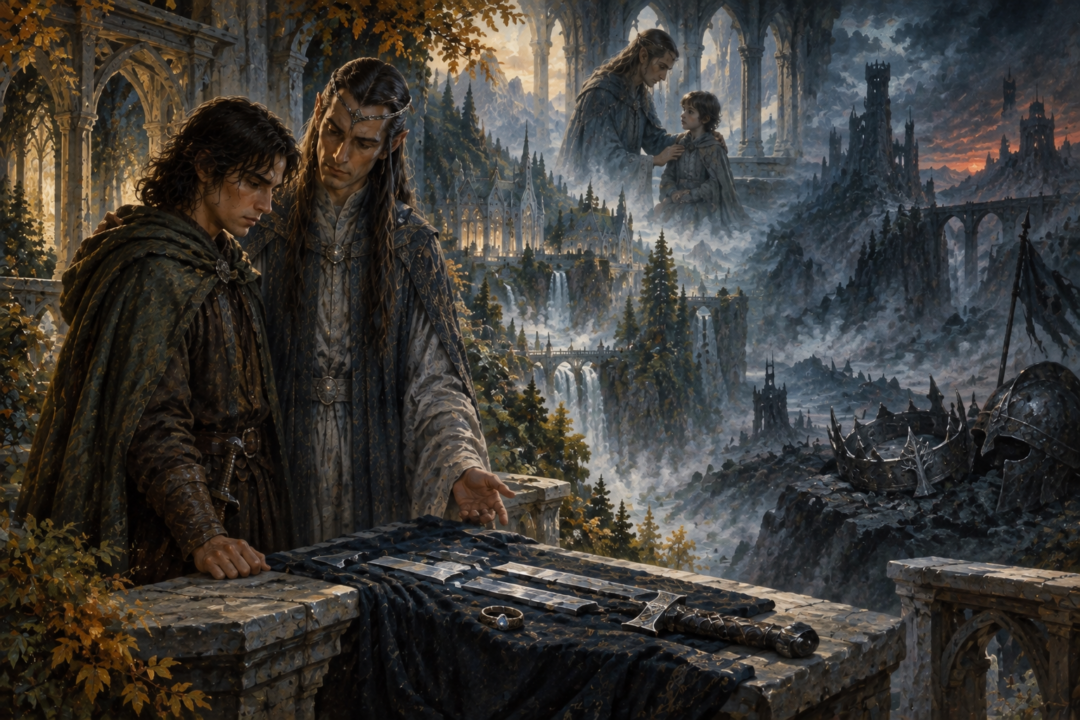
After he returns from journeys with Elladan and Elrohir, Elrond tells him his true name and ancestry. The protected child called Estel learns that he is Aragorn son of Arathorn and the heir of an ancient house.
Elrond then gives him the Ring of Barahir and the shards of Narsil.
These objects matter precisely because they do not belong to Elrond.
He has preserved them.
The Ring of Barahir reaches back through the history of the Edain and Númenor, while Narsil was the sword of Elendil, broken when Elendil fell in the overthrow of Sauron at the end of the Second Age. The shards passed down as an heirloom of Isildur’s house.
Elrond therefore acts as custodian, not owner.
Even more revealingly, he withholds the Sceptre of Annúminas for the time being, telling Aragorn that he must first earn it.
The foster-father does not manufacture the heir’s identity. He reveals it, returns part of its inheritance, and places responsibility upon the man who must now bear it.
Fosterage has reached its proper end.
Estel must go out into the world as Aragorn.
Why Aragorn’s “Elven-Wisdom” Does Not Make Him an Elf
Aragorn undeniably carries the influence of Rivendell.
Appendix A describes him after his long labours as extraordinarily hardy among living Men, knowledgeable in their crafts and lore, yet also “elven-wise.”
That phrase captures the balance.
He possesses knowledge associated with the Eldar, but the comparison remains meaningful because Aragorn is a Man.
His long lifespan likewise belongs to his Númenórean inheritance, not to his fosterage. The Dúnedain descend from the Númenóreans, whose lives were greatly extended compared with other Men. Aragorn’s ancestry reaches through the royal houses of Númenor to Elros, Elrond’s brother, who chose the fate of Men.
This creates one of the most beautiful complications in Aragorn and Elrond’s relationship.
They are not merely an Elf and an unrelated human foster-child.
Their histories divide from the same ancient family.
Elrond and Elros were brothers, but their descendants belonged to different destinies. Elrond remained among the Eldar. Elros became the first King of Númenor and accepted mortality.
Many generations later, Aragorn belongs to the mortal branch.
Elrond can foster him, educate him, love him, and eventually accept him as Arwen’s husband. But he cannot make Aragorn part of the immortal fate of the Elves.
Aragorn’s greatness depends partly upon accepting precisely the mortality that separates him from Elrond.
Arwen Makes the Distinction Painful
The difference becomes sharper when Aragorn loves Arwen.
Elrond does not dismiss Aragorn as socially unworthy. The problem is much deeper. Arwen is Elrond’s daughter, and marriage to Aragorn will bind her fate to mortality and ultimately separate her from her father.
The echoes of Beren and Lúthien are deliberate within the story itself: Aragorn is singing of their meeting when he first encounters Arwen in Rivendell and initially calls her Tinúviel.
But Aragorn is not Beren reborn, and Arwen is not simply Lúthien repeated. Their story belongs to the ending of the Third Age.
Elrond eventually declares that Arwen will not become the bride of any Man less than the King of both Gondor and Arnor. This is not a gift of kingship. Aragorn must achieve what his lineage makes possible but does not guarantee.
Again Elrond refuses to substitute fosterage for inheritance.
He does not say, in effect, “You are my son, therefore you are worthy.”
Aragorn must become fully what his own ancestry and responsibilities demand.
Aragorn Leaves Rivendell to Become Himself
After learning his identity, Aragorn does not remain safely in Elrond’s house.
He enters the Wild.
For nearly thirty years he labours against Sauron. He befriends Gandalf, travels widely, serves Thengel of Rohan and Ecthelion II of Gondor under other names, ventures into dangerous regions, and acquires knowledge of many peoples and lands.
This long period matters because ancestry alone cannot produce the king who eventually enters Minas Tirith.
Aragorn inherits a claim.
He must acquire experience.
Rivendell gives him preservation, education, memory, and wisdom. The Dúnedain give him his people, ancestry, and inherited responsibility. His years of wandering give him tested leadership and knowledge of the world he may someday rule.
None of those elements cancels the others.
They accumulate.
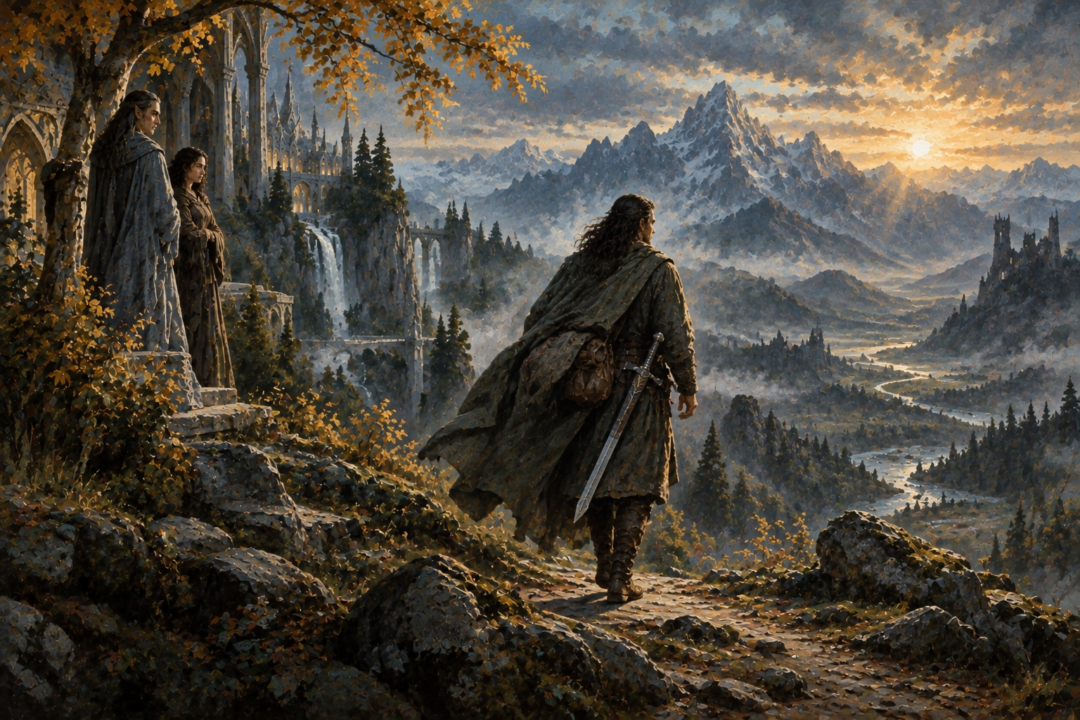
Elrond Preserves a Man Who Must Eventually Leave Him
There is a quiet tragedy inside the foster relationship.
Elrond shelters Aragorn because the heir must survive. He loves him as a son. His household helps shape the young man’s wisdom. Eventually, however, Aragorn’s fulfilment requires him to leave Rivendell, reclaim his Mannish identity publicly, and marry Elrond’s daughter.
The success of Elrond’s fosterage therefore contributes to the loss he must endure.
Yet that is precisely why the relationship matters.
Elrond does not preserve Aragorn in order to possess him.
He preserves him so that Aragorn can become himself.
That may be the clearest way to understand fosterage in Aragorn’s story. Rivendell does not overwrite his bloodline with an Elvish identity. It safeguards a threatened human inheritance until its bearer is strong enough to carry it openly.
The child called Estel survives because his name is hidden.
The man called Aragorn succeeds because, when the time comes, he accepts that name again.
He leaves the house of Elrond not as an Elf-made imitation of the Elder Kindred, but as something distinctly his own: a mortal descendant of Númenor, enriched by Elvish wisdom, heir to a broken kingdom, and a Man prepared to bear the weight of histories that Rivendell had kept safe for him.
Sources & Notes
- Tolkien Gateway — Aragorn https://tolkiengateway.net/wiki/Aragorn
- Tolkien Gateway — Elrond https://tolkiengateway.net/wiki/Elrond
- Tolkien Gateway — House of Isildur https://tolkiengateway.net/wiki/House_of_Isildur
These references document Aragorn’s descent, concealment as Estel, upbringing in Elrond’s household, and inheritance as Isildur’s heir. The article’s account of fosterage preserving rather than replacing his Mannish identity is interpretive synthesis.