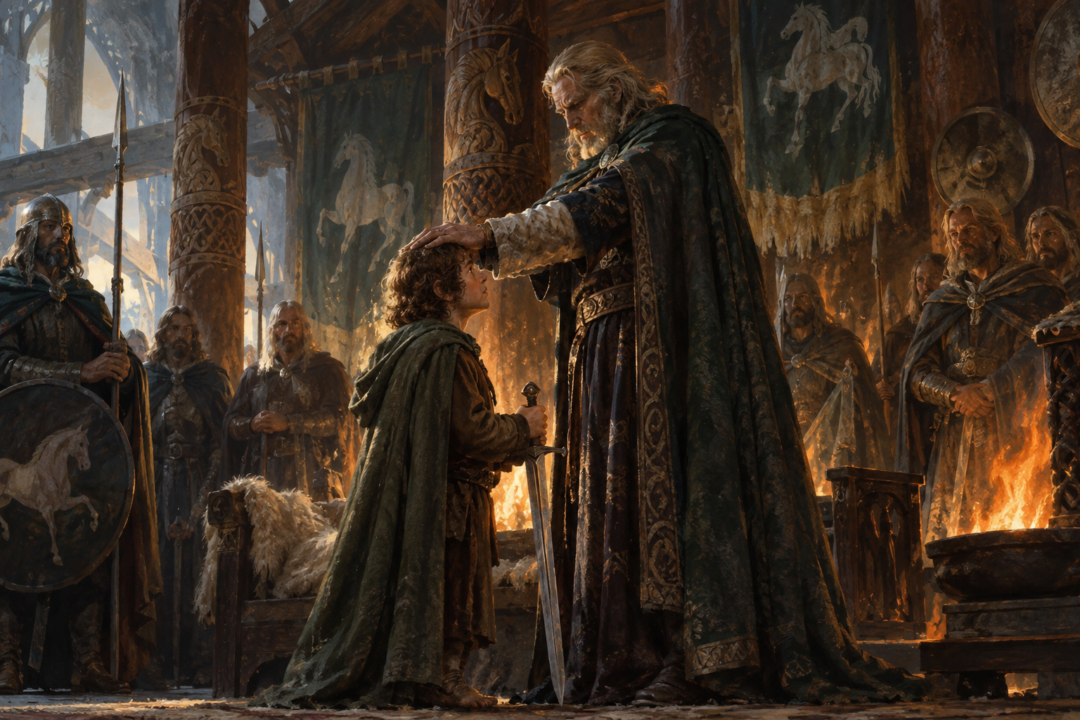
When Merry Brandybuck offers his sword to Théoden, the moment seems to settle his place in the coming war. The King of Rohan accepts him, names him an esquire of his household, and welcomes a hobbit into a warrior culture built around horses, loyalty, and service.
Then, almost immediately, Théoden refuses to take him into the greatest battle of the age.
To Merry, the contradiction is painful. What is the point of becoming the king’s swordthain if he cannot remain beside the king when the swords are actually drawn?
Yet Théoden’s decision is not a rejection of Merry’s courage. It reveals something more interesting about what service means in Rohan—and about the brutal practical demands of the Ride to Gondor.
Merry Does Not Enter Théoden’s Service as an Ordinary Rider
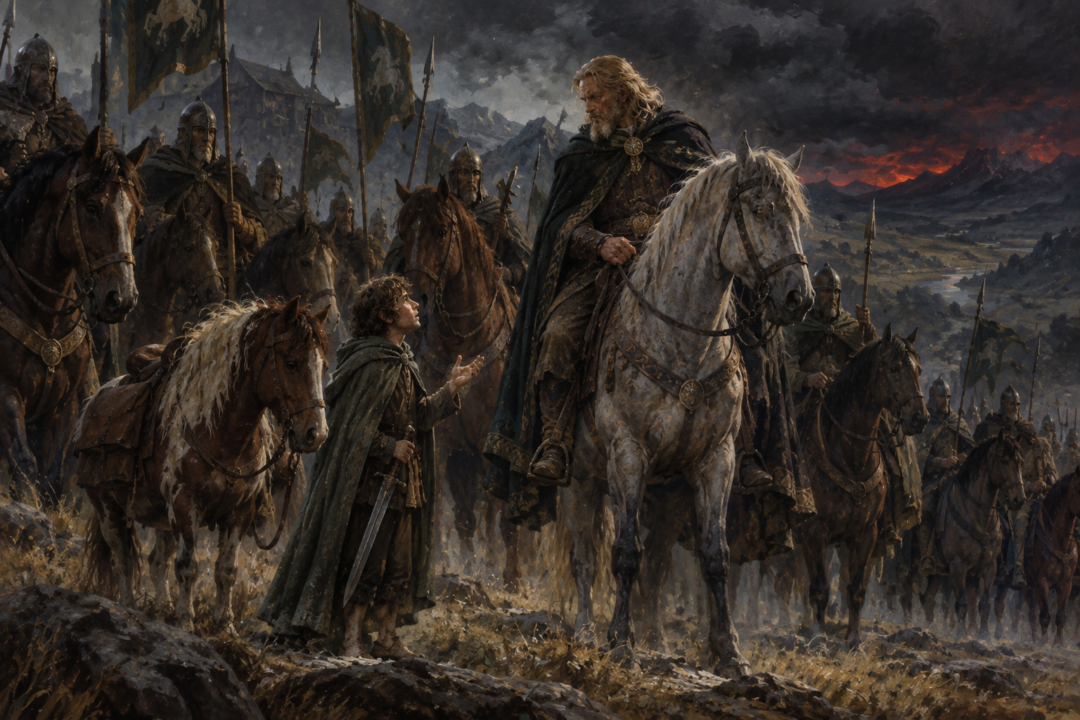
Merry’s relationship with Théoden grows during the journey through Rohan.
After Gandalf takes Pippin to Minas Tirith, Merry finds himself separated from his closest companion. Théoden treats him with unusual warmth. Merry rides beside the king, speaks with him about the Shire, and gradually becomes attached to the old ruler.
Eventually Merry offers Théoden his sword.
The king accepts.
He names Merry “esquire of Rohan of the household of Meduseld,” and Merry tells Théoden that he will be like a father to him. Théoden’s answer—“For a little while”—quietly foreshadows what is coming.
But nothing in this exchange makes Merry a mounted warrior of an éored.
He has entered Théoden’s personal service. That is significant, but it does not magically give him the physical ability, equipment, horse, or training of one of the Rohirrim.
That distinction becomes decisive once Gondor calls for aid.
The Ride to Gondor Changes Everything
When Hirgon brings the Red Arrow to Théoden, the situation is desperate.
Gondor is already under attack. Rohan cannot travel leisurely southward. Théoden intends to gather what strength he can and move rapidly toward Mundburg, the Rohirrim’s name for Minas Tirith.
This is where Merry’s size becomes a military problem.
Merry has been riding Stybba, a pony suited to him. But Stybba cannot accompany the great mounted host on its urgent march to Gondor.
Théoden explains that the Rohirrim will ride horses that are “tall and swift.” Merry, however willing, cannot simply ride one of their warhorses as one of the Riders does.
Merry responds exactly as we would expect. He suggests being tied onto a horse, hanging from a stirrup, or even running until his feet are worn away.
It is both comic and deeply serious.
Merry is saying that physical impossibility does not matter to him.
Unfortunately, it matters to Théoden.
Théoden Cannot Plan a Cavalry Campaign Around Merry’s Courage
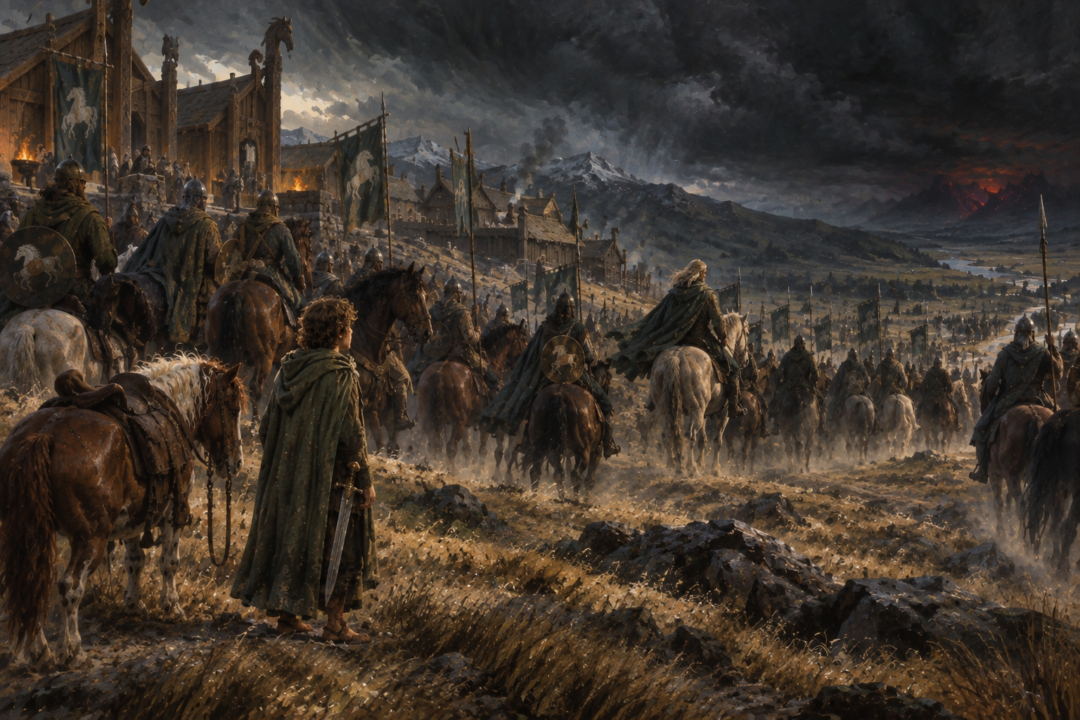
At Edoras, Merry asks the question at the heart of the issue: why accept him as swordthain if he is not permitted to remain beside his lord?
Théoden finally gives the clearest explanation.
He says that he received Merry partly for his “safe-keeping” and also so that Merry would do as the king commanded.
That changes the meaning of the earlier ceremony.
Merry interprets becoming a swordthain primarily as a promise to follow Théoden.
Théoden also understands it as assuming responsibility for Merry.
And now those two ideas collide.
The king states that none of his Riders can carry Merry as a burden. The journey to Mundburg is more than a hundred leagues, and the Rohirrim are attempting to reach a distant battlefield with extraordinary speed.
A spare passenger is not merely an inconvenience in those circumstances.
The Rider must manage the horse over a long forced march and then potentially enter battle immediately afterward. Théoden is organizing an army whose decisive weapon is mounted speed. He cannot reasonably command one of his warriors to carry Merry simply because Merry possesses the courage to go.
This is not contempt for hobbits.
It is logistics.
Being a Swordthain Means Obedience Too
There is also an uncomfortable truth in Théoden’s answer that Merry would rather ignore.
Service does not mean that the servant decides how he will serve.
Merry has sworn himself to Théoden. Théoden therefore reminds him that he accepted Merry partly “to do as I might bid.”
Merry wants his oath to mean: I will follow you into danger.
Théoden effectively answers: Then obey me when I command you to remain behind.
This makes the scene far richer than a simple dispute about Merry being too small.
Merry is unquestionably brave. Théoden knows that.
But courage does not erase command.
Indeed, obedience becomes hardest precisely when a command prevents Merry from doing the brave thing he desperately wants to do.
Théoden even distinguishes between different circumstances. If battle were taking place before his own gates, Merry might have an opportunity to prove himself. But the Rohirrim must first reach Gondor.
The obstacle is not simply the battle.
It is getting Merry to the battle without compromising another Rider.
Théoden Releases Merry From His Service—But Not His Friendship
Before leaving Dunharrow, Théoden initially attempts to solve the conflict gently.
He releases Merry from his service.
Importantly, he explicitly says that he does not release him from his friendship.
Merry may remain and, if he wishes, serve Lady Éowyn, who has been appointed to govern the people in Théoden’s absence.
The distinction matters.
Théoden is not casting Merry aside because he has proved useless. He is trying to remove the obligation Merry feels to accompany him.
Merry refuses to see matters that way.
All his friends have gone toward danger. Pippin is in Minas Tirith. Aragorn has taken the Paths of the Dead. The armies of the West are moving toward war.
Remaining safely behind feels to Merry like shame.
That emotion is central to his decision.
He does not merely want adventure. He wants the right to share the danger being faced by the people he loves.
And someone else nearby understands that feeling perfectly.
Dernhelm Recognizes the Same Wound
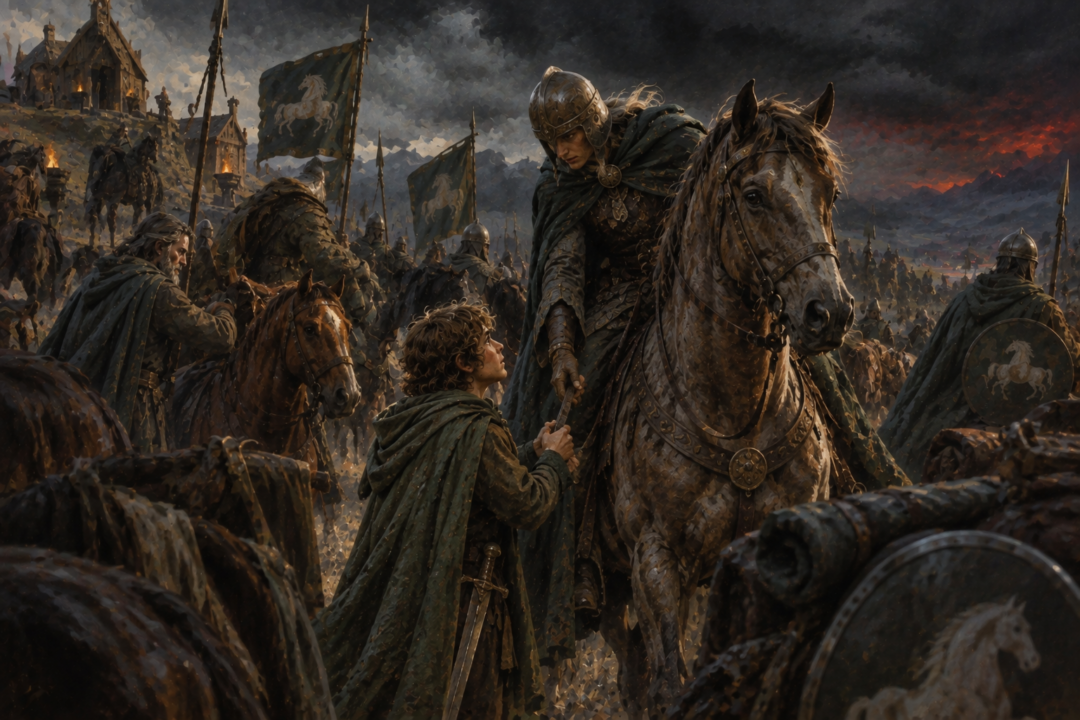
After Théoden gives his final refusal at Edoras, a young Rider quietly approaches Merry.
He calls himself Dernhelm.
The reader later learns that Dernhelm is Éowyn in disguise.
The pairing is deliberate and powerful because Éowyn has also been commanded to remain behind.
Théoden has entrusted her with an important responsibility: leadership of the people while the king and his Riders go to war. Yet Éowyn desires to ride into battle herself.
Merry and Éowyn therefore stand in strangely similar positions.
Neither lacks courage.
Neither believes remaining behind reflects what he or she is capable of doing.
And neither has permission to ride with Théoden.
Dernhelm secretly offers to carry Merry.
“Such good will should not be denied,” the disguised Éowyn tells him.
So the two people Théoden intended to leave behind ride toward Gondor together.
The King’s Judgment Was Reasonable—and Still Incomplete
It would be easy to read later events as proving Théoden wrong.
But that is too simple.
Théoden is correct about the immediate practical problem. Merry cannot ride to Gondor independently with the Rohirrim, and another Rider carrying him creates precisely the burden Théoden refused to impose.
Éowyn solves the problem only by choosing to carry Merry secretly.
Yet Théoden cannot foresee what will happen on the Pelennor Fields.
When the Lord of the Nazgûl attacks Théoden’s fallen position, Éowyn stands against him. Merry, nearly overwhelmed by terror, strikes the Ringwraith from behind with the sword he had taken from the Barrow-downs.
That weapon has a history Merry does not fully understand. It was forged in the wars against Angmar, and the narrative explicitly connects its making with hostility toward the realm of the Witch-king.
Merry’s blow breaks the spell-bound protection that prevents ordinary weapons from harming the Nazgûl in the usual way, allowing Éowyn’s following stroke to destroy the Witch-king’s embodied form.
The hobbit whom Théoden considered unable to contribute meaningfully to such a distant mounted battle becomes essential at one of its most decisive moments.
But Merry could not have demonstrated beforehand that this would happen.
Neither could Théoden have planned for it.
That uncertainty is part of the point.
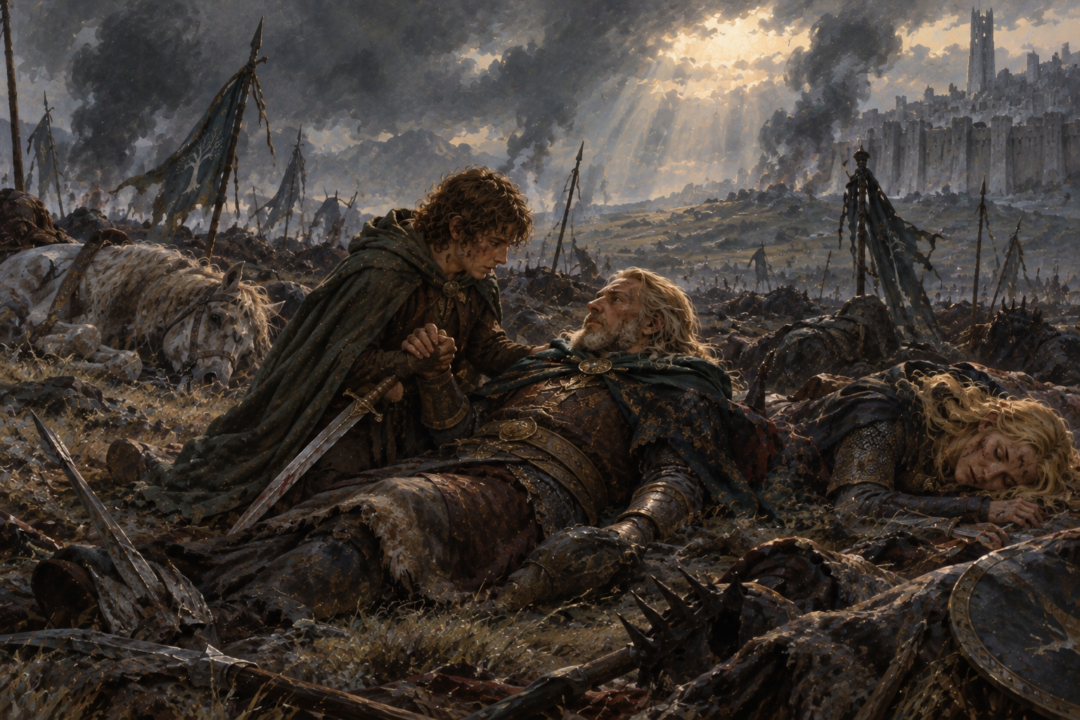
“Great Heart Will Not Be Denied”
The tragedy becomes complete beside the dying Théoden.
Merry believes he has failed.
He asks forgiveness for breaking the king’s command and laments that he has done little in Théoden’s service except weep at their parting.
Théoden does not condemn him.
Instead he forgives him, telling him not to grieve and saying that “great heart will not be denied.”
The phrase transforms their earlier disagreement.
Théoden had tried to protect Merry because he cared for him. Merry had disobeyed because he cared for Théoden.
Both choices came from loyalty.
And the outcome could not have been predicted by either of them.
Merry’s swordthainship therefore was never meaningless. It simply did not give him an automatic right to ride with the Rohirrim.
To Théoden, accepting Merry meant taking responsibility for him as well as receiving his service. When the king believed Merry could not accompany the cavalry without burdening another Rider, his duty as commander and protector outweighed Merry’s desire for glory or companionship.
Yet Merry’s story also shows the limits of judging usefulness only by what can be seen beforehand.
He was too small for the horses of Rohan.
He could not keep pace with the muster on his own.
He had no place in Théoden’s military plan.
And still, when Théoden fell beneath the shadow of the Witch-king, the unwanted passenger from the Shire was exactly where he needed to be.
Sources & Notes
- Tolkien Gateway — Meriadoc Brandybuck https://tolkiengateway.net/wiki/Meriadoc_Brandybuck
- Tolkien Gateway — Théoden https://tolkiengateway.net/wiki/Th%C3%A9oden
- Tolkien Gateway — Red Arrow https://tolkiengateway.net/wiki/Red_Arrow
These references document Merry’s service to Théoden, Théoden’s decision that he could not join the mounted host, and Gondor’s urgent summons by the Red Arrow. The logistical and protective reading of the order is the article’s synthesis.