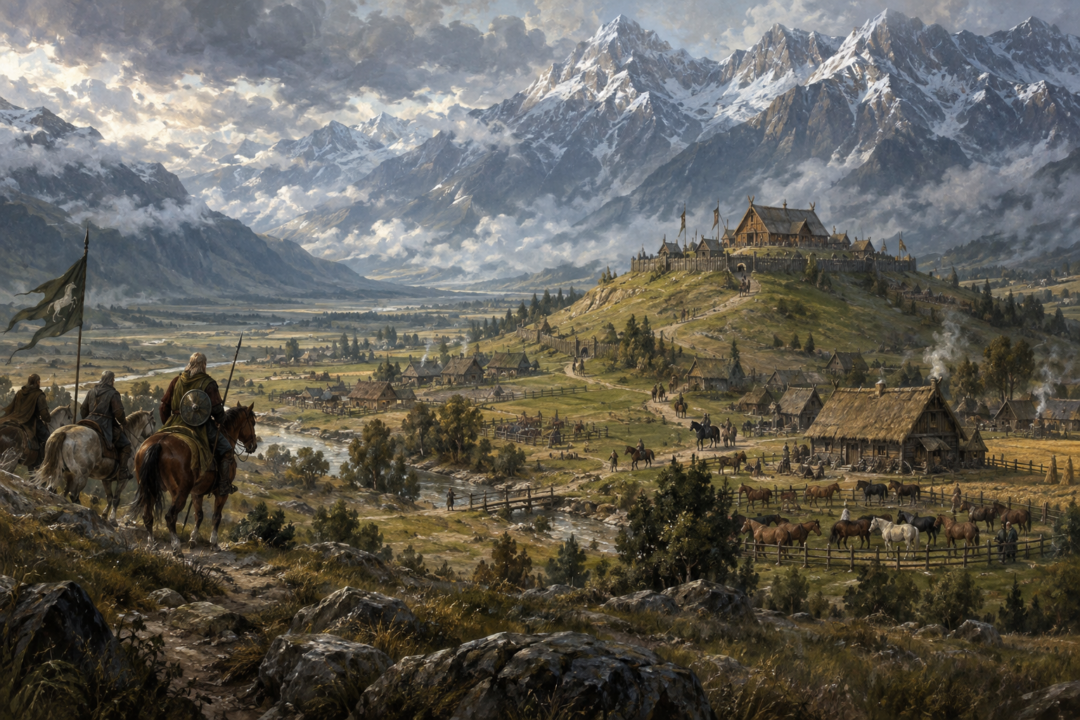
When most readers picture Rohan, they picture Edoras: the steep green hill, the clustered houses beneath it, and Meduseld shining above the settlement like the visible heart of the kingdom.
Yet Edoras was not the first royal seat of the Rohirrim.
That distinction belonged to Aldburg, lying elsewhere in the Folde. When Eorl the Young and his people received Calenardhon after the Battle of the Field of Celebrant, the beginnings of the new kingdom were rooted in this region beneath the White Mountains. Later kings might rule from Edoras, armies might range across the enormous grasslands of the Mark, and the political geography of Rohan might develop into eastern and western commands. But the Folde continued to contain both the newer royal centre and the older seat associated with Rohan’s founding generation.
That makes the Folde something unusual.
It was not merely the territory surrounding the capital. By the end of the Third Age, it preserved several layers of Rohirric history at once.
Before Rohan, There Was Calenardhon
Rohan did not begin as an ancient kingdom.
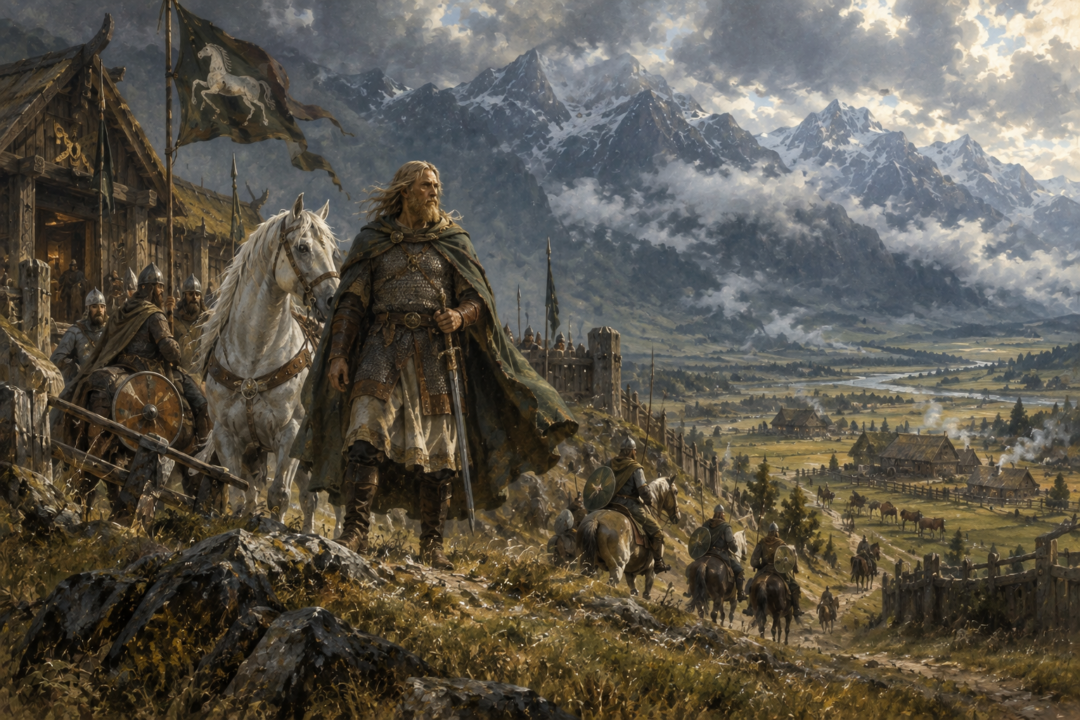
The territory had belonged to Gondor and was known as Calenardhon. By the middle of the Third Age, Gondor’s hold over the region had weakened severely. The decisive change came in T.A. 2510, when Gondor faced invasion and Cirion, its Ruling Steward, received unexpected aid from Eorl the Young and the Éothéod.
After their victory at the Field of Celebrant, Cirion granted Calenardhon to Eorl and his people. The alliance was confirmed by the famous oath sworn between them, establishing the friendship between Gondor and the new realm that would become Rohan.
The Rohirrim therefore entered a land that already possessed roads, fortifications, and a long Gondorian history. They did not create the landscape from nothing.
But they made it their own.
And the southern country beneath the White Mountains became especially important to the developing kingdom.
The populated heartlands of Rohan lay largely along those mountains rather than far out on the immense northern plains. Here valleys descended from the mountains, water was available, settlements could cluster around defensible places, and the great road linked the country eastward toward Gondor and westward across the Mark.
Within this southern belt lay the Folde.
Aldburg Came Before Meduseld
The clearest evidence for the Folde’s foundational importance is Aldburg.
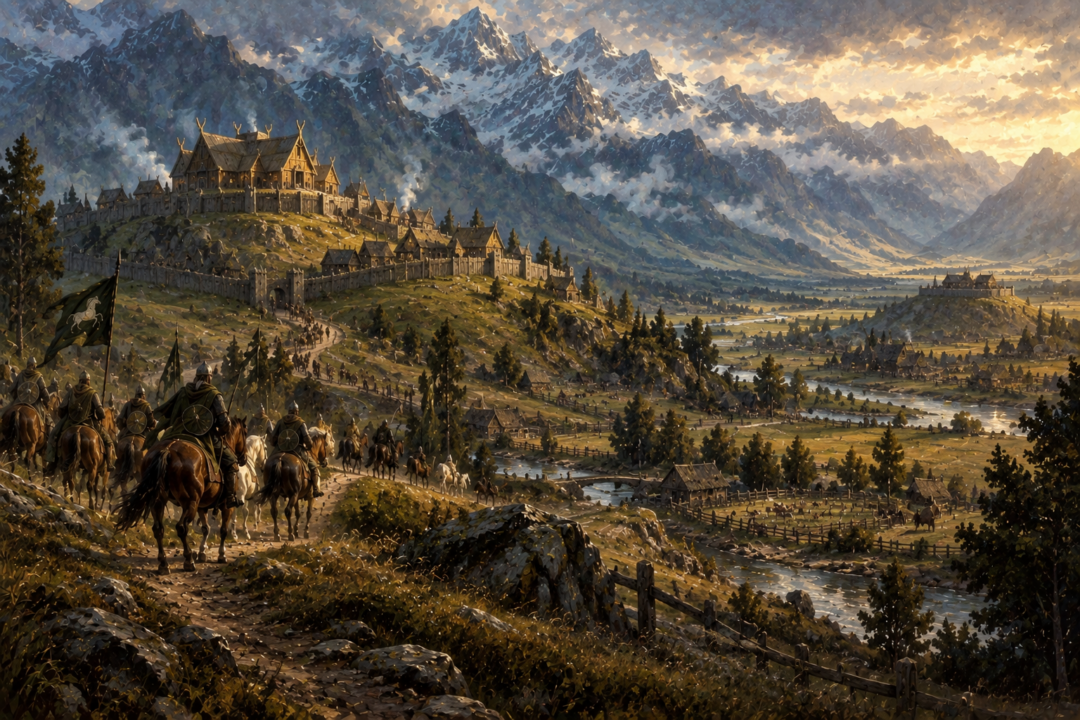
Material associated with the military organization of Rohan in Unfinished Tales identifies Aldburg in the Folde as Eorl’s dwelling. It was therefore the original royal seat before the kings established themselves at Edoras.
This matters because popular memory naturally makes Edoras feel almost synonymous with Rohan. Meduseld is where Théoden sits. The royal barrows stand outside the city. The muster gathers there. It is the political and ceremonial centre encountered in The Lord of the Rings.
But the royal story had already begun elsewhere.
Eorl’s son Brego transferred the royal seat to Edoras. The chronology preserved in the royal annals places the completion of Meduseld in T.A. 2569, during Brego’s reign.
Aldburg did not disappear when this happened.
Instead, it remained in the royal family.
Brego’s third son, Eofor, received Aldburg, and his descendants continued to be associated with it. Many generations later that line was represented by Éomund and his son Éomer.
Thus Rohan’s first royal centre survived beside its later one.
The kingdom did not erase its old heart when it built a new one.
Why the Folde Was More Than a Capital District
The name itself helps reveal the region’s character.
“Folde” represents an Old English word meaning land, earth, or country. The related names Westfold and Eastfold describe lands to either side, while the Folde occupied the central southern region around the royal centres.
Care is needed here. The texts never give us a detailed demographic survey showing exactly where every early Rohirric family settled, nor do they explicitly declare the Folde to be an intentionally preserved ancestral homeland.
What they do show is a striking concentration of early royal history.
Aldburg belonged to the first generation of the kingdom. Edoras belonged to the second. Both remained important centuries later.
That continuity is unusual enough to matter.
In many kingdoms, moving the capital diminishes the old centre until it becomes little more than a historical curiosity. Aldburg followed a different path. Its importance became less royal but remained dynastic and military.
The old seat survived inside the functioning structure of Rohan.
Aldburg Became a Military Centre
By the War of the Ring, Aldburg was associated with the military command of the eastern part of Rohan.
The appendices concerning the Battles of the Fords of Isen in Unfinished Tales explain the organization of the Marshals of the Mark and identify Aldburg as Éomer’s base. Éomer held responsibility in the East-mark before the great crisis of T.A. 3019.
This gives Aldburg an important continuity of purpose.
The house from which the first king had ruled was no longer the chief royal court, but the settlement remained tied to one of Rohan’s most important noble lines and to the defence of the kingdom.
Éomer’s connection makes that continuity particularly vivid. Through his father Éomund, he was descended from Eofor, Brego’s third son—the very prince to whom Aldburg had passed after the royal seat moved.
So when Éomer operated from Aldburg near the end of the Third Age, he was not simply an officer assigned to an arbitrary fortress.
He belonged to the branch of Eorl’s house historically connected with the place.
Nearly five centuries after Rohan’s foundation, the old royal seat was still occupied by descendants of the founding dynasty.
Edoras Did Not Replace the Past
Edoras nevertheless became the greater symbol of kingship.
Brego built Meduseld there, and the Golden Hall became the throne-hall of Rohan. Outside Edoras stood the burial mounds of the kings, marked with simbelmynë. By Théoden’s time the city embodied the accumulated memory of centuries of rule.
Yet Edoras and Aldburg should not be understood as rivals.
Together they reveal how the Folde accumulated history.
Aldburg represented the earliest establishment of Eorl’s house in the new land.
Edoras represented the consolidation of that kingdom under Eorl’s descendants.
The royal barrows then transformed the landscape around Edoras into something more than an administrative capital. The dead kings remained physically associated with the living seat of kingship.
The Folde consequently held both the abandoned first court and the continuing royal court—though “abandoned” must be qualified, because Aldburg itself remained occupied and important.
Rohan’s political centre moved.
Its older centre survived.
Geography Helped Keep the Folde Central
The Folde also occupied an advantageous position within the southern heartlands of Rohan.
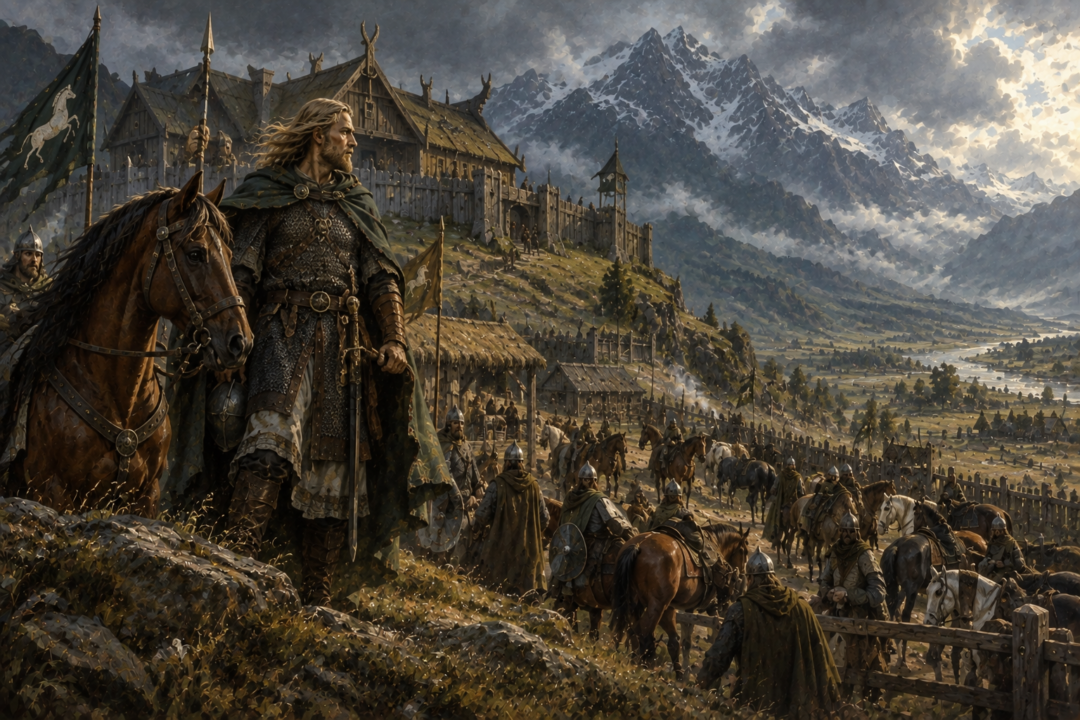
Edoras stood beneath the White Mountains near the mouth of Harrowdale, with the Snowbourn running outward toward the Entwash. Aldburg lay farther southeast in the Folde. The great road through southern Rohan connected this country with the Eastfold and ultimately Gondor.
Behind Edoras lay another crucial landscape: Dunharrow.
The refuge high above Harrowdale was vastly older than the Rohirrim themselves. Its ancient works and the road toward the Paths of the Dead belonged to histories the Rohirrim did not fully understand.
This created another layer of continuity.
The Rohirrim were newcomers compared with the ancient peoples who had inhabited or fortified parts of the White Mountains. Yet their own royal heartland became embedded within that older landscape.
The Folde therefore stood at an intersection of histories: Gondorian Calenardhon, the settlement of Eorl’s people, the establishment of Aldburg, the rise of Edoras, and the continuing road between Rohan and Gondor.
The War of the Ring Reveals the Pattern
The movements of characters during the War of the Ring make this geography visible.
When Gandalf carried Pippin eastward toward Minas Tirith, their journey took them through Rohan’s southern lands. Later Théoden led the Riders east toward Gondor.
The road did not simply cross anonymous grassland.
It passed through the settled belt from which Rohan’s kings had ruled and through which its forces could move toward their ancient ally.
That is one reason the image of Rohan as nothing but scattered horsemen on an endless plain is incomplete.
The Rohirrim certainly depended upon horses and possessed extraordinary mobility. But they also had permanent centres, inherited lordships, roads, refuges, royal tombs, cultivated valleys, and established systems of military organization.
The Folde gathers many of those features into one region.
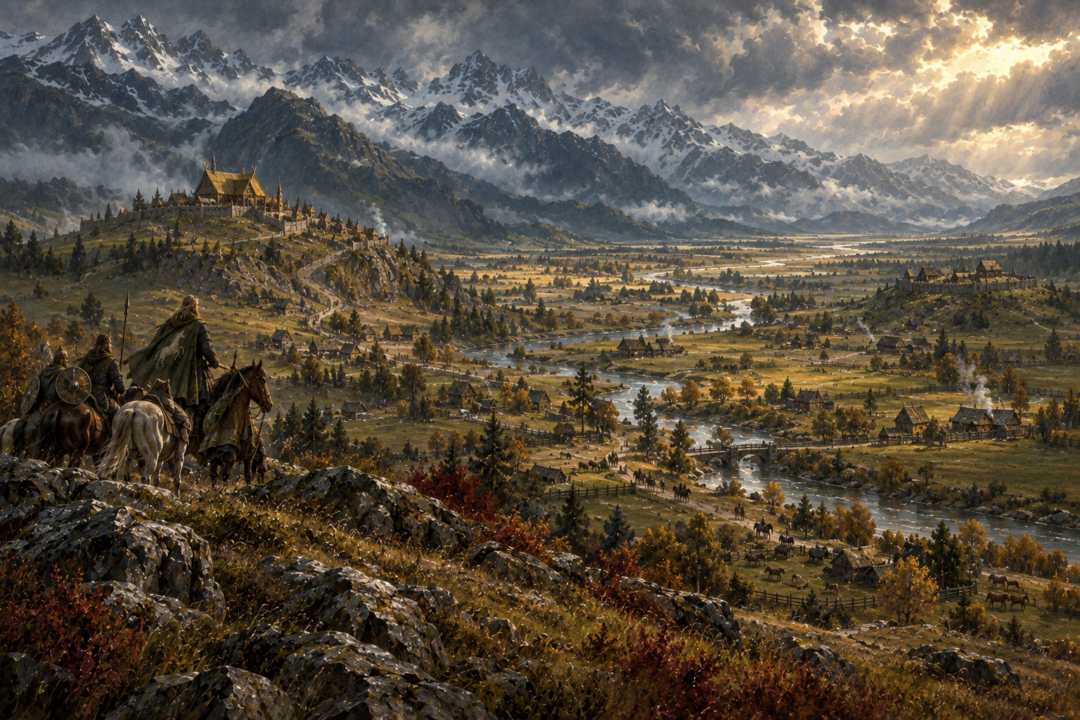
The Old Heart of the Mark
Calling the Folde the “oldest core” of Rohirric settlement requires one qualification: no surviving text gives a complete map of the earliest settlement process after T.A. 2510.
We cannot say that every first wave of Rohirrim concentrated there, or reconstruct precisely how population spread through the new kingdom.
But the political and dynastic evidence is much stronger.
Eorl’s seat was at Aldburg in the Folde. His son established the later royal centre at Edoras. Aldburg passed to another branch of the royal house rather than fading from importance. Centuries afterward, Éomer still had his home and military base there. Edoras remained the seat of the kings, surrounded by their burial mounds.
In that sense, the Folde preserved Rohan’s beginnings unusually well.
The history of the kingdom was not hidden in distant ruins.
It remained inhabited.
A rider travelling through the Folde near the end of the Third Age could move through a landscape containing the seat of the reigning king and the seat of the first king, both still woven into the political life of the Mark.
That may be the most revealing thing about the region.
Rohan was a comparatively young kingdom by the standards of Middle-earth, living beside civilizations whose histories reached back thousands of years. Yet within only five centuries the Rohirrim had already created their own geography of memory.
And at its centre stood the Folde: not merely “the land” around Edoras, but a landscape where the first chapters of Rohan had never entirely passed away.
Sources & Notes
- Tolkien Gateway — Folde https://tolkiengateway.net/wiki/Folde
- Tolkien Gateway — Aldburg https://tolkiengateway.net/wiki/Aldburg
- Tolkien Gateway — Rohan https://tolkiengateway.net/wiki/Rohan
These references document the Folde, Aldburg as Eorl’s early seat, and Rohan’s settlement and royal geography. The article’s description of the region as a layered landscape of Rohirric memory is interpretive synthesis.