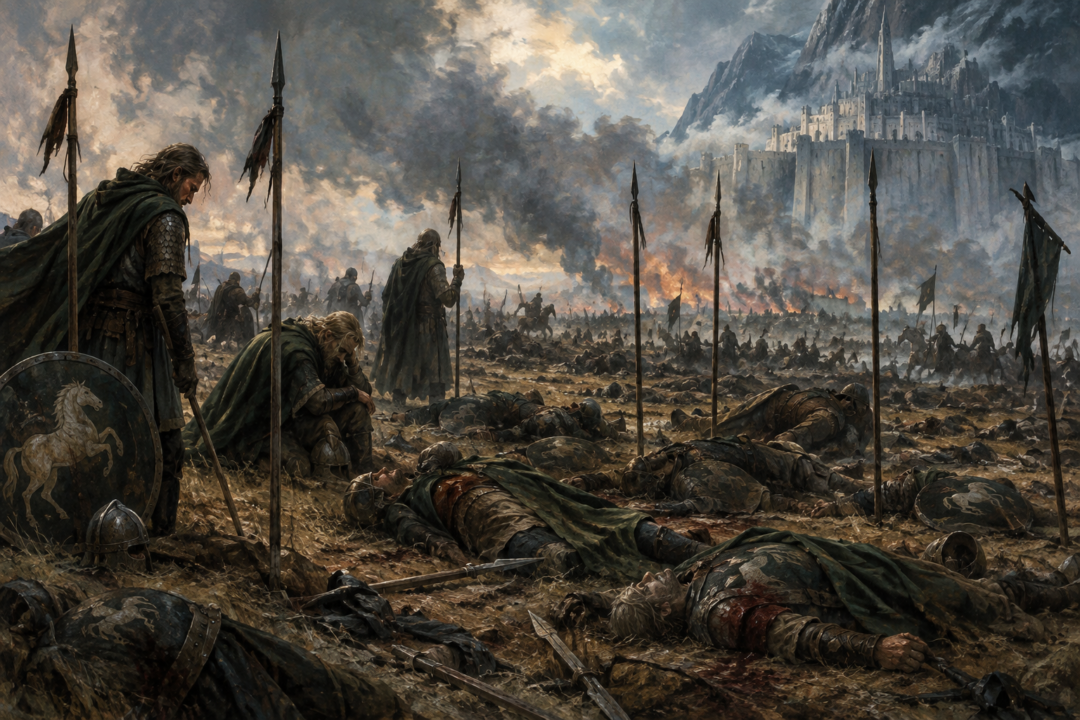
When the Battle of the Pelennor Fields ends, Minas Tirith has been saved, but the land before its walls has become an enormous graveyard.
Rohirrim lie far from the green plains of their homeland. Men of Gondor have fallen beside allies from distant fiefs. Southrons and Easterlings are dead among them. Théoden has fallen beneath Snowmane. The monstrous creature ridden by the Lord of the Nazgûl lies where Éowyn struck it down.
Yet one small detail reveals how differently these deaths are treated.
Before the battle is even finished, the seven fallen knights of Théoden's household are moved away from the Enemy dead. They cannot yet be carried from the field, so they are laid apart and spears are planted around them.
That separation is deliberate.
But it is important not to exaggerate what the text tells us. The Lord of the Rings never gives a complete account of how every corpse on the Pelennor was disposed of, and it does not explicitly describe a systematic burial policy separating every army. What it does show is something more interesting: the fallen defenders are gathered into a community of memory defined not simply by nationality, but by loyalty, fellowship, and shared sacrifice.
The Seven Knights Are Separated Before Burial
The clearest evidence comes immediately after the fall of the Witch-king.
Théoden is lifted from the battlefield. Éowyn, believed at first to be dead, is also carried toward Minas Tirith. But seven knights of the King's household have fallen nearby, including their chief, Déorwine.
The fighting is still too dangerous for their bodies to be removed.
So the Rohirrim do the next best thing: they lay their companions apart from their foes and place spears around them.
This is not yet burial. It is protection and identification.
The distinction matters because it shows that the battlefield has already ceased to be merely a place of killing. Even while the struggle continues, the Rohirrim are beginning to reclaim their dead from the chaos of combat.
Those bodies belong to a remembered fellowship.
Their enemies do not.
That does not necessarily mean hatred determines the later burial arrangements. The text never says that every enemy corpse was dishonoured. But the fallen household knights are unmistakably marked out as men whose identity must be preserved.
The Mounds of Mundburg Unite Rohan and Gondor
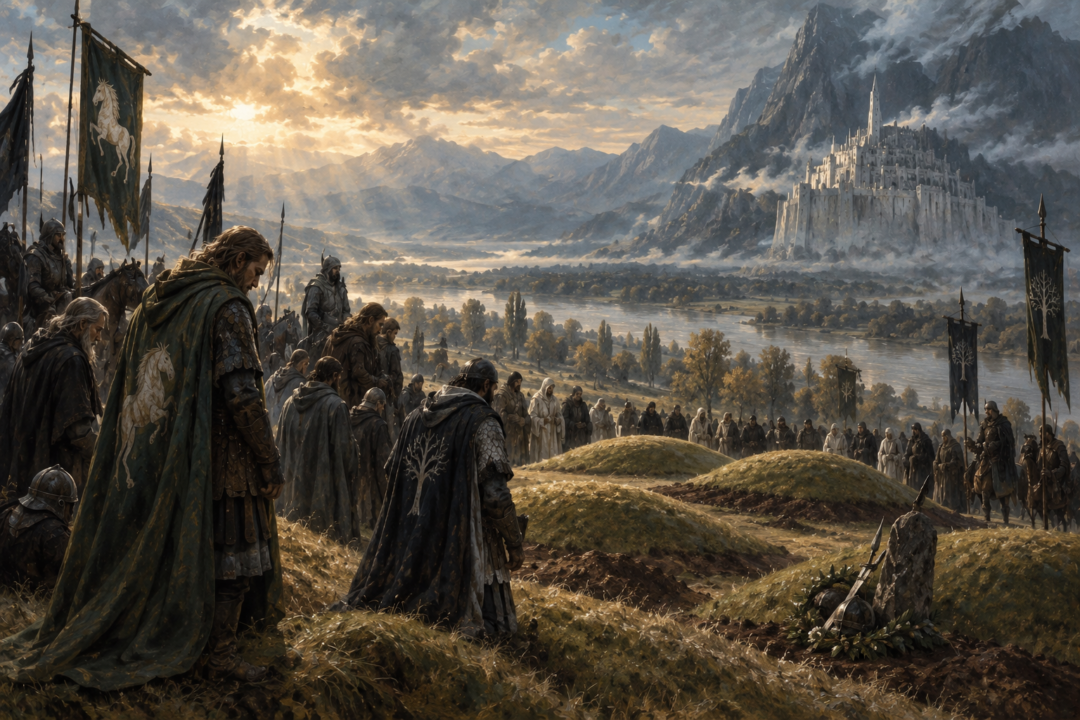
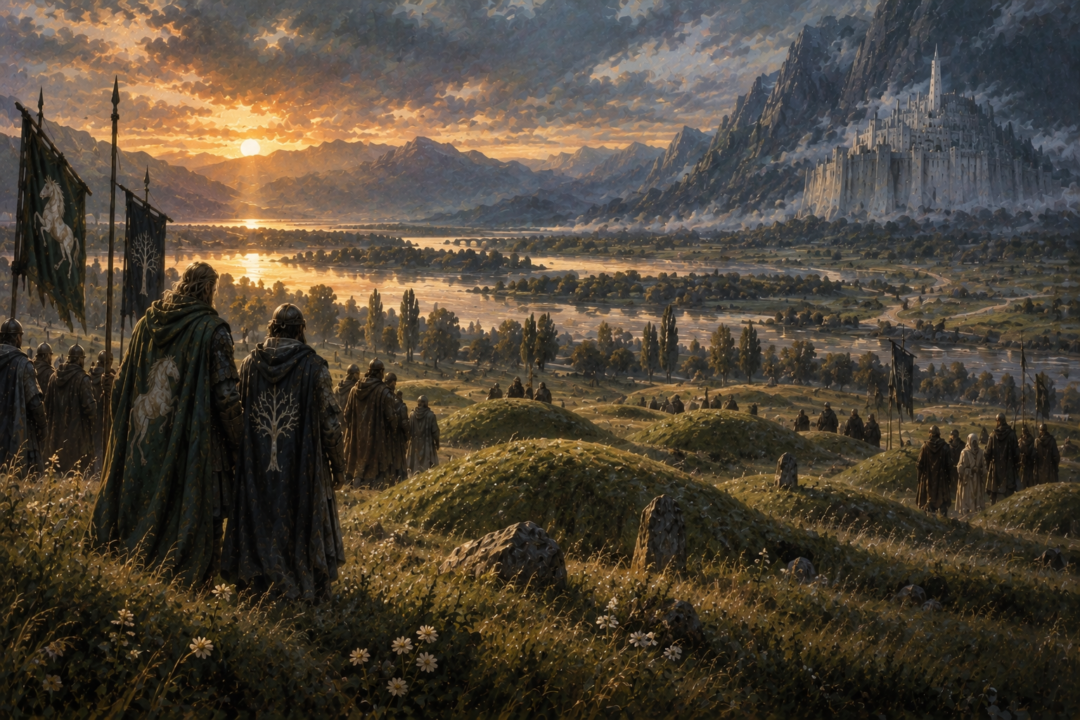
The strongest evidence for what happened afterward appears in the great Rohirric lament known as the Song of the Mounds of Mundburg.
The song remembers Rohirrim such as Harding, Guthláf, Dúnhere, Déorwine, Grimbold, Herefara, Herubrand, Horn, and Fastred. They do not return to their own country.
Instead, they remain beneath the earth in Gondor.
Crucially, the poem says they lie with their “league-fellows,” the lords of Gondor.
That phrase explains much.
The Pelennor dead are not simply arranged according to birthplace. Rohirrim and Gondorians can share the same landscape of burial because they fought within the same alliance.
The dead of Rohan have fallen in a foreign country, yet the grave does not make them strangers. Their oath-bound friendship with Gondor has effectively created a new community.
In life, they rode together.
In death, they remain together.
The Mounds of Mundburg therefore become something larger than military graves. They are physical evidence that the alliance between Gondor and Rohan was paid for in blood.
This Is Allegiance, Not Simply Ethnicity
That distinction becomes even clearer when the poem remembers other fallen leaders.
Forlong of Lossarnach does not return to his own valley. Hirluin does not return to Pinnath Gelin. Derufin and Duilin do not return to the lands around Morthond. The lament deliberately names the homes these men will never see again.
The tragedy depends upon distance.
These men came from different parts of Gondor and its associated fiefs, while the Rohirrim came from an entirely different kingdom. Yet death on the Pelennor binds them into the same remembered host.
The organizing principle is therefore not simply “Rohan here, Gondor there.”
It is fellowship.
The poem even collapses social distinctions when it observes that death took both lords and humble men. The battlefield has produced a community extending across rank and region.
This is why “buried by allegiance” is useful only if allegiance is understood broadly. The surviving text emphasizes the people who stood together against Sauron's assault, rather than presenting a detailed map of separate national cemeteries.
Théoden Is the Great Exception
One fallen Rohirrim does not remain in the Mounds of Mundburg.
Théoden.
His treatment shows that political fellowship does not erase older bonds of kingship and ancestry.
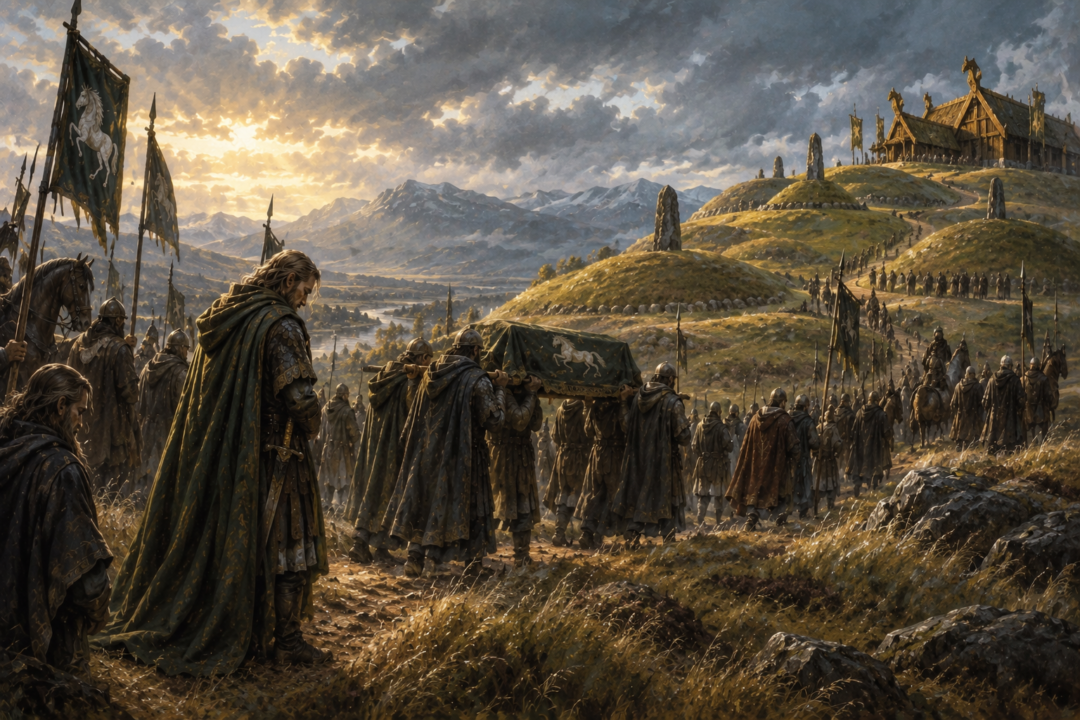
After his death, Théoden's body is brought into Minas Tirith and temporarily laid among Gondor's dead kings. But he is not permanently buried there.
Months later, when the companions of the Ring journey north after Sauron's defeat, Théoden is carried home to Rohan. At Edoras he is placed in a mound among the kings of the Mark.
That is exactly where a King of Rohan belongs.
The contrast is revealing.
Ordinary warriors and even prominent captains may remain where they fell, sharing burial with their allies. But Théoden's body has dynastic significance. His burial joins him to the line of kings that preceded him.
His grave is therefore not merely personal.
It belongs to the memory of the kingdom.
Snowmane Receives a Different Kind of Honour
The treatment of Snowmane makes the battlefield symbolism even sharper.
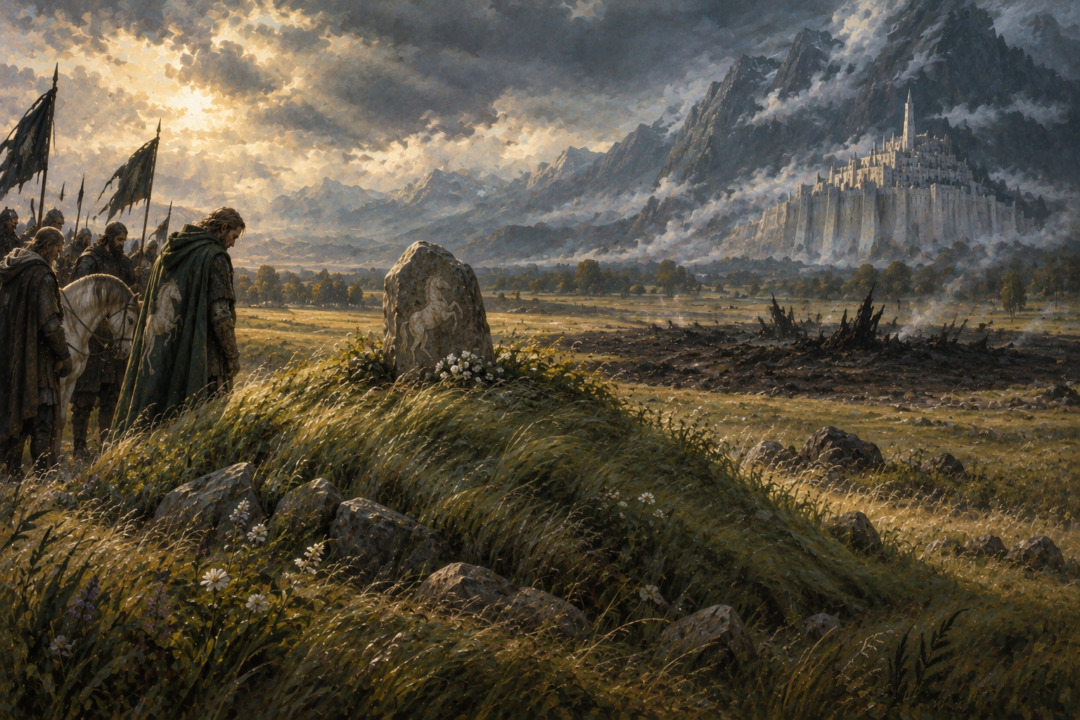
Snowmane dies beneath the assault of the Witch-king, his fall contributing to Théoden's mortal injuries. After the battle, the Rohirrim bury the horse on the Pelennor and raise a stone over him bearing an inscription in the languages of Gondor and the Mark.
Snowmane remains where he fell.
The text later tells us that the grass grows especially green and long upon his grave.
Nearby, however, the carcass of the Nazgûl's winged creature receives completely different treatment.
It is burned.
The ground where it is consumed remains black and bare.
The contrast could hardly be stronger: mound and scorched earth, green grass and barrenness, remembrance and obliteration.
Yet again, the text does not establish a universal law that allies must always be buried and enemies always burned. The contrast is attached specifically to Snowmane and the unnatural beast of the Nazgûl.
Symbolically, however, the distinction is unmistakable.
One creature belonged to fellowship.
The other belonged to terror.
The Enemy Dead Are More Complicated Than They First Appear
This is where the topic requires caution.
It is tempting to imagine that all of Sauron's dead were simply thrown into pits or burned while the Free Peoples received honoured burial. The published narrative does not tell us that.
Indeed, the enemy army contains very different kinds of beings.
There are Orcs, but there are also Men: Haradrim, Easterlings, Variags of Khand, and warriors from farther lands. Some fight fiercely to the end. The narrative does not provide a detailed description of their funerary treatment after the battle.
That silence matters.
Elsewhere in The Lord of the Rings, the humanity of enemy soldiers is not entirely erased. In Ithilien, after seeing a dead Southron, Sam wonders about the man's identity, where he came from, and whether he truly desired the war that brought him so far from home.
That moment prevents a simple moral equation between “enemy soldier” and “inhuman evil.”
So the separation of the Pelennor dead should not automatically be interpreted as a claim that every Man serving Sauron was beyond dignity or pity.
What the story clearly records is whom Gondor and Rohan remember as their own.
Burial Turns an Alliance Into Landscape
The Mounds of Mundburg also belong to a wider pattern in the history of Rohan.
Centuries earlier, when King Folcwine sent warriors to aid Gondor against the Haradrim, his twin sons Folcred and Fastred were killed at the Crossings of Poros. The Riders buried the brothers together in a single mound according to the custom of their people.
Their grave remained in Gondor rather than being returned to Rohan.
That earlier episode makes the Pelennor burials feel less accidental.
Rohirrim can fall abroad and remain there, their burial mound turning foreign ground into a place of ancestral memory.
After the Pelennor, the same process happens on a far greater scale.
The fields around Minas Tirith are no longer merely Gondorian farmland. They contain the dead of the Mark as well.
The alliance has literally entered the earth.
The Mounds Remember What the Battle Cost
There is a final reason the burial arrangement matters.
Victory could easily transform the Pelennor into a story about triumph: Théoden's charge, Éowyn's stand, Aragorn's arrival, and the destruction of Sauron's army.
But the Mounds of Mundburg resist that simplification.
The poem names men who never returned home. It remembers places that will never see their lords again. It places celebrated warriors beside the unnamed and reminds the listener that death came to high and low alike.
That is the deeper meaning of the graves.
The Pelennor is not divided merely into winners and losers.
It is transformed into a landscape of belonging.
The seven household knights are first laid apart from their foes because they are companions who must not disappear anonymously into the battlefield. Snowmane receives his own green mound because he too belonged to that fellowship. Théoden is eventually returned to the royal dead of Rohan because kingship binds him to another community stretching backward through generations.
And the warriors of Gondor and Rohan who remain beneath the Mounds of Mundburg are remembered together because their final allegiance was shared.
They came from different valleys, kingdoms, households, and ranks.
But when the earth closed over them beside the Great River, they had become league-fellows still.
Sources & Notes
- https://tolkiengateway.net/wiki/Mounds_of_Mundburg — overview of the burial mounds near Anduin and their association with the dead of the Battle of the Pelennor Fields.
- https://tolkiengateway.net/wiki/Song_of_the_Mounds_of_Mundburg — identifies the Rohirric song as a memorial to those slain and buried at the Mounds, with its primary-text reference to The Return of the King.
- https://tolkiengateway.net/wiki/Battle_of_the_Pelennor_Fields — battle account covering Théoden’s fall, the Rohirrim and Gondorian alliance, the named commanders, and the aftermath.
- https://www.encyclopedia-of-arda.com/m/moundsofmundburg.html — detailed reference on the shared Gondorian and Rohirric war graves, the named Rohirrim buried there, and Théoden’s separate burial at Edoras.
- https://www.encyclopedia-of-arda.com/d/deorwine.php — reference on Déorwine as chief of the King’s household knights, the seven defenders who fell around Théoden, and his later commemoration.
Sources document the seven household knights around Théoden, the shared Gondorian and Rohirric Mounds of Mundburg, the commemorative song, and Théoden’s exceptional return to Edoras.