The White Tree and Seven Stars: Why Gondor’s Most Famous Emblem Was Not Ordinary Military Heraldry
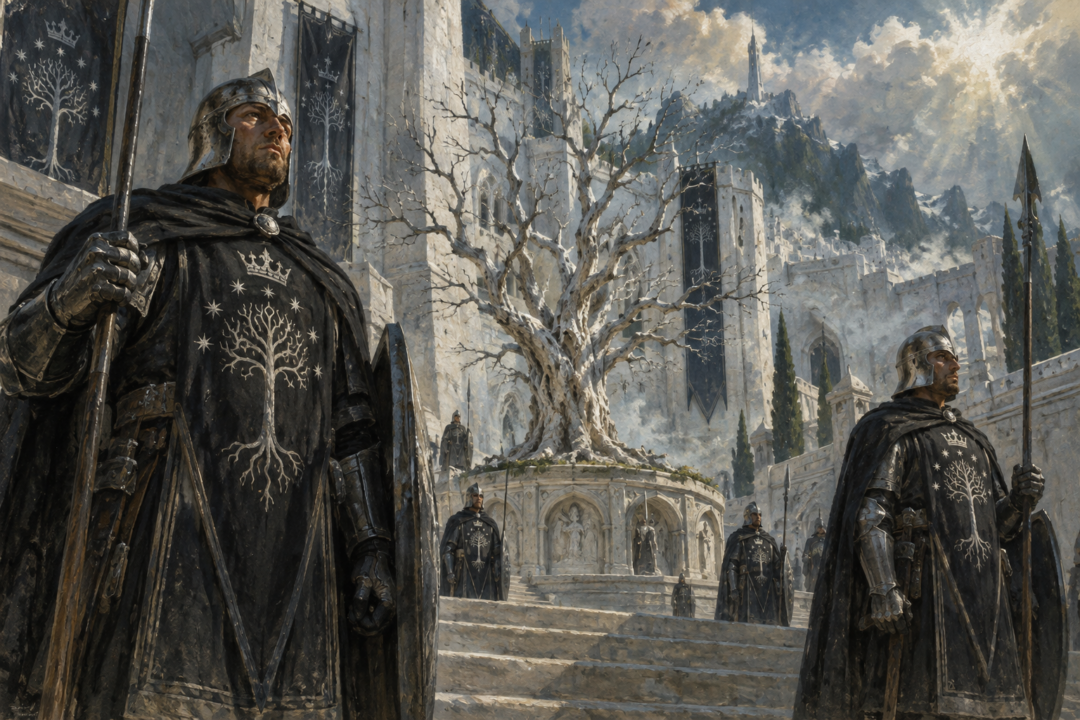
When Pippin first reaches Minas Tirith, he encounters one of the most recognizable sights in Gondor: black-clad Guards of the Citadel wearing the White Tree upon their breasts. To a casual observer, the device can look like the national badge of Gondor—the natural emblem for the soldiers defending its capital.
But the symbolism is more precise than that.
The White Tree, especially when joined by the stars and crown, belongs to a much older story: the royal house descended from Elendil. By the War of the Ring, that distinction has become almost painfully significant. Gondor still preserves the signs of kingship while living under Stewards who refuse to claim kingship for themselves.
That is why Aragorn's standard at the Pelennor Fields matters so much. The Tree is not merely telling Gondor's soldiers that reinforcements have arrived.
The complete device announces that something absent for generations has returned.
The Guards Wear the Memory of the Kings
In “Minas Tirith,” Pippin notices that the Guards of the Citadel are dressed in black, with the White Tree flowering upon their surcoats. Above it is a silver crown, while stars are worked around it.
The narrative immediately explains the exceptional nature of this clothing. These are the liveries of the heirs of Elendil, and at that time no others in Gondor wear them except the Guards of the Citadel.
That qualification is crucial.
The device is therefore not presented simply as standard Gondorian military uniform. The Citadel Guard occupies a special position at the heart of Minas Tirith, serving in the highest circle of the city where the throne, the Steward and the dead White Tree all preserve the memory of the kingdom's royal past.
When Pippin enters Denethor's service, he too receives this black-and-silver livery. His clothing places him symbolically inside that ancient tradition even though Gondor currently has no king.
The result is a remarkable contradiction. The royal house is absent, yet its signs remain on duty.
Gondor's Armies Had Other Identities
The forces gathered to defend Minas Tirith demonstrate that Gondor did not erase local and princely identities beneath a single universal military emblem.
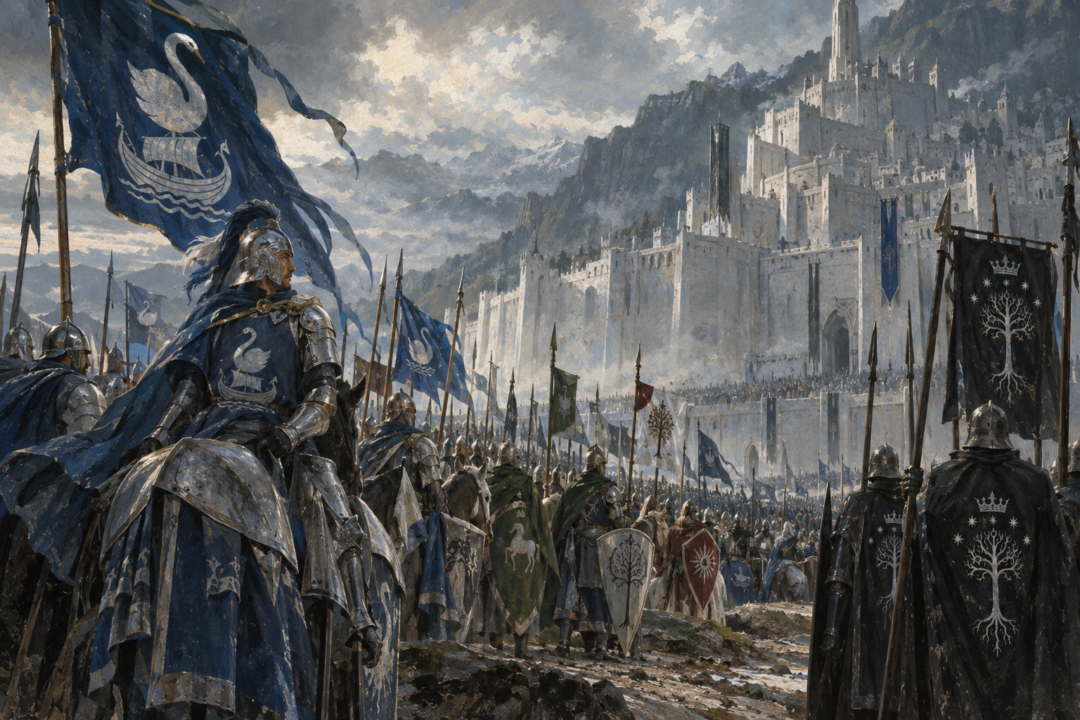
When reinforcements arrive from the southern fiefs, they come as distinct companies under their own lords. Most conspicuous is Prince Imrahil of Dol Amroth. His men are associated with the Silver Swan and the Ship, and his banner is blue.
That makes it dangerous to imagine every Gondorian captain marching beneath an identical Tree-and-Stars device.
Middle-earth's heraldic language is more varied. Rohan has the white horse on green. Dol Amroth has its own princely emblems. Individual houses and regions can possess recognizable signs. Mordor's armies likewise carry the signs of their own allegiance.
Against that background, the complete royal imagery of Gondor becomes more meaningful, not less.
The White Tree certainly represents Gondor in Aragorn's standard, because the text explicitly says so. But the combination of Tree, Seven Stars and crown carries dynastic significance beyond a generic battlefield identification.
These are the signs of Elendil.
The White Tree Reaches Back Beyond Gondor
The Tree itself possesses a lineage almost as important as the human line of kings.
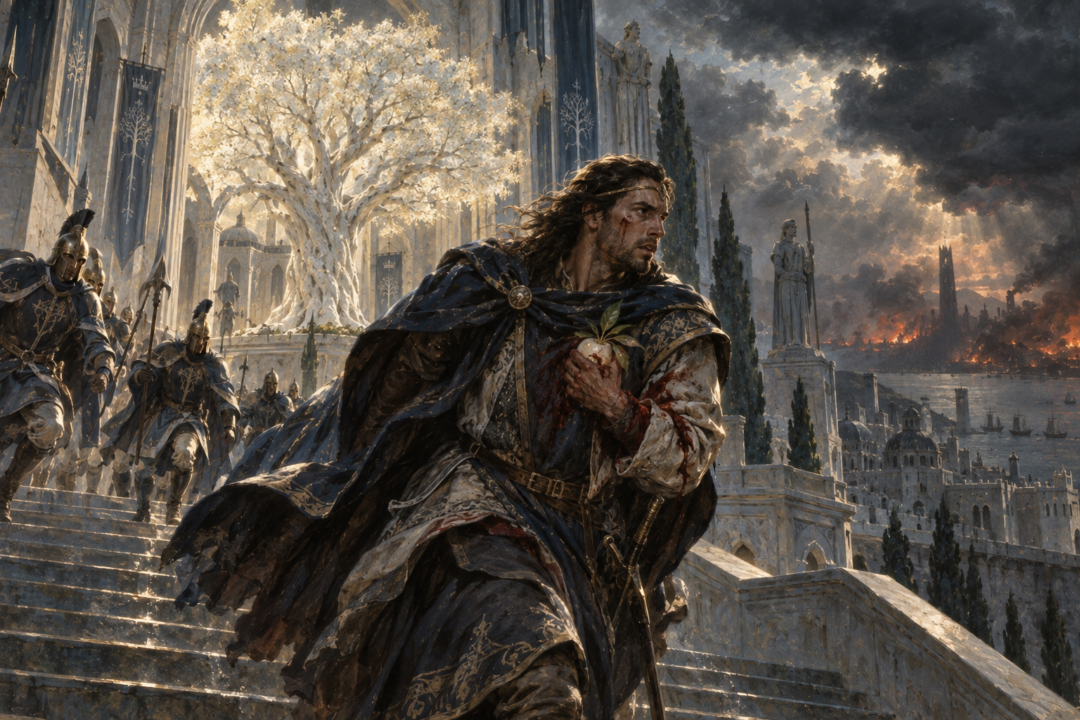
The White Tree of Minas Tirith descends through a succession of trees reaching back to Númenor and ultimately, through Nimloth and its ancestry, toward the Two Trees of Valinor. In Númenor, Nimloth the Fair stood in the King's court at Armenelos.
When Sauron's influence over Ar-Pharazôn placed the Tree in danger, Isildur secretly entered the guarded court and stole a fruit from it, suffering terrible wounds during his escape. From that fruit a new tree was eventually grown.
After the Downfall of Númenor, the Faithful carried this inheritance into Middle-earth. The White Tree therefore became more than decoration. Its survival paralleled the survival of Elendil's people and their memory of what had been lost.
Later descendants of that tree stood in Gondor.
By the end of the Third Age, however, the White Tree in the Court of the Fountain is dead.
It remains standing.
That detail captures Gondor's political condition with extraordinary economy: continuity without renewal, inheritance without a living king.
Why Seven Stars Appear Beside the Tree
The stars belong to the Númenórean inheritance as well.
A traditional verse remembered in Gondor speaks of “seven stars and seven stones and one white tree,” connecting the treasures brought from the drowned realm with the founding history of the Dúnedain kingdoms.
The seven stones are the palantíri brought by Elendil and his sons from Númenor. Appendix material also associates seven stars with Elendil's ships that carried the Stones.
The important point is that the stars are not simply decorative celestial ornaments.
They look backward across the Sea.
Combined with the White Tree, they create a compressed statement of legitimacy and memory: the surviving heritage of Númenor, the house of Elendil, and the kingdoms established by the Faithful in Middle-earth.
This is why the symbols gain such force when they reappear openly with Aragorn.
The Stewards Deliberately Did Not Become Kings
Gondor's constitutional restraint makes the heraldry even more significant.
After King Eärnur disappeared in Minas Morgul, the Stewards governed Gondor. Yet the Ruling Stewards did not simply convert royal authority into a new hereditary kingship.
Appendix A makes the distinction explicit. Each Steward ruled in the king's name until his return, even after the formula had become largely ceremonial through the passing centuries.
The Stewards did not sit upon the king's throne. They did not wear the crown or carry a sceptre. Their token of office was a white rod.
Their banner was equally restrained: white, without any device.
By contrast, the old royal banner was black and displayed the White Tree in blossom beneath seven stars.
The difference could hardly be clearer.
Gondor's Stewards possessed enormous practical authority, but their symbols acknowledged a boundary they would not formally cross. Their plain banner did not manufacture a new royal legitimacy.
Thus heraldry expresses one of Gondor's central political tensions: the kingdom continues, but the kingship remains vacant.
Aragorn Does Not Arrive Under an Ordinary Gondorian Banner
This context transforms one of the great reversals of the Battle of the Pelennor Fields.
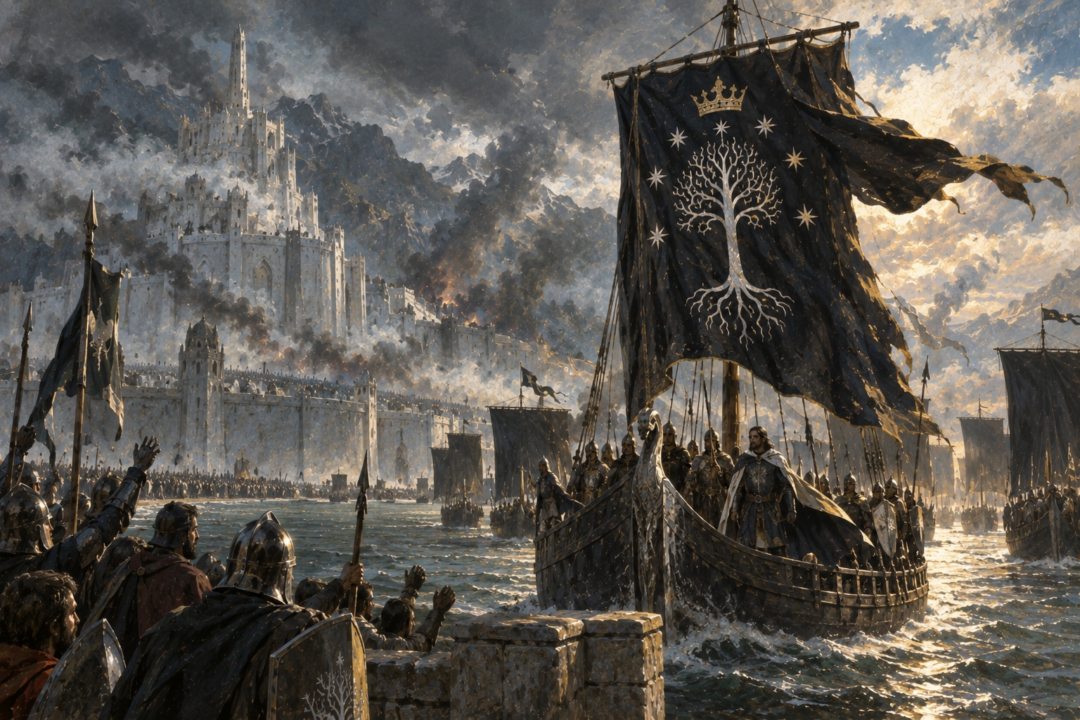
Ships are seen coming up the Anduin. At first their arrival appears disastrous because they are expected to belong to the Corsairs of Umbar.
Then the foremost ship turns, a great standard breaks open in the wind, and the truth becomes visible.
Upon the black field appears a flowering White Tree. Seven Stars surround it, and above them is a high crown.
The text identifies these specifically as the signs of Elendil, signs that no lord has borne for countless years.
Arwen had made the standard for Aragorn. Its stars are fashioned from gems, while the crown shines with mithril and gold.
The symbolism is therefore doing something far more precise than saying “Gondor has arrived.”
Gondor is already on the battlefield.
Its Steward's son has died defending it. Its soldiers are fighting around Minas Tirith. Prince Imrahil and the forces of the southern fiefs are already committed to the battle.
What appears on the river is the heraldry of restored royal claim.
Aragorn is publicly displaying the signs of his ancestry at the moment he comes openly into Gondor's war.
The Crown Completes the Message
It is worth distinguishing the different elements rather than treating them as one interchangeable symbol.
The White Tree can signify Gondor. The seven stars belong to the inherited symbolism of Elendil. The crown makes the royal meaning unmistakable.
Together they turn Aragorn's banner into a declaration of identity.
This does not mean that seeing a White Tree anywhere automatically proves that its bearer is a king. The Guards of the Citadel themselves show why such a simplistic rule would fail: they wear the ancient livery while serving the Steward.
Context matters.
But the complete royal standard—black field, flowering Tree, Seven Stars and high crown—is deliberately presented at the Pelennor as the return of signs that had vanished from the hands of living lords.
The distinction is between preserving royal memory and personally bearing the royal claim.

A Dead Tree, a Living Banner, and a New Tree
The imagery reaches its resolution only after the war.
The dead White Tree has remained in Minas Tirith throughout the long absence of the kings. When Aragorn is crowned, that dead tree cannot simply become alive again.
Instead, Aragorn later finds a young sapling on Mindolluin. Gandalf identifies it as a descendant of the older line, preserved long after hope of renewal seemed lost.
The dead tree is respectfully removed and laid to rest, while the new tree is planted in the Court of the Fountain.
This sequence mirrors the deeper pattern behind Gondor's heraldry.
The past is not discarded. Neither is it enough merely to preserve dead forms forever.
The old lineage must become living again.
That is what makes the White Tree and stars so different from ordinary military markings. They do identify allegiance, but they also carry history. They reach backward to Númenor, Elendil, Isildur and the lost kings; through centuries when Gondor was ruled by Stewards; and finally to the moment when an heir of Elendil once again openly bears their signs.
At the Pelennor, soldiers do not need a heraldic lecture to understand that something extraordinary has appeared on the river.
The Tree has been seen before.
The royal signs have not.
And in that difference lies the entire story of a kingdom that never completely forgot what it was waiting for.
Sources & Notes
This article is based on close reading and interpretation of Tolkien's published works and related source material where relevant.