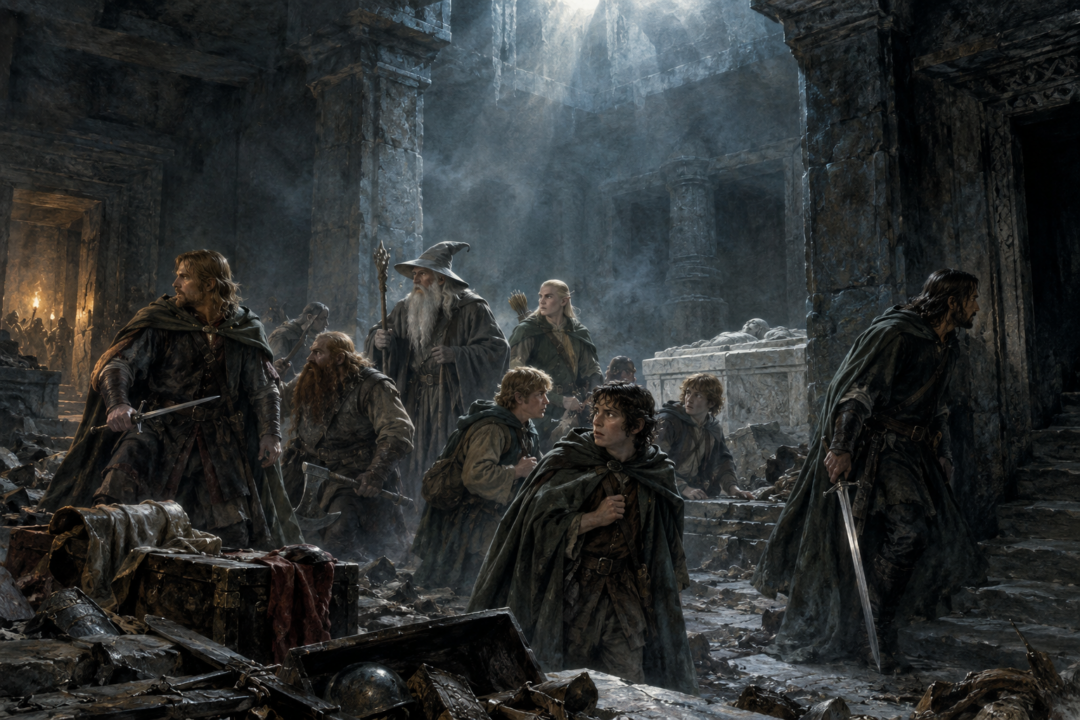
The Chamber of Mazarbul contains one of the most easily misunderstood tactical decisions in The Fellowship of the Ring.
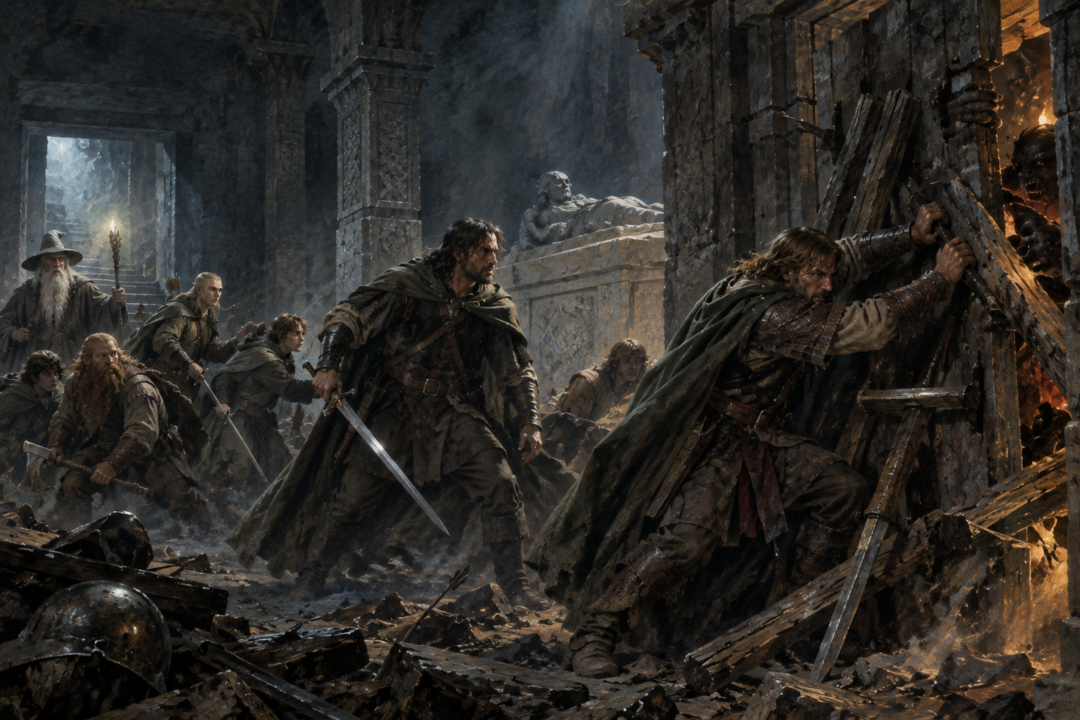
The drums begin. Orcs are approaching. The Fellowship has another door behind them. Yet instead of simply running through it, Aragorn orders the western door shut, and Boromir wedges it with broken blades and splintered wood.
At first glance, that seems backwards. If an escape route exists, why waste precious seconds barricading a door that cannot possibly hold forever?
The answer is hidden in the geography of Moria and in one crucial sentence from Aragorn. The Fellowship is not trying to turn the Chamber of Mazarbul into a fortress. They already know that it cannot be held.
They are trying to buy enough separation from their pursuers to survive what comes next.
They Are Already Trapped Before the Barricade Goes Up
The danger begins almost immediately after Gandalf finishes examining the Book of Mazarbul.
Until that moment, his intention is to return from the chamber to the Twenty-first Hall and continue toward Moria's eastern side. Then the drums begin beneath them, horns answer in the hall, and approaching feet reveal that the route they intended to take is being cut off.
Gandalf recognizes the terrible parallel immediately: the Fellowship has been caught in essentially the same place where the remnants of Balin's colony made their last stand. The Chamber of Mazarbul had been associated with Balin's seat and later became the place where his doomed people were overwhelmed.
But the Fellowship's situation is not completely hopeless.
The chamber has two doors.
One leads westward toward the Twenty-first Hall, where the enemy is gathering. The eastern door leads into another passage and down a stair. Aragorn listens there and hears no enemy approaching from that direction.
So why not immediately take it?
Because the eastern passage is not yet an escape route in any meaningful tactical sense.
It is an unknown tunnel descending into Moria.
The Western Route Is Already Lost
Before deciding what to do, Gandalf checks the western passage.
His light briefly reveals what is outside: many Orcs, including large Uruks, while something still more dangerous is with them. Gandalf believes at least one cave-troll is present. The western passage is therefore not a route through which nine travellers can simply charge and escape.
This matters because the Fellowship is not choosing between two equally usable exits.
One route is already occupied by a superior force.
The other is apparently clear but unknown.
That turns the chamber into a temporary defensive position whether they want it to be one or not.
Their problem is no longer simply, "Which way should we go?"
It is: how can they enter an unfamiliar descending passage without allowing the enemy to follow immediately at their backs?
That is the reason for the barricade.
Aragorn Explains the Real Problem
Aragorn examines the eastern side and identifies exactly why immediate flight is dangerous.
The passage plunges down a stair, and they do not know precisely where it leads. More importantly, fleeing blindly while the Orcs are directly behind them would surrender almost every advantage the Fellowship still possesses.
The eastern door itself cannot solve the problem. Its lock is broken, its key is gone, and it opens inward. Once the Fellowship passes through it, they cannot simply secure it behind themselves.
So Aragorn proposes delaying the enemy first.
This is the key to the entire encounter.
The fight in the Chamber of Mazarbul is not meant to defeat the Orc-host. Nor is Aragorn planning a heroic last stand.
It is a delaying action.
The Fellowship needs to hurt and disrupt the first attackers badly enough that pursuit becomes less immediate. Only then can they break away down the eastern passage with some breathing room.
That is why Boromir wedges the western door.
The Barricade Is Designed to Fail
Boromir does not possess proper materials for fortifying the chamber. He uses what is available: fragments of broken weapons and wood.
The western door itself is badly suited to defense. It opens inward, meaning pressure from outside can force it into the room. The wedges therefore do not transform it into an impregnable barrier.
They merely make the enemy work for the opening.
That distinction is important.
A barricade does not have to hold indefinitely to be useful. In a retreat, seconds matter. Anything that slows the front rank prevents the entire pursuing force from entering at once.
And that is almost exactly what happens.
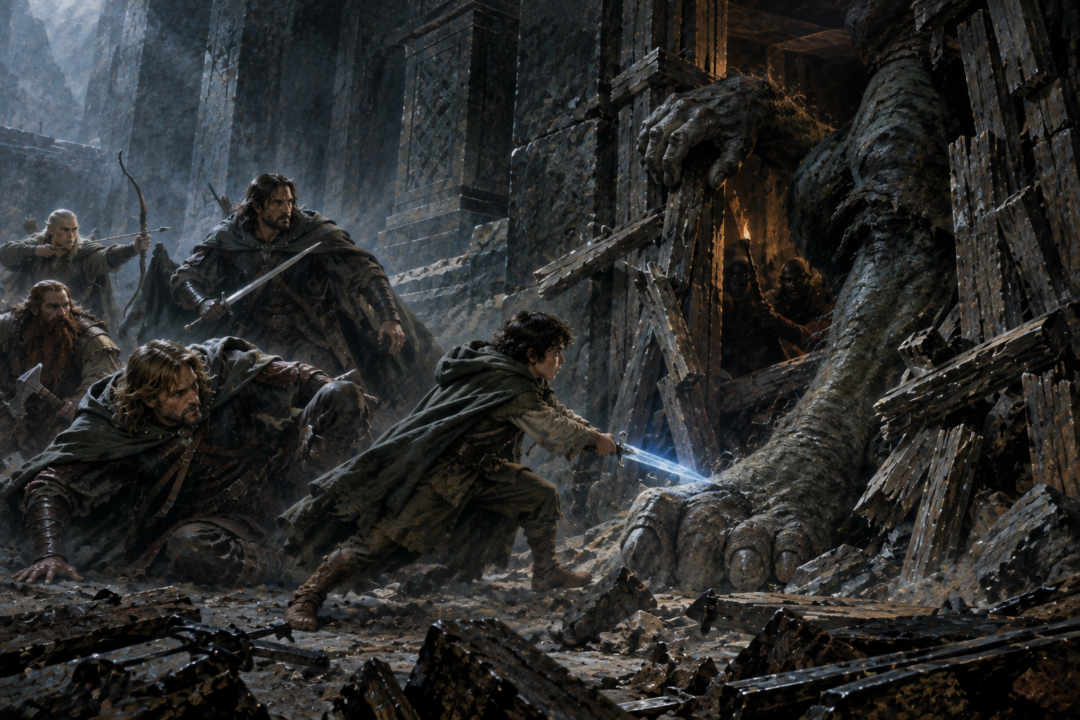
The enemy presses against the door. A huge arm and then a broad, toeless foot force through the widening gap. Frodo strikes the foot with Sting, causing the creature to withdraw. The barricade eventually gives way under repeated blows, and Orcs enter the chamber.
The defense has failed as a fortification.
As a delaying action, however, it creates something the Fellowship desperately needs: a narrow battlefront.
The Door Turns Numbers Into a Disadvantage
The Fellowship is badly outnumbered, but the Orcs cannot bring all their numbers to bear while squeezing through a doorway.
That changes the nature of the fight.
Instead of being surrounded in an open hall, the Company can face attackers entering through a restricted point. Aragorn and Boromir can meet the first rush directly. Legolas can shoot toward the entrance. Even the hobbits are not immediately swallowed by a mass of enemies.
The textual battle is brief and violent rather than a prolonged siege.
A large Orc-chieftain breaks into the chamber and knocks Boromir down with his shield before attacking Frodo. Frodo is struck by a spear, though his mithril coat prevents the wound from being fatal. Aragorn then kills the attacker.
The Orcs recoil.
That moment is what the Fellowship has been trying to create.
Not victory.
Hesitation.
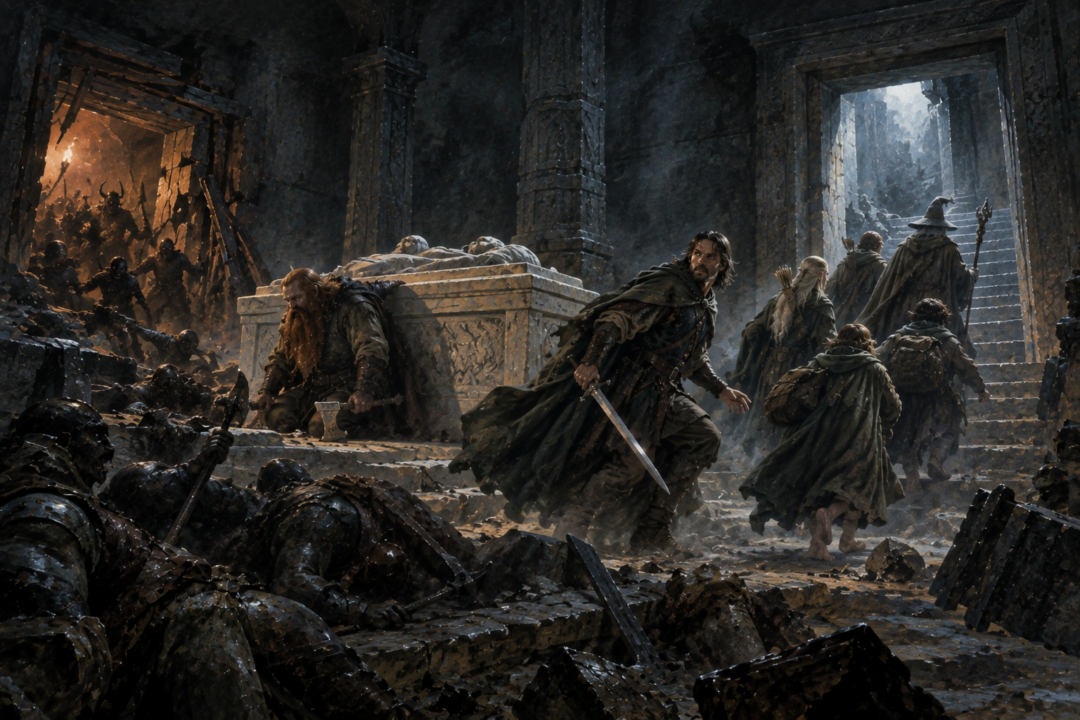
Once the first assault has been bloodily repulsed, Aragorn orders the Company to flee through the eastern door.
The timing is deliberate: they retreat when the enemy has temporarily drawn back rather than while Orcs are pouring unchecked into the room.
They Cannot Afford Pursuit at Arm's Length
Moria is perhaps the worst possible environment for a disorderly retreat.
The Fellowship does not possess a map detailed enough to guide every turn. Gandalf is navigating partly from memory and deduction. The eastern passage descends rapidly, and the Company soon encounters stairs, branching ways, darkness, and enormous subterranean spaces.
Running through such terrain with enemies immediately behind them would be disastrous.
The slower members of the Company could be overtaken. A wrong turn could trap everyone. A fall on a stair could halt the entire group.
The Fellowship therefore needs distance.
The battle in the chamber purchases that distance at considerable risk.
This is also why Aragorn had told the Company to keep their packs on while they could: they were preparing not to remain but to seize an opportunity to break away. The defensive preparations and the intention to escape are not contradictory. They are parts of the same plan.
They fight because they intend to flee.
The Chamber's History Makes the Moment Darker
There is also a grim irony surrounding the decision.
The Fellowship has just read the final record of Balin's people.
Those Dwarves had also been trapped by enemies in Moria. The West-gate had become unusable after the Watcher took Óin, while the Orcs captured the Bridge and halls within Khazad-dûm. Their surviving record ends as their position collapses.
Now Gimli stands in the same chamber beside Balin's tomb while another enemy closes in.
The resemblance is frightening enough that Gandalf recognizes it.
But there is a decisive difference.
The Fellowship still has an open road east.
Balin's surviving people were making a final defense because their avenues of escape had failed. Aragorn's Company defends the same chamber precisely because it still has somewhere to go.
That distinction separates a last stand from a rear-guard action.
The Fellowship cannot remain.
But neither can it safely run yet.
Gandalf Creates a Second Delay
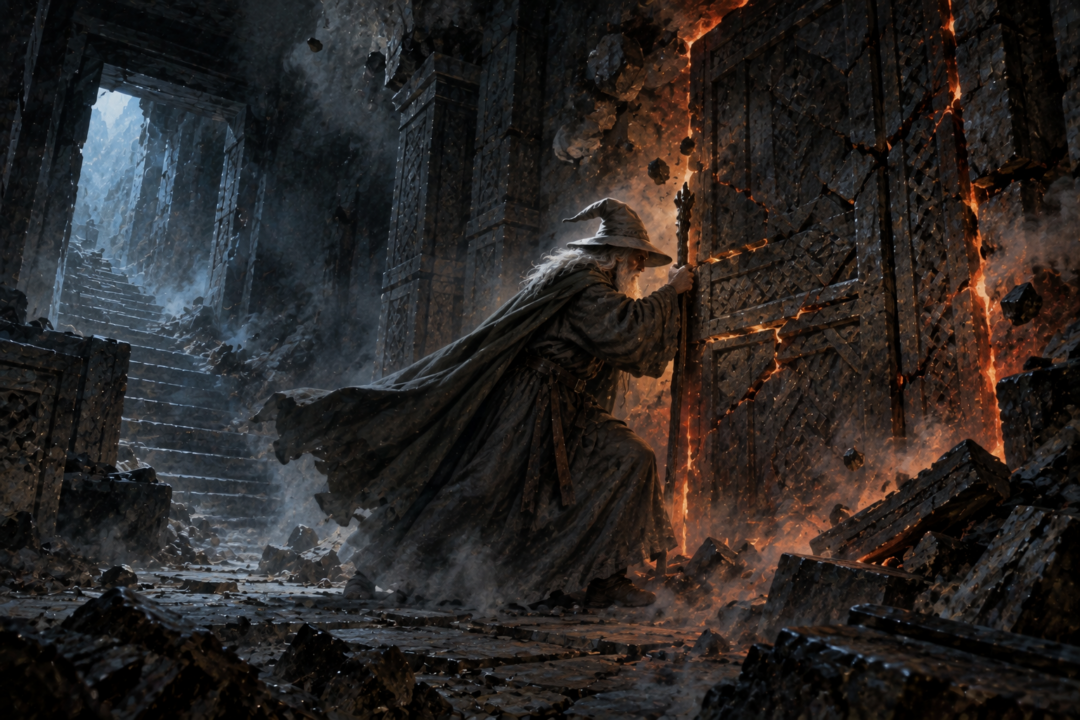
After the Company escapes the chamber, Gandalf remains behind briefly and attempts something more powerful than Boromir's improvised wedges.
He shuts the door and places a shutting-spell upon it.
Then something on the other side opposes him.
At this point Gandalf does not yet identify the being, but the confrontation is far beyond an ordinary struggle with Orcs. The opposing power nearly breaks him, and Gandalf responds with a Word of Command. The resulting contest causes the door and surrounding structure to collapse, leaving the chamber buried behind rubble. The adversary is later revealed as the Balrog of Moria.
Again, the purpose is delay.
First broken swords and timber.
Then steel and courage.
Then Gandalf's power.
Every stage of the retreat attempts to place another obstacle between the Fellowship and whatever is following.
But each obstacle lasts for less time than they need.
The Barricade Reveals How the Fellowship Survives Moria
The Chamber of Mazarbul is sometimes remembered as though the Company simply becomes trapped and fights its way free.
The actual sequence is more calculated.
They discover the western route is blocked. Aragorn confirms that the eastern route is temporarily clear. They cannot secure the eastern door behind them, so immediate flight would leave the enemy almost literally on their heels. They therefore obstruct the western entrance, force the attackers through a narrow approach, repel the first assault, and withdraw during the resulting pause.
It is dangerous because every available choice is dangerous.
And that is the deeper logic of the scene.
The Fellowship does not survive Moria by finding a safe road. By this point, there is no safe road.
They survive by repeatedly turning a few seconds into a few more yards: a wedged door, a defended threshold, an enemy's moment of hesitation, a wizard standing behind while everyone else runs.
The barricade was never supposed to save them.
It only had to make the enemy stop.
For a moment, it did.
Sources & Notes
- Tolkien Gateway — Chamber of Mazarbul https://tolkiengateway.net/wiki/Chamber_of_Mazarbul
- Tolkien Gateway — Battle of the Chamber of Mazarbul https://tolkiengateway.net/wiki/Battle_of_the_Chamber_of_Mazarbul
- Tolkien Gateway — Moria https://tolkiengateway.net/wiki/Moria
These references document the chamber’s layout, the Fellowship’s defensive fight there, and the wider hazards and constrained routes through Moria. The article’s explanation of the barricade as a delay-and-information tactic is interpretive synthesis.