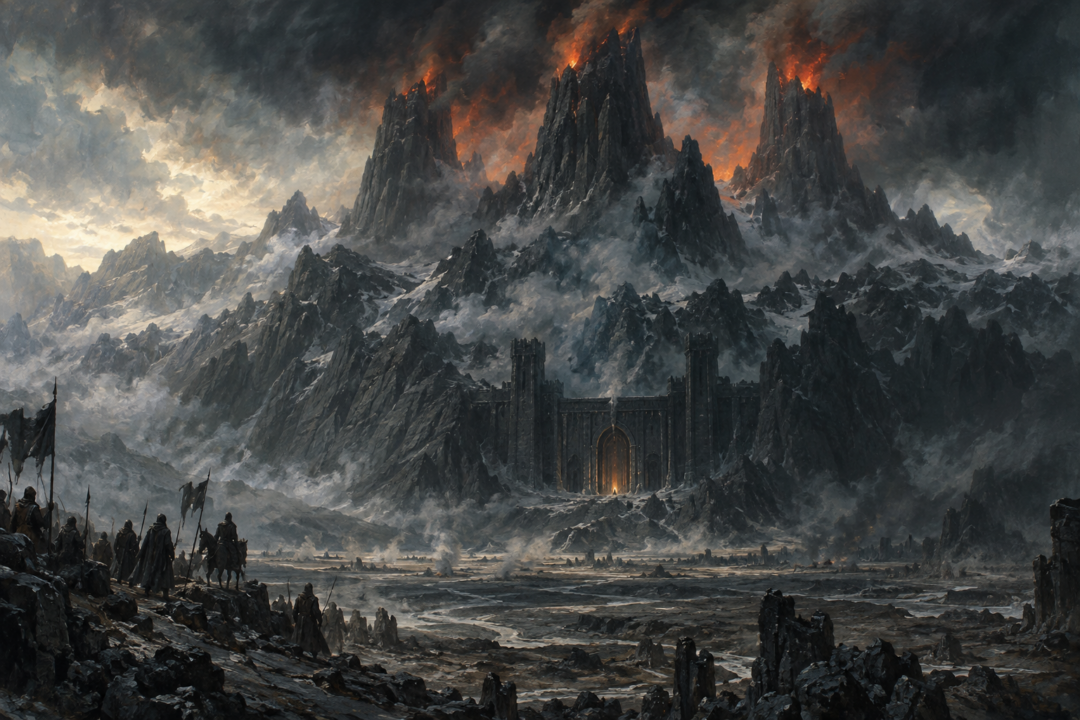
At the end of the First Age, one of the most spectacular structures in Middle-earth came crashing down.
Eärendil fought Ancalagon the Black in the skies above the final war against Morgoth. When the great dragon was slain, he fell upon Thangorodrim, and the towers were broken. Soon afterward Morgoth was captured, Angband was overthrown, and the geography of Beleriand itself was transformed by the catastrophe of the War of Wrath.
It is tempting to turn that destruction into something much more precise than the texts actually give us: if Thangorodrim collapsed, perhaps Angband beneath it was completely exposed, allowing us to reconstruct the fortress from the ruins.
But Angband was not simply a castle sitting directly underneath three mountains.
The descriptions we have point toward something far stranger: a subterranean dominion extending beneath the Iron Mountains, with tunnels, gates, mines, pits, furnaces, prisons, halls, and deep places whose full arrangement is never provided.
The destruction of Thangorodrim tells us something enormous happened above Angband.
It does not give us a blueprint of everything below.
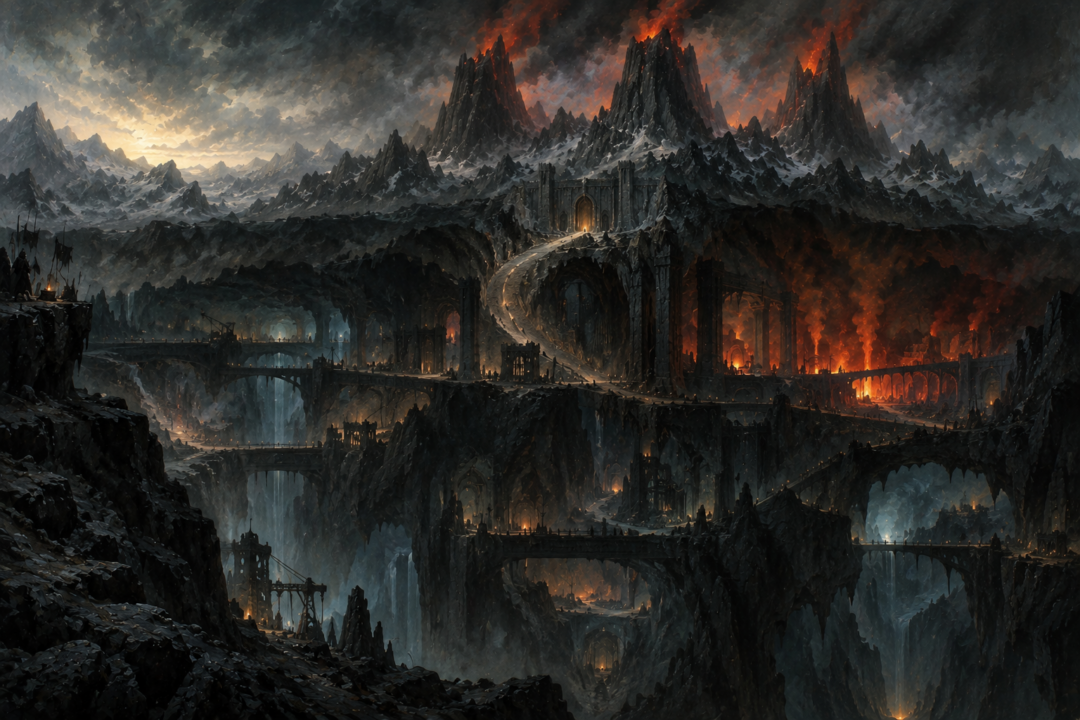
Thangorodrim and Angband Were Not the Same Thing
The first distinction is the most important.
Thangorodrim was associated so closely with Angband that the names can almost blur together in the imagination, but the texts distinguish them.
Angband was Morgoth's fortress beneath the Iron Mountains. Thangorodrim was raised above its great entrance after Morgoth returned to Middle-earth. In The Silmarillion, the peaks are described as being formed from the ash and slag of Morgoth's subterranean furnaces and the enormous waste produced by his tunnelling.
That detail changes how we should visualize the place.
The mountains were not simply natural peaks beneath which somebody happened to construct a dungeon. They were monumental accumulations produced by the industrial excavation of an already immense underground stronghold.
Angband therefore came first in an important sense. It had existed before Morgoth's return from Valinor, and it survived the earlier assault of the Valar imperfectly destroyed and incompletely searched.
Thangorodrim subsequently became the terrifying visible crown of that hidden world.
Destroying the crown is not automatically the same thing as exposing every chamber beneath it.
Angband Extended Into the Iron Mountains
The geography described in The Silmarillion makes the problem even clearer.
Morgoth established himself in the “endless dungeons” of Angband beneath Ered Engrin, the Iron Mountains. A great tunnel passed beneath the mountains and emerged southward through the mighty gate of Angband. Above and behind that gate Morgoth piled Thangorodrim.
This gives us a broad spatial relationship, but not a detailed plan.
There is an entrance complex. There are the towering mountains above and behind it. There are subterranean works beneath the Iron Mountains. And the very material used to create Thangorodrim came partly from extensive tunnelling underground.
Nothing in that description requires every important part of Angband to fit neatly beneath the footprint of the three peaks.
Indeed, the scale implied by the tunnelling points in the opposite direction. Angband belongs to a mountain system. Its underground geography extends into a region whose internal dimensions Tolkien never maps for us.
A modern cross-section showing three cones with a compact fortress immediately underneath may be visually convenient, but it goes beyond what the narrative establishes.
The Deep Places Are the Crucial Detail
There is another warning hidden in Angband's history.
When the Valar originally attacked Morgoth in the ancient Battle of the Powers, they destroyed his greater northern fortress, Utumno. Angband, however, was not completely destroyed, and its deepest places were not all searched.
That matters enormously.
Angband was already the sort of fortress in which surviving underground spaces could escape even a devastating assault by the Powers.
Later descriptions repeatedly reinforce the vertical depth of Morgoth's realm. Characters are taken down into Angband. Morgoth possesses subterranean halls, prisons, mines, smithies, and pits. His power is presented not merely through walls and towers but through descent.
The language is intentionally more evocative than architectural.
We know enough to understand the character of the place.
We do not know enough to draw every corridor.
That distinction becomes particularly important whenever maps of Angband appear online. Some may be thoughtful attempts to reconcile scattered descriptions, but any highly detailed floor plan inevitably contains reconstruction. Tolkien never supplies a canonical architectural survey showing every level and connection.
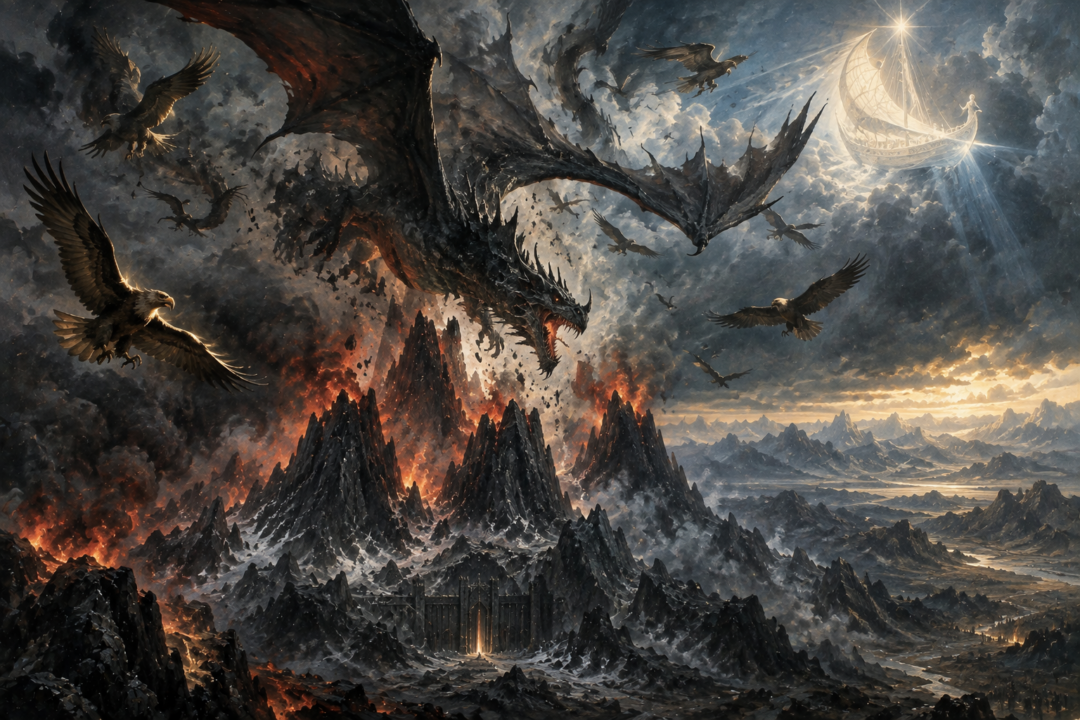
What Ancalagon Actually Destroyed
The account of Ancalagon's death is dramatic but remarkably concise.
During the last stage of the War of Wrath, Morgoth released his winged dragons. Eärendil came against them in Vingilot with the great Eagles. After the long aerial struggle, Ancalagon was cast down, and his fall broke the towers of Thangorodrim.
That is the firm textual event.
It does not say that Ancalagon's body punched through every level of Angband.
It does not describe successive floors collapsing beneath him.
It does not identify which tunnels were crushed, which chambers remained intact, or how far underground the physical destruction caused specifically by his impact reached.
The larger war certainly brought ruin to Morgoth's realm. Angband was defeated and its pits were destroyed. But that broader devastation should not be collapsed into the single event of Ancalagon striking Thangorodrim.
These are connected events within the same catastrophe, not a detailed engineering report.
The safest conclusion is therefore the simplest one: Ancalagon's fall broke Thangorodrim. The War of Wrath overthrew Angband. The texts do not provide enough structural information to calculate exactly how the first event propagated through every subterranean work of the second.
Morgoth Was Still Below
What happens to Morgoth himself makes the distinction particularly striking.
After his armies were defeated, he did not stand among the ruins of Thangorodrim waiting to be seized. The narrative says that he fled into the deepest parts of his mines.
There the victorious host eventually found him.
This is significant because it preserves the idea of depth even at the moment of Angband's final defeat.
The visible mountains have been broken. Morgoth's military power has collapsed. His last monstrous weapon has fallen from the sky.
Yet there are still depths into which he can retreat.
That does not prove those regions were structurally untouched. The War of Wrath was catastrophic on a scale that permanently altered northwestern Middle-earth, and the text does not give us the condition of individual tunnels.
But it does show why imagining Thangorodrim's destruction as instantly peeling open the entire underground fortress is too simple.
Angband still possesses an interior.
Morgoth still goes down into it.
His enemies still have to reach him there.
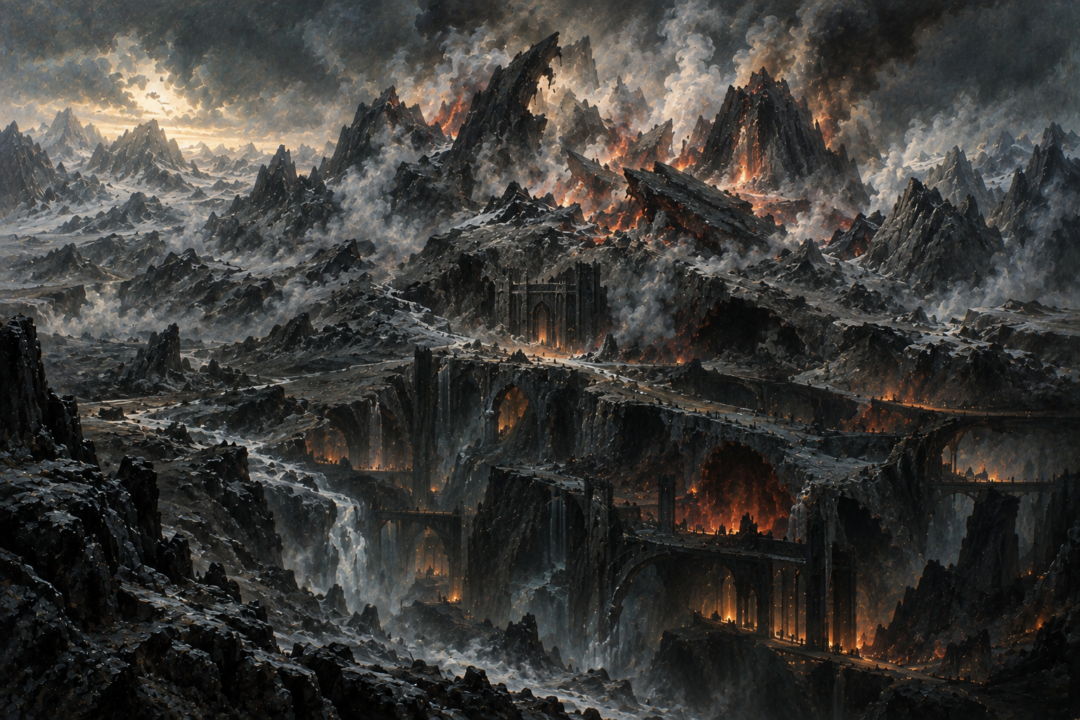
Angband Was Designed Around Concealment
There is a deeper thematic reason the uncertainty fits the fortress.
Angband is repeatedly characterized through hiddenness.
Its strength does not depend merely upon an impregnable front gate. Morgoth commands underground spaces that his enemies cannot easily observe or reach. His forces can remain concealed behind the Iron Mountains, while the great southern entrance presents only one face of a much larger system.
This helps explain why the long Siege of Angband was never equivalent to occupying the fortress.
The Noldor could watch its approaches and contain Morgoth for centuries, but they did not possess his subterranean realm. Their knowledge of what occurred inside remained limited.
That difference between visible containment and hidden power is fundamental to Angband.
Thangorodrim was the visible symbol of Morgoth's dominion: smoke, slag, height, fire and menace towering over the northern horizon.
Angband was the concealed machinery underneath.
Destroying one does not retroactively reveal the complete design of the other.
The War of Wrath Makes Reconstruction Harder, Not Easier
There is also a larger geological problem.
The end of the First Age was not a tidy siege followed by archaeologists examining an intact ruin.
The War of Wrath devastated Beleriand. Much of the region was eventually overwhelmed by the sea. Mountains, plains, rivers, coastlines and territories familiar from the earlier tales disappeared or were radically altered.
Angband's fall belongs inside that enormous upheaval.
Even if parts of its underground network were temporarily exposed during the fighting, the surviving narratives do not record a systematic exploration from which later peoples could construct an authoritative plan.
The reader receives the event as history and legend: Morgoth's armies are annihilated, the dragons are defeated, Thangorodrim is broken, Angband is ruined, and Morgoth is captured.
The story is concerned with the ending of his dominion, not preserving the measurements of his corridors.
A detailed map made from those events therefore cannot be treated as recovered canonical geography.
It is necessarily an interpretation.
What Can Actually Be Mapped
That does not mean Angband is completely unmappable.
Several broad relationships are reasonably secure.
Angband lay beneath the Iron Mountains in the north. Its principal gate opened southward. Thangorodrim rose above and behind the gate. The fortress contained extensive subterranean works associated with furnaces, mines, prisons and Morgoth's own halls. Its excavations were enormous enough that their refuse helped form the colossal towers above.
Those elements can anchor an illustration or speculative diagram.
The uncertainty begins when we attempt to connect them with precise corridors, distances and levels.
How far laterally did the mines extend?
How many major entrances existed?
Exactly where was Morgoth's throne relative to the gate?
Which passages connected particular prisons, furnaces or barracks?
How much of Angband lay immediately beneath Thangorodrim rather than deeper beneath Ered Engrin?
The surviving canonical narratives do not provide a complete answer.
A responsible map therefore needs to distinguish between textual geography and artistic reconstruction.
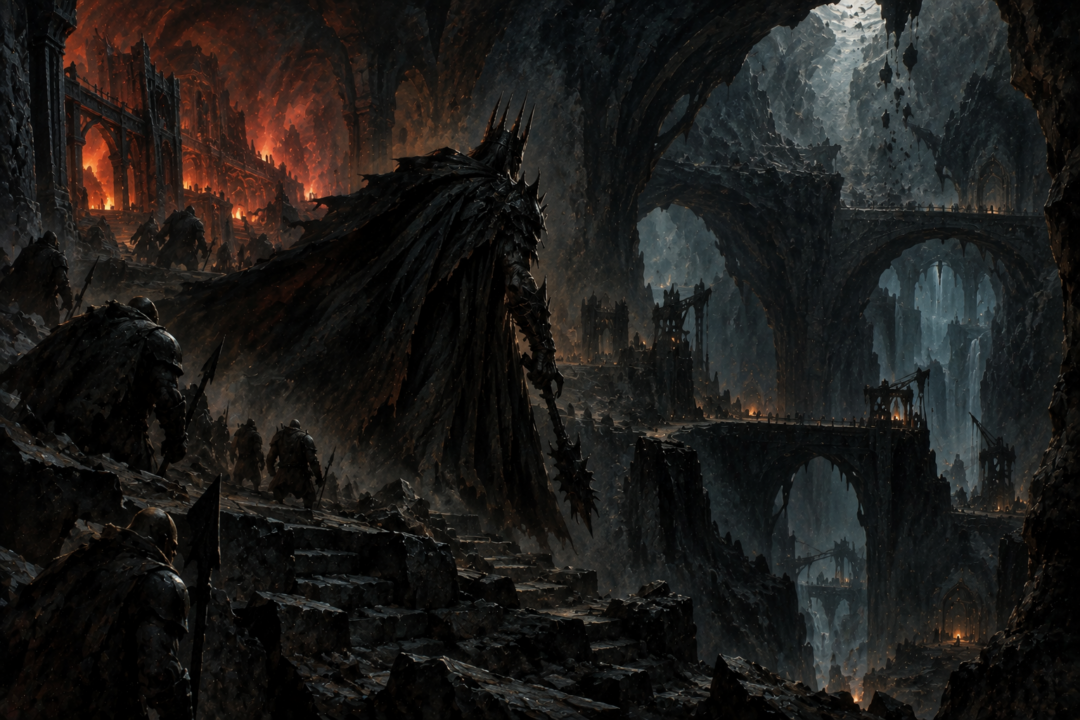
The Mystery Is Part of Angband's Scale
Perhaps the most powerful image of Angband is not a perfectly labelled floor plan.
It is the opposite.
Imagine standing on Anfauglith and looking north. Ahead rises the terrible entrance to Morgoth's realm. Above it loom the smoking towers of Thangorodrim. Behind them stretches the barrier of the Iron Mountains.
What you can see is already overwhelming.
But it is only the surface.
Somewhere beyond the gate are furnaces feeding smoke upward, passages driven through the mountains, mines descending into darkness, prisoners held far from daylight, and halls from which Morgoth directs his wars.
No narrator ever turns on all the lights.
Even when Thangorodrim finally falls, the mystery does not suddenly become architectural certainty.
The towers can be broken.
The fortress can be conquered.
Morgoth himself can be dragged from his final hiding place and cast out of the world.
But none of that leaves us with a canonical map of every road beneath Angband.
In a strange way, that absence preserves something essential about the place.
Angband was never merely three mountains with rooms underneath.
It was a hidden kingdom beneath the earth—and the texts deliberately allow much of that darkness to remain dark.
Sources & Notes
- Tolkien Gateway — Thangorodrim https://tolkiengateway.net/wiki/Thangorodrim
- Tolkien Gateway — Angband https://tolkiengateway.net/wiki/Angband
- Tolkien Gateway — War of Wrath https://tolkiengateway.net/wiki/War_of_Wrath
These references distinguish the volcanic towers of Thangorodrim from the larger subterranean fortress of Angband and document their destruction in the War of Wrath. The article’s warning that the event does not supply a complete plan of every deep work is interpretive caution.