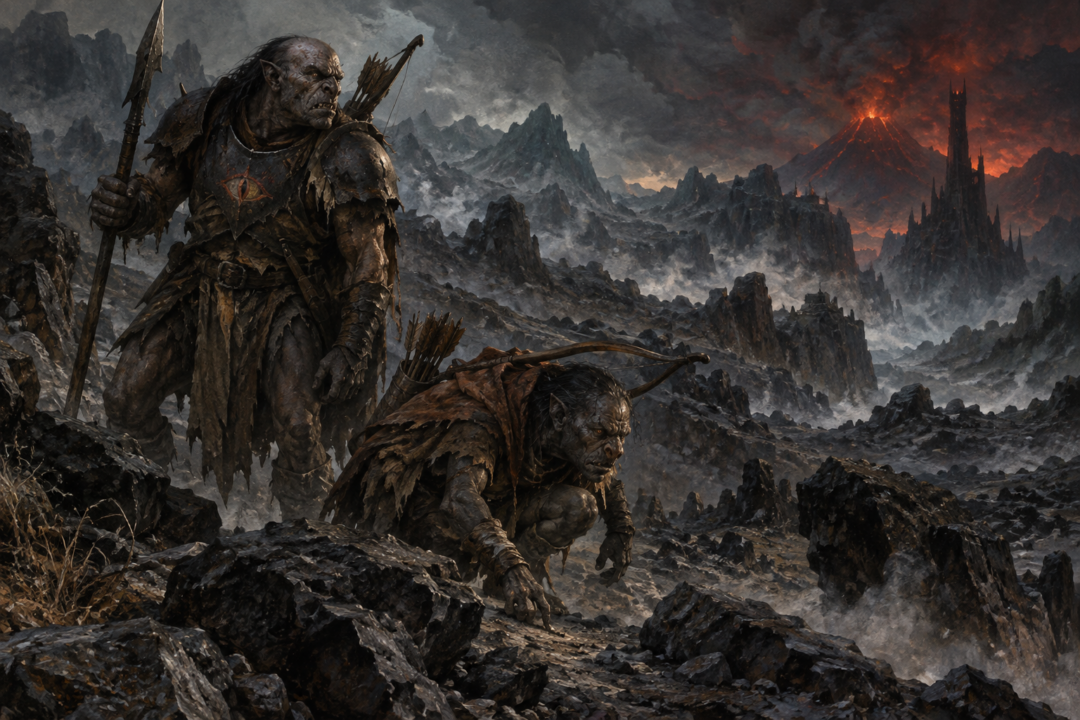
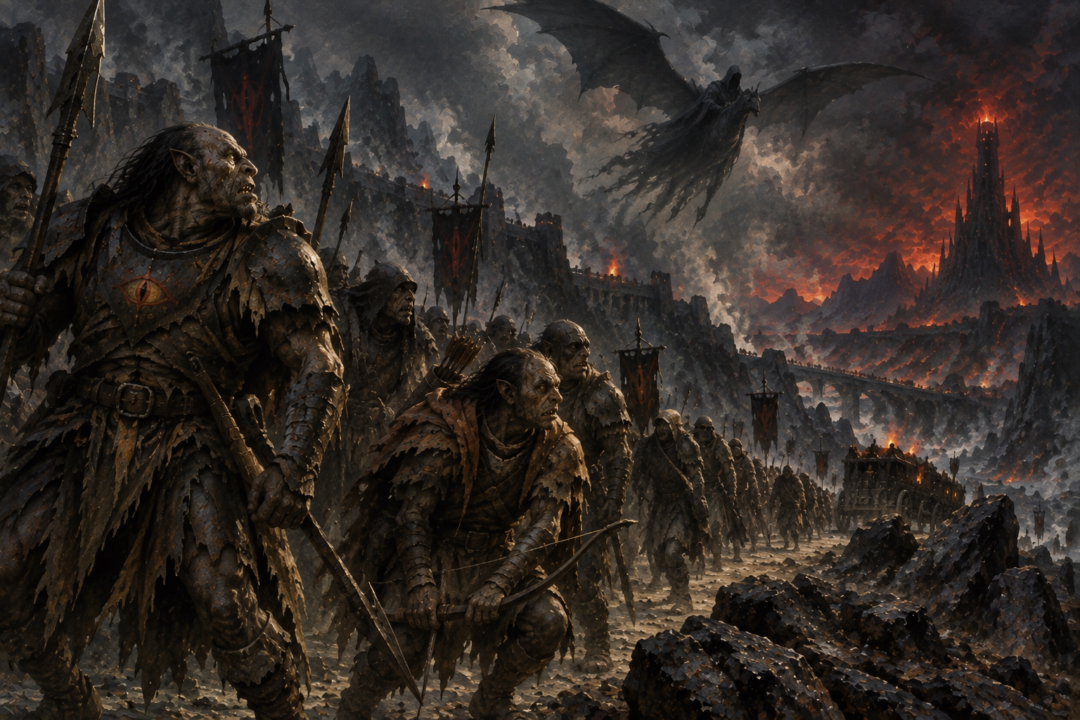
Near the end of The Lord of the Rings, Frodo and Sam are hiding in Mordor when two Orcs pass close enough for them to overhear. The encounter is brief. One Orc is a large fighting soldier. The other is smaller, dressed in ragged brown, armed with a horn bow, and equipped with unusually wide, snuffling nostrils. The narrator immediately identifies what those physical traits suggest: he is “evidently a tracker of some kind.” Heyzine
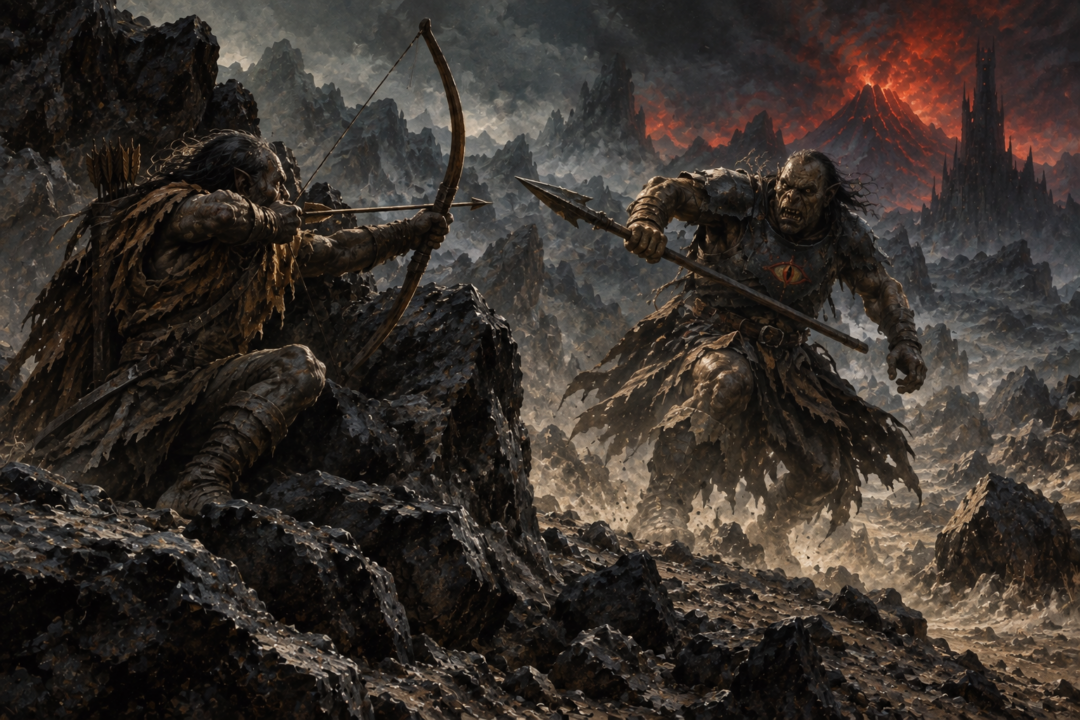
The scene ends violently. The two Orcs quarrel, the soldier threatens to report the tracker, and the tracker kills him with an arrow before disappearing into Mordor.
It is easy to read the episode simply as another example of the hatred and disorder inside Sauron’s realm. Frodo himself draws attention to exactly that aspect. But there is another revealing detail hidden inside the argument.
These two Orcs are not doing the same job.
One has apparently been selected or employed for tracking. The other is explicitly presented as a fighting Orc. Their equipment, physiques, responsibilities, and even their grievances differ.
In only a few paragraphs, Mordor stops looking like an undifferentiated mass of Orc warriors. It begins to look like a system in which different kinds of servants perform different kinds of work.
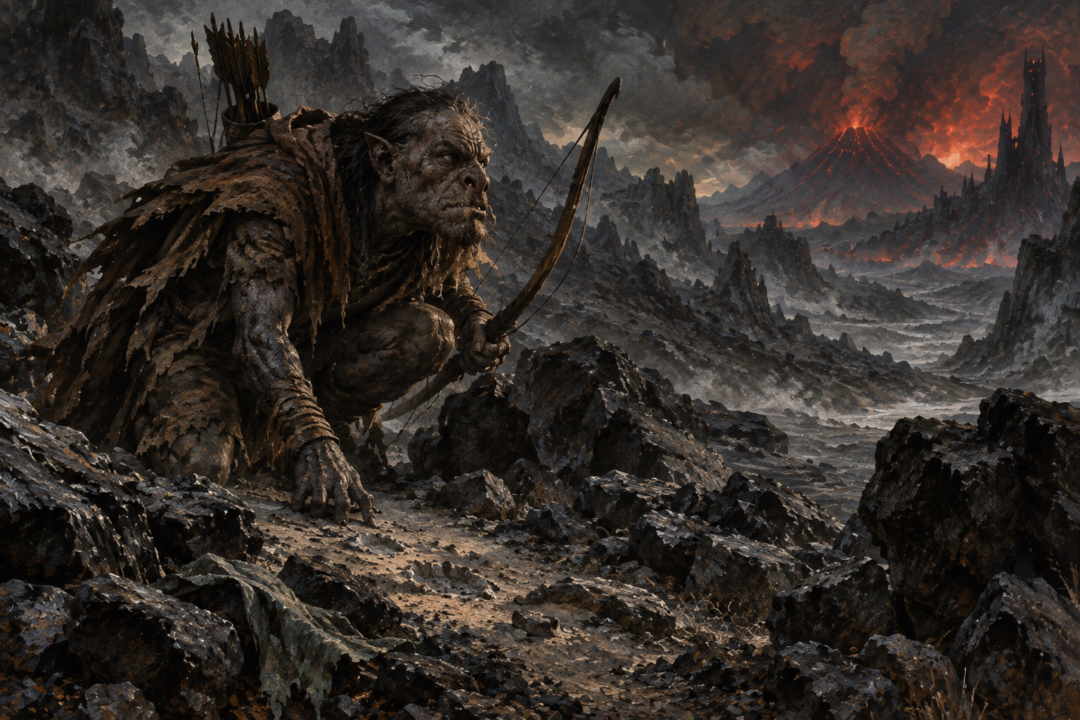
The Tracker Is Physically Different
The distinction begins before either Orc speaks.
The tracker belongs to a “small breed.” He is black-skinned, has unusually broad nostrils, wears ragged brown clothing, and carries a horn bow. His companion is a large fighting Orc resembling the Orcs of Shagrat’s company. He bears the Eye and carries a short, broad-headed spear, with a bow as additional equipment. Heyzine
That contrast matters.
The text does not provide a taxonomy of specialized Orc breeds, and it would go too far to claim that Mordor deliberately bred a distinct biological caste for every occupation. Tolkien never gives us such a system.
But the passage does establish something narrower and more defensible: the Orc identified as a tracker differs noticeably from the large fighting Orc beside him, and his physical characteristics are directly connected by the narration with his apparent function.
His most important ability is scent.
During their conversation, the tracker complains that there is no point continuing to wear out his nose on the stones because the trail has disappeared. The search has become confused partly because Gollum has interfered with evidence left by the hobbits. tolkiengeek.blogspot.com
This is not ordinary infantry work.
The tracker is performing a specialist search function.
Mordor Needs More Than Soldiers
That specialization makes sense once we consider Mordor itself.
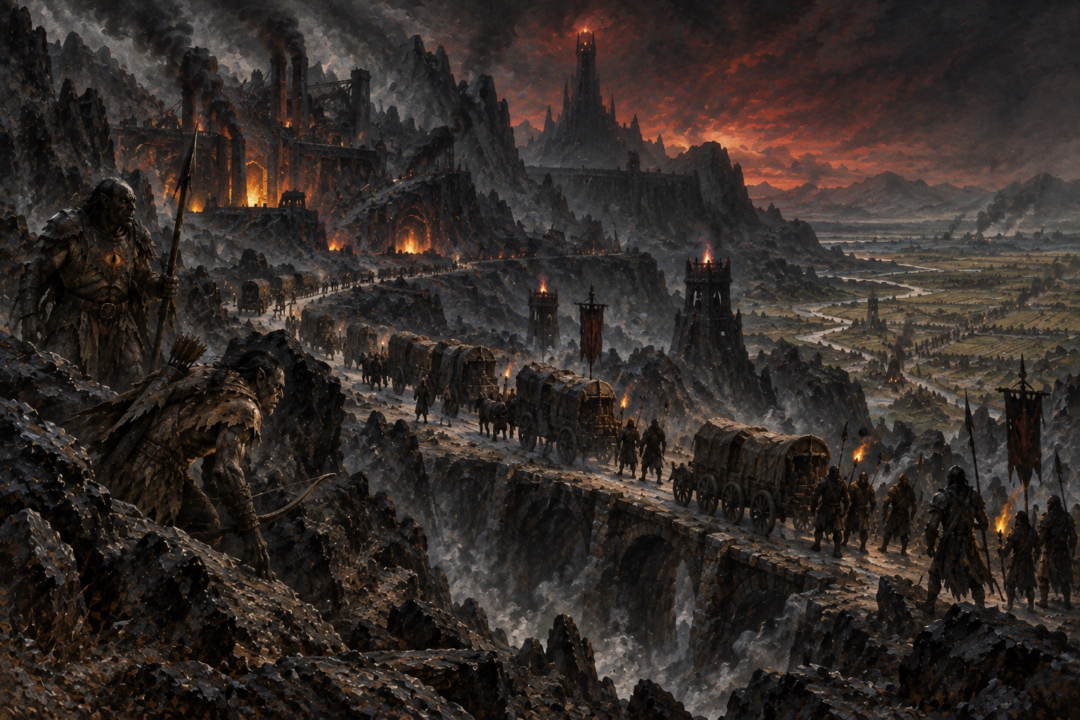
Sauron possesses enormous military forces, but armies cannot function through fighting alone. Mordor contains fortresses, roads, mines, forges, supply routes, agricultural regions, slaves, garrisons, patrols, messengers, commanders, and administrative mechanisms.
The text makes this especially clear while Frodo and Sam cross the Black Land. They do not know about the slave-worked fields around Lake Núrnen farther south, nor the roads running toward tributary territories from which long wagon trains bring goods, booty, and new slaves. In northern Mordor are mines and forges.
Gwydion Madawc Williams
Sauron’s war machine therefore depends upon labor far beyond the battlefield.
Somebody has to guard roads.
Somebody has to carry messages.
Somebody has to transport supplies.
Somebody has to operate fortresses.
And when intruders disappear into the broken landscape of the Morgai, somebody has to find their trail.
The tracker encountered by Frodo and Sam is a tiny glimpse of that larger machinery.
Orcs Already Show Other Functional Roles
The tracker is not the only evidence that Orcs perform differentiated duties.
Earlier in the story, Orc companies employ scouts. Among the Isengarders carrying Merry and Pippin, an Orc called Snaga is associated with scouting duties, and Uglúk angrily blames scouts when the Rohirrim discover the company.
At Cirith Ungol, the Orcs operate within a recognizable command structure. Shagrat commands the Tower’s garrison, while Gorbag leads a company from Minas Morgul. Their conversation shows patrol activity, reporting responsibilities, competing chains of command, and concern over intelligence reaching higher authorities.
None of this proves a neat bureaucratic table of Orc occupations. The evidence is fragmentary.
But it does show that “Orc” is not itself a job description.
Orcs scout, track, guard, patrol, fight, carry messages, command other Orcs, and perform tasks within larger military systems.
Sauron’s forces contain functional distinctions because his realm requires them.
The Tracker and Soldier Do Not Respect Each Other
The most interesting part of the scene is that specialization does not create solidarity.
It creates resentment.
The tracker complains bitterly about the soldiers involved in the hunt. In effect, his complaint is that they have failed at their part of the operation and then called specialists to repair the damage. The soldier responds with threats rather than cooperation.
Their argument therefore reveals a recognizable institutional problem: different parts of the same system blame one another when the system fails.
The soldier possesses physical strength and the authority implied by association with Shagrat’s military company. The tracker possesses a skill the soldier needs but apparently cannot reproduce.
Neither respects the other.
That is important because Mordor’s organization is powerful without being harmonious.
Sauron can force radically hostile individuals and groups into coordinated action, but coercion does not transform them into willing comrades.
“Name and Number”: A Glimpse of Control
Then comes one of the strangest details in the exchange.
The soldier threatens to give the tracker’s “name and number” to the Nazgûl now controlling the Tower. Heyzine
The text never explains what the number means.
We should therefore resist turning the phrase into an elaborate imagined Mordor personnel system. We do not know how numbers were assigned, recorded, or used.
But the threat itself is significant.
The tracker can apparently be identified to higher authority in a way that goes beyond merely describing him. The soldier expects reporting him to a Nazgûl to have consequences.
That suggests some mechanism of identification and accountability among Sauron’s servants, even though its exact workings remain unstated.
And the tracker is frightened enough by the threat that his anger immediately intensifies.
The system works because everyone knows something terrible stands above it.
The Nazgûl Hold the System Together
The tracker calls the Nazgûl “Shriekers” and clearly hates them. Yet hatred does not free him from their authority.
This helps explain how Mordor can function despite constant internal hostility.
Its servants do not need to love one another.
They do not even need to trust one another.
They need to fear what happens if they disobey.
That distinction runs throughout the Orc scenes of The Lord of the Rings. Shagrat and Gorbag can cooperate when duty requires it, yet their rivalry eventually explodes into slaughter inside Cirith Ungol. The surviving Mordor tracker and soldier can participate in the same search, yet their quarrel ends with one killing the other.
The organization is therefore real, but its cohesion is imposed from above.
Once that pressure weakens, personal hatred quickly reappears.
Specialization Makes Mordor More Dangerous
It would be comforting to imagine Mordor as powerful only because Sauron can throw enormous numbers of Orcs into battle.
The tracker suggests something more formidable.
The enemy can adapt personnel to particular problems.
Frodo and Sam are not being hunted merely by soldiers wandering randomly through the mountains. A creature especially capable of following traces has been sent after them.
And he nearly succeeds.
Frodo realizes afterward that the hunt had been much closer than they understood. Their survival depended partly upon confusion among their enemies and partly upon the Orcs’ own internal hostility. Heyzine
That makes the scene more frightening, not less.
Mordor possesses specialized capabilities capable of finding two tiny fugitives in an enormous hostile landscape.
Its weakness is that the creatures operating those capabilities hate the system, hate one another, and sometimes sabotage their common purpose.
The Tracker Wins the Fight
There is also a final irony.
Physically, the soldier appears to be the more dangerous Orc. He is larger, armed with a spear, and explicitly described as a fighting Orc.
Yet when he attacks, the tracker moves behind a stone and shoots him in the eye. Heyzine
The specialist defeats the warrior.
The passage does not present this as a general rule about Orc combat, and we should not make it one. But narratively, the moment reinforces the distinction already established between them.
The tracker is not simply a weaker version of the soldier.
He possesses a different set of useful abilities.
His smaller size does not make him harmless. His bow, awareness, speed, and positioning allow him to kill the larger Orc almost immediately.
Specialization means capability, not merely hierarchy.
Mordor Is Organized — But It Is Not United
Frodo gives Sam the deeper explanation after the killing.
This mutual hatred is the spirit of Mordor. Orcs may turn on one another when left to themselves, but Frodo warns Sam not to draw too much hope from that fact: had the two Orcs discovered the hobbits, they would have abandoned their quarrel long enough to kill their common enemies. Heyzine
That observation captures the contradiction at the center of Sauron’s realm.
Mordor is organized enough to maintain garrisons, supply systems, patrols, command structures, identifiers, specialist trackers, soldiers, mines, forges, roads, and vast armies.
But organization is not fellowship.
The tracker and soldier cooperate because something stronger and more terrifying compels them to. Beneath that pressure remain jealousy, fear, resentment, ambition, and hatred.
That may be what makes the tiny scene in the Morgai so revealing.
The two Orcs show us that Sauron’s power is more sophisticated than a simple horde. Mordor divides tasks because conquest requires specialized labor.
Yet the same encounter exposes the weakness inside that machinery.
The soldier needs the tracker’s skill.
The tracker needs the military system around him.
Both answer ultimately to powers they fear.
And the moment the pressure binding them together becomes uncertain, one servant of Mordor puts an arrow through another servant’s eye.
The Dark Lord can organize labor.
He cannot turn domination into loyalty.
Sources & Notes
- Tolkien Gateway — Orcs of Mordor https://tolkiengateway.net/wiki/Orcs_of_Mordor
- Tolkien Gateway — The Land of Shadow https://tolkiengateway.net/wiki/The_Land_of_Shadow
- Tolkien Gateway — Cirith Ungol https://tolkiengateway.net/wiki/Cirith_Ungol
These references document Mordor’s Orc soldiery, the tracker-and-soldier episode in “The Land of Shadow,” and the military environment around Cirith Ungol. The article’s reading of their argument as evidence of differentiated labor roles is interpretive analysis.