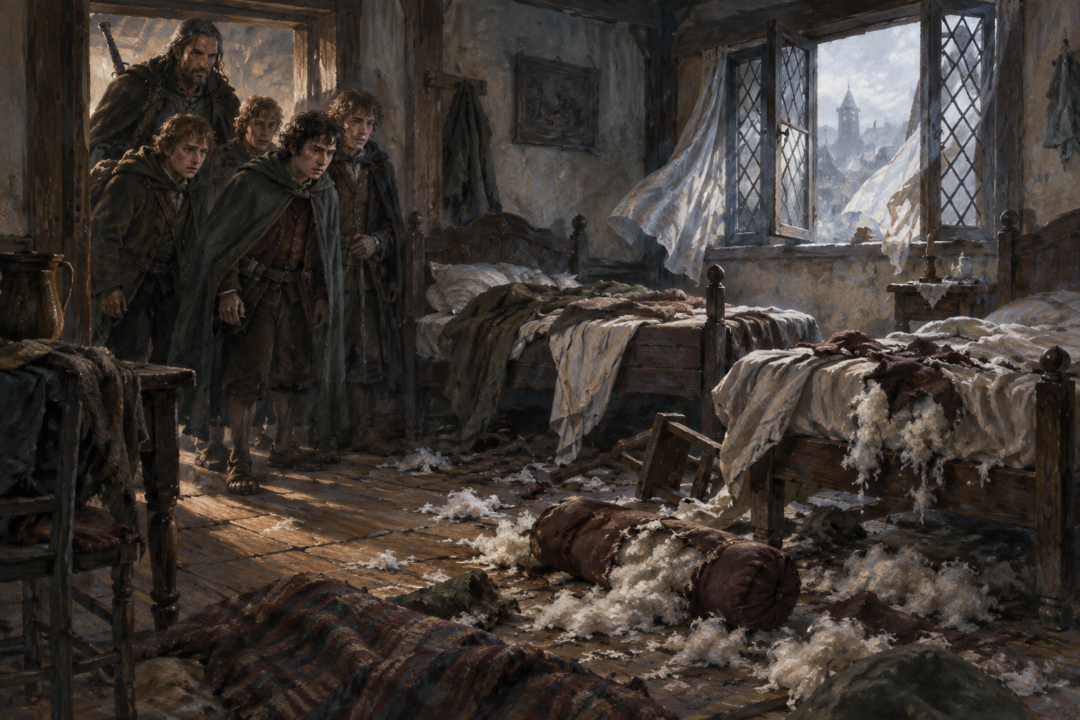
When Frodo and his companions walk into their bedrooms at the Prancing Pony on the morning after meeting Strider, the evidence looks horrifyingly simple. The windows have been forced open. The beds are in disorder. The bolsters that Nob had arranged beneath the blankets to imitate sleeping hobbits have been slashed and thrown onto the floor. Even the mat has been torn apart.
Someone came for them in the night.
That much is certain.
What is much less certain—at least if we restrict ourselves to the narrative of The Fellowship of the Ring—is the familiar mental picture of several Black Riders personally standing over four beds and stabbing them.
The distinction matters because the Bree episode reveals something more interesting than a failed assassination. It shows how the Enemy operates when brute force is unnecessary: through terror, informants, compromised locals, and uncertainty. And the surviving evidence inside the hobbits' room proves less about the identity of the attackers than readers sometimes assume.
Strider Expected Trouble, but Not Quite the Obvious Kind
Before the bedrooms are attacked, Strider has already worked out that the Black Riders are operating inside Bree.
Merry has gone outside and encountered an unseen horror near Bill Ferny's house. Strider identifies what happened to him as the effect of the Black Breath. More importantly, he concludes that the Riders have entered Bree secretly and have been in contact with Ferny. He also suspects the squint-eyed Southerner of being a spy.
Yet when Merry asks whether the Riders will attack the inn, Strider does not expect a direct assault.
His reasoning is revealing. The Riders are strongest in darkness and isolation. He does not think they will openly attack a populated, lighted building while they still have other opportunities to hunt the Ring-bearer across Eriador.
Instead, he fears something subtler. The Riders' weapon is terror, and people in Bree are already within their influence. Strider specifically suggests that Ferny, some of the strangers, and perhaps even the gatekeeper may be driven into doing evil work for them.
That warning should shape how we read what happens next.
Strider does not merely fear nine supernatural hunters. He fears a network forming around them.
The Bolsters Were Deliberate Decoys
The ruined bedding is not an accidental detail.
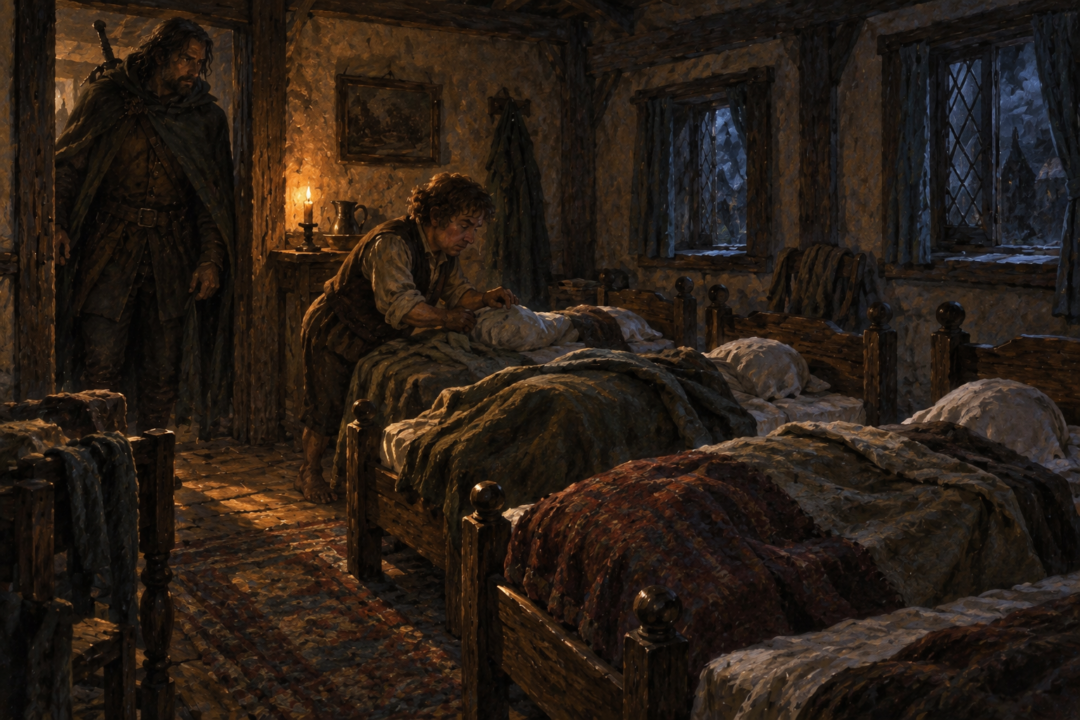
Strider tells the hobbits not to sleep in their assigned bedrooms. Instead they remain in the parlour, where they barricade themselves as well as they can. Nob is sent to make the abandoned beds look occupied.
The deception succeeds at least in one crucial respect.
Whoever enters the rooms during the night attacks the false sleeping shapes rather than the real hobbits.
At dawn, Strider leads the company back to the bedrooms. The windows have been forced. The beds have been disturbed. The bolsters have been cut open and scattered. The room has been violently searched or wrecked.
The immediate conclusion is secure: Strider's precaution saved the hobbits from being present when hostile intruders entered their rooms.
That is what the slashed bolsters prove.
They also show that the attackers were not simply thieves looking for unattended valuables. The arrangement representing sleeping bodies was deliberately attacked. Someone was interested in the occupants of those beds.
But the physical evidence does not, by itself, identify the hands holding the blades.
The Published Scene Never Shows the Attack
This is one of the most important details in the entire question.
In The Fellowship of the Ring, the reader does not witness the assault on the bedrooms.
Frodo sleeps elsewhere. His dreams are disturbed by wind, galloping hoofs, and a distant horn. Morning comes. Only afterward does Strider take everyone to inspect the damage.
We therefore encounter the attack exactly as the characters do: through its aftermath.
There is no narrated scene in which Black Riders enter the Prancing Pony, stand above the decoy beds, draw weapons, and strike. Nor does the morning inspection explicitly identify the attackers.
This leaves a deliberate-looking gap between cause and evidence.
Appendix B later records that on September 30, 3018, both Crickhollow and the Inn at Bree were “raided” in the early hours. But that compact chronology does not narrate the bedroom attack or tell us, in that entry, precisely who wielded the blades at the inn.
The certainty of the event is stronger than the certainty supplied by the main narrative about its immediate perpetrators.
Bill Ferny Is More Important Than the Bedding
If we want to understand the danger in Bree, Bill Ferny's house is arguably more revealing than the ruined beds.
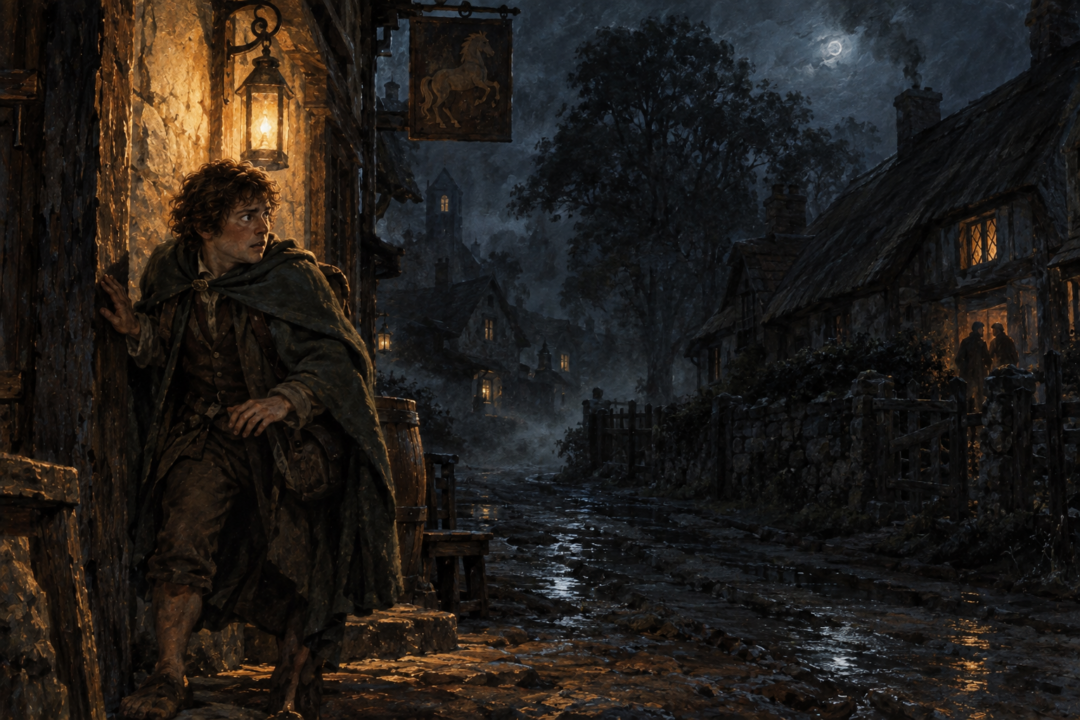
After Frodo accidentally puts on the Ring in the common-room, Ferny and the squint-eyed Southerner leave together. Later, Merry encounters the dreadful presence near Ferny's home. Strider concludes that the Riders have visited Ferny and now possess the news they need.
This fits his larger warning: the Nazgûl do not always need to perform every act themselves.
Their presence can turn ordinary malice, greed, fear, or treachery into instruments of Mordor.
Ferny is already an unpleasant and suspicious figure, and later events confirm that his hostility is not momentary. When the hobbits return after the War of the Ring, they learn that he has sided with the dangerous outsiders who troubled Bree. He eventually appears in the Shire among the Chief's Men.
But even here precision matters. Those later actions confirm Ferny's willingness to collaborate with hostile forces; they do not retroactively prove from The Fellowship of the Ring alone that he personally slashed the bolsters.
Suspicion is not the same thing as textual identification.
Later Material Makes the Nazgûl Case Much Stronger
The wider textual history complicates the mystery.
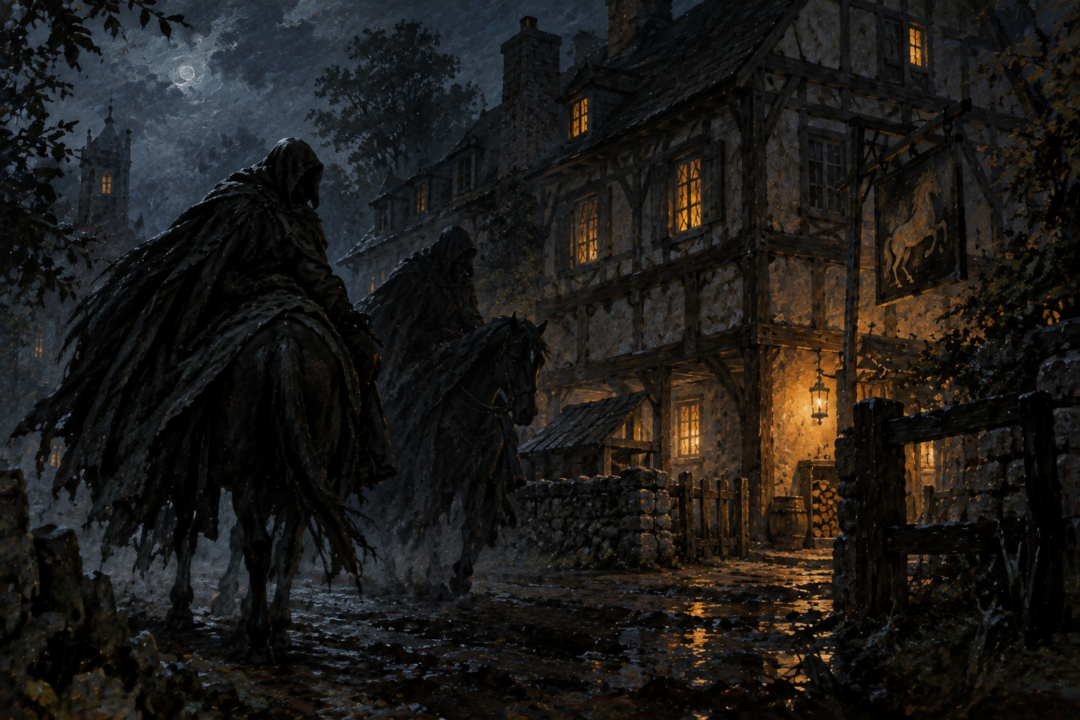
Material associated with “The Hunt for the Ring,” including later notes concerning the movements of the Nazgûl, gives a more specific account than the published Bree chapters. In one late scheme, two Riders at Bree, having learned of the events at the inn, make plans for an attack, and the inn is attacked by those Riders before dawn.
That evidence makes a direct Nazgûl attack much more than a guess. It appears to represent a later conception of what happened behind the scenes.
But the development of the story was not entirely linear. Earlier planning material explored another possibility: Bill Ferny and the Southerner being used to break into the inn.
That history explains why categorical claims can become misleading.
If the question is, “What does the finished narrative of The Fellowship of the Ring explicitly show?” the answer is limited: hostile intruders entered the rooms and attacked the decoys.
If the question is, “What did the broader conception of the hunt eventually indicate?” then later material supports the view that two Nazgûl themselves attacked the inn.
Those are related claims, but they are not identical.
The Lost Ponies Reveal a Second Attack
The bedrooms are only half the disaster.
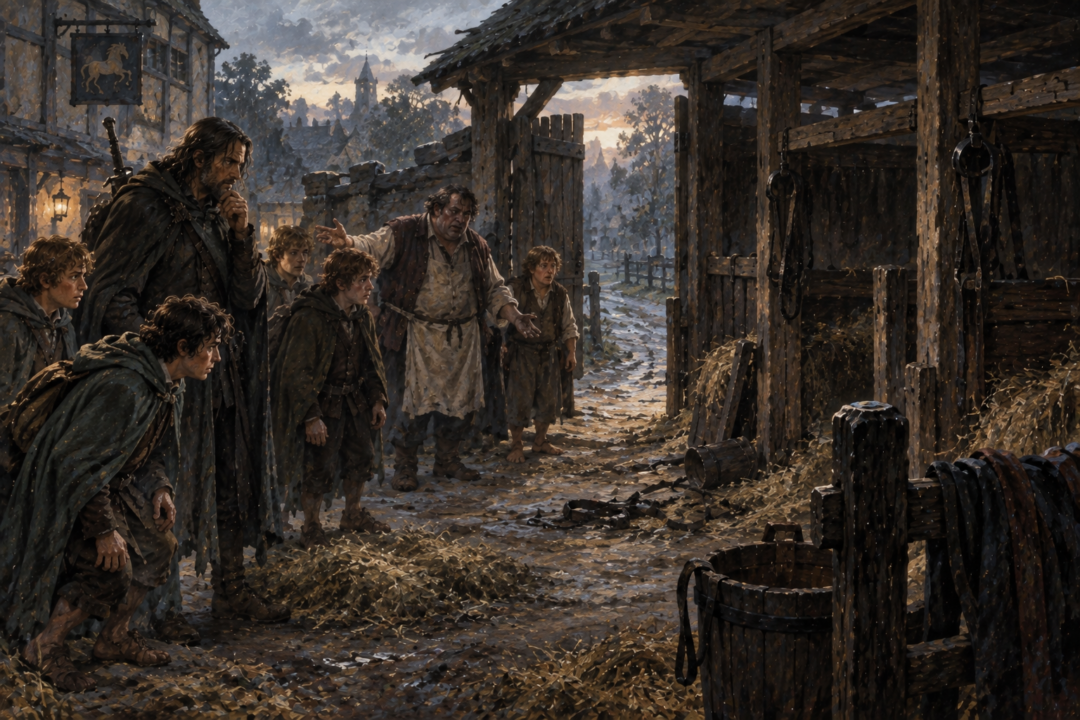
Almost immediately afterward, the travellers discover that their ponies have vanished. The stable doors have been opened during the night, and nearly every usable animal has disappeared.
This is strategically more damaging than shredded bedding.
A failed attack on empty beds leaves the Ring-bearer alive. Removing his transport makes escape harder, delays his departure, and leaves him exposed on the road. Whether every part of the night's sabotage was performed by the same people is not explicitly established in the main narrative.
What is clear is that hostile activity around the inn extends beyond one dramatic bedroom.
The enemy's reach has penetrated Bree.
Strider therefore wants to leave immediately. The company ultimately has to purchase the miserable pony owned by Bill Ferny—the animal Sam later names Bill—and begin the journey toward Rivendell under worse conditions than they had intended.
The attack has failed to capture Frodo, but it has still imposed a cost.
Why Strider's Mistake Matters
There is also an intriguing irony in Strider's prediction.
He correctly understands the Nazgûl's methods. He recognizes their preference for terror and secrecy, identifies their human contacts, and anticipates evil action during the night.
Yet he says he does not think the Riders themselves will openly attack the inn.
If the later account of two Riders attacking the Prancing Pony is taken as the intended behind-the-scenes explanation, then Aragorn's judgment was reasonable but not completely correct.
That is not a failure of characterization. It makes the episode more convincing.
Aragorn possesses far more knowledge than the hobbits, but he is not omniscient. He is interpreting an enemy whose movements are concealed. His wisdom lies partly in acting on uncertainty: he does not need to know exactly who will come through the windows before deciding that the beds are unsafe.
His precaution works because he prepares for the danger he cannot fully predict.
What the Slashed Bolsters Actually Tell Us
The ruined beds at the Prancing Pony are powerful evidence, but only if we resist making them say more than they do.
They prove that the threat surrounding Frodo has become immediate and physical. They prove that someone broke into the hobbits' rooms. They strongly indicate that the apparent sleepers were targets rather than incidental obstacles. And they prove that Strider's decision to hide the hobbits elsewhere was potentially lifesaving.
They do not, from the bedroom scene alone, prove the identity or number of the attackers.
The surrounding chapter deliberately emphasizes something broader: the Black Riders have entered a settled community and begun gathering information through frightened or corruptible people. Ferny, the Southerner, and perhaps others make Bree dangerous even when no Ringwraith is visible.
Later material supplies a stronger answer to the hidden question and points toward two Riders attacking the inn themselves. But the published narrative preserves the experience of Frodo and his companions: they sleep through the crucial moment and wake to evidence.
That uncertainty is part of what makes Bree so effective.
Until the Prancing Pony, the Black Riders have largely been shapes on roads, distant hoofbeats, and dreadful presences in the dark. After that night, the hobbits can look at a ripped-open bolster lying on the floor and see what almost happened to them.
The Shadow no longer needs to be visible.
It has reached through the window.
Sources & Notes
- Tolkien Gateway — Prancing Pony https://tolkiengateway.net/wiki/Prancing_Pony
- Tolkien Gateway — Nazgûl https://tolkiengateway.net/wiki/Nazg%C3%BBl
- Tolkien Gateway — Bill Ferny https://tolkiengateway.net/wiki/Bill_Ferny
These references document the attack at Bree, the Black Riders’ pursuit of Frodo, and Bill Ferny’s role among the hostile people around the inn. The article’s distinction between evidence of intrusion and proof of the attackers’ exact identity is interpretive analysis.