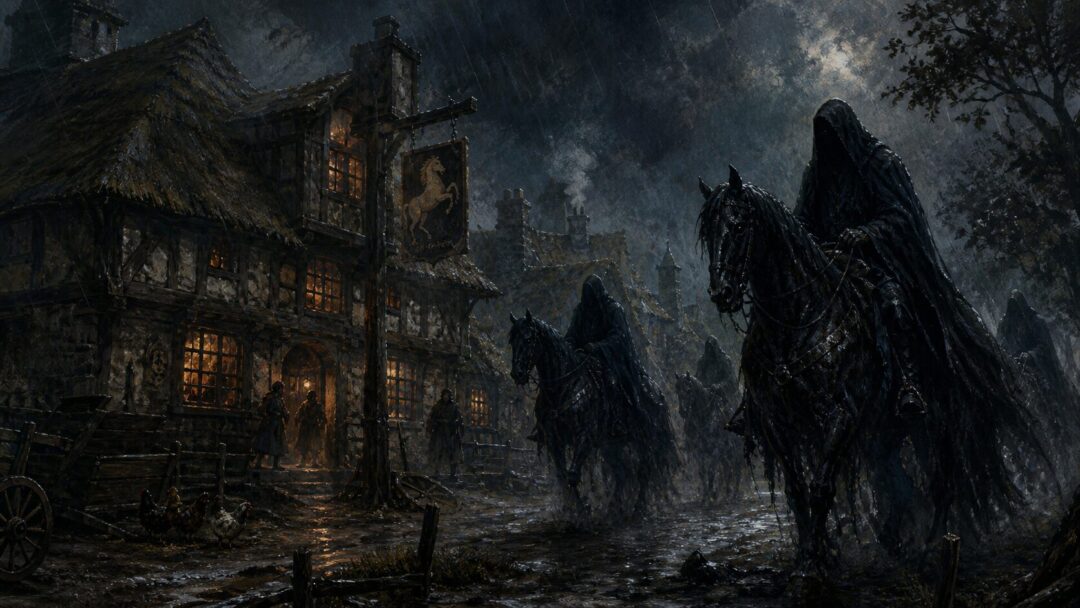
Most people remember the Bree attack as a movie invention.
The four hobbits arrive at the Prancing Pony. They are frightened, uncertain, and far from the safety of the Shire. Strider moves them away from their assigned room. Later that night, the Black Riders enter the inn, raise their blades, and stab down into the beds.
Only then do we discover the truth.
The hobbits are not there.
They are sleeping somewhere else.
It is one of the most memorable early images of danger in the film: black figures in a dark room, striking at what they think are helpless sleeping victims. It tells the audience, instantly and visually, that Frodo has not merely wandered into a dangerous journey. He is being hunted.
But here is the important point.
That exact scene is not shown in the book.
And yet the book does contain the attack.
That difference matters.
The film does not invent the danger from nothing. It takes a terrifying event that the written story leaves mostly unseen and turns it into a direct visual moment. To understand why that choice works, we have to go back to what actually happens in Bree.
The Attack Is There — But Off the Page
In the book, the hobbits do not witness the attack on their room.
After Frodo’s accidental disappearance in the common room, after his talk with Strider, and after Butterbur remembers Gandalf’s letter, the hobbits are warned not to sleep in the rooms originally prepared for them.
Strider does not trust the situation.
He knows the Black Riders are near. He has already seen signs that Bree is no longer safe. Merry has been overcome outside, and Strider believes the Enemy’s servants may use local people or suspicious strangers to help them.
So the hobbits sleep elsewhere.
The next morning, the truth is revealed.
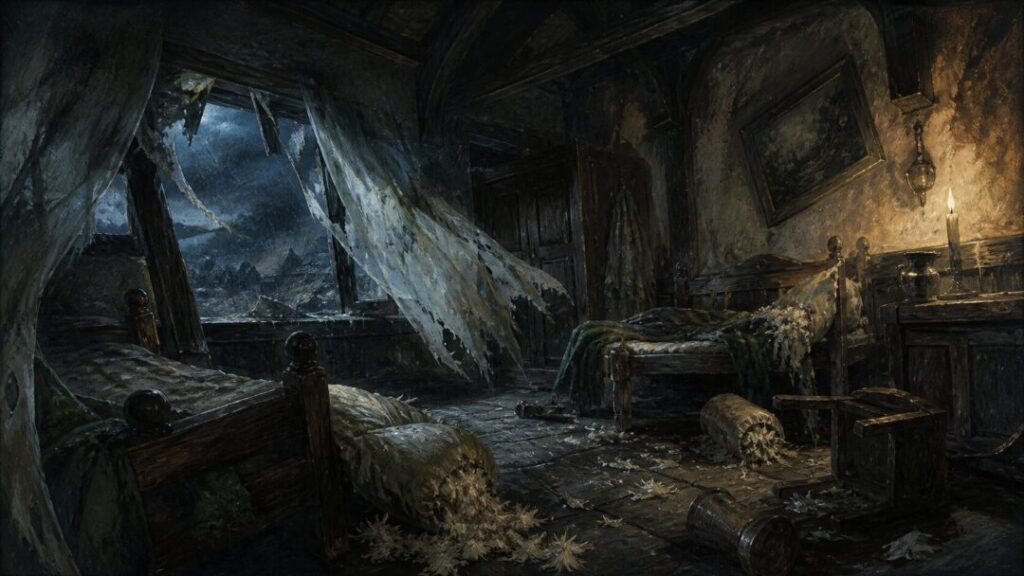
Their original bedrooms have been broken into. The windows have been forced. The beds are overturned. The bolsters are slashed and thrown on the floor. The room looks as if someone—or something—came there expecting to find them.
The book does not pause to show black-cloaked figures entering the inn.
It gives us the aftermath.
That is a very different kind of fear.
The film turns the attack into suspense.
The book turns it into realization.
One makes us watch the danger happen. The other makes us understand how close it came after the fact.
Why the Film Needed to Show It
Film and prose create fear differently.
A book can withhold the event and let the reader imagine it. The silence becomes part of the terror. We see the ruined room only after the hobbits are safe, and that delayed knowledge makes Strider’s caution feel suddenly vital.
But a film has less time to let that kind of suspicion grow.
The audience needs to feel, quickly and clearly, that Bree is not just a stop on the road. It is the place where the hunt nearly succeeds.
By showing the Nazgûl entering the Prancing Pony and attacking the empty beds, the film gives visual form to a danger that is already present in the text.
It also solves a pacing problem.
In the book, the road from the Shire to Bree is long and strange. The hobbits pass through the Old Forest. They meet Tom Bombadil. They are trapped by the Barrow-wight. Their journey has already become uncanny before they ever reach the Prancing Pony.
In the film, much of that material is removed.
That means Bree has to carry more weight.
It must become the first major threshold between the familiar world and the larger war. The inn cannot simply be a place where the hobbits meet Strider. It has to become the place where the audience understands that the Ringwraiths are truly closing in.
The attack does that immediately.
It Makes Strider’s Warning Pay Off
The Bree sequence also has another job.
It introduces Strider.
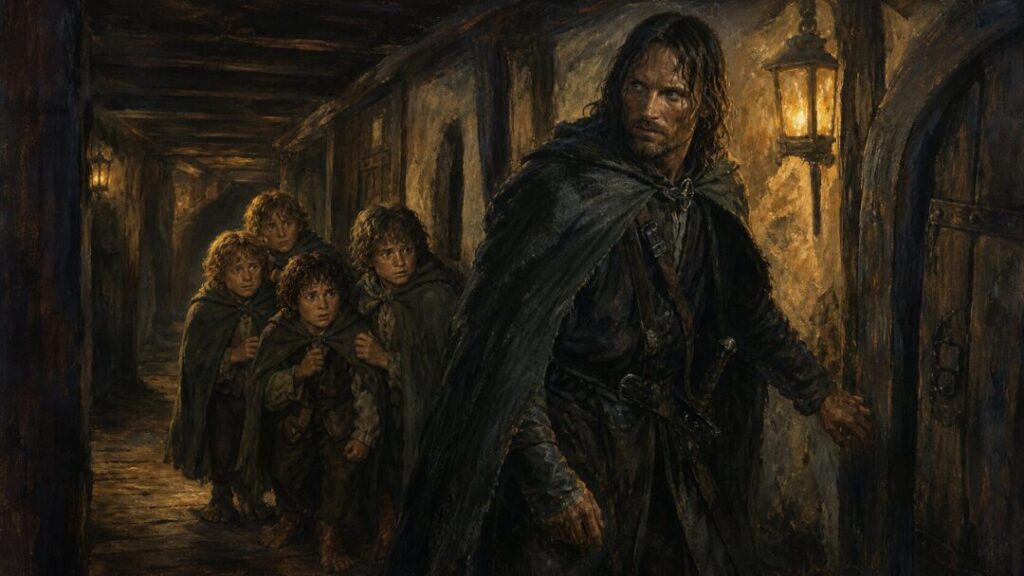
At first, he is not presented as a comforting figure. He watches Frodo from the shadows. He knows too much. He speaks in riddles. He seems dangerous, and the hobbits have every reason to be afraid of him.
The book handles this tension through conversation, suspicion, and Gandalf’s letter. Strider proves himself gradually. He warns them, explains what he knows, and becomes their guide only after doubt and hesitation.
The film has to compress that process.
The attack on the empty beds becomes evidence.
Strider said the hobbits should not sleep in their assigned room. The Nazgûl attack that exact room. Therefore, Strider was right.
This does not remove all uncertainty from him, but it changes the audience’s relationship to him. He is no longer merely a frightening stranger in the corner. He becomes the reason the hobbits survived the night.
That is important because the story needs us to accept his guidance quickly.
From Bree onward, the hobbits are no longer traveling by Shire instinct. They are in the wild, pursued by servants of Sauron. They need a protector who understands roads, enemies, and danger in ways they do not.
The attack makes that need visible.
The Nazgûl Become More Than Distant Riders
Before Bree, the Black Riders are frightening partly because they are strange.
They sniff. They ask questions. They appear on roads and under trees. They are not yet fully explained, and that mystery gives them power.
But the story cannot keep them at a distance forever.
At Bree, their threat changes.
They are no longer simply following.
They have entered the world of Men.
That is one of the most unsettling things about the Prancing Pony attack. Bree is not a battlefield. It is not Mordor. It is not an ancient ruin or a haunted forest. It is an inn, a place of travelers, food, beds, gossip, and ordinary weariness.
The Nazgûl invading that space shows how far the Shadow can reach.
In the book, this is felt through aftermath and implication. The room is destroyed. The ponies are driven away. The hobbits must leave Bree in worse condition than they entered it.
In the film, the same idea is made immediate.
The servants of Sauron do not need a fortress to become terrifying. They only need a closed door, a sleeping victim, and darkness.
The Book Leaves Room for Uncertainty
There is one subtle point that should not be overstated.
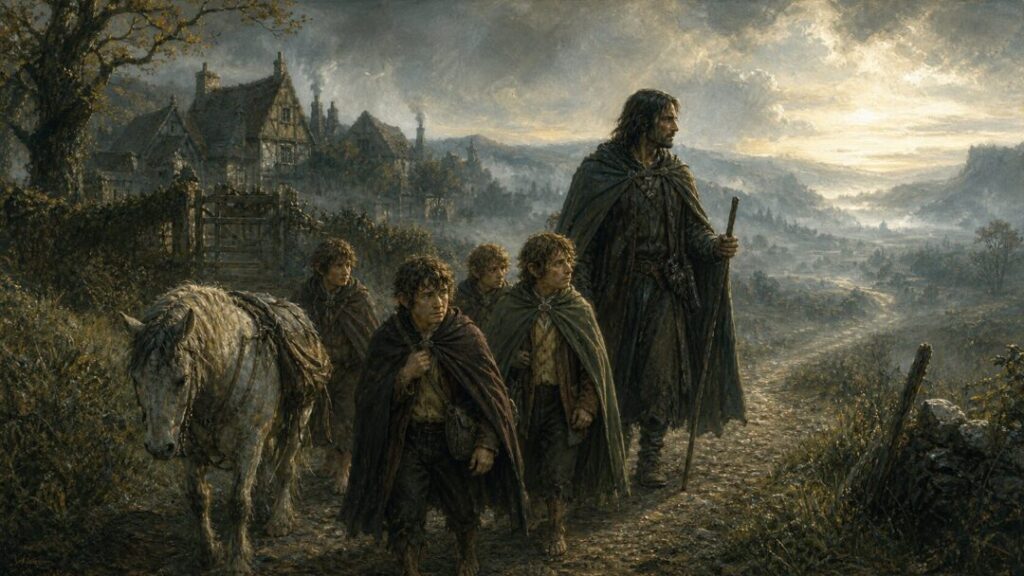
The book strongly presents the attack as part of the danger surrounding the Black Riders, but it does not give us a scene in which the hobbits watch the Nazgûl do it. Strider also speaks of the possibility that the Riders may use other people in Bree for “evil work,” including figures such as Bill Ferny or suspicious strangers.
So the text leaves a little narrative distance between the attackers and the aftermath.
This does not make the danger less real.
It makes Bree feel more corrupted.
The Enemy’s power is not only in the Ringwraiths themselves. It is also in fear, betrayal, bribery, and the weakness of ordinary people. Bree is dangerous because the Black Riders are near, but also because not everyone in Bree can be trusted.
The film simplifies this.
It places the Nazgûl directly inside the room and makes them the visible agents of the attack. That is not the same as the book’s method, but it serves the same dramatic function: the hobbits were nearly found, and Strider’s intervention saved them.
For a visual story, that clarity matters.
Why It Feels So Important Even Though the Plot Could Continue Without It
On a bare plot level, the story could move forward without showing the attack.
The hobbits could meet Strider, learn they are in danger, leave Bree, and continue toward Weathertop. The major events would still happen.
But stories are not built only from plot points.
They are built from pressure.
The Bree attack increases that pressure at exactly the right moment.
Until then, Frodo still has some connection to the smaller world he knows. Bree is strange, but it is still an inn. There are rooms, meals, pipes, songs, and ordinary people.
After the attack, that comfort is gone.
Sleep is no longer safe.
Walls are no longer safe.
Names are no longer safe.
Even the bed prepared for Frodo becomes a trap.
That is why the scene feels more important than its plot function alone. It changes the emotional temperature of the journey. The road ahead is not adventurous anymore. It is hunted.
The Scene Also Foreshadows Weathertop
The attack at Bree points forward to the attack at Weathertop.
At Bree, the hobbits are saved because they are not where the Nazgûl expect them to be.
At Weathertop, they cannot avoid the confrontation.
The Riders come closer. Frodo is wounded. The danger that was only barely escaped at the inn becomes personal, physical, and lasting.
That progression is crucial.
Bree shows what might have happened.
Weathertop shows what does happen.
By adding a visible attack before Weathertop, the film prepares the audience for the seriousness of the Ringwraiths. Their blades are not symbolic. Their pursuit is not vague. When they strike, the result can change the fate of the Ring-bearer.
The book achieves this through atmosphere, dialogue, and mounting dread.
The film achieves it through image.
Both versions serve the same larger movement: the hobbits are being drawn out of the Shire’s small perils and into the reach of Sauron’s war.
What the Adaptation Really Changed
The question is often phrased as if the film added a scene that was not important.
But the more accurate answer is this:
The film dramatized an event the book leaves offstage.
It changed the method, not the underlying danger.
In the book, the ruined room tells us the hobbits were almost caught.
In the film, we see the attempt.
In the book, fear arrives as evidence.
In the film, fear arrives as action.
Neither version is careless. They are simply using different tools.
The written version can afford to let the reader sit with uncertainty. It can make the morning discovery feel like a cold hand on the back of the neck. The visual version needs an image strong enough to communicate the same dread in seconds.
Black Riders stabbing empty beds does exactly that.
Why Bree Matters More Than It Seems
Bree is not just the place where the hobbits meet Aragorn.
It is the place where the journey changes shape.
Before Bree, the hobbits are fleeing.
After Bree, they are being guided.
Before Bree, the Enemy feels like something on the road behind them.
After Bree, the Enemy has entered rooms, towns, and human dealings.
Before Bree, Frodo’s danger is frightening but still half-understood.
After Bree, the danger is undeniable.
That is why the attack matters.
It is not there merely to create a jump of fear. It marks the collapse of ordinary safety. The Ring has drawn the Shadow into the world of inns and travelers, and the hobbits now know there is no harmless place to hide.
The film understood that this turning point needed to be felt.
So it took the book’s unseen terror and gave it a shape.
And in doing so, it made one of the quietest shocks in the early chapters into one of the clearest visual warnings in the entire first part of the story.
The beds were empty.
But only because Strider had understood the danger before the hobbits did.
That is the real purpose of the scene.
Not to add a new plot.
But to show how close the story came to ending in Bree.
Sources & Notes
- J.R.R. Tolkien, The Lord of the Rings, Book I, Chapter 9, “At the Sign of the Prancing Pony” — Frodo’s vanishing in the inn and Strider’s shadowed introduction set up Bree as the first major point of human suspicion and danger.
- J.R.R. Tolkien, The Lord of the Rings, Book I, Chapter 10, “Strider” — Strider warns the hobbits against trusting their prepared rooms, and Gandalf’s letter helps turn him from alarming stranger into necessary guide.
- J.R.R. Tolkien, The Lord of the Rings, Book I, Chapter 11, “A Knife in the Dark” — the morning discovery of forced windows, slashed bolsters, and missing ponies gives the attack mainly as aftermath rather than an eyewitness scene.
- Peter Jackson, The Lord of the Rings: The Fellowship of the Ring (2001) — the adaptation makes the Prancing Pony bed attack visible onscreen, converting Tolkien’s off-page threat into immediate visual suspense before Weathertop.