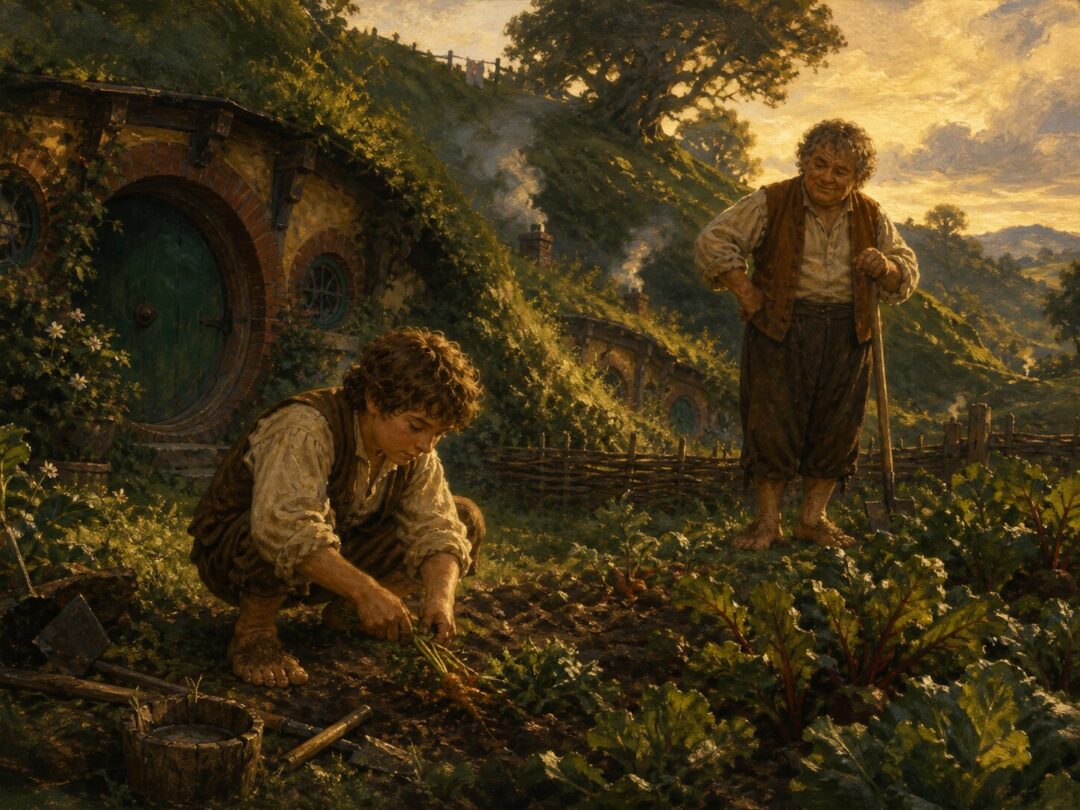
Samwise Gamgee may be the most rooted character in The Lord of the Rings.
He belongs to the Shire almost as naturally as grass belongs to a field. He knows gardens, potatoes, beer, rope, paths, weather, cooking, and the small habits of ordinary Hobbit life. He does not begin as a prince, exile, warrior, scholar, or hidden lord.
He begins as a gardener.
That is why the question feels strange at first:
Was Sam Gamgee an orphan?
The short answer is no — not during the events of The Lord of the Rings.
But the longer answer is more interesting than a simple family-tree correction. Sam’s father is present, named, active, and emotionally important. His mother, however, is almost entirely absent from the story. She is known by name, but not by voice. She exists in the record, but not in the scenes.
And that difference matters.
Because Sam’s family background quietly reveals something essential about him. He is not a rootless hero searching for belonging. He already belongs somewhere. His tragedy is not that he has no home.
It is that he must leave the home he loves in order to save it.
Sam’s Father Is Very Much Alive
The clearest reason Sam is not an orphan is simple:
His father is alive during the story.
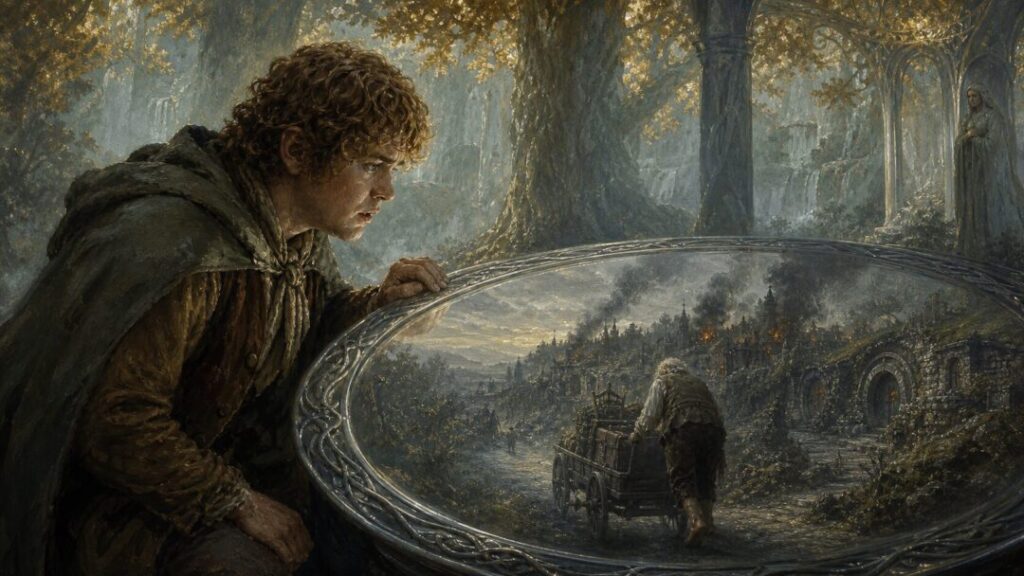
Hamfast Gamgee, better known as the Gaffer, appears early in The Fellowship of the Ring. He is not merely a name in an appendix. He speaks. He has opinions. He is known in Hobbiton. He represents a particular kind of Shire wisdom: practical, suspicious of strange business, proud of proper work, and deeply attached to ordinary life.
The Gaffer is also part of Sam’s identity.
Sam is not introduced as a lone Hobbit with no ties. He is the son of Hamfast Gamgee, living close to Bag End, working as a gardener, and inheriting a place in the same small world his father knew before him.
That matters because Hobbit society is intensely local. Families, names, holes, roads, gardens, and neighbors all carry weight. To be “son of Hamfast” is not a meaningless detail. It places Sam in a living social world.
He is not an orphaned wanderer.
He is a young Hobbit from Bagshot Row, with a father everyone knows.
Who Was Sam’s Mother?
Sam’s mother was Bell Goodchild.
That is the firmest lore-accurate answer.
She married Hamfast Gamgee and was the mother of Sam and his siblings. The family record gives Sam several brothers and sisters: Hamson, Halfred, Daisy, May, and Marigold. Sam is part of a large Hobbit family, not a solitary child.
But Bell Goodchild is different from the Gaffer in one important way.
She does not become a visible character in the main narrative.
The story does not give her dialogue. It does not show Sam speaking with her. It does not clearly describe her death. It does not build a memory scene around her. She is present in the family record, but absent from the emotional surface of the story.
This is where many readers begin to wonder.
Was she dead by the time of the Quest? Possibly — but the text does not clearly state that in the main narrative. Was Sam motherless in a practical sense? The story does not give enough evidence to say with certainty. Was he an orphan? No, because his father is alive.
The safest answer is this:
Sam’s mother is named, but her fate is not treated as a major narrative fact.
Anything beyond that must be phrased carefully.
The Silence Around Bell Goodchild
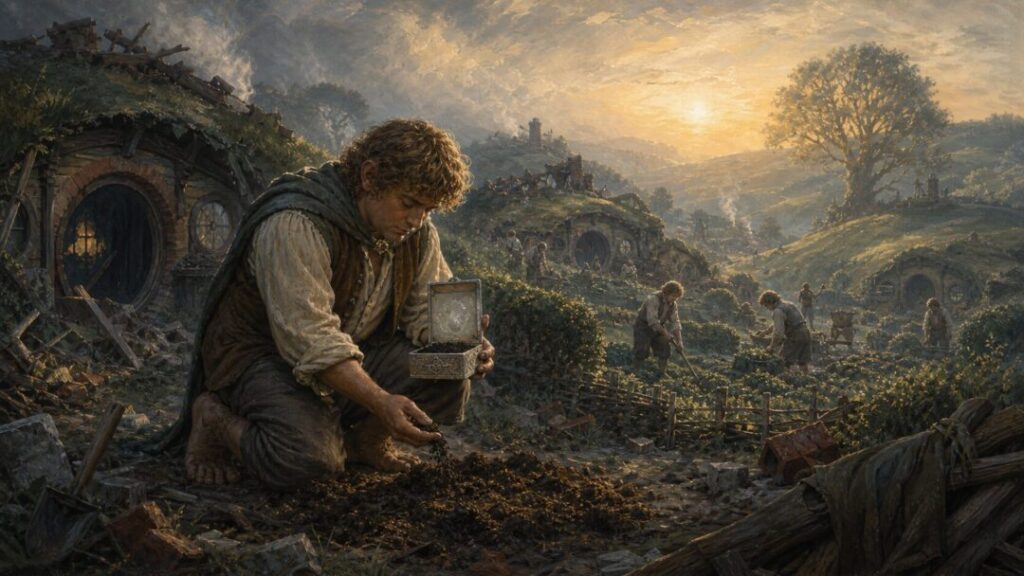
The silence around Bell Goodchild is easy to overlook because the story gives us so much of the Gaffer.
The Gaffer speaks in Hobbiton. He comments on Bilbo and Frodo. He represents the older, earthier voice of the Hill. Sam quotes him and remembers his sayings. Even far from home, Sam carries his father’s voice with him.
Bell does not receive the same treatment.
That does not mean she was unimportant to Sam. The text simply does not tell us. Middle-earth is full of figures who are named but not explored, especially in Hobbit genealogies. A family tree can preserve a name without turning that person into a character.
Still, the contrast is striking.
Sam’s father is not only alive; he is thematically alive. He shapes Sam’s speech, work ethic, caution, and attachment to home. Bell Goodchild remains mostly in the background, a real part of Sam’s ancestry but not a developed presence in the story.
So the mystery is not whether Sam had parents.
He did.
The mystery is why the story lets one parent become vivid while the other remains nearly silent.
Sam’s Fear in Lórien
One of the strongest proofs that Sam is not emotionally rootless comes in Lothlórien.
When Sam looks into Galadriel’s Mirror, he sees trouble in the Shire. Among the things that disturb him is the sight of the Gaffer being forced down the Hill with his belongings.
This moment is crucial.
Sam is far from home, surrounded by Elven beauty, caught up in a quest larger than anything the Shire has ever imagined. Yet what pierces him is not glory, prophecy, or the fate of kings.
It is his father.
The vision does not show Sam an abstract disaster. It shows him a personal wound. Bagshot Row is threatened. Trees are being cut down. The Gaffer is displaced.
Sam’s instinct is immediate: he wants to go home.
This is not cowardice. It is love. Sam’s first loyalty is not to heroic adventure. It is to the small, ordinary world that made him.
That is part of what makes him so powerful.
Sam does not save Middle-earth because he dreams of greatness. He helps save it because the world contains gardens, fathers, homes, meals, children, trees, and people who should not be driven from their doors.
The Gaffer After the Quest
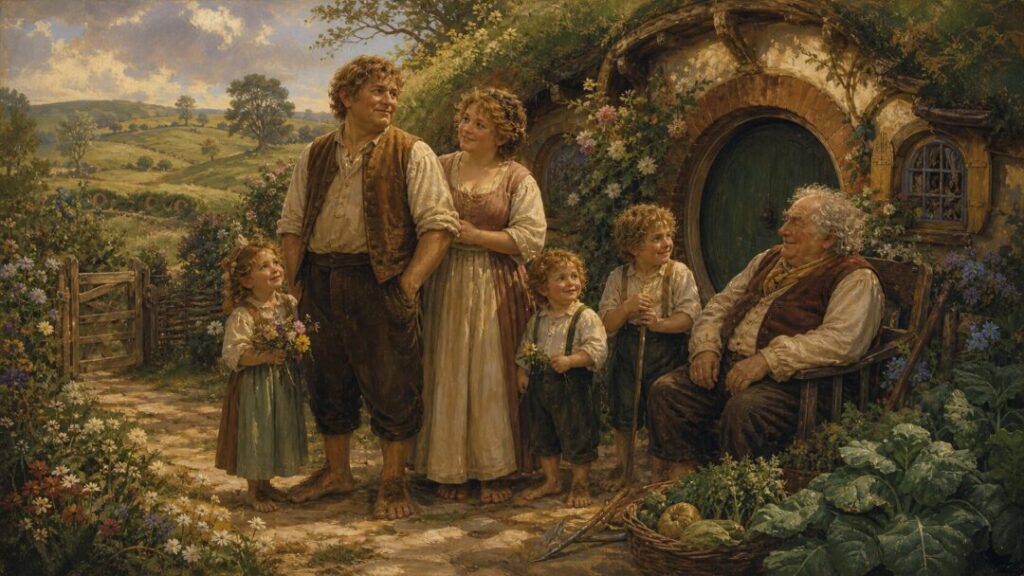
When the Travellers return to the Shire, Sam’s fears are not foolish. The Shire has indeed been damaged. The old order has been disrupted. Homes have been destroyed or altered. The Gaffer has suffered under these changes.
But he is still alive.
This is important because it means Sam’s return is not merely symbolic. He does not come back to a vanished childhood or a dead household. He returns to people who can still be helped.
The restoration of the Shire includes the restoration of ordinary bonds.
Sam marries Rosie Cotton. He becomes part of a renewed household. He plants, rebuilds, heals, and eventually becomes one of the central figures of the Shire’s future. But he does not do this as an orphaned hero starting from nothing.
He does it as someone who carries his family past into his family future.
The Gaffer remains part of that life for a time. In the later chronology, his death comes in the early Fourth Age, after the War of the Ring is over. By then Sam is no longer the young gardener who left the Shire in fear and uncertainty. He is a husband, father, and one of the great figures of Hobbiton.
So even when Sam eventually loses his father, that loss belongs to a different chapter of his life.
It is not the condition under which he begins the Quest.
Why the Question Matters
So why does the question feel meaningful at all?
Because Sam often feels emotionally self-sufficient.
He serves Frodo. He cooks. He watches. He carries supplies. He remembers songs. He takes responsibility when others collapse. By the time he reaches Mordor, Sam can seem almost impossibly sturdy.
Readers may look at that strength and wonder where it came from.
The answer is not that Sam had no family.
The answer is that Sam came from a world of work, habit, affection, and duty. His strength is domestic before it is heroic. It grows from gardens, kitchens, tools, sayings, meals, and remembered voices.
The Gaffer’s influence helps explain that.
Sam’s courage is not the courage of someone cut loose from the world. It is the courage of someone tied to it by a hundred small cords.
That is why he can keep going when the great ones fail.
He does not carry an ideology into Mordor.
He carries home.
Sam Is Not Frodo
This is also where Sam differs sharply from Frodo.
Frodo is not exactly an orphan in the emotional sense by the time the story begins, because Bilbo has adopted and loved him. But Frodo’s biological parents are dead, and that loss belongs to his background. Frodo is a Baggins of Bag End, but also someone marked by absence.
Sam’s background is different.
He is not placed in the story as a bereaved heir. He is placed as a working Hobbit with living ties, a father nearby, siblings in the family record, and a future that remains deeply connected to the Shire.
This difference shapes their endings.
Frodo cannot remain in the Shire after the Ring. His wounds go too deep. The place he saved can no longer fully heal him.
Sam can remain. He must remain. He has “so much to enjoy and to be, and to do.” His life after the Quest is not an afterthought. It is part of the meaning of the Quest itself.
Frodo saves the Shire and leaves it.
Sam saves the Shire and lives in it.
That difference begins long before the Grey Havens. It begins in who they are, what they have lost, and what still holds them.
The Real Answer
So, is Sam Gamgee an orphan?
No.
During The Lord of the Rings, Sam’s father is alive, present, and emotionally important. His mother, Bell Goodchild, is known by name, but the story gives very little about her life or fate. The text does not support treating Sam as an orphan during the Quest.
But the question reveals something deeper.
Sam’s story is not built around the wound of having no home. It is built around the pain of leaving a home that still exists.
That is why his homesickness matters. That is why the vision of the Gaffer in Lórien hurts him so deeply. That is why his return to the Shire is not just a closing chapter, but a fulfillment.
Sam is not powerful because he is unattached.
He is powerful because he is attached.
To Frodo.
To the Gaffer.
To Rosie.
To Bagshot Row.
To the Party Tree.
To potatoes and gardens and plain Hobbit speech.
To the ordinary world that heroes are supposed to protect.
The great irony of Sam Gamgee is that he becomes heroic precisely because he never wanted to leave ordinary life behind.
He was not an orphan searching for a home.
He was a Hobbit who already had one.
And because he loved it so completely, he helped save everything beyond it.
Sources & Notes
- J.R.R. Tolkien, The Lord of the Rings, Appendix C, “Family Trees” — the Baggins of Hobbiton and Longfather-tree of Master Samwise list Hamfast Gamgee and Bell Goodchild as Sam’s parents, with Sam among a larger Gamgee family.
- J.R.R. Tolkien, The Lord of the Rings, Book I, Chapter 1, “A Long-expected Party” — the Gaffer appears in Hobbiton as a living, opinionated presence closely tied to Bag End and Sam’s ordinary Shire world.
- J.R.R. Tolkien, The Lord of the Rings, Book I, Chapter 2, “The Shadow of the Past” — Sam is caught listening while working near Bag End, grounding him as the Gaffer’s son and Frodo’s gardener rather than a rootless wanderer.
- J.R.R. Tolkien, The Lord of the Rings, Book II, Chapter 7, “The Mirror of Galadriel” — Sam’s vision of the Shire, including the Gaffer being turned out, shows how strongly his father and home still hold his heart during the Quest.
- J.R.R. Tolkien, The Lord of the Rings, Book VI, Chapter 8, “The Scouring of the Shire” — Sam returns to an injured but living Shire, marries Rosie, and helps restore the ordinary home life he fought to save.
- J.R.R. Tolkien, The Lord of the Rings, Appendix B, “The Tale of Years” — the early Fourth Age entries place Hamfast Gamgee’s death after the War of the Ring, confirming that Sam did not begin the Quest as an orphan.