At first, the contrast sounds almost unfair.
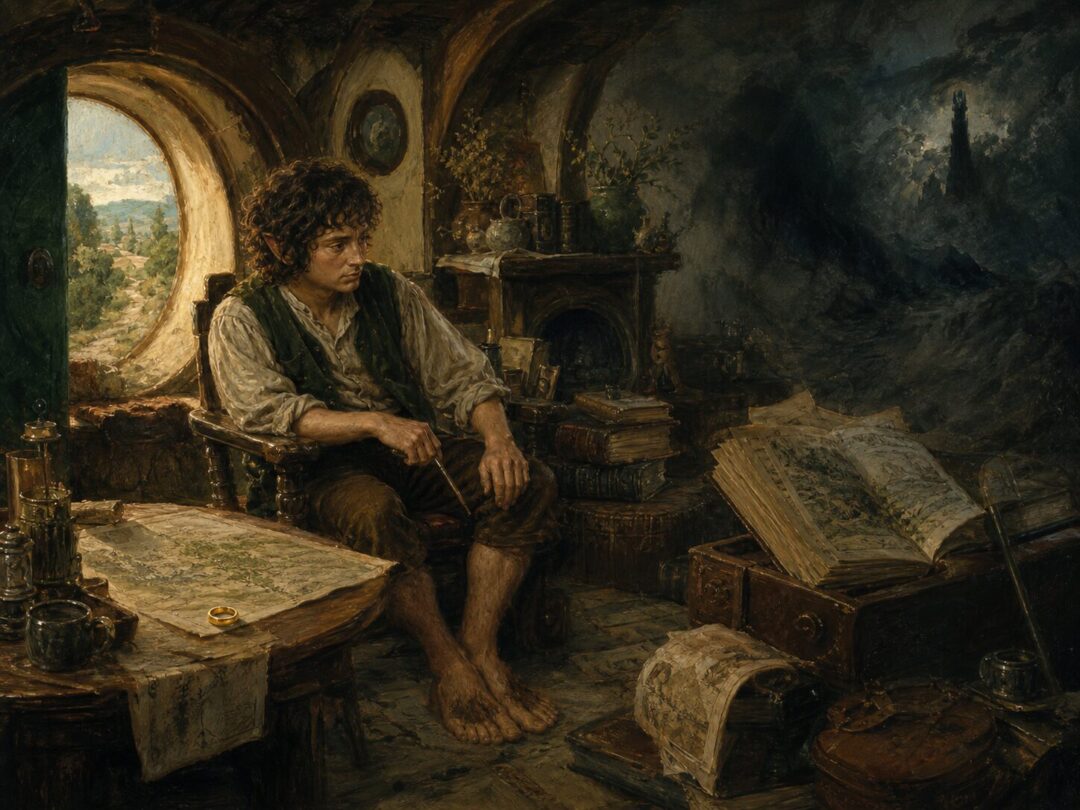
Frodo Baggins is associated with wisdom.
Samwise Gamgee, one of the most beloved figures in Middle-earth, carries a name that can be understood as “half-wise” — or, in older wording, something close to “half-wit.”
That seems strange.
Sam is not merely comic relief. He is not a fool. He is not a burden on the Quest. Without him, Frodo would not have reached Mount Doom. Without him, the Ring would almost certainly never have come to the Fire.
So why does the Ring-bearer receive a name connected with wisdom, while the gardener who saves him again and again receives a name that sounds like an insult?
The answer is not that Sam is stupid.
The answer is that Middle-earth is quietly asking us what wisdom really is.
And it begins with the way hobbit names work.
Frodo’s Name Is Not Just a Label
“Frodo” is connected with an older word meaning wise by experience.
That last part matters.
Frodo is not “wise” because he begins the story as a great sage. He is not Elrond. He is not Gandalf. He is not a keeper of ancient lore.
At the beginning, Frodo is a gentle, thoughtful hobbit of the Shire. He is more educated and inward-looking than many around him. He has been influenced by Bilbo. He knows stories, songs, languages, and strange rumors from beyond ordinary hobbit life.
But he is still inexperienced in the things that will define him.
He has never faced the Nazgûl.
He has never felt the Ring’s full weight.
He has never crossed the Dead Marshes.
He has never stood at the edge of Mordor with no hope left except endurance.
Frodo’s wisdom is not complete at the beginning.
It is gained.
That is why the meaning fits him so painfully well. His wisdom is not comfortable wisdom. It is not the wisdom of someone who studies evil from a safe distance.
It is the wisdom of someone who carries evil close to his heart and learns what pity, weakness, mercy, and failure truly mean.
Frodo Becomes Wise Through Suffering
Frodo’s great insight is not military. It is not political. It is not even magical.
It is moral.
Again and again, Frodo sees what others do not want to see.
He pities Gollum when Sam distrusts him.
He understands, more deeply than most, that Gollum is not merely a monster but a ruined person.
He recognizes that the Ring works by possession, hunger, and domination.
He slowly comes to understand that victory may demand more than courage.
This does not mean Frodo is always right in every practical decision. His trust in Gollum leads him into danger. His mercy does not make Gollum safe. The texts never ask us to pretend otherwise.
But Frodo’s pity is not naïve in the larger moral pattern of the story.
It is essential.
Gandalf’s earlier words about pity and mercy are fulfilled through Frodo’s treatment of Gollum. Frodo does not destroy the Ring by personal strength at the final moment. In fact, at the Crack of Doom, he claims it.
That failure is central.
Frodo’s wisdom does not make him invincible. It does not allow him to master the Ring. It allows him to go farther than almost anyone else could have gone, and it allows mercy to remain alive long enough for the final turn of events to occur.
His wisdom is real.
But it is also wounded.
Samwise Sounds Smaller Than He Is
Then comes Samwise.
The name “Samwise” carries the sense of “half-wise.” In plain terms, it points toward someone simple, rustic, or not fully wise.
That can sound harsh, especially because Sam becomes one of the great heroes of the story.
But the name belongs to a particular hobbit-world texture.
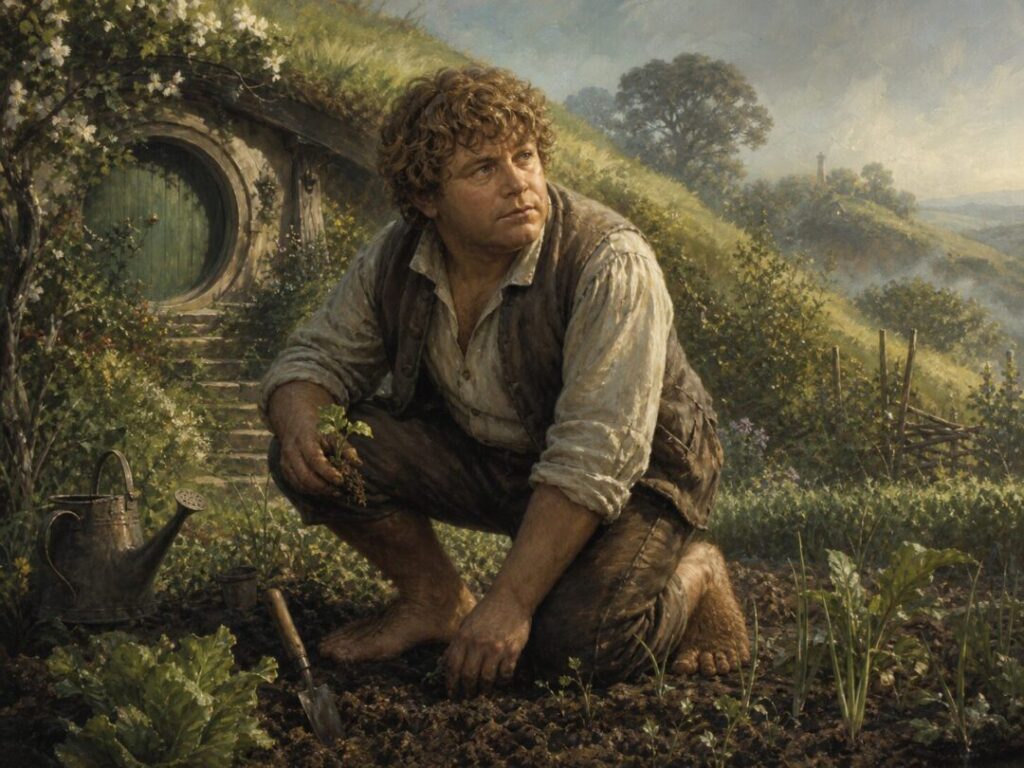
Sam is not introduced as a prince, scholar, or hidden lord. He is Frodo’s gardener. He speaks plainly. He has strong opinions. He is suspicious of strangers, especially Gollum. He loves stories of Elves and heroes, but he does not begin as someone who fully understands the old world he dreams about.
He is rooted in the Shire.
More specifically, he is rooted in work, soil, loyalty, food, family, and ordinary affection.
That ordinariness is not a flaw.
It is the foundation of his strength.
Sam’s name makes him sound small because, in the social world of the Shire, he is easy to underestimate. He is the servant, the gardener, the one who follows.
But the story slowly reveals that this “half-wise” hobbit possesses a kind of wisdom that greater people often lack.
Sam’s Wisdom Is Practical Before It Is Philosophical
Sam does not usually speak in high reflection.
He cooks.
He packs.
He watches.
He remembers rope.
He worries about food.
He keeps Frodo moving.
He looks at danger with the blunt suspicion of someone who does not want fine words to hide a trap.
This can make him seem less subtle than Frodo.
And in some ways, he is.
Sam does not understand Gollum as Frodo does. His harshness toward Gollum matters, and the story does not completely excuse it. There are moments when a kinder word from Sam might have changed the emotional balance between them. That possibility is implied, but not stated as certainty.
This is important.
Sam is not secretly perfect.
His wisdom has limits. His love is fierce, but it can also be possessive and suspicious. His loyalty to Frodo sometimes leaves little room for pity toward anyone who threatens him.
Yet when the Quest reaches its darkest places, Sam’s practical wisdom becomes indispensable.
He knows Frodo must eat.
He knows they must keep moving.
He knows despair is deadly.
He knows that even when great plans collapse, the next step still matters.
That is not half-wisdom in the moral sense.
That is survival wisdom.

Frodo Sees the Tragedy of Gollum
The clearest difference between Frodo and Sam appears in their treatment of Gollum.
Frodo sees himself in Gollum.
Not completely. Not sentimentally. But enough to understand that Gollum is a warning. Gollum shows what the Ring can do to a mind and soul over time. He is not just an enemy outside Frodo. He is a possible future.
This is one of Frodo’s deepest insights.
Because he bears the Ring, he understands its pull in a way Sam cannot fully share. Sam briefly carries the Ring, but Frodo bears it for far longer and under far greater pressure. Frodo’s pity comes from experience.
That is “wise by experience” in its darkest form.
Sam, by contrast, sees Gollum mostly as a threat to Frodo. And he is not wrong. Gollum is dangerous. Gollum does betray them. Gollum does lead them toward Shelob.
But Sam’s view is incomplete.
Frodo sees the ruined person.
Sam sees the immediate danger.
Both perceptions contain truth.
Only one is enough to preserve the chain of mercy on which the Quest finally depends.
Sam Sees What Frodo Can No Longer See
Yet the contrast turns again.
As the Ring grows heavier, Frodo’s world narrows. His memory of home fades. His strength fails. He becomes more and more consumed by the burden he carries.
Sam, meanwhile, remembers.
He remembers the Shire.
He remembers gardens.
He remembers light, food, water, stars, and songs.
He remembers that the world is larger than Mordor.
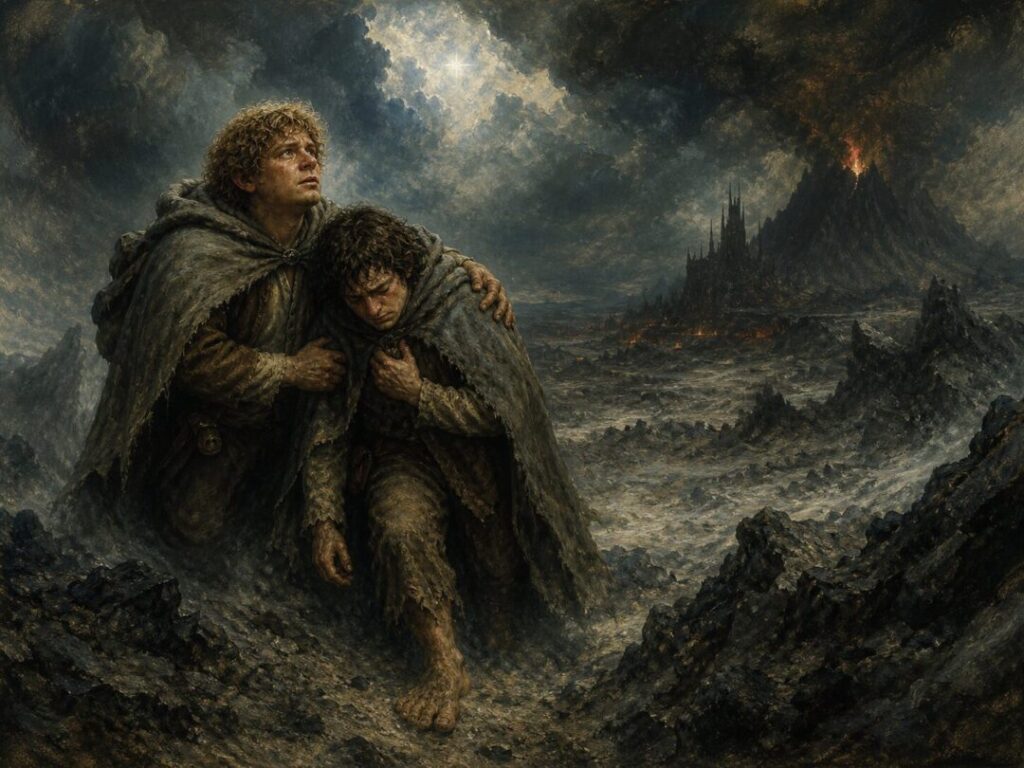
One of Sam’s most powerful moments comes when he sees a star above the darkness of Mordor. The vision does not give him a military strategy. It does not remove the danger. It simply reminds him that beauty exists beyond the Shadow’s reach.
That is wisdom too.
Not the wisdom of lore.
Not the wisdom of rulers.
Not even the wounded moral wisdom of Frodo.
It is the wisdom of hope that has no argument except its own refusal to die.
Sam does not always understand the great designs of the world.
But he understands that darkness is not the whole story.
“Half-Wise” Becomes a Hidden Compliment
This is where Sam’s name becomes extraordinary.
At the beginning, “Samwise” may sound like a comic rustic name. It fits the gardener who listens under windows, speaks bluntly, and enters the great tale almost by accident.
But the story changes the weight of the name.
Sam is “half-wise” only if wisdom means polish, education, subtlety, and ancient knowledge.
He is not half-wise in courage.
He is not half-wise in love.
He is not half-wise in endurance.
He is not wise in the same way Frodo is wise.
That is the point.
Frodo’s wisdom comes through bearing, pity, and suffering. Sam’s wisdom comes through humility, service, memory, and love of ordinary things. Frodo understands the tragedy of the Ring. Sam understands why the world must be saved from it.
Frodo knows the burden.
Sam knows the home beyond the burden.
Neither wisdom is complete without the other.
The King’s Letter and “Fullwise”
There is one later textual detail that makes the pattern even clearer.
In material connected with the unpublished epilogue and the King’s Letter, Sam is referred to with a form meaning “Fullwise,” suggesting that the one once called “half-wise” should now be understood differently.
This is not a scene most readers encounter in the main published narrative, so it should be handled carefully. But it reflects the same idea already present in the story itself.
Sam’s name begins in humility.
His life reveals fullness.
He becomes Mayor of the Shire. He helps restore what was damaged. He plants, heals, remembers, and continues. He is not transformed into a lord of war or a master of hidden arts. He remains Sam.
That is precisely his greatness.
The story does not need to make him less ordinary in order to honor him.
It honors the ordinary thing itself.
Why Frodo Could Not Be Sam, and Sam Could Not Be Frodo
Frodo and Sam are sometimes compared as if one must be the greater hero.
But the story resists that.
Frodo carries the Ring in the deepest sense. He bears the spiritual pressure, the temptation, the growing wound. His pity toward Gollum helps keep alive the only path by which the Ring is finally destroyed.
Sam carries Frodo.
Not symbolically only, but literally at the end. He carries him physically when Frodo can no longer climb. He carries the memory of the Shire when Frodo can barely imagine it. He carries stubborn hope when wisdom itself seems exhausted.
Frodo is wise because he has been changed by the burden.
Sam is half-wise because he begins with only the simple half of wisdom: loyalty, labor, affection, and common sense.
But by the end, that “simple half” is revealed as the half without which all higher wisdom fails.
The wise Ring-bearer needs the half-wise gardener.
And Middle-earth is saved by both.
The Real Meaning of the Contrast
So why was Frodo “wise” and Samwise “half-wise”?
Because the names set up a contrast the story slowly overturns.
Frodo’s name points to wisdom gained through experience, and his journey proves it. He becomes one of the most morally perceptive figures in the tale, not because he is untouched by evil, but because he understands its cost from within.
Sam’s name points to simplicity, and his journey transforms that simplicity into something radiant. He begins as someone others might underestimate. He ends as the one whose plain loyalty, practical courage, and stubborn love make the Quest possible.
The joke hidden in Sam’s name is not cruel.
It is revelatory.
Middle-earth does not say that Sam was secretly a scholar, prince, or prophet all along. It says something better.
It says that wisdom can wear muddy feet.
It can speak in plain words.
It can worry about dinner.
It can love one person so faithfully that, through that love, the whole world is preserved.
Frodo is wise by experience.
Sam is half-wise only until we understand what the other half was.
And by the end, it was never missing.
It was simply hidden in the garden.
Sources & Notes
- J.R.R. Tolkien, The Lord of the Rings, Appendix F, “On Translation” — Tolkien explains the translated hobbit names: Frodo reflects Maura, associated with wisdom gained by experience, while Samwise reflects Banazîr/Samwís, “half-wise” or simple.
- J.R.R. Tolkien, The Lord of the Rings, Book I, Chapter 2, “The Shadow of the Past” — Gandalf’s words about pity, mercy, and Gollum establish the moral pattern that Frodo later carries forward.
- J.R.R. Tolkien, The Lord of the Rings, Book IV, Chapter 1, “The Taming of Sméagol” — Frodo’s treatment of Gollum shows a Ring-bearer’s hard-won pity, while Sam remains watchful and practically suspicious.
- J.R.R. Tolkien, The Lord of the Rings, Book VI, Chapter 2, “The Land of Shadow” — Sam’s glimpse of the star above Mordor expresses the plain, stubborn hope that the article identifies as his own kind of wisdom.
- J.R.R. Tolkien, The Lord of the Rings, Book VI, Chapter 3, “Mount Doom” — Frodo’s final failure at the Fire and Sam’s literal carrying of him show why the Quest depends on both Frodo’s wounded wisdom and Sam’s loyal endurance.
- J.R.R. Tolkien, The History of Middle-earth IX: Sauron Defeated, “The Epilogue” / “The King’s Letter” — the later King’s Letter material plays on Sam’s name by suggesting that ‘Half-wise’ has become, or deserves to be called, ‘Fullwise.’