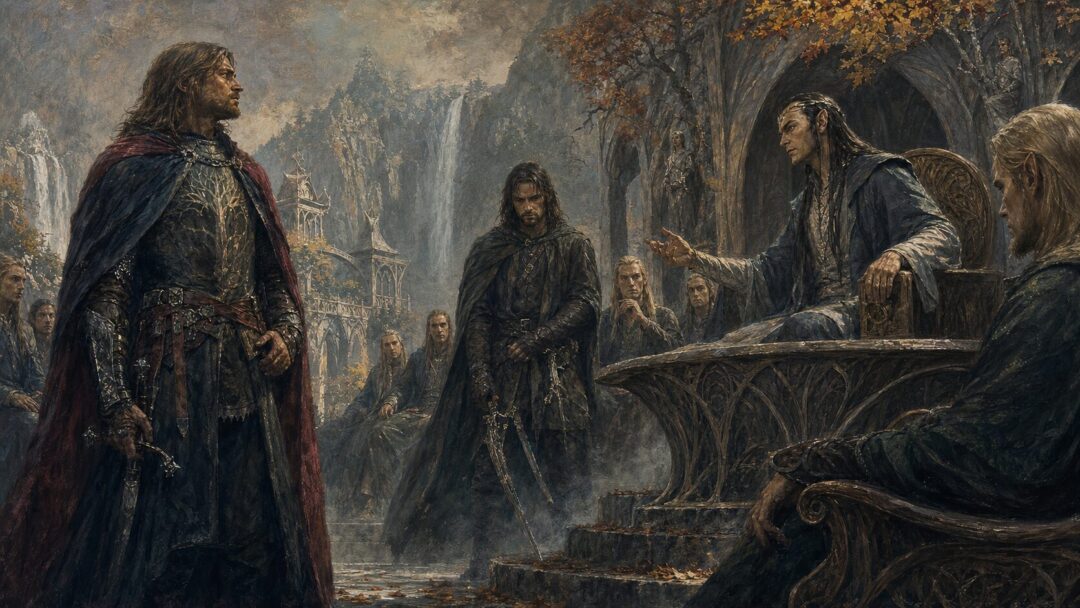
When Aragorn first stands before Boromir at the Council of Elrond, the scene can seem strange.
Boromir has come from Gondor after a long and dangerous journey. He has ridden north because of a mysterious dream, one that spoke of the Sword that was broken, Imladris, Isildur’s Bane, and a Halfling.
Then, in Rivendell, he meets a weather-worn Ranger.
At first, Boromir does not know what to make of him.
He asks what Aragorn has to do with Minas Tirith. It is a sharp question, and a revealing one. Boromir is not being foolish. From his point of view, this man looks nothing like a lord of Gondor. He is travel-stained, northern, and unknown.
Then Elrond gives the answer.
Aragorn is the son of Arathorn. More importantly, he is descended from Isildur, Elendil’s son.
That is the moment the name begins to matter.
Not because Boromir personally knows the house of Arathorn. The text gives no reason to think he does. But because the explanation places Aragorn inside a history that Gondor has never truly escaped.
Aragorn is not merely a Ranger.
He is the living heir of an unresolved question.
Boromir Did Not Come Looking for Aragorn
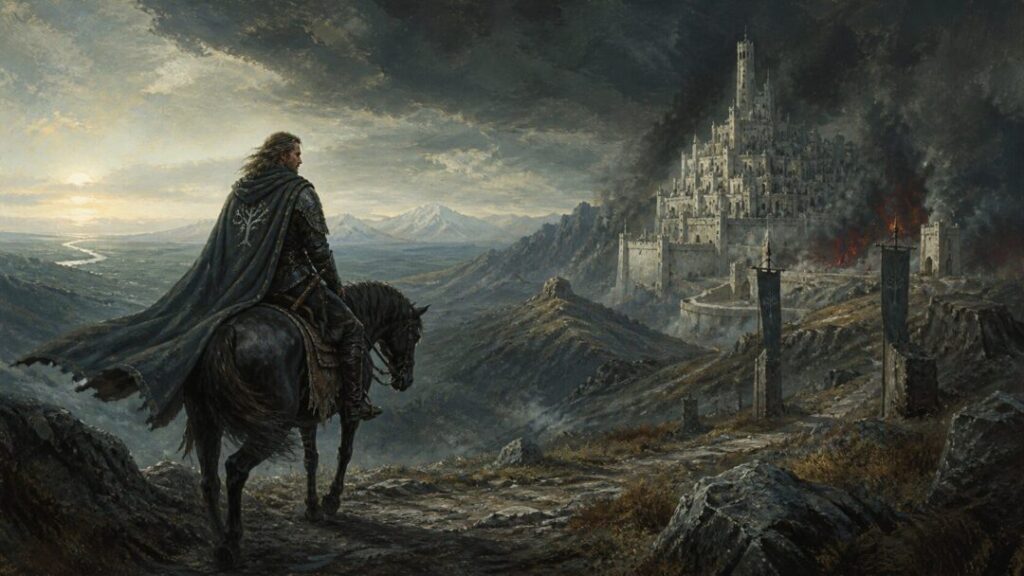
The first thing to understand is that Boromir does not travel to Rivendell because he has heard of Aragorn.
He comes because of the dream.
In that dream, a voice tells him to seek the Sword that was broken. It says that the sword dwells in Imladris. It says that counsels will be taken there, stronger than Morgul-spells. It speaks of Isildur’s Bane waking, and of a Halfling standing forth.
Boromir does not fully understand these words.
That is important.
He is not arriving with a clear prophecy in his hand and a complete map of its meaning. He knows enough to be troubled, and enough to act. His brother Faramir had received the dream more than once, and Boromir received it once as well. Denethor tells him that Imladris is the house of Elrond, and Boromir takes the road himself.
So when Aragorn appears, Boromir is not prepared to recognize him instantly.
The dream points to objects and signs: the broken sword, Isildur’s Bane, the Halfling. It does not say, “You will meet Aragorn son of Arathorn.”
That is why Boromir’s first response is uncertainty.
He knows he is in the place named by the dream. He knows something great is being revealed. But he does not yet know how this rough northern man fits into Gondor’s fate.
The Name Alone Was Not the Point
“Aragorn son of Arathorn” may not have meant much to Boromir by itself.
That is a point often missed.
The house of the Chieftains of the Dúnedain had survived in the North in secrecy and obscurity. Aragorn himself had spent much of his life hidden under other names. The people of Gondor did not seem to speak casually of him as a known prince waiting in exile.
So the force of the moment is not simply that Boromir hears the name Aragorn.
The force comes from what Elrond attaches to it.
Aragorn is descended through many fathers from Isildur. He is connected to Elendil. He possesses the shards of Narsil, the Sword that was broken. He belongs to the northern line of the Dúnedain.
In other words, Boromir is not being asked to admire a famous name.
He is being asked to face a lineage.
And for Gondor, lineage is not decorative. It is political. It is sacred memory. It reaches back to Númenor, to Elendil, to the founding of the realms in exile, and to the ancient division between the North-kingdom and the South-kingdom.
Boromir understands that world.
He is the heir of the Steward of Gondor. His entire life has been shaped by a throne that stands empty.
Gondor Had Not Forgotten the King
By the time of the War of the Ring, Gondor has had no king for many generations.
The last king of Gondor, Eärnur, vanished after riding to Minas Morgul. After him, the Stewards ruled. They did not take the title of king. They governed in the king’s name, preserving the realm and defending it against Mordor.
This matters deeply.
Gondor is not a republic that has moved beyond monarchy. Nor is it a kingdom where a new royal house has replaced the old one. Its rulers are Stewards, however powerful they have become.
Even Denethor, proud and formidable as he is, is not king.
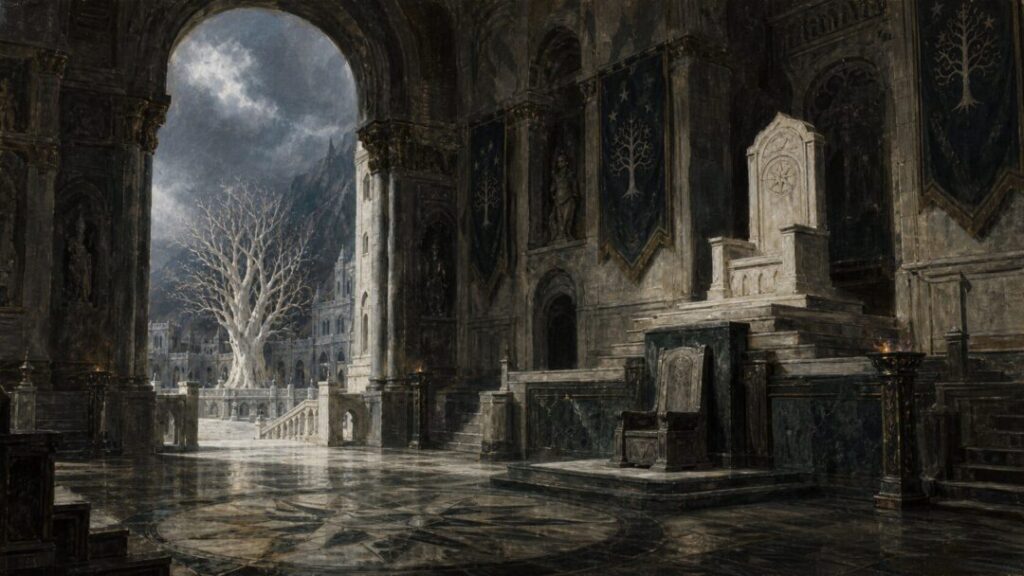
So Boromir grows up in a political world built around absence.
There is a White Tree in the court, but it is dead. There is a throne, but the Steward sits below it. There is a realm with ancient royal memory, but no crowned king.
That means the return of an heir is not a small matter.
It threatens to transform the entire structure of Gondor’s authority.
Boromir would understand this immediately.
The Old Claim of the North
Aragorn’s claim is not appearing out of nowhere.
Long before the Council of Elrond, the northern line had already touched Gondor’s history in a painful way.
After King Ondoher of Gondor and his sons were killed, Arvedui of the North-kingdom claimed the crown of Gondor. His claim rested partly on his descent from Isildur and partly on his marriage to Fíriel, the daughter of Ondoher.
Gondor rejected that claim.
The crown was given instead to Eärnil, a captain of the southern royal house who had won great honor in war. Arvedui did not press the claim by force, and the matter passed into history.
But it was not erased.
The descendants of the northern line did not forget it. The texts make clear that the claim remained part of their inheritance.
So when Aragorn is revealed at Rivendell, he is not simply saying, “I come from an old family.”
He represents a claim Gondor once refused.
That does not mean Boromir instantly sees him as rightful king. The text does not show that. In fact, Boromir’s reaction suggests hesitation and resistance.
But he understands enough to know that this revelation is dangerous, enormous, and impossible to treat lightly.
The Sword That Was Broken
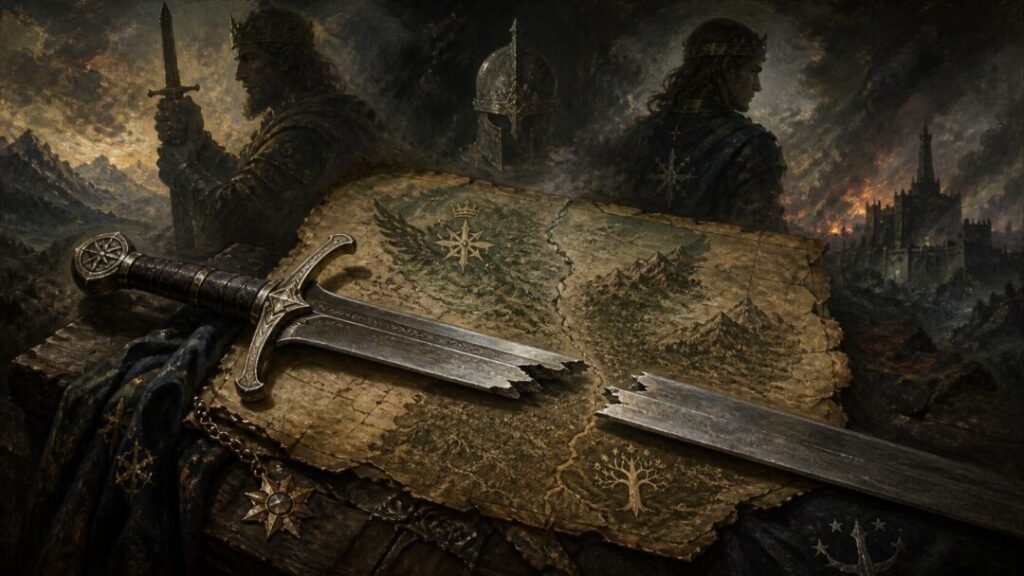
The dream told Boromir to seek the Sword that was broken.
At Rivendell, that sign is revealed.
Aragorn carries the shards of Narsil, the sword of Elendil. This is not a random heirloom. Narsil broke beneath Elendil when he fell in the war against Sauron, and with its broken blade Isildur cut the Ring from Sauron’s hand.
The sword connects Aragorn to the last great overthrow of the Dark Lord.
It also connects him to Gondor’s own founding memory.
Elendil and his sons founded the realms in exile after the downfall of Númenor. Isildur was not a foreign figure to Gondor’s history. He was one of its founders. He had lived in Minas Ithil before it was taken and became Minas Morgul. His story was tied to the very land Boromir defended.
So the broken sword is not merely proof that Aragorn owns an old weapon.
It is a symbol of unfinished history.
The sword broke when the old world fell into ruin. It was preserved by Isildur’s heirs. And according to Aragorn, it was said among his people that it would be made again when the Ring was found.
Boromir has come because the dream told him to seek it.
Now it is before him.
That is why the moment carries such pressure. The dream, the sword, the Ring, the Halfling, and the heir of Isildur all converge in one room.
Boromir cannot dismiss it.
But accepting it is another matter.
Boromir’s Pride Was Not Simple Arrogance
Boromir’s reaction to Aragorn is often reduced to pride.
There is truth in that. Boromir is proud. He is proud of Gondor, proud of its strength, proud of its long resistance against Mordor. He does not easily bow to northern claims or hidden heirs.
But his pride is not empty vanity.
Gondor has paid in blood for centuries. Its people have guarded the West while others lived in relative peace. Boromir has fought in that war directly. He has seen Osgiliath contested. He knows what Mordor means not as legend, but as pressure on the borders of his home.
So when a Ranger from the North is revealed as Isildur’s heir, Boromir’s hesitation is understandable.
Where has this heir been, from Gondor’s point of view?
That question is not entirely fair, because Aragorn has labored against Sauron in many ways, often secretly. But Boromir does not know the full shape of Aragorn’s life at first. He sees Gondor bleeding, and he sees a northern claimant appearing at a council far from Minas Tirith.
His doubt is not proof that he understands nothing.
It is proof that he understands exactly how much is at stake.
“Gondor Has No King”
In the book, Boromir does not simply fall down and accept Aragorn.
Instead, he continues to think as a man of Gondor.
That is why his attitude is so revealing. He can recognize the significance of Isildur’s heir and still resist what it might mean in practice. He can respect ancient things and still believe Gondor’s present strength belongs to those who have defended it.
This tension becomes even clearer later in the story.
Boromir’s loyalty is to Gondor first. He wants power to defend it. He thinks in terms of walls, weapons, armies, and desperate necessity. The Ring tempts him through that desire.
Aragorn, by contrast, must prove kingship not by claim alone, but by service, restraint, healing, and victory.
That is crucial.
The story does not treat Aragorn’s bloodline as meaningless. It matters profoundly. But it also does not present kingship as a mere legal technicality. Aragorn must become visible as the king he already has the right to be.
Boromir meets the claim before he sees the full proof.
That is why his uncertainty feels so human.
Why “Son of Arathorn” Still Matters
Even if Boromir did not know Arathorn personally, the form of the name matters.
“Aragorn son of Arathorn” is the style of a lineage-conscious world. It places a man inside inheritance, memory, and descent. Among the Dúnedain, fathers matter because the line matters.
But the name becomes truly powerful only when Elrond connects it to Isildur.
Arathorn was not famous to Boromir in the way Isildur was. Isildur’s name belonged to the deep memory of Gondor and the War of the Last Alliance. Isildur’s Bane was part of the riddle that brought Boromir north. The Sword that was broken was bound to Isildur’s house.
So the answer is layered.
“Aragorn son of Arathorn” matters because it identifies the man.
“Descended from Isildur” matters because it identifies the claim.
“The Sword that was broken” matters because it confirms the sign.
Together, they transform a stranger into a figure Boromir cannot ignore.
The Political Shock of Rivendell
The Council of Elrond is often remembered as a council about the Ring.
And it is.
But for Boromir, it is also something else: a confrontation with Gondor’s past.
He learns that the weapon he came seeking is not in Gondor’s keeping. It has been preserved in the North. He learns that Isildur’s Bane is not an old phrase but the One Ring itself. He learns that the Halfling in the dream is real. And he learns that the heir of Isildur is alive.
Every piece of the dream has weight.
But Aragorn is the most politically unsettling piece.
If the Ring is a weapon, Boromir can imagine using it. If the sword is an heirloom, he can honor it. If the Halfling is a messenger of fate, he can wonder at him.
But Aragorn is different.
Aragorn implies change.
Not only victory over Mordor, but the possible end of the Steward’s rule. Not the destruction of Gondor, but its transformation. Not a new power, but the return of an old one.
That is harder for Boromir to accept than a prophecy.
The Tragedy of Boromir’s Position
Boromir stands between two truths.
The first truth is that Gondor needs help. Its strength is failing. Mordor is rising. The war cannot be won by pride alone.
The second truth is that Gondor has endured with almost unimaginable courage. Boromir’s people have not been idle. They have not forgotten the West. They have held the line while the Shadow grew.
So when Aragorn appears, Boromir is not meeting a simple savior.
He is meeting a challenge to his understanding of duty.
If Aragorn is truly the heir, then Gondor’s hope may not lie only in the strength of its captains. It may lie in something older, stranger, and less controllable than Boromir wants to admit.
That is one reason the scene is so powerful.
Boromir is not too ignorant to understand Aragorn.
He understands enough to be unsettled.
Why the Moment Matters
“Aragorn son of Arathorn” means something to Boromir because it is not just a name.
It is the beginning of a revelation.
It points to Isildur.
It points to Narsil.
It points to the broken line of kings.
It points to Gondor’s long rule by Stewards.
It points to a claim once rejected and now returning at the edge of doom.
Boromir does not fully accept Aragorn at once. The story would be weaker if he did.
His hesitation gives the moment its realism.
A hidden heir does not simply walk into history and erase a thousand years of political memory. A kingdom does not instantly rearrange itself because a lineage is spoken aloud. A proud captain of Gondor does not forget the blood his people have spent defending the world.
But Boromir knows enough to feel the ground shift.
That is the real answer.
The name matters because it opens the door.
The lineage matters because it reveals what stands behind the door.
And the broken sword matters because it proves that the door was never truly closed.
At Rivendell, Boromir does not merely meet Aragorn.
He meets the return of the question Gondor has been living with for centuries:
If the Stewards rule only until the King returns…
what happens when he finally does?
Sources & Notes
- J.R.R. Tolkien, The Lord of the Rings, Book II, Chapter 2, “The Council of Elrond” — Boromir’s dream sends him to Imladris for the Sword that was broken, Isildur’s Bane, and the Halfling.
- J.R.R. Tolkien, The Lord of the Rings, Book II, Chapter 2, “The Council of Elrond” — Elrond identifies Aragorn as son of Arathorn and heir of Isildur, giving the name its dynastic meaning for Boromir.
- J.R.R. Tolkien, The Lord of the Rings, Appendix A, “Gondor and the Heirs of Anárion” — the death of Eärnur and the rule of the Stewards explain why Gondor still has an empty kingship rather than a replacement royal house.
- J.R.R. Tolkien, The Lord of the Rings, Appendix A, “The North-kingdom and the Dúnedain” — Arvedui’s old claim to Gondor through Isildur and Fíriel shows the northern claim was a remembered political issue, not a new invention.
- J.R.R. Tolkien, The Silmarillion, “Of the Rings of Power and the Third Age” — Narsil’s breaking, Isildur’s cutting of the Ring from Sauron, and the realms in exile give the broken sword its historical force.