The Red Book’s Source Fiction Makes Uncertainty Part of Middle-earth
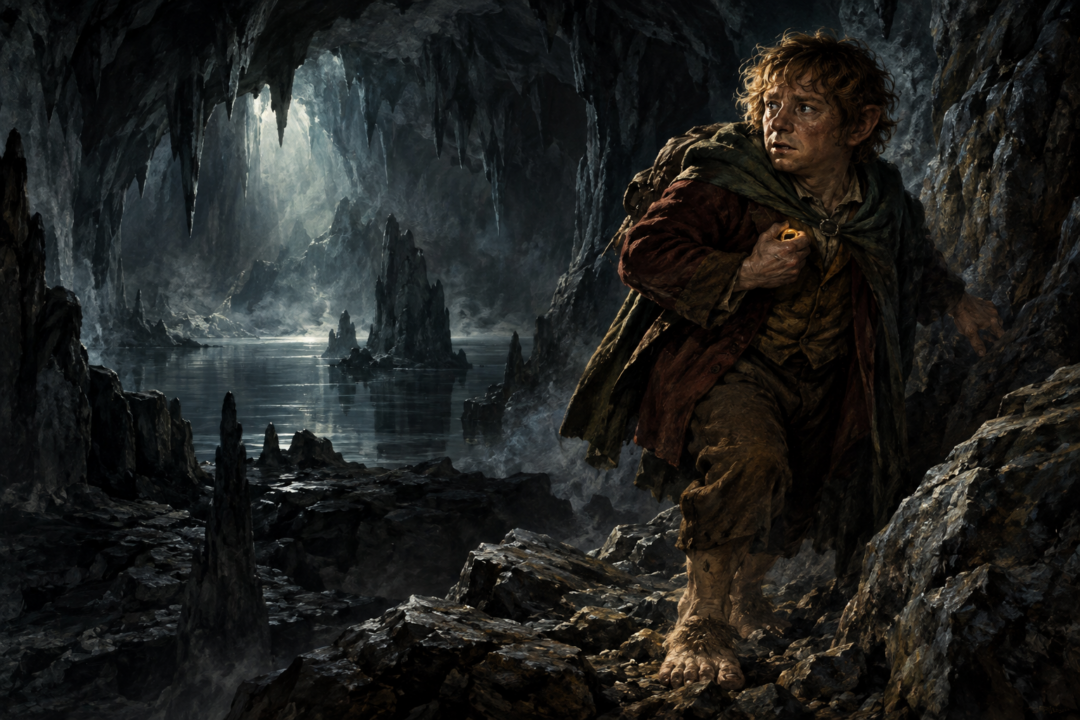
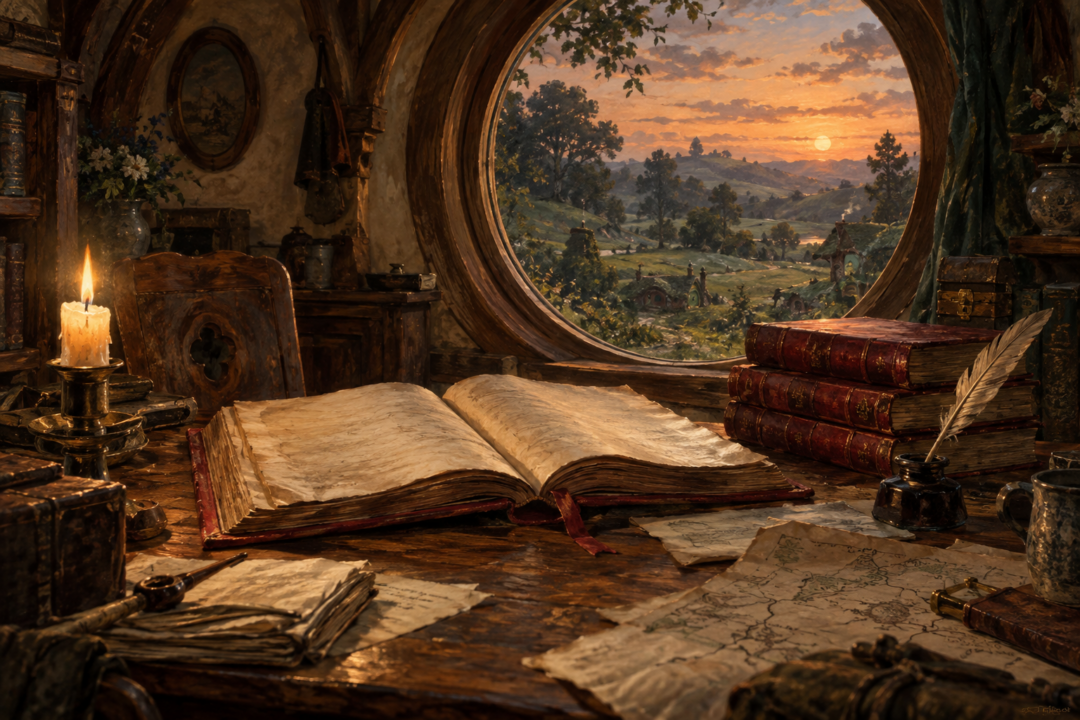
Bilbo’s red-bound book looks, at first, like one of the gentlest objects in Middle-earth. It begins as a hobbit’s private record of an improbable adventure. Frodo inherits it, fills its remaining pages with the War of the Ring, and eventually leaves it to Sam. Behind the familiar story, however, lies a stranger idea: the history we read is not presented as a perfect window onto Middle-earth.
It comes through witnesses, memoirs, loose notes, copies, corrections, translations, and later commentary.
The Prologue to The Lord of the Rings identifies the Red Book of Westmarch as the principal source for the history of the War of the Ring. The original manuscript does not survive within this fictional history. Instead, the text is imagined as descending through copies, including a particularly important manuscript prepared in Gondor by Findegil, the King’s Writer. Brief Notes
That framing device does something remarkable. It does not merely make Middle-earth seem old. It makes knowledge about Middle-earth feel historical: valuable, recoverable, but sometimes incomplete.
The Story We Read Has a History of Its Own
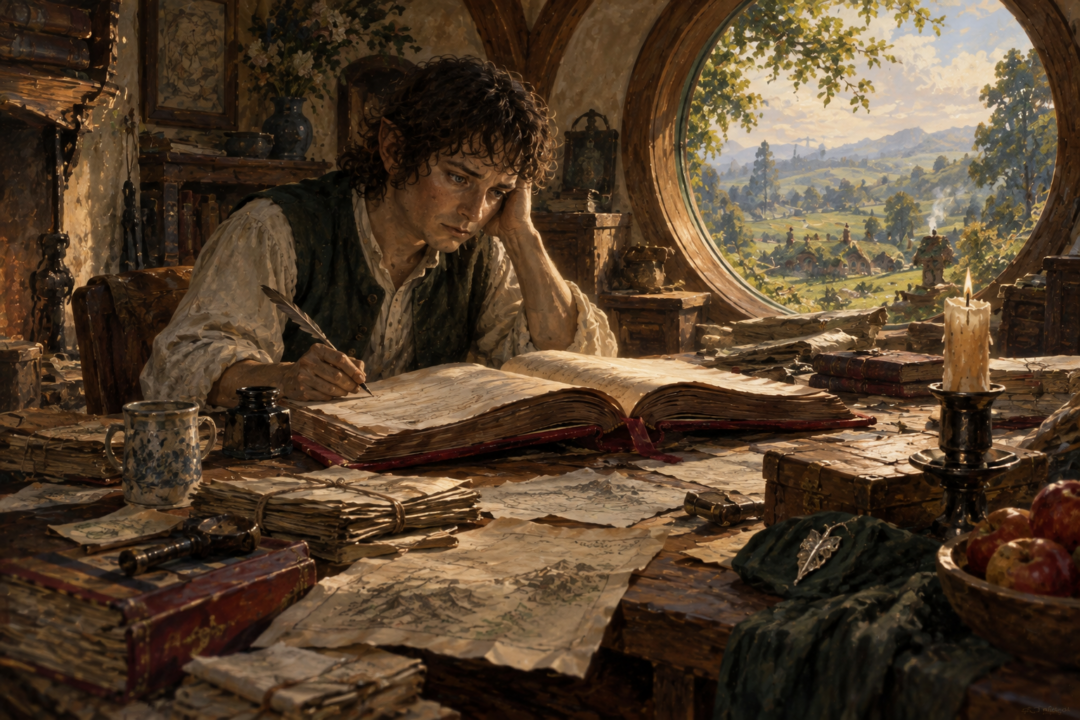
The Red Book began as Bilbo’s private diary. Frodo brought it back from Rivendell with additional notes and nearly filled its pages with his account of the War of the Ring. Bilbo’s three volumes of translations from Elvish lore were preserved with it, and in Westmarch another volume was eventually added containing genealogies, commentaries, and other material concerning the hobbits of the Fellowship. Lektsia
The crucial detail is what happened afterward.
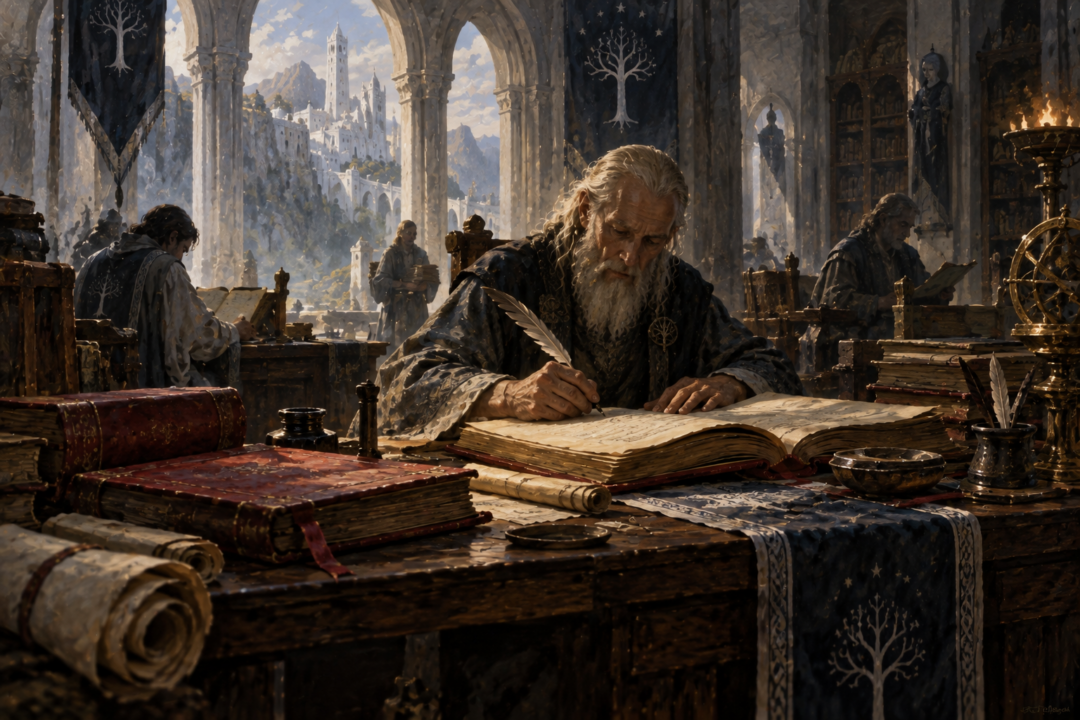
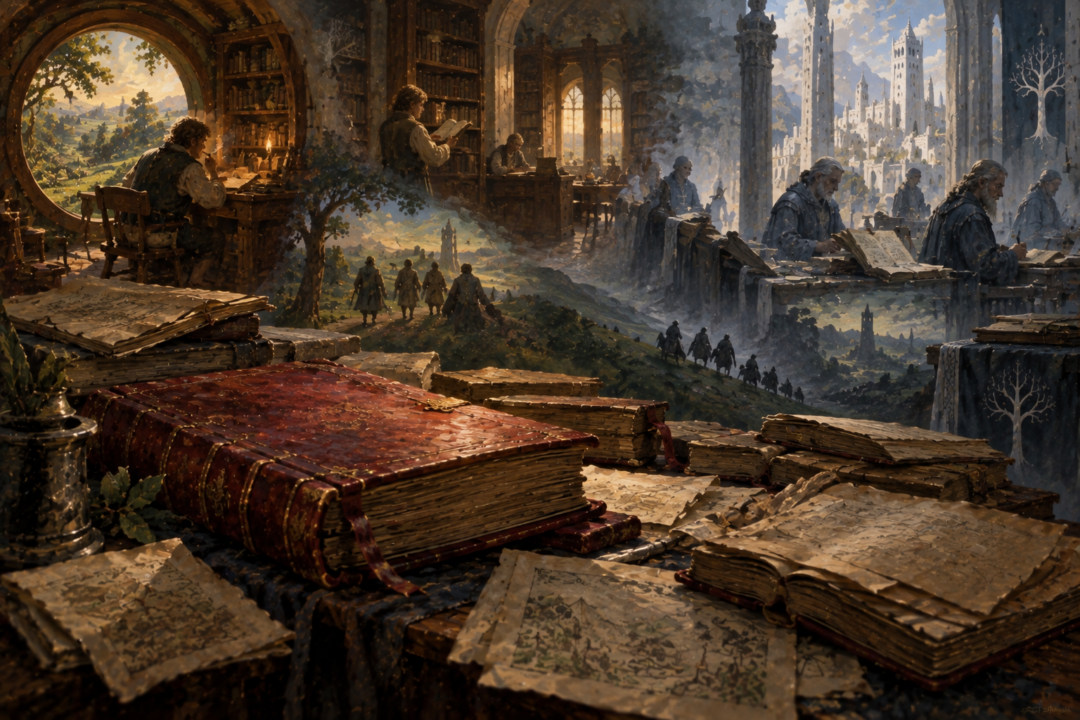
The original Red Book was not preserved. Copies were made. One important textual line passed through the Thain’s Book and Gondor, where the material received annotations and corrections, especially concerning Elvish names, words, and quotations. Findegil completed a major copy in the Fourth Age, and this manuscript was returned to the Shire and kept at Great Smials.
So the implied source behind The Lord of the Rings is already several steps removed from the events.
Someone experienced something.
Someone remembered it.
Someone wrote it down.
Other people added information.
Scribes copied it.
Scholars corrected parts of it.
And the whole surviving tradition was eventually rendered into the language in which the reader encounters it.
That is much closer to the transmission of an ancient chronicle than to an omniscient fantasy narrator.
Bilbo’s Story About Gollum Proves the Problem Is Real
The most important example is hiding in one of the most famous episodes in the entire legendarium: Bilbo’s discovery of the Ring.
Bilbo originally gave his companions a false account of what happened beneath the Misty Mountains. In that version, Gollum had promised him a present if Bilbo won the riddle-game. When Gollum could not produce it, Bilbo supposedly accepted help escaping instead.
But that was not what happened.
Bilbo had found the Ring accidentally, and Gollum had never voluntarily offered it to him. Gandalf became suspicious precisely because dishonesty of this kind was unusual for Bilbo. The false account was also written into Bilbo’s memoirs. The Prologue explains that Bilbo apparently never altered his own version, even after the Council of Elrond. Some copies therefore preserved his story, while others included the corrected account derived from Frodo or Sam. Isach
This is more than a clever explanation for different versions of The Hobbit.
Inside the fictional history, it establishes that an important primary source can be wrong.
And even more significantly, the error is preserved.
The later keepers of the tradition appear reluctant simply to erase Bilbo’s words. The result is something resembling real textual history: contradictory testimony can survive because the document itself matters.
The archive remembers not only what happened, but what people once believed—or wanted others to believe—had happened.
A Witness Can Be Honest and Still Know Only Part of the Story
The Red Book framework also encourages a distinction between dishonesty and limited perspective.
Bilbo’s false account of the Ring is an unusually clear case because the narrative explicitly identifies it as false. But much of Middle-earth’s history involves a subtler problem: witnesses simply cannot know everything.
Bilbo experiences the Quest of Erebor as Bilbo.
That sounds obvious, but Unfinished Tales, particularly “The Quest of Erebor,” demonstrates its importance. Gandalf’s later account supplies motives and circumstances surrounding Thorin’s expedition that Bilbo did not know during the adventure. Bilbo’s story is therefore not necessarily defective whenever it lacks something. It is the story available to the participant who lived through those particular events.
The same principle matters enormously for the War of the Ring.
Frodo cannot personally witness Aragorn’s entire road through the south while simultaneously crossing Mordor. Sam cannot know what Pippin sees in Minas Tirith unless that knowledge reaches him afterward. A comprehensive history of the War therefore requires recollection, comparison, and information supplied by multiple participants.
The Red Book is not simply memory written down.
It is memory assembled.
Middle-earth Contains Archives, Not Just Legends
After the War, the Shire itself develops a stronger historical consciousness.
The “Note on the Shire Records” says that the hobbits’ role in the great events at the end of the Third Age encouraged greater interest in their history. Traditions that had largely been oral were collected, and substantial libraries eventually existed at places including Undertowers, Great Smials, and Brandy Hall. Brief Notes
This changes the texture of the world.
Middle-earth does not merely contain ancient events waiting for the reader to discover them. It contains people trying to preserve those events.
That effort can succeed.
It can also fail.
Documents disappear. Copies differ. Traditions preserve fragments. Later scholars add commentary. Names require correction. Information from Gondor supplements records made in the Shire.
Even the Red Book itself accumulates layers.
History becomes something constructed from surviving evidence rather than something automatically available in perfect form.
Translation Adds Another Layer
There is another distance between the reader and the supposed original: language.
Appendix F presents the Common Speech, or Westron, as having been rendered into English, with names often translated according to their meanings. Thus familiar forms such as Rivendell represent names that would not literally have appeared that way in a Westron manuscript. The speech of Rohan is treated differently so that its linguistic relationship to the Common Speech can be suggested through another relationship familiar to an English-speaking reader. Google Groups
The effect is easy to overlook.
The English text is implicitly an interpretation.
Some linguistic distinctions cannot be reproduced exactly. Appendix F notes, for example, a distinction in Westron between familiar and deferential pronouns that ordinary English cannot neatly represent. Pippin’s speech in Minas Tirith therefore carried social implications for Gondorians that the translated dialogue cannot fully reproduce. ResearchGate
This means uncertainty exists not only in what survives, but in how surviving material can be communicated.
The reader is not standing directly inside the Third Age.
The reader is looking backward through language.
Why Contradictions Can Make the World Feel More Real
Fantasy worldbuilding often seeks consistency by eliminating contradictions.
The Red Book framework sometimes does the opposite.
A contradiction can become evidence.
Bilbo’s conflicting accounts reveal the Ring’s effect upon him. Differences between manuscript traditions suggest copying and editorial history. Gondorian corrections imply that Shire scribes did not possess perfect knowledge of Elvish language and lore. Later genealogies show descendants attempting to organize the memories of an earlier generation.
None of this means every apparent contradiction in the wider legendarium automatically has an in-world explanation. That would go beyond what the texts establish.
But where the Red Book framework explicitly applies, variation is part of the fiction.
Middle-earth can therefore feel less like a database in which every fact exists with equal certainty and more like a remembered past.
Some things are witnessed.
Some are reported.
Some are translated.
Some are reconstructed.
Some are lost.
The Great Irony of the Red Book
The deepest irony is that one of Middle-earth’s most important histories is largely preserved through hobbits.
Kings possess archives. Elves preserve memories stretching across Ages. Gondor has learned scribes and ancient records.
Yet the account through which the end of the Third Age is chiefly presented begins with Bilbo Baggins writing about his adventures.
That modest origin matters.
Bilbo writes because something extraordinary happened to him. Frodo continues because events far greater and darker than Bilbo’s adventure must be remembered. Sam inherits the unfinished pages because history does not end neatly when its central hero leaves.
Later generations copy, annotate, preserve, and study what they left behind.
The result is not absolute certainty.
It is continuity.
And perhaps that is exactly why the Red Book feels so convincing as an artifact of Middle-earth. It has authors. It has custodians. It has variants. It has mistakes. It has corrections. It even has a lost original.
The past survives, but never untouched.
That principle quietly runs beneath The Lord of the Rings. The reader receives an extraordinarily detailed history while being repeatedly reminded that history has travelled a very long road before reaching the page.
Middle-earth is therefore not only a world with a past.
It is a world in which people argue with, preserve, translate, correct, and sometimes misunderstand their past.
The uncertainty is not a crack in the worldbuilding.
It is part of what makes the world seem to have existed before the story reached us.
Sources & Notes
- Tolkien Gateway — Red Book of Westmarch https://tolkiengateway.net/wiki/Red_Book_of_Westmarch
- Tolkien Gateway — The Hobbit https://tolkiengateway.net/wiki/The_Hobbit
- Tolkien Gateway — The Quest of Erebor https://tolkiengateway.net/wiki/The_Quest_of_Erebor
- Tolkien Gateway — Findegil https://tolkiengateway.net/wiki/Findegil
These references document the Red Book’s layered authorship and manuscript transmission, Findegil’s copy, the revision of Bilbo’s account of the Ring, and the alternative perspective supplied by ‘The Quest of Erebor.’ The article’s argument that this source fiction builds historical uncertainty is interpretive synthesis.