
Lembas looks, at first, like the answer to one of warfare’s oldest problems.
An army must eat. Every soldier who marches needs food, and every wagon carrying food requires animals, drivers, roads, time, and still more provisions. Yet in The Lord of the Rings, the Fellowship leaves Lothlórien carrying small packages of Elven waybread so sustaining that it later becomes Frodo and Sam’s principal food as they struggle toward Mount Doom.
Why, then, could Gondor not solve its military supply problem with lembas?
The answer reveals something important about Middle-earth. Lembas was extraordinarily effective travel food, but it was never presented as an industrial foodstuff. Its usefulness depended not merely on how nourishing each cake was, but on who possessed it, how it was produced and distributed, and the ancient customs governing its use.
For a scout, messenger, mariner, or desperate traveler, those qualities made lembas almost ideal.
For thousands of soldiers, they created an entirely different problem.
Lembas Was Made for the Journey
The Sindarin name lembas is commonly translated as “waybread,” and that purpose is fundamental to understanding it.
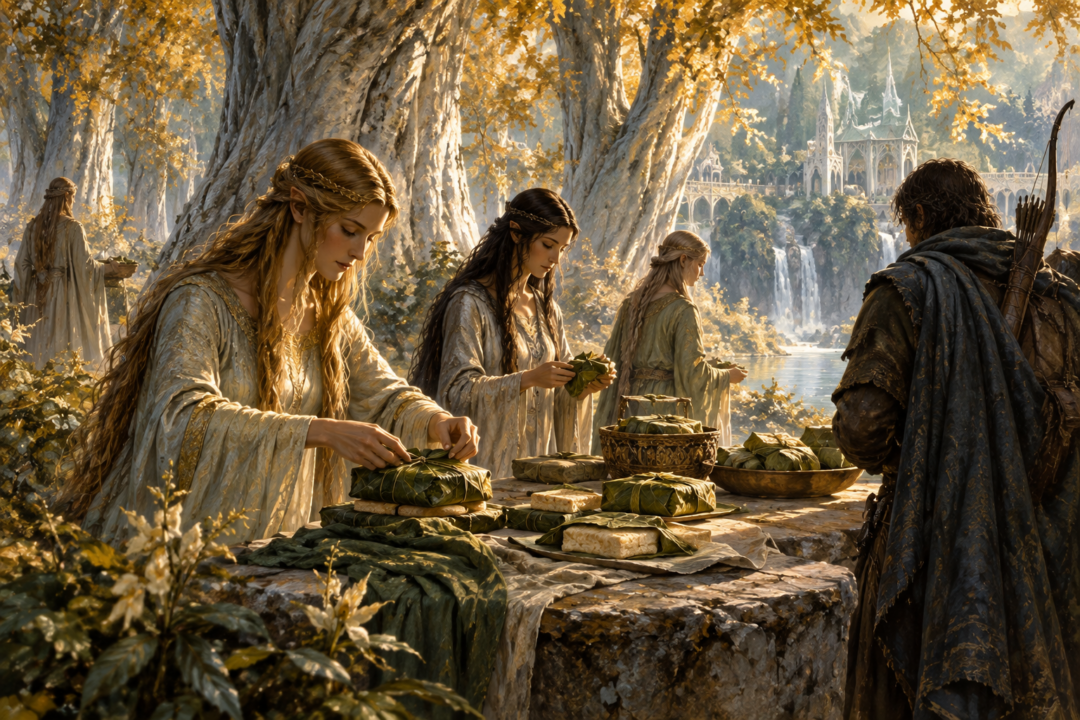
When the Fellowship prepares to leave Lothlórien, the Elves give them cakes that are thin, brownish on the outside and cream-colored within. They are wrapped so that they can remain fresh for a long time. The travelers are specifically warned that the food is more strengthening than the waybread made by Men and that relatively little is required.
This makes lembas exceptionally well suited to travelers who must carry everything themselves.
The Fellowship is the obvious Third Age example. They are only nine when they leave Rivendell, and fewer after Gandalf falls in Moria. They are not an army with wagons and organized supply lines. Once they leave Lórien, they are increasingly a small mobile company operating far from dependable sources of food.
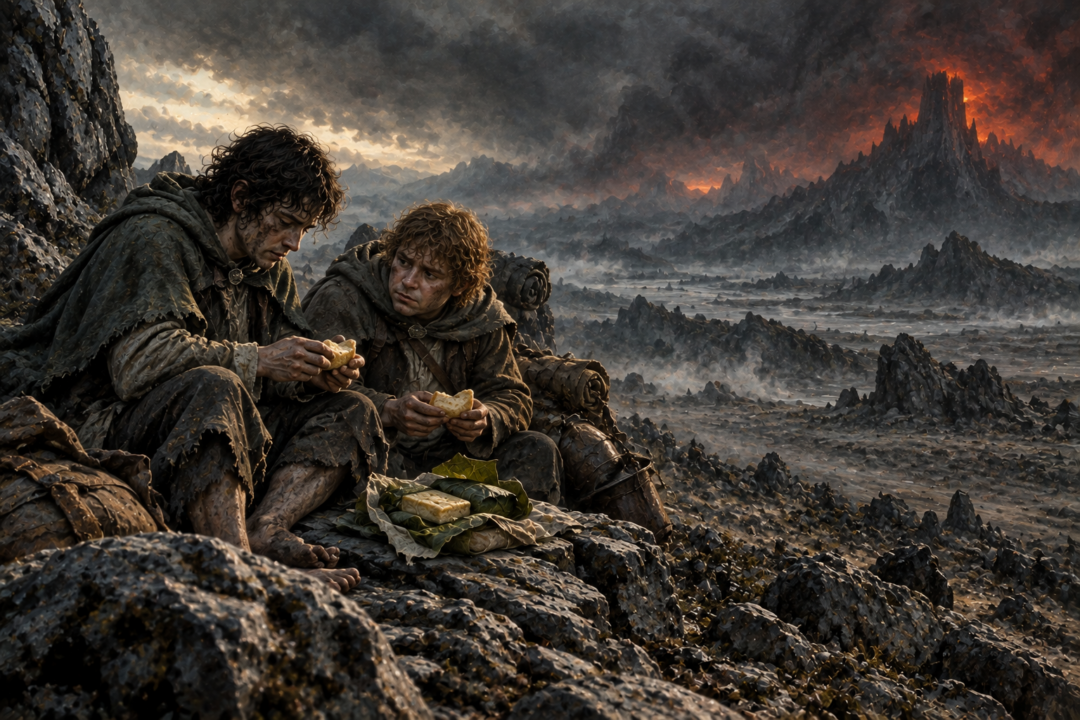
Frodo and Sam demonstrate the principle in its most extreme form. As their journey approaches Mordor, ordinary provisions disappear. Lembas becomes essential precisely because they are two travelers carrying their survival on their backs.
That is the environment in which lembas is most impressive: small numbers, extreme distances, limited carrying capacity, and little opportunity to resupply.
In other words, exactly the circumstances faced by scouts.
A Scout’s Problem Is Weight; an Army’s Problem Is Scale
Imagine a ranger or messenger sent several days beyond friendly territory.
Every additional meal normally means additional weight. More food reduces the space available for water, spare clothing, weapons, rope, blankets, and other necessities. Hunting or foraging may be unreliable, slow, or dangerously conspicuous.
Lembas changes that equation.
Its exceptional sustaining power means that a traveler can carry a comparatively small amount of food while remaining on the road for a long time. Its keeping qualities matter just as much. A ration that spoils quickly is of little use to someone crossing empty country.
But multiplying one scout by ten thousand soldiers does not automatically produce the same advantage.
An army does not merely need efficient food. It needs food that can be produced, accumulated, distributed, replaced, and transported in enormous quantities.
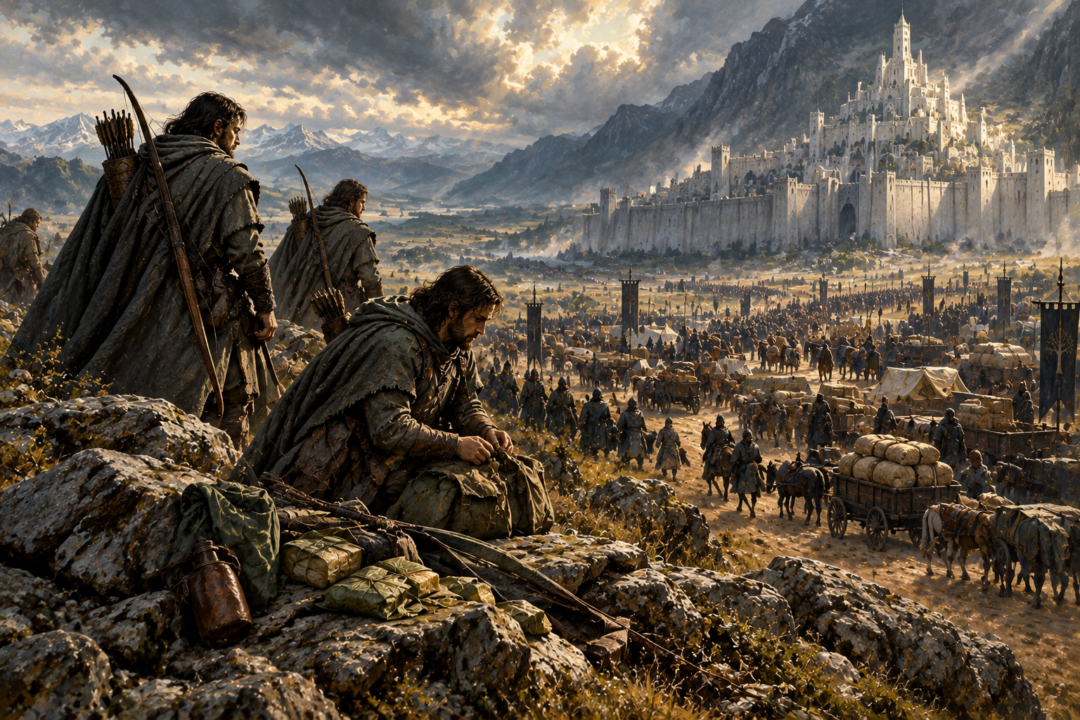
Nothing in the texts indicates that Gondor possessed the means to manufacture true lembas.
That distinction matters more than the bread’s nutritional power.
Lembas Was Not Ordinary Elven Baking
Later writings concerning lembas give it a much deeper history than the Fellowship initially understands.
The tradition associates the grain from which it was made with Yavanna and Aman. The special corn could grow swiftly under suitable conditions and required comparatively little sunlight, but its cultivation was surrounded by Elven practice and care.
The making and distribution of lembas were also governed by custom. Knowledge of its preparation belonged to designated Elven women, while its keeping and giving were traditionally associated with the highest-ranking woman of an Elven people—the “bread-giver.”
This makes the gift from Galadriel considerably more significant than handing the Fellowship a sack of exceptionally nutritious biscuits.
Lembas belonged to an inherited tradition.
The First Age provides an even clearer example. When Melian gives lembas to Beleg for Túrin, The Silmarillion emphasizes the extraordinary nature of the act: the Eldar had not previously permitted Men to use that waybread, and such gifts to mortals remained rare.
So although lembas could sustain mortals, availability was never simply a question of whether mortals would find it useful.
That alone makes the idea of provisioning Gondor’s armies with it difficult.
Gondor could not simply order another ten thousand rations from a bakery in Minas Tirith.
Even the Elves Used It Selectively
The known examples of lembas use follow a revealing pattern.
Melian sends it with Beleg in connection with Túrin.
Elven mariners sent west from Gondolin carried waybread for their voyage, and Voronwë later shared his remaining supply with Tuor.
Galadriel gives it to the Fellowship when they depart Lothlórien.
Frodo and Sam preserve and ration it on the road into Mordor.
These are exceptional journeys involving individuals or small companies. They are precisely the situations where a food with tremendous sustaining power and low carrying burden has its greatest value.
There is no comparable textual example of thousands of Elven warriors being routinely provisioned entirely on lembas for a campaign.
That absence does not prove that Elven armies never carried any. The texts simply do not provide enough evidence to make such a claim.
But it does mean we should resist turning lembas into something the stories never establish: a universally available military ration.
Its recorded role is overwhelmingly that of waybread.
Gondor Had a Different Kind of Food System
Gondor was a large human realm with cities, farms, roads, horses, fortifications, and military forces spread across considerable territory.
Its survival depended upon ordinary production.
The Pelennor Fields themselves were cultivated lands surrounding Minas Tirith, with farms and other agricultural infrastructure within the defended region. The city was therefore connected to a broader human economy capable of supporting a population and military establishment.
That is exactly what an army needs.
Military logistics rewards repeatability. Grain can be grown by many farmers. Flour can be transported. Bread can be baked repeatedly. Livestock can be raised. Supplies can be stored and moved from one settlement or depot to another.
None of this makes ordinary food superior to lembas for an individual traveler.
It makes ordinary food scalable.
That is the crucial difference.
Even if one cake of lembas could replace a much heavier quantity of ordinary provisions, Gondor would still need access to enough lembas for every soldier, day after day. The texts never suggest that Gondor possessed either its source crop or its method of manufacture.
A miraculous ration that cannot be manufactured by your kingdom is not a military supply system.
The Dúnedain Had Their Own Answer
There is, however, a fascinating detail that shows Men understood the value of concentrated traveling provisions.
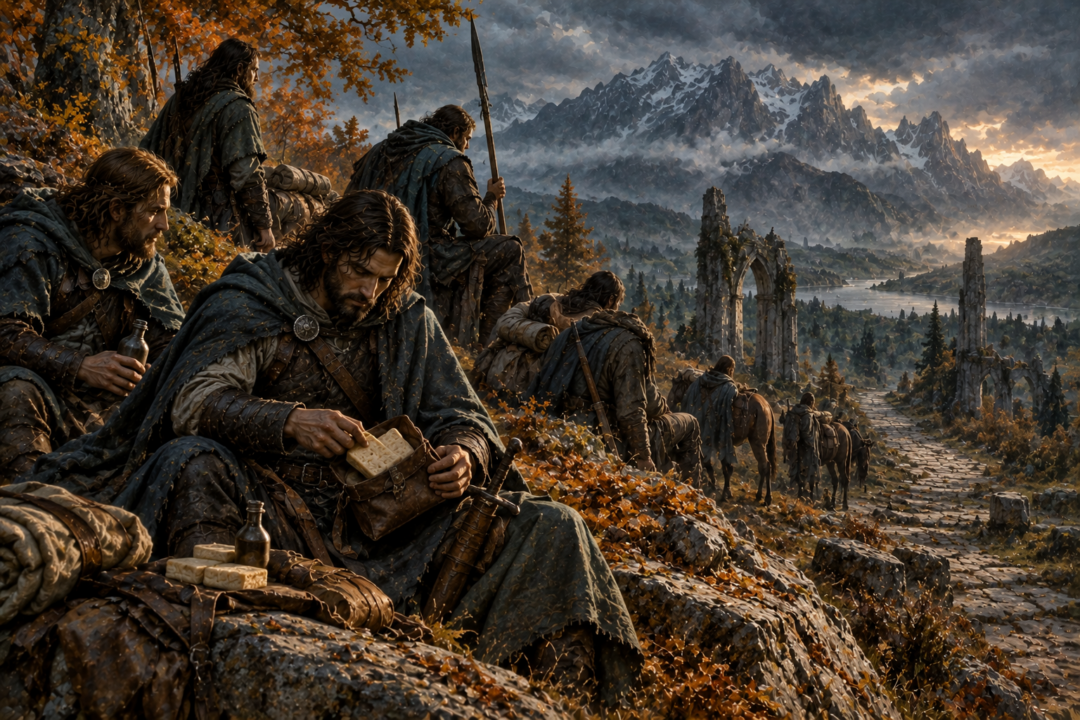
In the account of the Disaster of the Gladden Fields in Unfinished Tales, Isildur’s company carries a Númenórean form of waybread. Each man has wafers capable of sustaining life for many days, together with a small cordial.
This is not identified as true Elven lembas.
That distinction is enormously important.
The Dúnedain had apparently developed their own durable provisions for arduous journeys. Rather than demonstrating that Men could manufacture lembas, the episode shows something more plausible: they created an analogous solution using their own knowledge.
And the context again matters. Isildur’s company is traveling north after the War of the Last Alliance. The waybread is carried individually in sealed wallets. It is travel provisioning.
This provides perhaps the strongest model for what Gondorian scouts might realistically have carried.
A ranger operating in Ithilien need not possess Galadriel’s lembas to benefit from the same logistical principle. Durable, concentrated waybread—whether descended from Númenórean traditions or otherwise—would be immensely useful to soldiers moving independently.
But the surviving texts do not tell us that the Rangers of Ithilien specifically carried such wafers, so that possibility should remain exactly that: a plausible comparison, not established fact.
Why Lembas Becomes More Valuable as the Company Gets Smaller
There is a subtle irony in the Fellowship’s journey.
At first, lembas is one gift among many.
Later, after the Company breaks, its importance increases dramatically.
Frodo and Sam have no wagons. They have no pack animals. They cannot safely purchase supplies. Hunting becomes increasingly impractical, and the land itself becomes more barren as they approach Mordor.
Their logistical system has collapsed until almost nothing remains except what two hobbits can carry.
And that is when lembas approaches its perfect use case.
Its power is not that it can feed civilization.
Its power is that civilization can disappear behind the traveler, and the traveler can continue.
This helps explain why imagining Gondor replacing its grain stores with lembas misses the nature of the gift. Gondor’s armies belonged to a kingdom. They could draw strength from fields, roads, towns, storehouses, carts, animals, and organized labor.
Frodo and Sam eventually had none of those things.
They had what they could carry.
Could Galadriel Have Supplied a Few Gondorian Scouts?
In principle, true lembas would have been extraordinarily useful to a small reconnaissance party, messenger, or similarly isolated group.
But even here a distinction is necessary.
The texts establish that Galadriel possessed and distributed lembas in Lórien. They establish that mortals could eat it. They establish that giving it to mortals was exceptional rather than routine.
They do not establish a regular lembas supply arrangement between Lothlórien and Gondor.
So the strongest lore-grounded conclusion is not that Gondor actually issued lembas to its scouts.
It is that lembas is almost perfectly suited to the logistical requirements of scouts, while the cultural and production constraints surrounding it make mass provisioning an entirely different proposition.
A handful of cakes can transform the endurance of a handful of travelers.
An army requires thousands upon thousands of repeatable rations.
Those are not the same problem.
The Real Power of Waybread
Lembas is sometimes treated as though it were simply fantasy survival food: extraordinarily calorie-dense bread that conveniently removes the need to discuss meals.
The texts make it stranger and more interesting than that.
Its history reaches back into the Elder Days. Its making belongs to guarded knowledge and inherited custom. Its distribution carries significance. Giving it to mortals can itself be an act of unusual favor.
That is why its scarcity matters.
If Minas Tirith could manufacture lembas by the wagonload, much of what distinguishes it would disappear. It would become merely a superior military ration.
Instead, Middle-earth gives Men another answer: agriculture, roads, stores, carts, durable traveling foods, and the accumulated practical knowledge of their own civilizations.
Lembas belongs at the opposite extreme.
When the road has vanished, when ordinary supplies are gone, when the traveler must carry almost nothing and somehow continue, Elven waybread becomes priceless.
That is why it could have been superb food for a scout.
And why nothing in the lore suggests it could simply replace the fields and supply trains that kept Gondor’s armies alive.
Sources & Notes
- https://tolkiengateway.net/wiki/Lembas — Tolkien Gateway, Lembas (Tolkien primary-text references in article)
- https://tolkiengateway.net/wiki/Mass%C3%A1ni%C3%AB — Tolkien Gateway, Mass%C3%A1nië (Tolkien primary-text references in article)
- https://tolkiengateway.net/wiki/Melian — Tolkien Gateway, Melian (Tolkien primary-text references in article)
Relevant Tolkien text and chronology are referenced by the linked Tolkien Gateway entries; interpretive conclusions remain distinguished from canon.