Lembas Was Never Just Food: Why Elven Waybread Belonged to Care and Authority
When the Fellowship leaves Lothlórien, Galadriel gives them something far less spectacular than enchanted cloaks, boats, or the gifts she later places in individual hands. They receive small cakes of lembas, wrapped in leaves, meant to sustain them when ordinary provisions fail.
At first glance, lembas seems like Middle-earth’s perfect trail ration: light, durable, and extraordinarily sustaining.
But its history makes that explanation incomplete.
Lembas is not simply Elvish food technology. The texts repeatedly connect its keeping and distribution with female authority, especially the Queen or highest-ranking woman of an Elven people. It is reserved for exceptional need. When it crosses the boundary between Elves and Men, that act carries unusual significance.
Its power therefore lies in more than nourishment.
Lembas belongs to a distinctive kind of authority: the authority to preserve life, recognize need, and decide when something precious should be given away.
The Queen Did Not Merely Serve the Bread
One of the clearest statements about lembas appears in the story of Túrin.
When Beleg prepares to return to Túrin in the wild, Thingol allows him to choose a sword. Beleg selects Anglachel, a formidable weapon whose troubled nature Melian immediately perceives.
Melian then gives Beleg something entirely different.
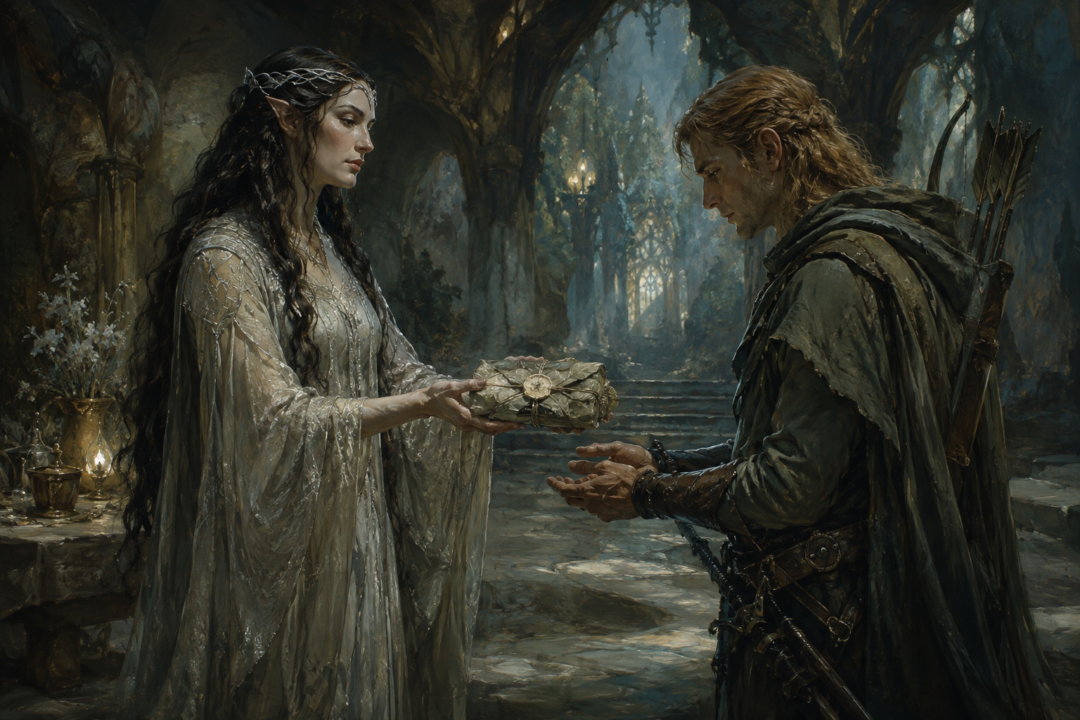
She provides him with lembas, wrapped in silver leaves and sealed with the Queen’s seal. The narrative explicitly explains that according to Eldarin custom, the keeping and giving of lembas belonged to the Queen alone.
That detail changes how the food should be understood.
This is not merely a royal kitchen supplying an expedition. Custody of lembas is itself attached to office and authority. Melian determines that Beleg may carry it and that he may use it to help others.
The contrast with Anglachel is especially striking, even if we should be cautious about treating it as a deliberately constructed symbolic opposition.
Thingol gives Beleg a weapon capable of defeating enemies. Melian gives him something capable of sustaining companions.
Both gifts matter in the dangerous country beyond Doriath.
But they represent radically different forms of power.
Melian’s Gift Crosses a Boundary
Melian’s decision matters even more because the intended beneficiary is Túrin.
The Silmarillion emphasizes that allowing Men to use lembas was extraordinarily rare. Melian’s gift therefore represents exceptional favour toward Túrin, even though the bread is physically entrusted to Beleg.
That favour is not sentimental decoration.
Túrin has left the ordered protection of Doriath and entered a life of hardship among outlaws. Beleg cannot simply remove every danger surrounding him. What Melian can provide is something that allows life to continue amid those dangers.
And Beleg does exactly that.
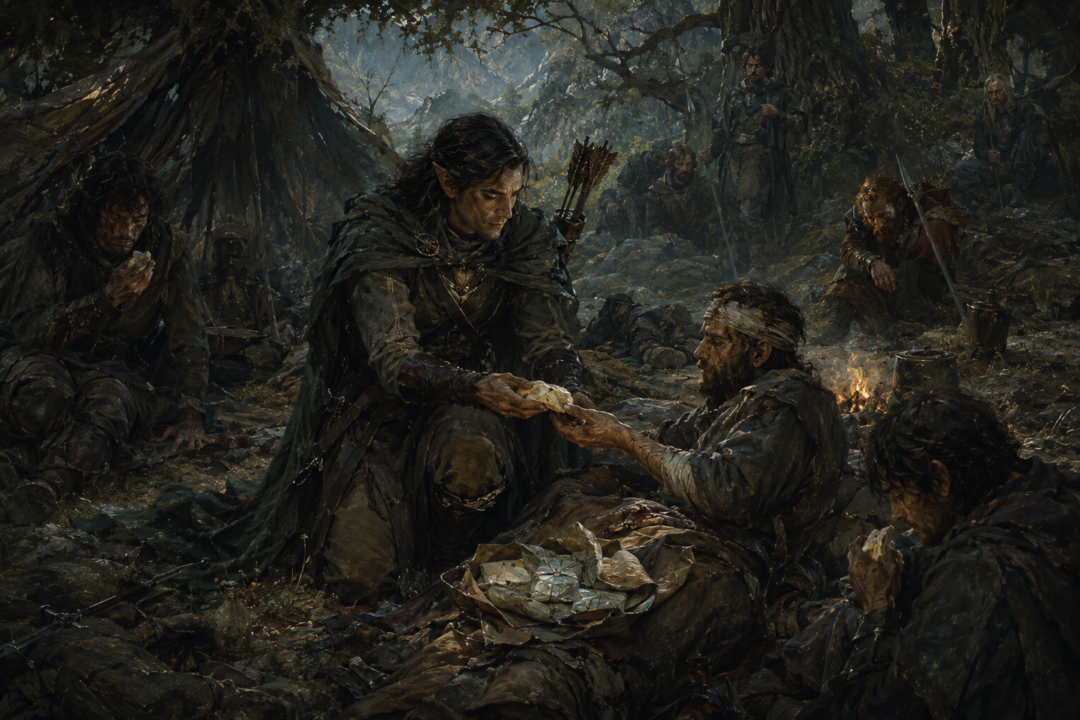
Among Túrin’s company, he tends the wounded and sick and gives them Melian’s lembas. The bread thus moves outward from the Queen, through a trusted bearer, toward people living beyond her immediate protection.
Authority becomes care at a distance.
That pattern helps explain why the Queen’s custody is important. Lembas is valuable partly because it is not ordinary food available without restriction. Its distribution requires judgment.
Someone must decide when the need is great enough.
The Older Tradition Makes the Pattern Even Clearer
A late text generally known as “Of Lembas,” published in The Peoples of Middle-earth, expands the tradition considerably.
Because this material belongs to Tolkien’s later writings rather than the main published narratives, its details should not simply be treated as though they appear directly in The Lord of the Rings. But it provides important insight into the conception behind lembas.
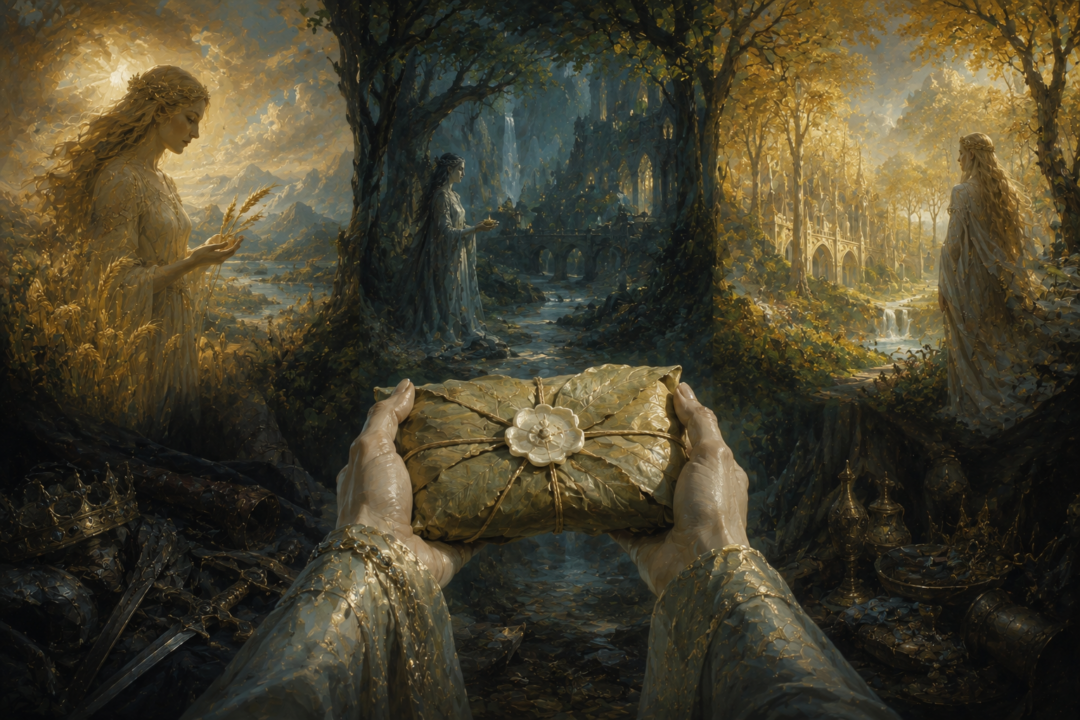
In this account, the grain from which lembas was made ultimately derives from Yavanna and from Aman. The knowledge surrounding it remained especially associated with Elven women.
Most significantly, its keeping belonged to the highest-ranking woman of an Elven people, whether she was called Queen or held another corresponding position. The tradition associates this office with titles connected to the making and keeping of the bread.
The underlying idea is remarkably consistent with Melian’s role in The Silmarillion.
Lembas is not common wealth simply stored in a palace.
Its custodian possesses responsibility over a life-preserving gift.
That distinction matters. Authority here is expressed not by commanding armies or pronouncing judgments but by deciding when preservation is necessary and who may receive what has been carefully guarded.
Galadriel Continues the Same Pattern
Thousands of years later, the Fellowship encounters essentially the same pattern in Lothlórien.
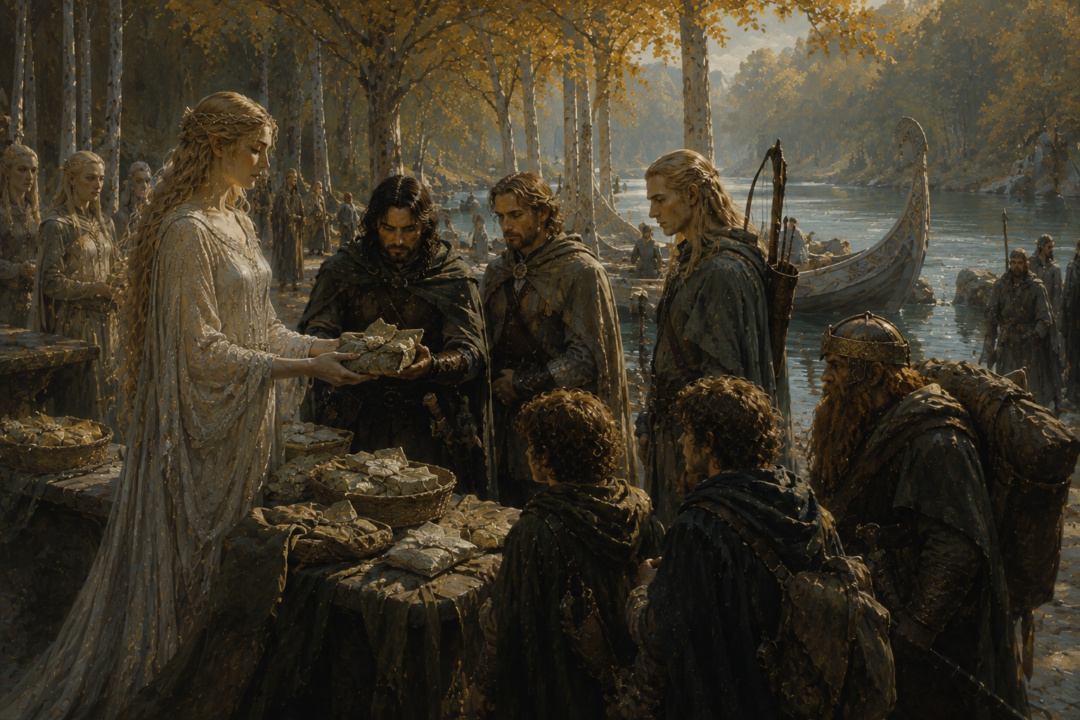
Before their departure, the travellers are supplied with lembas. They are told that it is stronger than food made by Men and that a relatively small amount can sustain a traveller through prolonged exertion.
Galadriel’s gift is therefore practical. The Fellowship is heading into increasingly dangerous country with no certainty of where its members will find food.
Yet the older history gives the scene greater weight.
Galadriel is not handing out an amusing Elven delicacy.
She is giving outsiders something traditionally guarded and rarely shared with Men.
The Fellowship contains Elves, Men, Hobbits, a Dwarf, and a Wizard, and the gift is made because their road has become desperate enough to justify it.
The same logic visible in Melian’s gift appears again: precious nourishment is released from protected Elven lands so that others may survive beyond them.
Lembas Becomes Most Important When Everything Else Disappears
The deepest significance of Galadriel’s provision does not become clear in Lórien.
It becomes clear in Mordor.
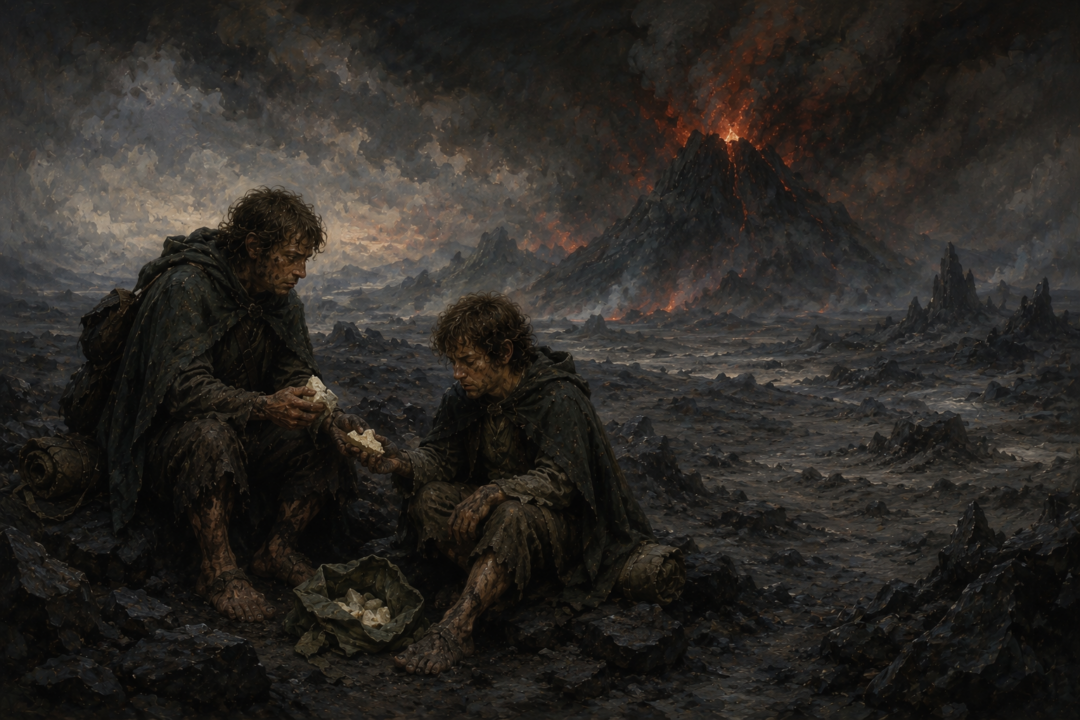
By the final stages of Frodo and Sam’s journey, almost every ordinary support has been stripped away. Their companions are gone. Their strength is failing. The landscape itself offers little that can sustain them.
Lembas remains.
Near the end, its effect is described as going beyond simply filling the stomach. As Frodo and Sam depend increasingly upon it, the waybread strengthens their endurance and helps them continue when their physical reserves are nearly exhausted.
The text does not make lembas limitless or miraculous in the crude sense. It does not eliminate thirst, exhaustion, fear, or suffering. Frodo and Sam still approach the limits of what their bodies can endure.
What it gives them is enough strength to continue.
That is exactly what waybread should do.
It does not replace the journey.
It makes another step possible.
Even Gollum Reveals What Lembas Is
Gollum’s reaction provides another revealing contrast.
He cannot comfortably eat lembas and rejects it. The narrative does not give a simple mechanical rule explaining this response, so it is better not to turn the episode into an elaborate theory about who is spiritually permitted to consume Elven food.
Still, the contrast is hard to miss.
Frodo and Sam increasingly depend upon a food preserved within Elven tradition and given freely for their need. Gollum, whose existence has been shaped for centuries by possession, hunger, secrecy, and the Ring, cannot share comfortably in it.
Lembas belongs to an economy of gift rather than possession.
Nobody in the Fellowship earns it. Nobody conquers Lórien to obtain it. Galadriel does not trade it for obedience.
It is entrusted to them because they will need it.
A Different Kind of Power in Middle-earth
Middle-earth contains many objects whose importance comes from control.
The One Ring dominates wills. Palantíri allow distant sight but become dangerous when users attempt to master circumstances beyond their wisdom. Great weapons preserve the memory of victories and bloodshed. Thrones, fortresses, and heirlooms establish political legitimacy.
Lembas operates differently.
Its custodian possesses something rare, but the purpose of that custody is ultimately release.
The Queen keeps the bread so that it can be given rightly.
That makes lembas an unusually clear example of authority ordered toward preservation rather than domination.
Melian does not accompany Túrin into the wilderness, yet her care reaches him there. Galadriel does not walk into Mordor with Frodo and Sam, yet something placed in their hands beneath the trees of Lórien remains with them almost to the end.
Neither woman controls what happens after the gift leaves her keeping.
That may be the most important point.
The giver provides strength without taking ownership of the recipient’s road.
The Meaning Hidden Inside the Waybread
Calling lembas “provisions” is therefore accurate, but insufficient.
It is food for travellers. It keeps for long periods. It sustains the body under extraordinary hardship.
Yet the customs surrounding it turn provisioning into something larger.
The right to keep lembas belongs to a figure entrusted with discerning need. Giving it can mark extraordinary favour. Receiving it means carrying the care of a protected realm into places where that realm’s protection cannot otherwise reach.
And at the darkest point of the Ring-bearer’s road, the humble gift proves more immediately useful than many objects that appear far grander.
That is one of the quiet patterns running through Middle-earth: power is not always revealed by what someone can command.
Sometimes it is revealed by what they have been trusted to preserve—and by knowing when the time has come to give it away.
Sources & Notes
- The Encyclopedia of Arda — Waybread: overview of lembas, its sustaining properties, and the special authority governing its making and distribution — https://www.glyphweb.com/arda/w/waybread.html
- The Encyclopedia of Arda — Galadriel: background on the Lady of Lórien who provisions the Fellowship with lembas — https://www.glyphweb.com/arda/g/galadriel.html
- The Encyclopedia of Arda — Melian: background on the Maia associated with the guarded tradition of waybread in Doriath — https://www.glyphweb.com/arda/m/melian.html
- The Encyclopedia of Arda — Doriath: context for the Sindarin realm in which the lembas tradition was preserved — https://www.glyphweb.com/arda/d/doriath.html
Sources document the key people, places, institutions, and chronology used in this interpretation.