By the time Frodo and Sam cross Mordor, almost everything that once made travel possible has been stripped away from them. They have no guide. Their food is dwindling. Water is uncertain. Frodo is weakening beneath the Ring. And ahead lies a country built not merely tolkiengateway.net own armies efficiently through a landscape where two wandering hobbits should be painfully conspicuous.
Then something absurd happens.
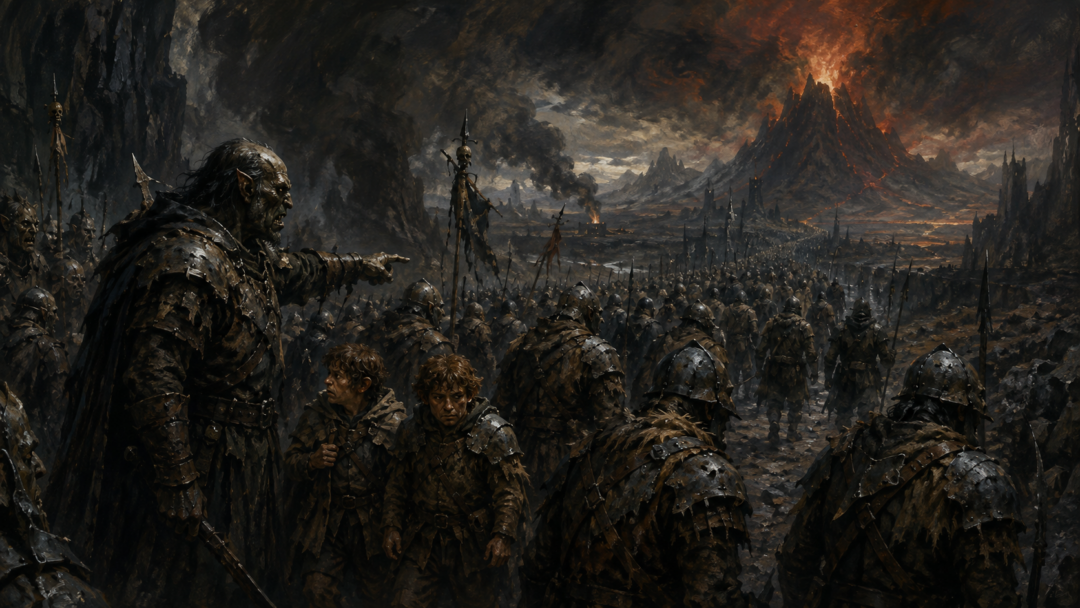
Frodo and Sam are overtaken by a company of Orcs.
Instead of exposing them, the Orcs mistake the disguised hobbits for stragglers of their own kind and force them into the ranks.
It is brutal. Frodo is driven almost beyond endurance. Sam reaches the point where he is prepared to attack one of their tormentors rather than watch his master collapse.
Yet the episode also gives them something they desperately need.
For a few dangerous hours, Mordor stops treating Frodo and Sam as intruders.
Its own military machine carries them forward.
They Are Already Wearing the Enemy’s Identity
The accident begins much earlier, in the Tower of Cirith Ungol.
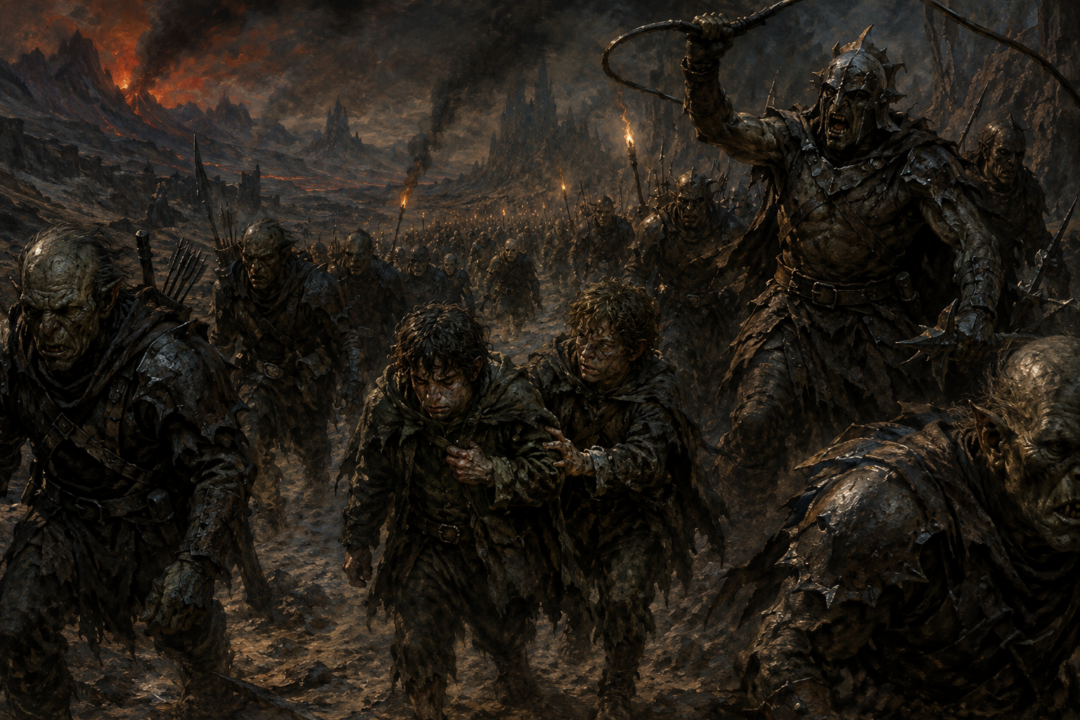
After Sam rescues Frodo, the hobbits cannot simply walk out dressed as travellers from the Shire. They take Orc clothing and equipment from the tower and disguise themselves before entering Mordor.
That disguise is imperfect. Frodo and Sam are far smaller than the great Uruks, and neither understands the organization of Sauron’s armies. But Mordor contains different breeds and sizes of Orcs, and in darkness their appearance is apparently convincing enough.
This matters because Mordor is no empty wilderness.
Frodo and Sam can see evidence everywhere that enormous forces are being gathered and moved. Roads, camps, fortifications and troop movements make the interior of the Black Land dangerous precisely because it is occupied.
On 18 March 3019, they are travelling along the road leading from the region of Durthang toward the Isenmouthe when an Orc company catches them. The Orc leader does not stop to conduct a careful investigation. In the darkness, the two small figures in Orc gear are simply taken for members of the army who have fallen out of place.
The disguise has suddenly become more useful than Frodo and Sam could have planned.
They are not hiding from the enemy.
They are hiding inside it.
The March Gives Them the Protection of Being Ordinary
This is perhaps the strangest advantage the march provides.
For most of the Quest, Frodo survives by avoiding attention. In Mordor, however, concealment becomes increasingly difficult. There are patrols, roads, strongholds and armies everywhere. Two solitary travellers creeping through such a landscape can attract suspicion simply because they are solitary.
Inside the Orc column, that problem reverses.
Now Frodo and Sam are surrounded by enemies, but those enemies provide camouflage.
An observer seeing the marching company has little reason to inspect every individual soldier. Frodo and Sam become two small shapes among many others, driven forward with the rest.
The enemy’s expectation protects them.
Sauron’s servants expect to see Orcs on an Orc-road. They expect those Orcs to be marching north and east under orders. They expect smaller troops to be bullied by larger ones.
Frodo and Sam fit the pattern just well enough.
The scene quietly demonstrates one of the weaknesses of a vast authoritarian war machine: it can become dependent on obedience and appearances. The Orc commander is interested in keeping the column moving, not in discovering the personal history of every exhausted soldier.
Frodo and Sam survive because, for once, nobody thinks they are important.
Mordor Forces Them to Move Faster Than They Could Move Alone
The second accidental gift is far more painful.
Speed.
Frodo is already deteriorating. The Ring feels increasingly burdensome as he approaches the place where it was forged, and the physical journey itself has nearly exhausted him. Left to themselves, the hobbits must move cautiously, stop frequently and avoid every visible concentration of enemies.
The Orcs allow none of that.
Once absorbed into the company, Frodo and Sam must match its punishing pace.
The march is not a comfortable ride through Mordor. It is forced movement under threat of violence. Smaller Orcs are themselves being driven hard, with larger Uruks enforcing discipline. Frodo and Sam are trapped within the same system of coercion.
For Frodo especially, the cost is terrible. By the time the road descends toward the plain, his strength is failing, and Sam fears that he will collapse and expose them both.
Yet every step they are forced to take is still a step deeper into Mordor.
They could never have chosen such a pace for themselves.
The enemy chooses it for them.
That is the cruel irony: the march nearly destroys Frodo, but it also pushes him farther along the route toward the final stage of his Quest.
The Orc Road Becomes Safer Than the Wilderness
Earlier in Mordor, Frodo and Sam repeatedly struggle with terrain.
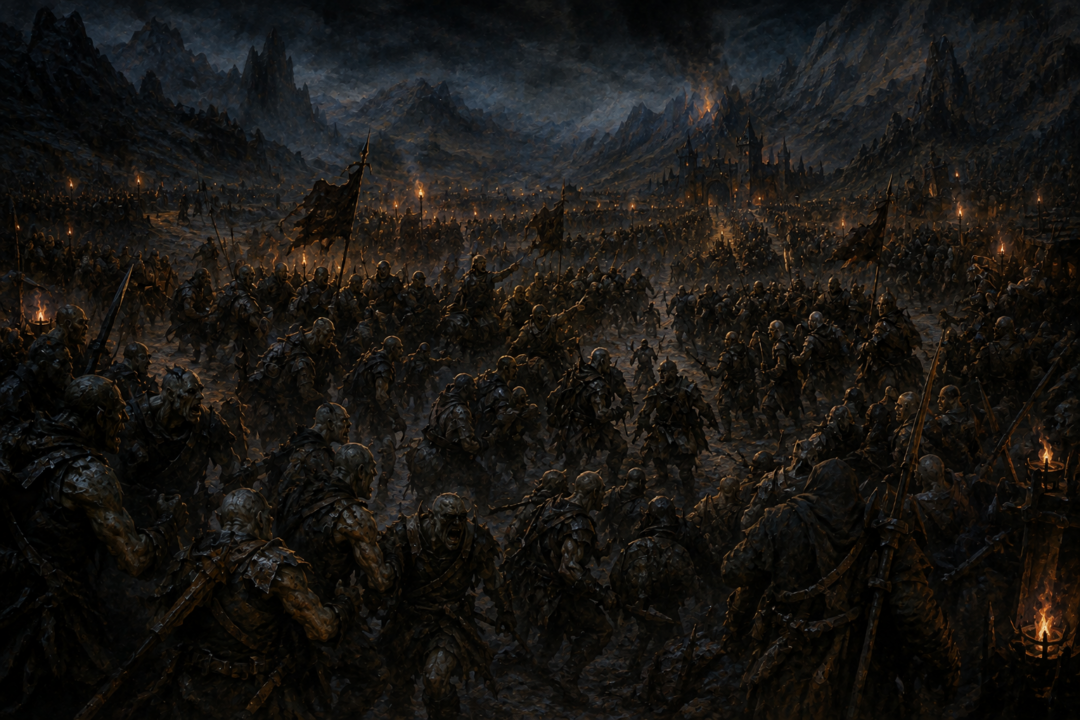
The mountains and ravines of the western interior make direct travel extraordinarily difficult. Their attempt to find a usable route ultimately leads them toward established roads because roads are the only practical way to cover certain stretches of ground.
But a road in Mordor creates an obvious problem.
Roads belong to Sauron.
They are used by messengers, patrols and armies.
Normally, travelling openly upon one would be an enormous risk. The Orc march briefly removes that contradiction. Frodo and Sam are no longer two strangers using the Enemy’s road; they appear to be part of the force for which the road exists.
The infrastructure intended to strengthen Mordor momentarily helps the people trying to destroy its master.
There is no suggestion that this was planned. Frodo and Sam did not arrange to be captured by the column, and they certainly do not welcome it.
But once it happens, Mordor’s road network carries them forward under the cover of Mordor’s own army.
Aragorn’s Challenge Turns the March Into an Escape Route
The most important part of the episode comes at its end.
Frodo is approaching his limit when the marching Orcs reach an area where several roads converge near the entrance to Udûn. Troops are being moved in response to the advance of the Captains of the West.
That movement is not accidental.
Aragorn, Gandalf and the surviving leaders outside Mordor have deliberately marched toward the Black Gate after the Battle of the Pelennor Fields. Their strategic hope is to draw Sauron’s attention away from his own land and give the Ring-bearer whatever chance remains.
They do not know Frodo’s exact position.
But their gamble works.
Sauron is concentrating forces against the approaching army. As different companies meet near the road junction, confusion breaks out. The troops jostle and struggle for precedence.
That disorder gives Sam the opening he needs.
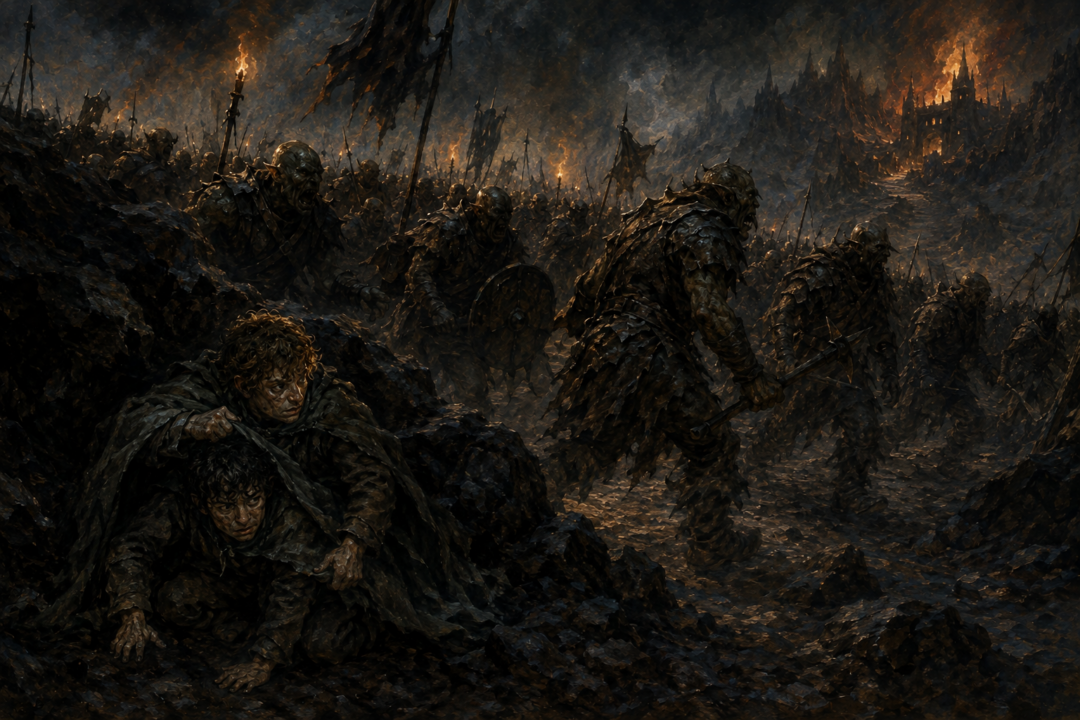
He pulls Frodo down, and the hobbits crawl away from the mass of Orcs into the darkness. The same mobilization that forced them into the march now helps conceal their escape.
The Orc march therefore becomes part of a much larger pattern.
Sauron is looking outward.
His enemies are moving toward the Black Gate.
And the real danger is already inside his country.
The Enemy’s Strength Creates Blind Spots
It would be easy to describe Frodo and Sam’s escape as mere luck.
Luck is certainly involved.
But the circumstances also expose structural weaknesses in Sauron’s power.
His armies operate through fear, compulsion and rigid command. Orcs themselves complain about orders from above and are repeatedly shown quarrelling among themselves. The troops that seize Frodo and Sam are being driven toward war because Sauron requires bodies at the front.
That system is formidable when everyone knows where the enemy is.
It becomes less reliable when the enemy looks insignificant.
Frodo and Sam are too small to resemble the threat Mordor expects. They possess no army. They do not approach Barad-dûr as conquerors. They carry no banner.
They merely keep moving.
The Orc commander sees two undersized soldiers who need to be whipped back into formation.
Sauron’s entire military structure sees essentially the same thing: nothing important.
And that failure of imagination is precisely what the Quest requires.
The Gift Is Real, but It Almost Kills Frodo
None of this makes the Orc march a fortunate event in any simple sense.
The hobbits receive speed and concealment at the price of enormous physical danger.
Frodo nearly collapses.
Sam nearly abandons concealment in order to attack their driver.
Had Frodo fallen a little earlier, the disguise could have failed. Had one Orc examined them carefully, the Quest might have ended. Had the road junction been quieter, they might have been driven all the way into a controlled military position from which escape was impossible.
Their advantage exists only because several dangers happen to overlap in exactly the right way.
That is why the scene works so well.
What saves Frodo and Sam is not sudden strength.
It is the enemy’s inability to recognize what weakness can accomplish.
Mordor Carries the Ring Closer to Its Own Destruction
After escaping the Orcs, Frodo and Sam are still far from safety.
At dawn Sam can see Mount Doom in the distance, and the realization that their remaining provisions may be enough only for the outward journey brings him face to face with the possibility that neither of them will return. The road toward Orodruin remains terrible.
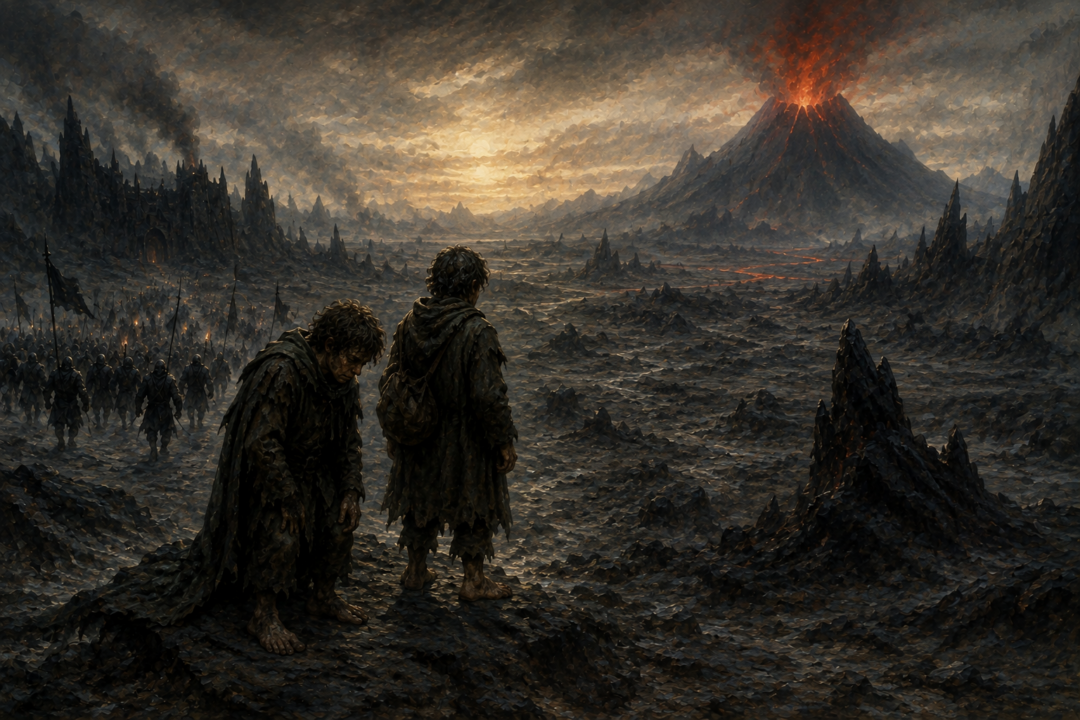
It's a Dangerous Business, Frodo
But the Orc march has changed their position.
For several hours, they have travelled openly through one of the most dangerous regions in Middle-earth while surrounded by the very servants who would have killed them if their identities were known.
The paradox is almost perfect.
Sauron built roads to move his armies.
His officers used violence to keep those armies moving.
His mobilization filled those roads with troops.
And because Frodo and Sam looked sufficiently like two miserable soldiers caught in that machinery, the machinery swallowed them instead of stopping them.
Then it carried them forward.
The Orcs never choose to help the Ring-bearer.
They never even know he is there.
That is exactly why the moment is so dangerous—and why its accidental gift matters so much.
For a few desperate hours, the road to Mount Doom is hidden inside an Orc march.
Sources & Notes
- The Encyclopedia of Arda — Orcs: overview of the armies whose discipline and movements Frodo and Sam exploit inside Mordor — https://www.glyphweb.com/arda/o/orcs.html
- The Encyclopedia of Arda — Mordor: geographical context for the hostile land the hobbits must cross toward Orodruin — https://www.glyphweb.com/arda/m/mordor.html
- The Encyclopedia of Arda — Frodo Baggins: biographical reference covering Frodo’s passage through Mordor as Ring-bearer — https://www.glyphweb.com/arda/f/frodobaggins.html
- The Encyclopedia of Arda — Samwise Gamgee: biographical reference covering Sam’s support of Frodo during the final crossing of Mordor — https://www.glyphweb.com/arda/s/samwisegamgee.html
Sources document the key people, places, institutions, and chronology used in this interpretation.