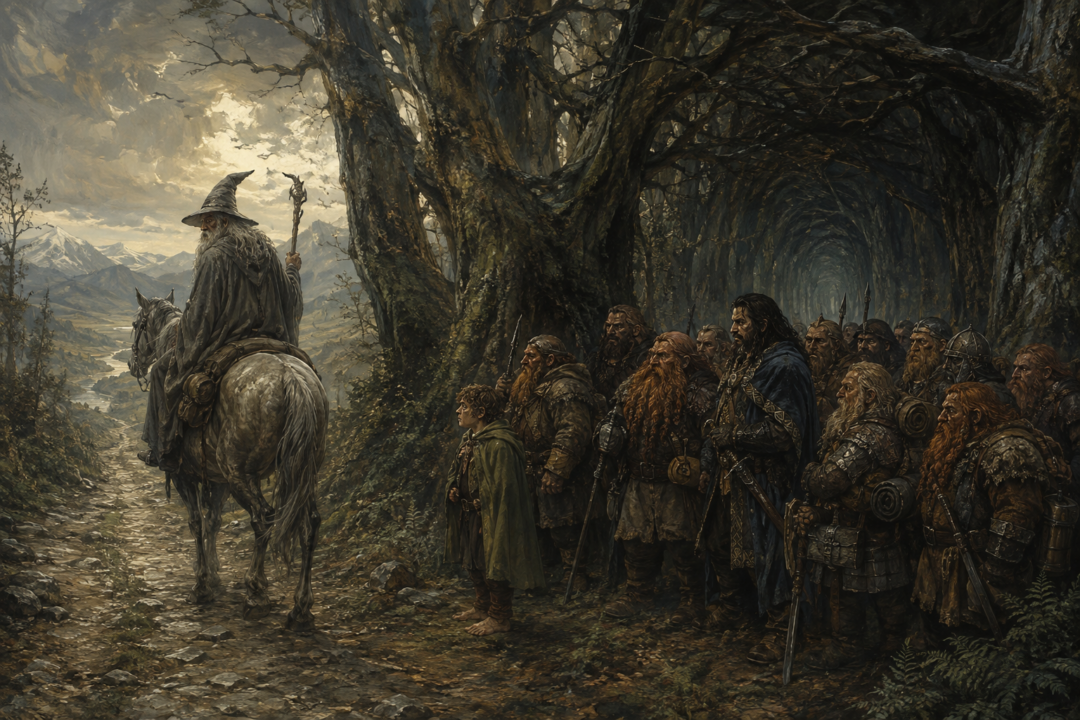
At the western edge of Mirkwood, Bilbo faces one of the most frightening moments of his journey—and no dragon is anywhere in sight.
The road disappears beneath dark trees. Beorn has warned the travellers not to leave the path. Somewhere beyond the forest waits the Lonely Mountain and Smaug. Yet just when Thorin’s Company seems to need its wizard most, Gandalf announces that he is leaving.
To Bilbo and the Dwarves, the timing looks almost absurd.
But Gandalf is not abandoning the Quest of Erebor. He is moving from one part of a much larger struggle to another.
His mysterious “pressing business away south” connects The Hobbit directly to the return of Sauron, the White Council, and the strategic importance of the very quest Gandalf appears to be leaving behind. And his departure also forces something that cannot happen while he remains beside Bilbo: the burglar must finally become capable of surviving without him.
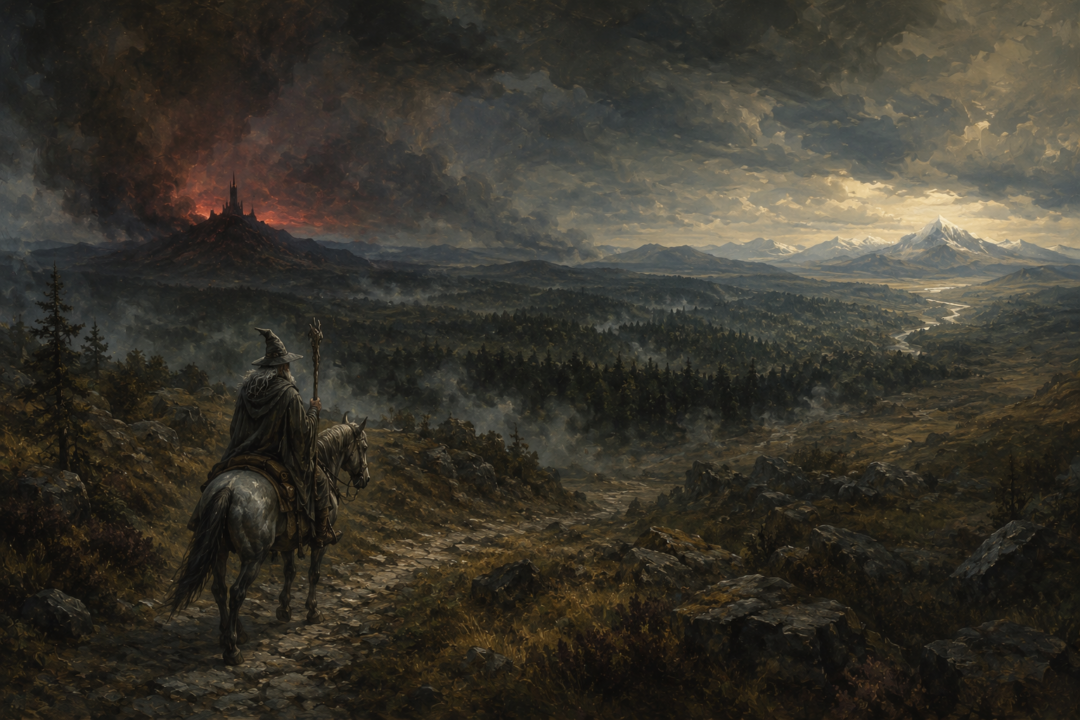
Gandalf Warns Them Before They Reach Mirkwood
Gandalf’s departure is not a sudden whim.
After the Eagles rescue the travellers from the goblins and wolves, Gandalf tells them that he will soon have to leave. By the time they reach Beorn’s country, the Company therefore knows that its wizard will not accompany it all the way to Erebor.
At the Forest Gate, Gandalf confirms that the moment has arrived. He has “pressing business away south,” and he says that he is already late.
The Dwarves are understandably dismayed. Mirkwood is precisely the kind of place where having Gandalf seems most valuable.
The forest is dangerous enough that both Beorn and Gandalf emphasize one central rule: the travellers must remain on the path. Gandalf cannot promise that they will meet again. Their survival, he tells them, will depend upon their own courage, sense, and luck.
Then he points to the least impressive-looking member of the expedition.
Bilbo.
Gandalf insists that there is more in the Hobbit than the others realize.
That confidence becomes crucial almost immediately.
The “Business Away South” Was Far Bigger Than Thorin’s Quest
The Hobbit initially keeps Gandalf’s other business mysterious. Later material makes the larger chronology clear.
In the same year as the Quest of Erebor, Third Age 2941, the White Council moved against the Necromancer in Dol Guldur.
And the Necromancer was Sauron.
Gandalf had already discovered this before Bilbo ever left Bag End. He had entered Dol Guldur and learned that the power occupying the fortress was not merely some obscure sorcerer. During one of his ventures there he had also found the imprisoned Dwarf-king Thráin, Thorin’s father, and received from him the map and key that would eventually make the Quest of Erebor possible.
These threads are therefore connected long before Mirkwood.
According to the chronology preserved in The Lord of the Rings, the White Council attacked Dol Guldur in 2941. Saruman had previously opposed an assault but now agreed to it. Sauron, however, had anticipated his enemies and withdrew, later openly returning to Mordor.
So when Gandalf rides away from Bilbo and Thorin, he is not leaving an important mission for an unrelated errand.
He is turning toward Sauron.
Gandalf Was Fighting Two Dangers at Once
The deeper reason for Gandalf’s behaviour appears in the account of the Quest of Erebor preserved in Unfinished Tales.
Gandalf was worried not only about Sauron in the south but also about Smaug in the north.
A living dragon occupying Erebor was more than Thorin’s personal tragedy. Smaug was an enormous potential danger in any future war. Gandalf feared what might happen if Sauron used the dragon against his enemies.
This helps explain why he became involved with Thorin at all.
Restoring the Dwarves of Durin’s Folk to Erebor was not simply a treasure hunt from Gandalf’s perspective. Removing Smaug and strengthening the North could serve the wider resistance to Sauron.
Gandalf could not know exactly how the quest would unfold. He certainly did not possess a detailed plan in which Bilbo would discover Smaug’s weak point and Bard would kill the dragon. But he understood the strategic problem.
There were two dangerous powers near the great routes of the North: Sauron’s stronghold at Dol Guldur and Smaug’s occupation of the Lonely Mountain.
In 2941, Gandalf was involved in efforts against both.
His departure at Mirkwood is where those two threads visibly separate.
Thorin and Bilbo continue east toward Smaug.
Gandalf goes south toward the struggle against Sauron.
Why Not Simply Take the Company With Him?
Because Thorin’s expedition and the White Council’s attack were fundamentally different undertakings.
The Company had one road to follow: through Mirkwood and onward toward Erebor.
They also faced a deadline imposed by Thrór’s map. The moon-letters revealed the secret of the hidden door, and their instructions depended upon Durin’s Day. Delaying indefinitely was therefore not a harmless option.
Gandalf’s southern business could not simply be folded into their journey.
Nor does the text suggest that thirteen Dwarves and a Hobbit were intended to participate in the White Council’s operations against Dol Guldur. The Council consisted of the Wise, powers such as Gandalf, Saruman, Elrond, and Galadriel. The exact military details of the assault are not fully described, so it would be unsafe to imagine a conventional battle in detail.
What is clear is that the Council moved against Sauron’s fortress and drove him from Dol Guldur, although his withdrawal was part of plans already prepared.
Thorin’s Company had a different task.
And Gandalf believed it was now capable of continuing without him.
That belief was tested almost immediately.
Mirkwood Proves Why Bilbo Had to Be There
Once Gandalf disappears, the expedition begins to change.
The Company enters Mirkwood and gradually loses the security provided by stronger protectors. There is no Elrond to interpret hidden writing, no Eagles to lift them from disaster, no Beorn to supply them, and no Gandalf to rescue them when their judgment fails.
Eventually the travellers stray from the path while seeking the lights of the Wood-elves.
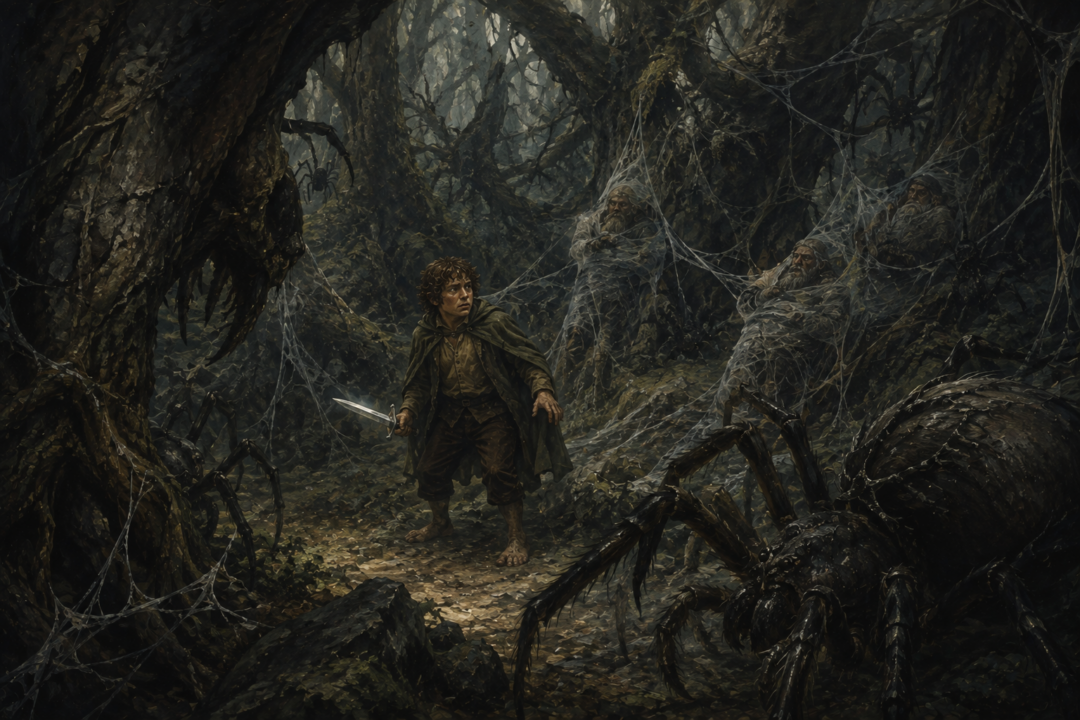
Then come the spiders.
This is one of Bilbo’s decisive transformations.
Separated from the Dwarves, he kills a giant spider himself and names his sword Sting. He then uses the Ring, his wits, and considerable courage to rescue his companions.
Later, when the Dwarves are imprisoned by the Elvenking, Bilbo remains free because he is invisible. Gandalf is nowhere nearby to devise an escape. Bilbo must observe, plan, steal keys, and eventually create the extraordinary barrel escape that carries the Company out of the Woodland Realm.
The Hobbit whom Thorin originally regarded as an unsuitable burglar has become indispensable.
Gandalf’s prediction at the Forest Gate was justified.
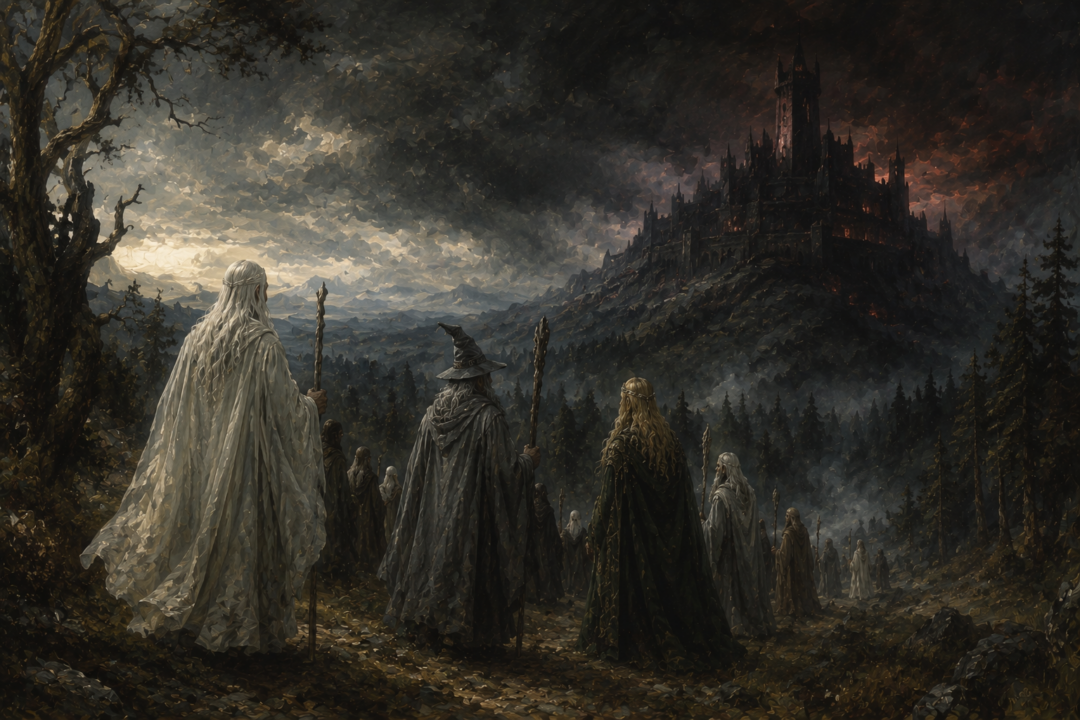
Gandalf’s Absence Is Not the Same as Abandonment
There is an important distinction here.
Gandalf does not leave because he stops caring about Thorin’s expedition. The wider texts show almost the opposite: he had invested considerable thought in making the quest possible.
He had brought Thorin and Bilbo together. He had supplied the map and key. He had guided the Company through part of the Wild. He had repeatedly intervened when catastrophe threatened.
But Gandalf rarely treats guidance as permanent guardianship.
That pattern becomes even clearer in The Lord of the Rings. His role is often to advise, encourage, reveal possibilities, and bring people together rather than to accomplish every task himself.
At Mirkwood, this becomes painfully practical.
Bilbo cannot remain forever the frightened Hobbit waiting for Gandalf to solve the next crisis.
Thorin cannot reclaim Erebor if his expedition is incapable of moving whenever the wizard is absent.
Their road has become their responsibility.
The Strange Success of Gandalf’s Divided Strategy
What makes Gandalf’s departure especially significant is what happens afterward.
The White Council attacks Dol Guldur. Sauron withdraws and eventually returns openly to Mordor.
Meanwhile Thorin’s Company survives Mirkwood, reaches the Lonely Mountain, and awakens Smaug. The dragon attacks Lake-town and is killed by Bard.
The aftermath is costly. Thorin’s obsession with the recovered treasure helps drive the crisis that precedes the Battle of Five Armies, and Thorin himself dies after the battle.
Yet Erebor is restored under Dáin Ironfoot, while Dale is rebuilt under Bard.
Those outcomes later matter enormously.
During the War of the Ring, Sauron attacks the North as well as Gondor and Rohan. Dale and Erebor are attacked by his allies, and King Brand of Dale and King Dáin II die fighting before the Gate of Erebor. Their peoples survive the siege until news of Sauron’s defeat arrives.
Gandalf’s concern about the northern balance of power was therefore not imaginary.
It would be too strong to claim that he foresaw every consequence of Bilbo’s journey. The texts do not support that.
But they do show that he understood the strategic danger posed by Smaug and the importance of events in the North.
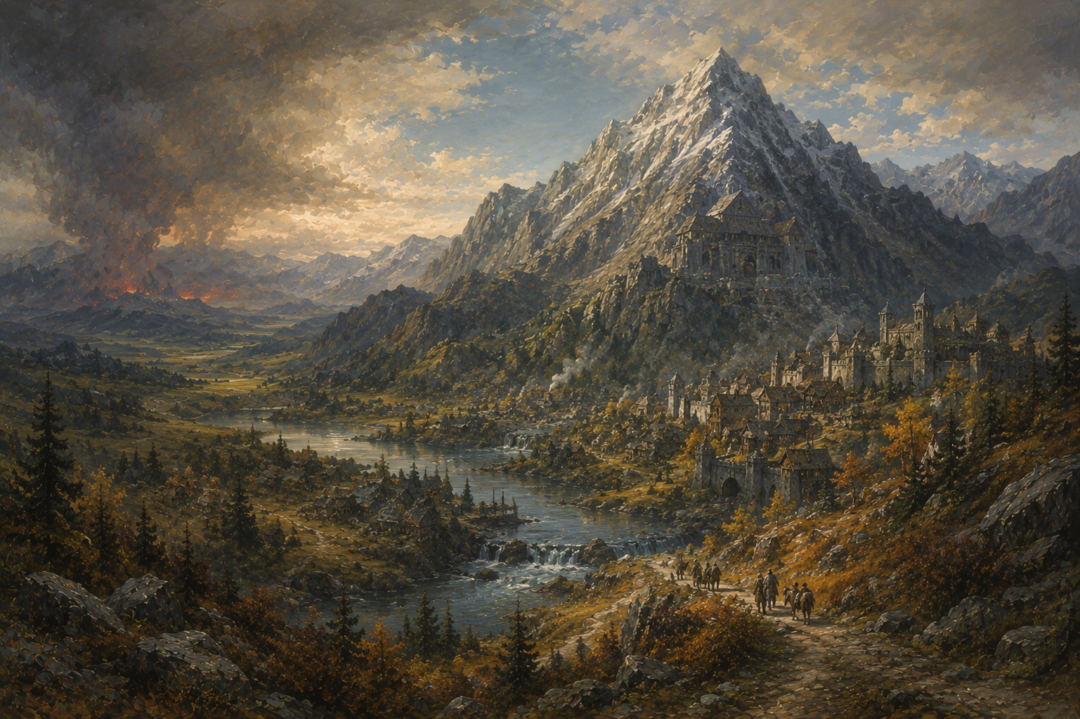
The Wizard Leaves Because the Quest Has Become Bilbo’s
At first glance, Gandalf’s departure before Mirkwood looks like one of the strangest decisions in The Hobbit.
Seen against the larger history of Middle-earth, it becomes almost inevitable.
Southward lay Dol Guldur and Sauron.
Eastward lay Erebor and Smaug.
Both dangers mattered.
Gandalf had helped set Thorin’s expedition in motion precisely because the fate of the Lonely Mountain was connected to the security of the wider world. But he could not walk every road at once.
So at the Forest Gate he entrusted one road to Thorin, the Dwarves, and—most importantly—Bilbo.
That trust changes the story.
Before Mirkwood, Bilbo often survives because powerful people save him.
Inside Mirkwood, he begins saving everyone else.
Gandalf’s departure therefore marks more than a temporary separation. It is the point at which the wizard’s strange choice of burglar finally has to prove itself.
And while Gandalf rides south toward one shadow threatening Middle-earth, the smallest member of the Company walks beneath the trees toward another.
Sources & Notes
- The Encyclopedia of Arda — Gandalf: biographical reference covering his departure from Thorin’s Company to address the Necromancer — https://www.glyphweb.com/arda/g/gandalf.html
- The Encyclopedia of Arda — Mirkwood: geographical context for the dangerous forest the Company enters without Gandalf — https://www.glyphweb.com/arda/m/mirkwood.html
- The Encyclopedia of Arda — White Council: reference on the council whose move against Dol Guldur draws Gandalf away — https://www.glyphweb.com/arda/w/whitecouncil.html
- The Encyclopedia of Arda — Dol Guldur: reference for the Necromancer’s stronghold and the strategic threat behind Gandalf’s departure — https://www.glyphweb.com/arda/d/dolguldur.html
Sources document the key people, places, institutions, and chronology used in this interpretation.