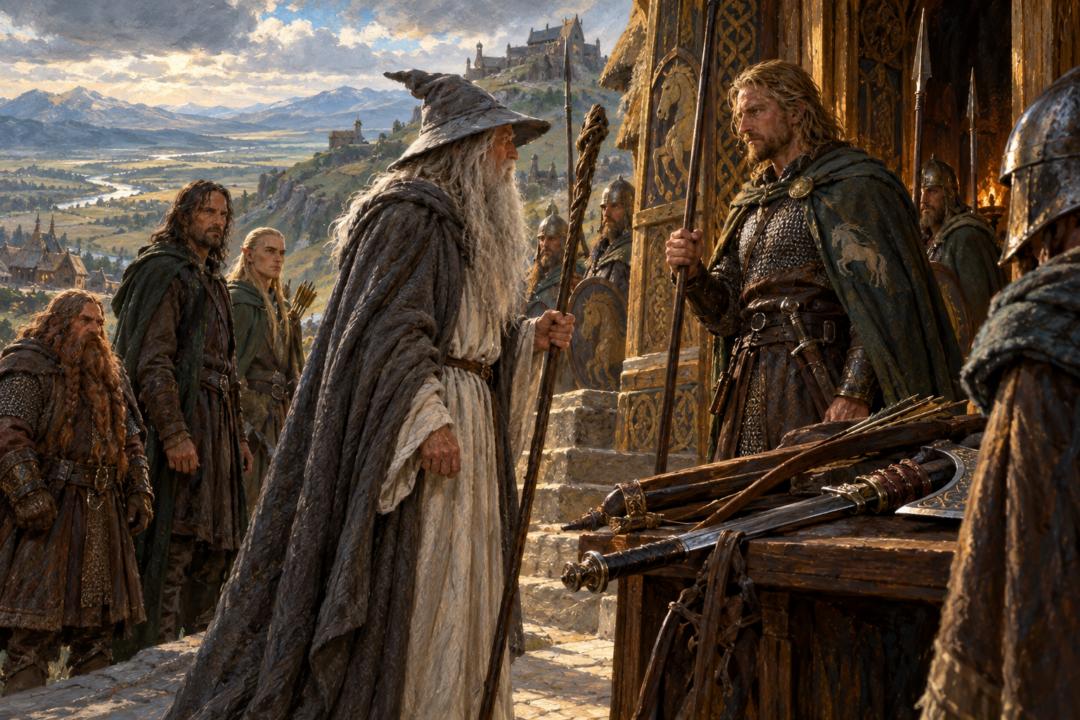
At the doors of Meduseld, the fate of Rohan turns on something surprisingly small: a walking staff.
Gandalf, Aragorn, Legolas, and Gimli have climbed the hill of Edoras seeking an audience with Théoden. Before them stands Háma, the Doorward of the King. His instruction is clear. The strangers may enter the Golden Hall, but they must leave their weapons outside.
Even Andúril is not exempt.
Yet when Háma comes to Gandalf's staff, something changes.
Háma knows perfectly well that a wizard's staff might be more than an old man's support. He says so himself. And then, despite that knowledge, he lets Gandalf carry it into Théoden's presence.
It can look like a convenient loophole needed to move the story forward. Read carefully, however, and the scene reveals something much more interesting about Rohan. Háma is not fooled into forgetting his responsibility. He makes a judgment.
And what happens afterward suggests that this willingness to exercise judgment rather than merely obey may be one of Háma's defining traits.
Háma Has Already Proved That He Takes His Duty Seriously
The first important point is that Háma is not presented as careless.
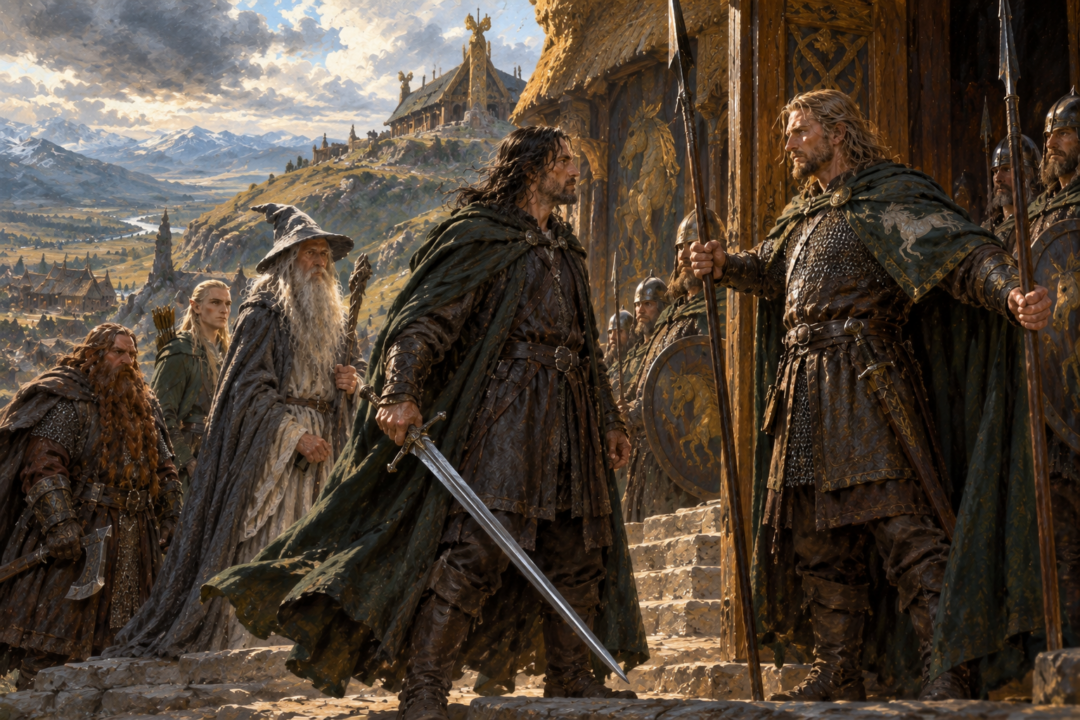
When Aragorn refuses to surrender Andúril, Háma does not retreat before his lineage or reputation. Aragorn identifies himself as Elendil's heir and questions whether Théoden's will should prevail over his own.
Háma's answer is essentially territorial and constitutional: this is Théoden's house.
He even bars the entrance with his sword.
That matters because it eliminates the easiest explanation for what happens next. Háma does not allow Gandalf's staff through because he is weak, inattentive, intimidated by famous strangers, or generally unwilling to enforce Théoden's commands.
Quite the opposite.
He is prepared to deny entrance to Aragorn rather than compromise the authority of the King whose door he guards.
Gandalf himself eventually urges compliance. Glamdring is surrendered. Aragorn leaves Andúril behind, though only after giving stern instructions that no one should touch it. Legolas and Gimli also surrender their weapons.
Only then does the staff become the issue.
And Háma immediately recognizes the problem.
Gandalf Does Not Really Hide What He Is
Gandalf's argument rests on his outward appearance as an old man. Would Háma really deprive an elderly traveller of the support on which he leans?
But Háma is not naïve.
His response is one of the most revealing lines in the entire encounter:
“The staff in the hand of a wizard may be more than a prop for age.”
In other words, Háma sees through the ambiguity.
He knows Gandalf is a wizard. He knows the staff may possess significance beyond its use as a walking stick. The text therefore gives us little reason to interpret the decision as simple deception.
Háma then explains his reasoning. When certainty is impossible, he says, “a man of worth will trust to his own wisdom.” He believes the travellers are friends and people worthy of honour, without evil purpose.
That is the heart of the scene.
Háma does not decide that the staff is harmless.
He decides that Gandalf can be trusted.
The distinction is enormous.
The Order Itself Has a Troubling Source
Later in the confrontation inside Meduseld, the question of the staff returns.
Gríma Wormtongue angrily objects that Gandalf should not have been admitted with it. His words reveal an important detail: Gríma had specifically advised that Gandalf's staff should be left outside.
That changes how we understand the encounter at the door.
The restriction is being enforced in Théoden's name, and Háma treats the King's authority seriously. But the text also establishes that Gríma has been shaping the information and counsel surrounding Théoden.
By this point Rohan is politically sick.
Éomer has been imprisoned. Théoden has become suspicious of loyal servants and allies. Gríma consistently discourages resistance to Saruman while weakening those who might oppose him. Gandalf arrives to find a king isolated within his own hall while danger grows outside it.
Háma cannot know everything the reader eventually learns.
The text never says that he consciously deduces Gríma's entire treachery at the doorway, nor that he predicts exactly what Gandalf will do once admitted.
But Gríma's later complaint makes one conclusion reasonable: the staff prohibition was not an incidental household custom applied without political context. Gríma particularly wanted Gandalf separated from his staff.
Háma nevertheless chose otherwise.
Háma's Choice Fits a Pattern
The strongest evidence for understanding the staff scene comes from what Háma does afterward.
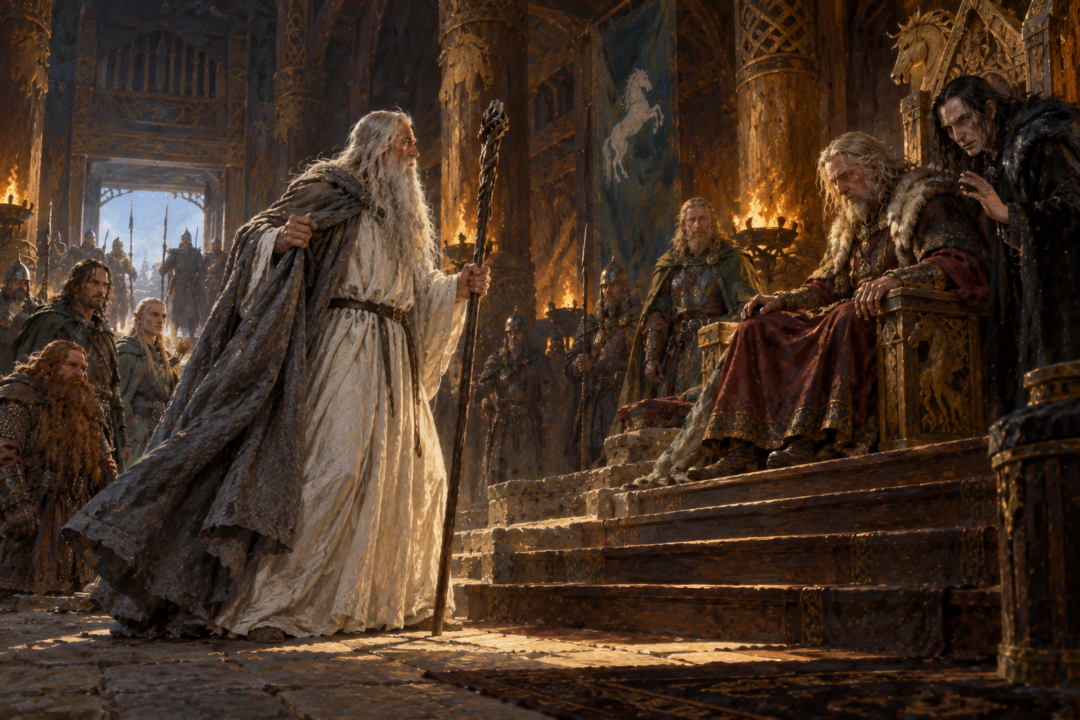
Once Théoden begins to recover his authority, he orders that Éomer be brought before him.
Háma brings Éomer.
But Éomer arrives carrying his sword, Gúthwinë.
Théoden notices immediately and asks whether Háma has again failed to follow instructions. Háma openly admits that he gave Éomer the sword. His explanation is revealing: Éomer had requested it, and Háma judged it appropriate because his heart was glad to see Éomer free again.
This is remarkably similar to the encounter with Gandalf.
Háma receives an order.
He understands the order.
Then circumstances force him to decide whether literal obedience best serves his king.
He does not casually reject authority. Nor does he hide what he has done afterward.
Instead, he accepts responsibility for exercising discretion.
Théoden's response is equally important. He does not punish Háma. Rather, he recognizes that Háma may sometimes anticipate his commands.
That retrospective moment casts new light on the doorway scene.
Háma's defining quality is not disobedience.
It is judgment.
Loyalty to Théoden Is Not the Same as Obedience to Gríma
This distinction becomes crucial because Rohan's crisis is fundamentally a crisis of corrupted counsel.
Gríma does not need to sit on Théoden's throne himself. His power depends on influencing what the King hears, whom the King trusts, and which actions appear prudent.
The machinery of legitimate authority remains in place.
There is still a king.
There are still commands.
There are still guards carrying them out.
That makes Háma's position unusually difficult.
A loyal servant cannot simply disregard Théoden whenever he disagrees with an instruction. If every warrior in Edoras did that, royal authority would collapse.
Yet blind obedience presents another danger. If Théoden's decisions are being shaped by a malicious counsellor, then perfect execution of every instruction can help that counsellor tighten his control.
Háma navigates between those dangers.
At the door he enforces Théoden's authority firmly against Aragorn. But when confronted with Gandalf, he does not surrender his own moral agency.
He asks a more difficult question than “What was I told?”
He judges the people standing before him.
Why the Staff Matters
It would be easy to exaggerate Gandalf's staff into a mechanically defined magical device, but the text does not give us a simple rule that Gandalf is powerless without it.
What can safely be said is that the staff clearly matters within the scene.
Gríma specifically wanted it excluded.
Háma specifically recognizes that a wizard's staff may be more than support.
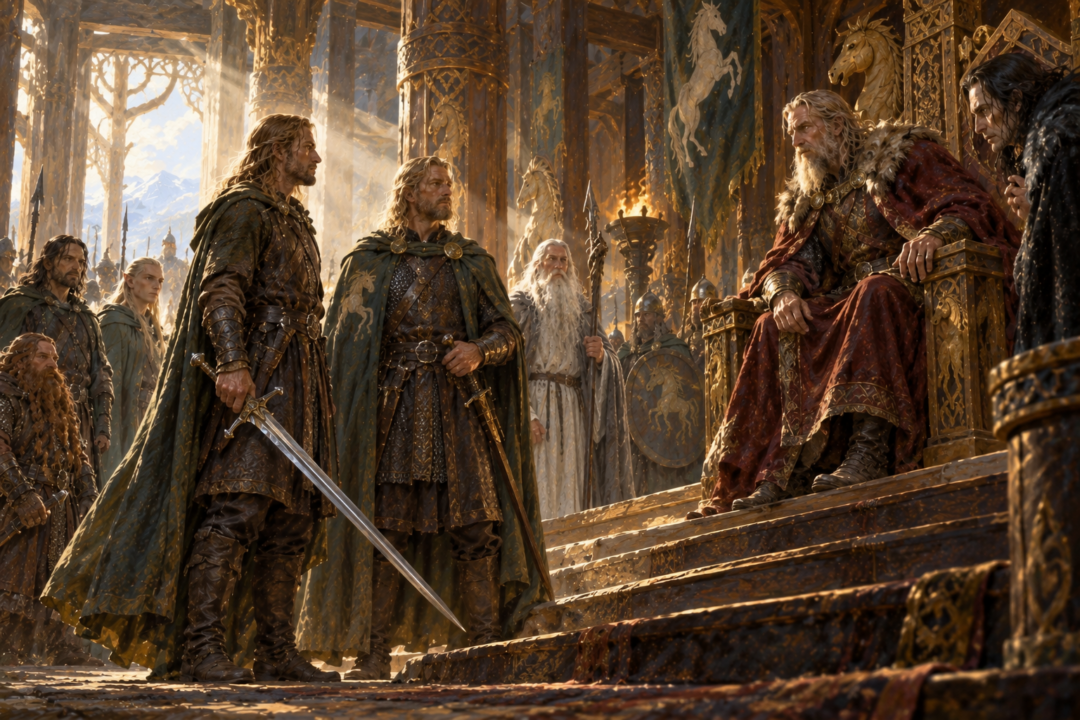
And once inside the hall, Gandalf uses the staff during his confrontation with Gríma and the awakening of Théoden from the despair and weakness in which he has been sunk.
The sequence makes Háma's decision consequential without requiring us to invent a rigid system of wizardly magic.
He allowed Gandalf to enter as Gandalf, rather than forcing him to abandon something closely associated with his authority and power.
Gríma understands the danger almost immediately.
By then, however, it is too late.
Háma Does Not Know the Future
There is an important restraint to preserve here.
Háma should not be turned into a secret mastermind who knowingly engineers Théoden's restoration.
The text does not tell us that.
He cannot know precisely what Gandalf intends to do inside Meduseld. He cannot foresee the confrontation with Wormtongue in every detail. And there is no evidence that Gandalf privately arranged the exception with him beforehand.
What Háma possesses is something less spectacular and, in some ways, more admirable.
He has incomplete information and must decide anyway.
He knows Gandalf's staff could be dangerous.
He also believes Gandalf and his companions are honourable and have no evil purpose.
So he accepts the risk of trusting his own judgment.
That is why the moment feels so human. Great events in Middle-earth repeatedly depend not only upon overwhelming power or ancient wisdom, but upon smaller decisions made by people who cannot see the entire board.
Háma sees only the men before his door.
He chooses whom to trust.
The Cost of Háma's Loyalty
Háma does not survive long enough to see the War of the Ring reach its conclusion.
After Théoden rides to war, Háma goes with him. At the Battle of the Hornburg, he falls before the gates, defending the fortress. Théoden later has him buried alone beneath a mound in the shadow of the Hornburg.
His death gives the Meduseld episode additional weight.
Háma is no rebel against Théoden. His story ends in service to him.
That makes his earlier willingness to bend an instruction easier to understand. His loyalty is not directed toward rules for their own sake. It is directed toward the King and the people those rules exist to protect.
When he lets Gandalf keep the staff, he risks making the wrong judgment.
When he arms Éomer, he again goes beyond the strict wording of what he was told.
Yet both actions emerge from the same kind of loyalty: active rather than mechanical, responsible rather than passive.
The Doorward Who Actually Guards the Kingdom
Háma's title is wonderfully appropriate.
He is the Doorward of Théoden.
A doorward exists to keep danger out. But that duty becomes complicated when danger is already inside.
Gríma stands beside the throne.
Gandalf stands outside the door.
The ordinary logic of security would suggest that the stranger carrying the suspicious staff is the threat. The deeper reality is almost the reverse: the King's trusted counsellor is serving Saruman, while the dangerous-looking stranger has come to help Théoden resist him.
Háma does not know all of this when he makes his choice.
But he sees enough to hesitate.
And in that hesitation lies the significance of the scene.
Háma guards Théoden not merely by preventing people from entering his hall, but by recognizing the moment when the King's safety requires allowing the right person through.
That is why Gandalf enters Meduseld with his staff.
Not because Háma fails at his duty.
Because, when obedience and judgment suddenly pull in different directions, Háma understands that duty sometimes requires both.
Sources & Notes
- https://tolkiengateway.net/wiki/H%C3%A1ma — Tolkien Gateway, H%C3%A1ma (Tolkien primary-text references in article)
- https://tolkiengateway.net/wiki/The_King_of_the_Golden_Hall — Tolkien Gateway, The King of the Golden Hall (Tolkien primary-text references in article)
- https://tolkiengateway.net/wiki/Herugrim — Tolkien Gateway, Herugrim (Tolkien primary-text references in article)
Relevant Tolkien text and chronology are referenced by the linked Tolkien Gateway entries; interpretive conclusions remain distinguished from canon.