When the One Ring falls into the fire, it is tempting to imagine Middle-earth resetting itself.
Sauron is overthrown. Barad-dûr collapses. Aragorn becomes king. The White Tree flowers again. The great enemy who shaped so much of the Third Age is gone.
Yet the ending of The Lord of the Rings is striking precisely because the world does not become new.
The Shire must still be repaired. Frodo remains wounded. The Elves continue to depart. The Three Rings lose their power. Old kingdoms can be restored, but their long histories cannot be undone. Even the calendar does not provide one perfectly universal dividing line between one Age and the next.
The Third Age ends, but Middle-earth carries its structures, memories, losses, and unfinished consequences forward.
That may be one of the deepest ideas hidden inside the chronology of the legendarium: an Age can end without history starting over.
Destroying the Ring Does Not Restore the Previous World
The destruction of the One Ring on 25 March 3019 is the decisive event of the War of the Ring. Sauron's power collapses, the Nazgûl are destroyed, and his ability to take physical shape and dominate Middle-earth is effectively ended.
But something else ends with him.
The Three Rings of the Elves were bound to the fate of the One. They had not been made by Sauron, nor had he touched them, but their power belonged to the same ring-lore ultimately subjected to the Ruling Ring. During the Third Age, their bearers used them in connection with realms where preservation was unusually strong.
Once the One was destroyed, the power of the Three failed.
That means victory itself carries a cost.
Galadriel's earlier warning to Frodo makes the dilemma clear. If he succeeds, the power connected with her Ring will diminish, and Lórien will eventually fade. If Sauron recovers the One, everything is worse. There is no path in which evil is defeated and the Elves simply continue preserving Middle-earth exactly as it had been.
The old arrangement has become impossible.
This makes the end of the Third Age fundamentally different from a magical reset. The heroes do not recover the world as it existed before Sauron's return. Their victory makes a different future possible, but it cannot prevent everything beautiful from passing away.
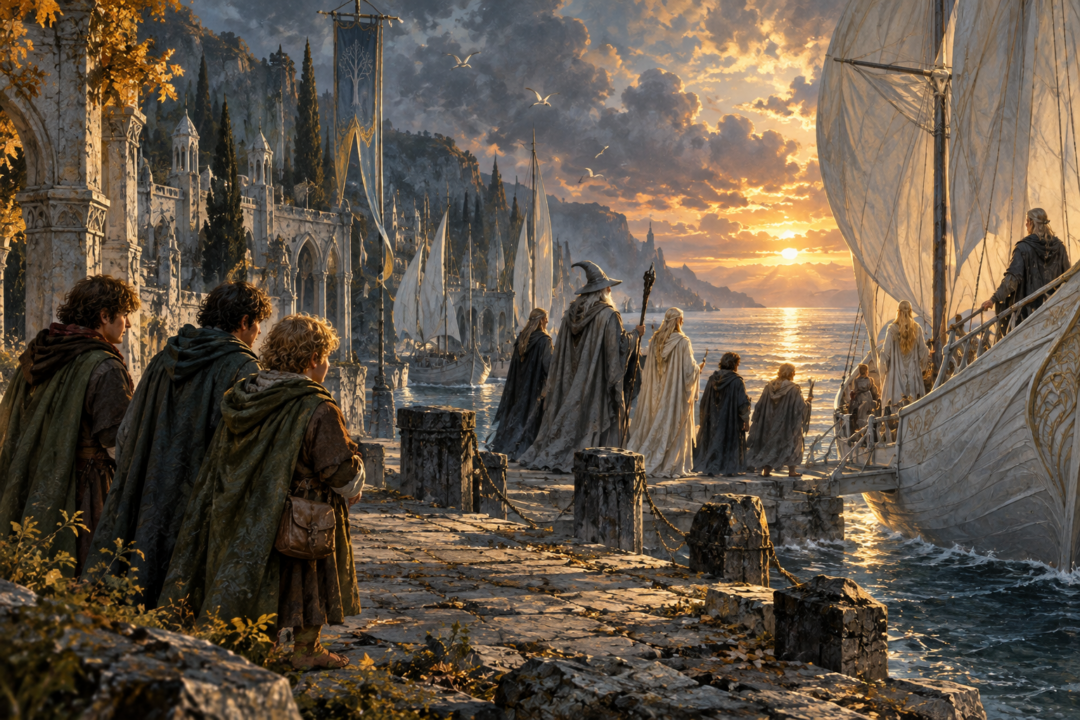
The Elves Win — and Still Leave
The departure from the Grey Havens is therefore not merely a sad epilogue added after the real story is finished.
It is part of what victory means.
In September 3021, Elrond, Galadriel, Gandalf, Bilbo, and Frodo depart over the Sea. With Elrond and Galadriel go two of the greatest surviving figures of the Elder Days still dwelling in Middle-earth; Gandalf's task against Sauron is completed; Bilbo and Frodo depart as Ring-bearers.
The Third Age is conventionally brought to its close with this departure.
Yet even here, the transition is gradual rather than absolute.
Not every Elf vanishes on the same day. Círdan remains at the Grey Havens. Celeborn remains in Middle-earth for a time. Legolas stays and establishes himself in Ithilien, and only after Aragorn's death does the tradition recorded in the appendices say that he builds a ship and sails away, with Gimli accompanying him.
The fading of the Eldar is therefore a process.
The Fourth Age can begin while remnants of the older world are still physically present within it.
That distinction matters. Ages describe great historical transitions, but the people living through them do not suddenly wake in a world emptied of everything belonging to yesterday.
The Shire Shows What Victory Actually Requires
Nowhere is this clearer than in the Shire.
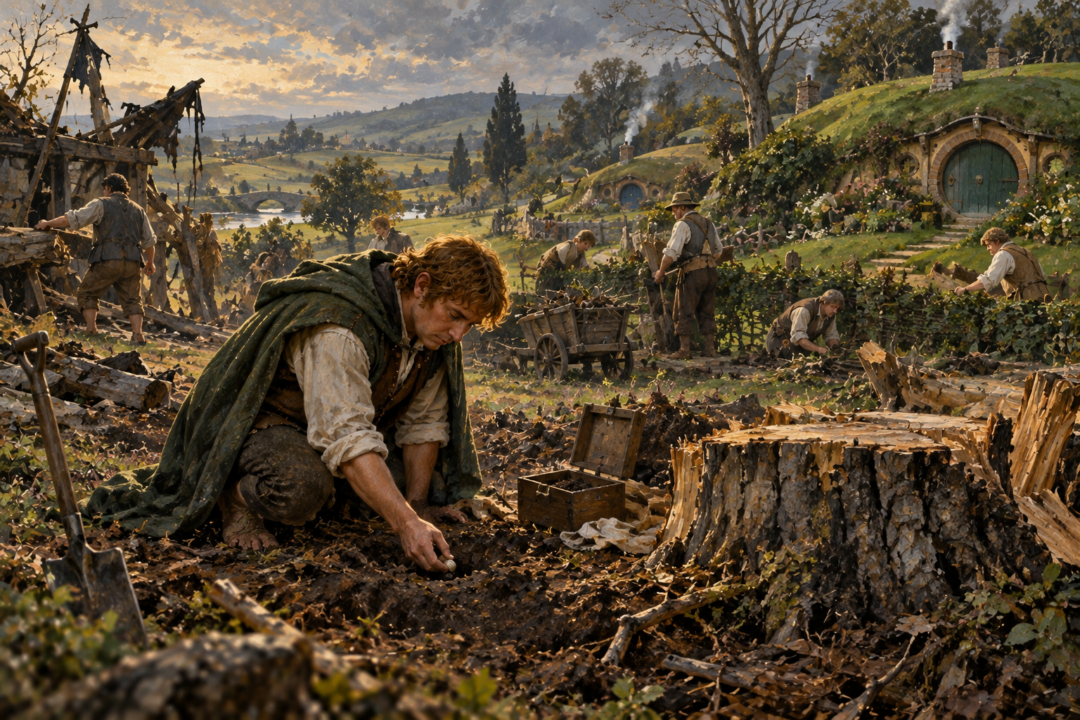
After surviving Mordor, the four returning hobbits might reasonably expect home to represent the thing that was saved. Instead they find gates, rules, ugly construction, felled trees, armed Men, and a society bullied under Saruman's diminished but still malicious influence.
Sauron has already fallen.
The War of the Ring is effectively decided.
And yet evil remains locally embedded in institutions, habits, buildings, fear, and damaged land.
The Scouring of the Shire is important because it refuses the idea that destroying the central source of evil automatically repairs every place affected by lesser evils.
Merry, Pippin, Sam, and Frodo have to act again.
Even after Saruman is gone, their work is not finished. Sam uses the gift Galadriel gave him: earth from her orchard and a mallorn seed. He distributes the earth throughout the Shire and plants the seed where the Party Tree had stood.
The result is extraordinary renewal, especially in the following year.
But it is renewal, not reversal.
The original Party Tree does not return. A new tree grows where it was lost.
That difference captures the entire transition between Ages in miniature.
Aragorn Restores a Kingdom That Already Has a History
The political settlement follows the same pattern.
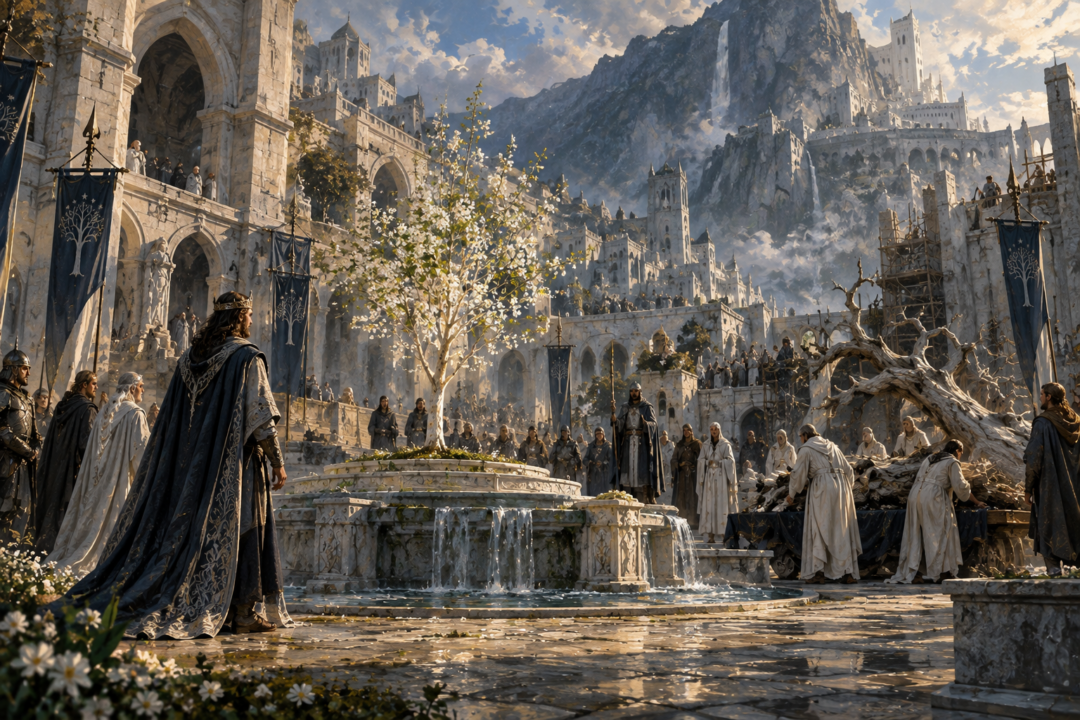
Aragorn's coronation does not establish a kingdom without a past. It restores kingship to realms shaped by thousands of years of division, decline, war, and memory.
Arnor had long since ceased to exist as a functioning northern kingdom. Its successor states had fallen. Gondor survived, but for centuries it had been ruled by Stewards while awaiting a king who might never return.
Elessar therefore inherits rather than erases.
The Reunited Kingdom reconnects the northern and southern realms of the Dúnedain, but it does so in a landscape still marked by what happened before. Ruined places do not cease to have histories because a rightful king now reigns. Old peoples retain their own lands and customs. The Shire, for example, becomes a Free Land under the protection of the Northern Sceptre, and Elessar later forbids Men from entering it.
The new order incorporates boundaries and inheritances instead of flattening them.
Even the White Tree expresses this pattern.
The dead tree in Minas Tirith is not simply made alive again. Aragorn finds a sapling descended from the ancient line, and the dead tree is laid to rest with honor.
Continuity survives through descent, memory, and renewal—not through pretending death never occurred.
Frodo Is the Human Cost of the Same Principle
The most painful unresolved structure is not a kingdom or an Elven realm.
It is Frodo.
The Ring is destroyed, but Frodo does not become the person he was before carrying it.
He suffers recurring pain connected with the wound he received on Weathertop and with the anniversary of his poisoning by Shelob. More deeply, his experiences have left him unable to settle fully into the peace that his actions helped secure for others.
This is crucial to the moral architecture of the ending.
Saving the world does not guarantee that the person who bore the greatest burden will personally enjoy the world he saved.
Frodo returns to Bag End. He participates in the restored Shire. He passes the Red Book to Sam. Yet eventually he recognizes that remaining in Middle-earth will not provide the healing he needs.
His departure is not presented as the undoing of everything that happened to him. The voyage West is associated with healing and peace, but the text does not suggest that history itself has been erased.
Frodo carries the consequence of the old Age across its boundary.
Again, the Age ends before all its wounds do.
Even the Calendar Resists a Perfect Boundary
There is an unexpectedly revealing detail in the chronology: the beginning of the Fourth Age depends partly on whose reckoning is being used.
The appendices associate the ending of the Third Age with the departure of the Ring-bearers and the Keepers of the Three in 3021. Gondor's New Reckoning, however, begins from 25 March, commemorating the fall of Sauron, while Shire-reckoning continues its own sequence of years.
This is more than calendrical trivia.
Different communities experience historical turning points differently.
For Gondor, the restoration of the King and the downfall of Sauron naturally define a new political world. For the Elves, the departure of the Keepers of the Rings marks another kind of ending. Hobbits continue counting according to their established reckoning.
History has changed profoundly, but people still inhabit inherited systems.
There is no cosmic hand wiping every ledger clean.
The Fourth Age Inherits the Third
The Fourth Age is commonly associated with the Dominion of Men, but that phrase should not be mistaken for an instantly completed transformation.
Early Fourth Age Middle-earth still contains members of the Fellowship. Sam remains in the Shire for decades. Merry and Pippin eventually travel south again. Legolas remains in Ithilien. Gimli's later tradition connects him with Legolas's final voyage. Aragorn himself lives until Fourth Age 120.
The generation that defeated Sauron therefore extends deep into the supposedly new world.
And when Aragorn finally dies, another transition occurs rather than an ending to transition itself. Eldarion succeeds him. Arwen goes to Lórien and dies there the following year. Legolas's departure marks another withdrawal of the older world.
The Fourth Age keeps shedding pieces of the Third long after its official beginning.
That is exactly what we should expect from a history built around fading, inheritance, and memory.
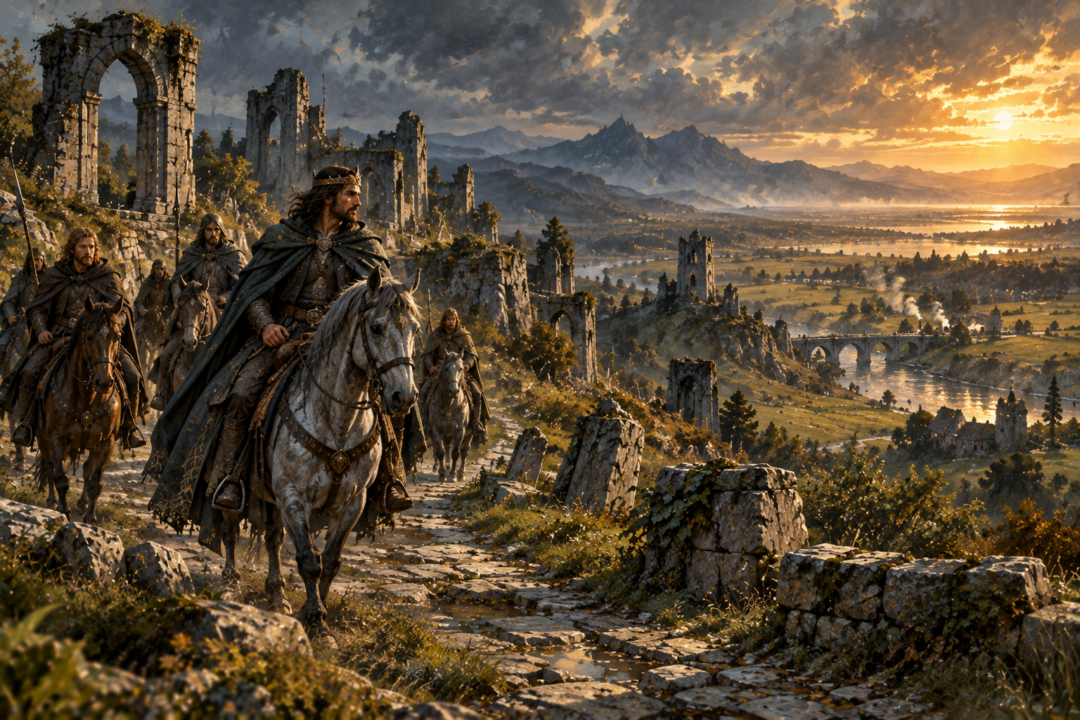
Middle-earth Moves Forward by Carrying What Cannot Be Repaired
The ending of The Lord of the Rings is hopeful, but its hope is not based on restoration to an untouched state.
Sauron cannot be allowed to remain merely because defeating him has costs. The Ring must be destroyed even though the Three will fail. The Shire must be replanted even though its lost trees cannot simply be returned. The kingdom must be renewed even though centuries of decline remain part of its history. Sam must build a life even though Frodo cannot remain beside him forever.
The pattern is remarkably consistent.
Good does not triumph by reversing time.
It triumphs by making faithful use of what remains.
That is why the final movement from the Third Age into the Fourth feels both victorious and mournful. The great enemy is defeated, but mortality is not. Memory is not. Consequence is not. The passing of the Elves is not halted. The dead do not return, and even the survivors eventually depart.
The new Age begins inside the remains of the old one.
Perhaps that is why Middle-earth's ending feels so convincing. History does not close one door, clear the stage, and begin again with untouched foundations.
The White Tree grows from an ancient line. The Shire is replanted. The King returns to a realm whose ruins still remember other kings. The Elves depart gradually. The Ring-bearer cannot simply go home and become who he once was.
The Shadow passes.
What comes afterward must still be built among everything it left behind.
Sources & Notes
- https://tolkiengateway.net/wiki/Third_Age — Tolkien Gateway, Third Age (Tolkien primary-text references in article)
- https://tolkiengateway.net/wiki/Fourth_Age — Tolkien Gateway, Fourth Age (Tolkien primary-text references in article)
- https://tolkiengateway.net/wiki/Ages — Tolkien Gateway, Ages (Tolkien primary-text references in article)
Relevant Tolkien text and chronology are referenced by the linked Tolkien Gateway entries; interpretive conclusions remain distinguished from canon.