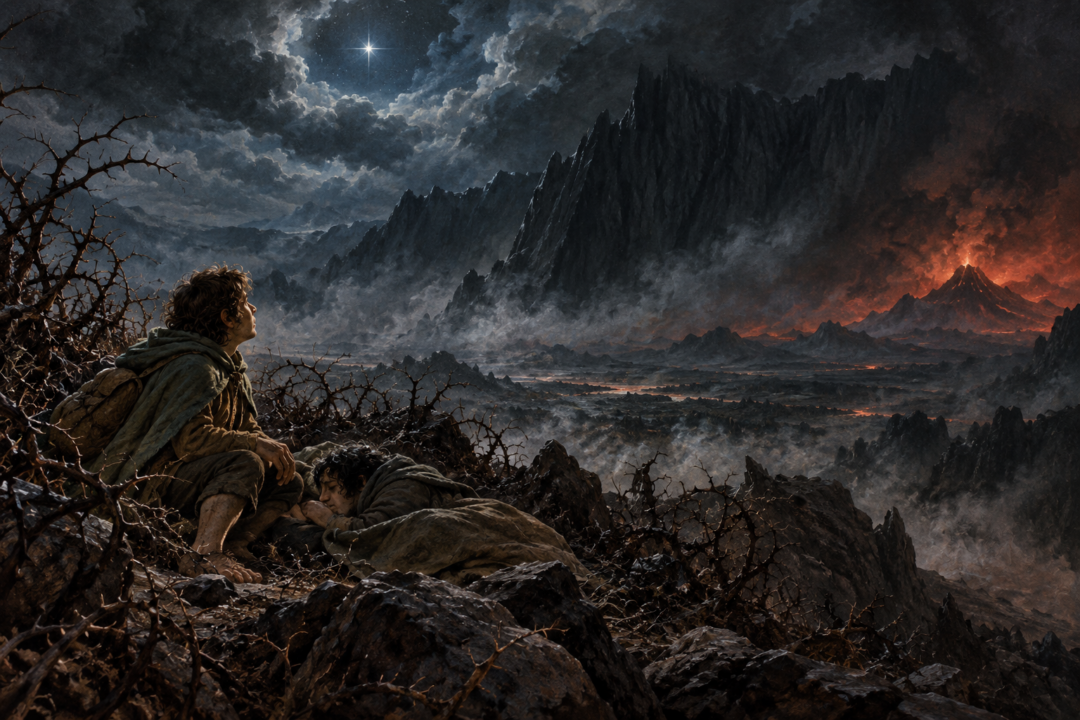
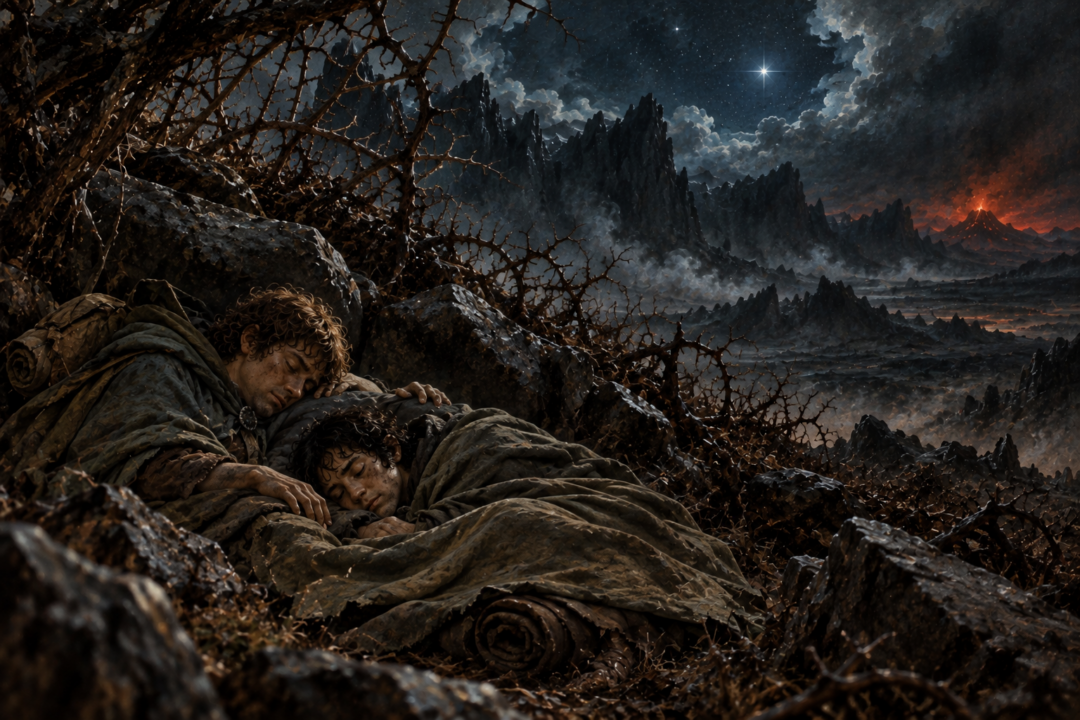
Sam Gamgee is sitting awake in Mordor while Frodo sleeps.
They are hungry, desperately short of water, surrounded by enemies, and still separated from Mount Doom by country that seems almost impossible to cross. Sam has no military plan that can change those facts. He cannot summon help. He cannot even promise Frodo that they will survive.
Then he looks up.
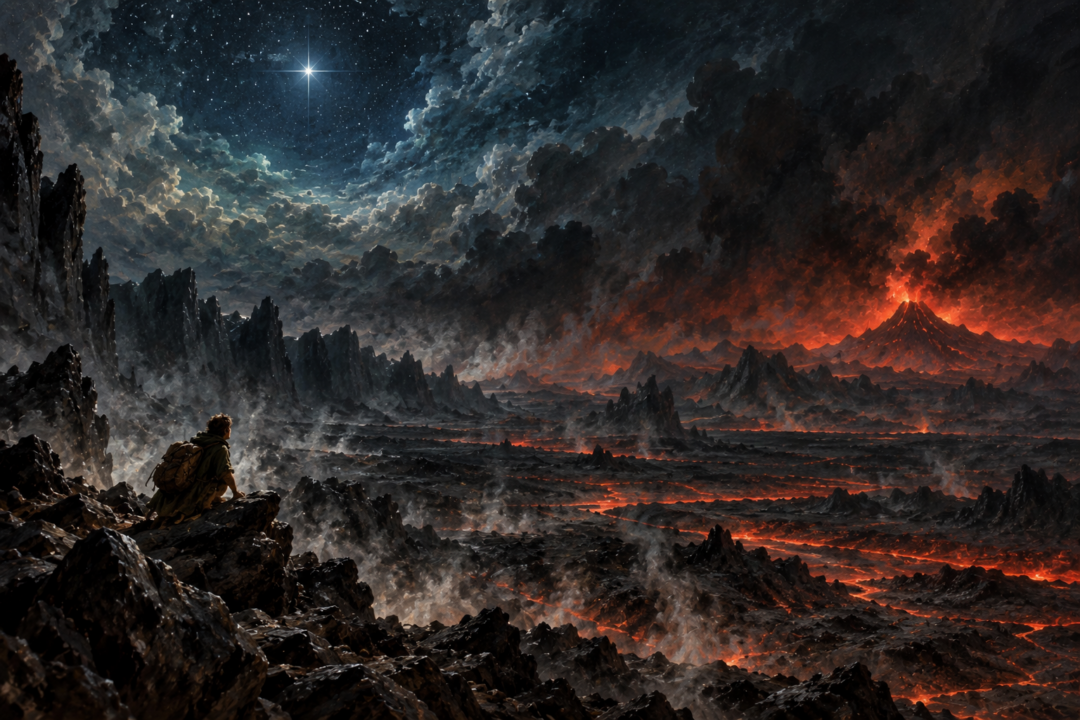
Above the Ephel Dúath, through the clouds, Sam glimpses a single white star. What follows in “The Land of Shadow” is one of the quietest turning points in The Lord of the Rings. Nothing outside Sam changes. Mordor remains Mordor. Sauron remains powerful. The Ring remains a crushing burden.
What changes is the scale at which Sam sees his situation.
That change gives him something immediately useful: freedom from fear long enough to sleep.
Sam Does Not Need False Hope
By this stage of the journey, ordinary optimism would be difficult to justify.
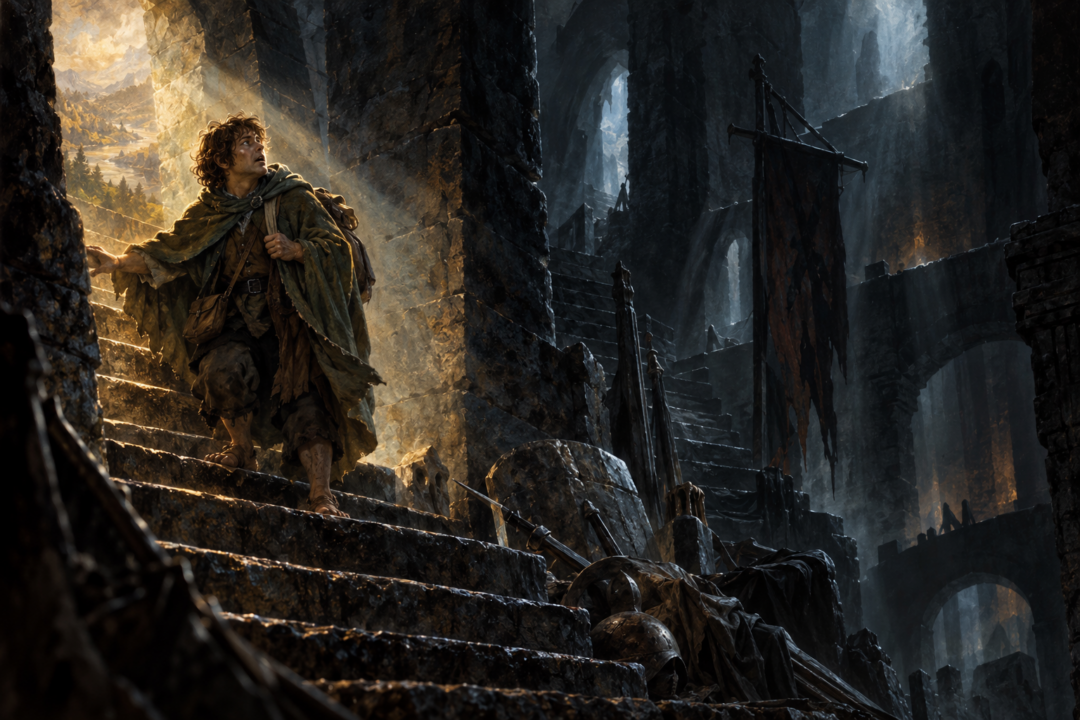
Frodo and Sam have escaped the Tower of Cirith Ungol and entered Mordor itself. Their provisions are dwindling. Water has become a serious concern. They must cross the hostile country toward Orodruin while avoiding Orcs and the forces gathering under Sauron.
Sam is also increasingly aware of a terrible possibility: even if they reach the Fire, there may be no return journey.
This matters because the star scene is not built upon Sam convincing himself that everything will work out.
He does not suddenly discover a hidden road to safety. He receives no message that Gondor has survived or that armies are coming. He gains no new information about Frodo's ability to finish the quest.
His hope comes from somewhere else.
He realizes that Sauron's apparent totality is not actually total.
Mordor can fill Sam's immediate world with darkness, but it cannot possess everything that exists.
That distinction becomes psychologically decisive.
First Came Defiance
The star scene becomes even more revealing when compared with something Sam has already done.
While searching for Frodo in the Tower of Cirith Ungol, Sam begins to sing.
The song remembers the West: spring, flowers, trees, running water, birds, sunlight and stars. Its conclusion insists that even under darkness the Sun and stars remain.
It is an extraordinary act in Sauron's country. Sam is effectively answering a place designed around fear with memories of things that fear cannot erase.
But the later narration makes an important distinction.
Sam's song in the Tower had been “defiance rather than hope.”
That difference is crucial.
Defiance says: I will resist you.
Hope says: you are not everything.
In the Tower, Sam still stands psychologically inside the contest. He is alone, frightened for Frodo, and forcing himself forward. His song is an act of resistance.
When he sees the star later, something subtler happens. For a moment, he stops measuring the whole world by his own immediate danger.
That is why the star can do what defiance alone could not.
Mordor Controls the Horizon, Not the Heavens
Sauron's power is repeatedly associated with domination: towers, armies, surveillance, slaves, roads, fortifications and a landscape bent toward war.
Inside Mordor, that power can feel universal because almost everything within sight bears evidence of it.
The star exposes the illusion.
Sam looks from the “forsaken land” toward something above it. The Shadow suddenly becomes, in his thought, “a small and passing thing.” Beyond its reach remain “light and high beauty.”
This does not mean Sauron is militarily insignificant. At precisely this point in the story, he commands enormous forces and Frodo's mission remains perilously close to failure.
“Small” is therefore best understood in the larger perspective that comes upon Sam.
Sauron's Shadow may dominate the ground beneath Sam's feet, but it is not the final measure of reality.
The practical effect is enormous. Fear works partly by shrinking attention until the threat appears to be the whole world. Sam's upward glance reverses that narrowing.
The enemy has not become weaker.
The enemy has become smaller in Sam's understanding.
Is Sam Looking at Eärendil?
The text calls what Sam sees a white star and does not explicitly name it in this passage.
There is, however, a strong lore-grounded reason to associate the moment with Eärendil.
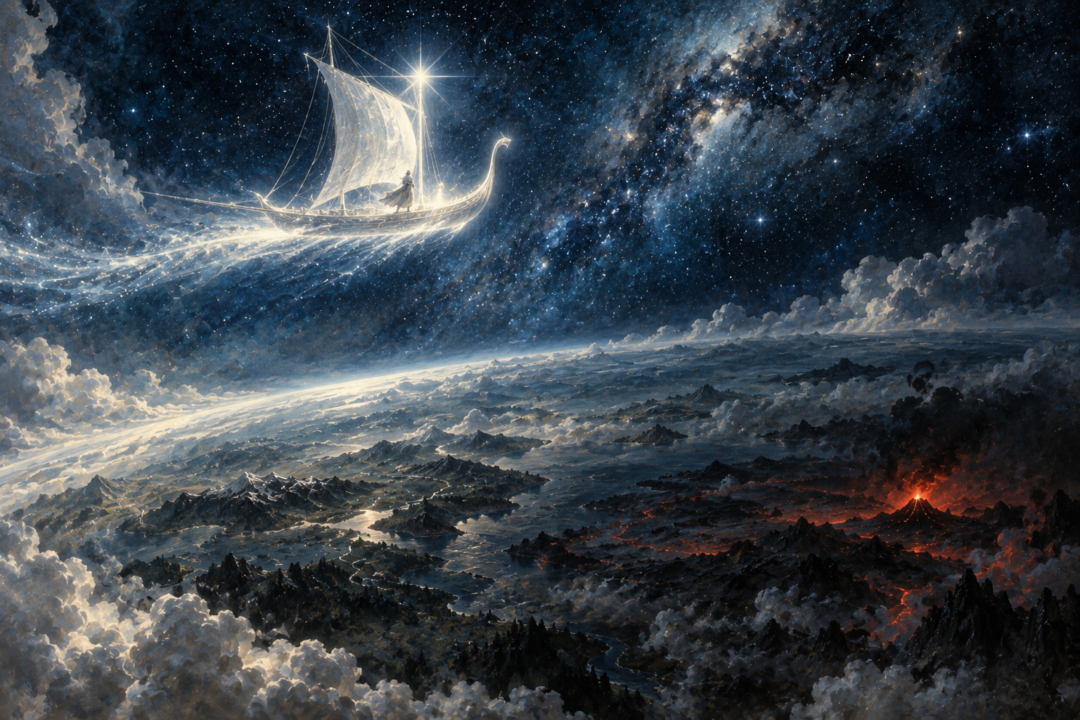
In the mythology of the Elder Days, Eärendil carries a Silmaril through the heavens aboard Vingilot. His light becomes a star seen from Middle-earth and is known as Gil-Estel, the Star of High Hope.
That history already intersects directly with Frodo and Sam's journey.
Galadriel's phial contains light connected with Eärendil's star. In Shelob's darkness, that light becomes a weapon against a creature descended from the ancient darkness of Ungoliant. Sam also understands that the light in the phial links their own adventure to the older tale of Beren and the Silmaril.
So interpreting the white star above Mordor as Eärendil is highly fitting and supported by the wider textual pattern, though the narrative does not pause in this particular scene to identify the star by name.
More important than astronomical identification is what the star means within the story.
Eärendil's light belongs to a history vastly older than Sauron's present dominion. The Shadow feels permanent from inside Mordor. The heavens testify otherwise.
The Reset Works Because Sam Stops Thinking About Sam
Here the passage takes an easily overlooked turn.
After seeing the star, Sam does not immediately begin thinking enthusiastically about reaching Mount Doom.
Instead, his own fate temporarily stops troubling him.
Even Frodo's fate stops troubling him for a moment.
That sounds strange. Sam's defining loyalty is his devotion to Frodo. Why would hope make him think less about his master?
Because his anxiety has been trapped inside questions he cannot answer.
Will Frodo survive?
Will Sam survive?
Can they reach the Mountain?
Can they escape afterward?
Sam cannot resolve any of these problems while sitting beneath the brambles at night.
The star does not answer them.
Instead, it releases him briefly from needing an answer.
There are realities beyond Sauron's reach regardless of what happens to Sam personally. Evil therefore does not acquire ultimate victory merely because Sam is frightened, suffering, or even doomed.
That shift is what makes the moment a practical morale reset rather than merely an inspiring thought.
Sam becomes capable of doing the next necessary thing.
He sleeps.
Sleep Is the Proof That the Hope Is Real
The physical consequence of the scene is remarkably ordinary.
Sam crawls back beside Frodo, puts away his fear, and falls into deep, peaceful sleep.
When they wake, Sam is refreshed enough to continue.
That sequence matters.
Throughout the Mordor journey, survival depends upon painfully mundane necessities: sleep, water, food, concealment, judgment and the ability to keep walking. Heroism here is not separated from the body's limits.
Sam cannot carry on indefinitely through sheer willpower.
Fear itself has become another drain on his dwindling resources.
The glimpse of the star interrupts that drain.
Nothing about their strategic position has improved overnight. Yet Sam has recovered enough inner steadiness to continue functioning within it.
That is why “morale reset” is a useful modern description, provided we remember that it is interpretation rather than terminology used by the text. The scene shows Sam moving from exhausted vigilance to a larger perspective, then from that perspective into restorative sleep.
Hope becomes useful because it changes what he can do next.
Sam's Hope Is Rooted in Things Larger Than Victory
This pattern runs throughout Sam's journey.
His strongest sources of endurance are rarely fantasies of personal triumph. He thinks about the Shire, food, gardens, songs, stories and Frodo. In Cirith Ungol, memories of western lands become a song. Earlier, while approaching Mordor, Sam and Frodo discuss whether they themselves have entered one of the great tales.
Sam's imagination repeatedly connects immediate suffering to a world extending beyond it.
The star is the purest version of that habit.
He cannot see the Shire from Mordor.
He cannot see his friends.
He cannot know how the war is going.
But he can see one point of light that Mordor did not create and cannot extinguish.
That is enough.
Not enough to guarantee victory.
Enough to continue.
The Shadow's Greatest Illusion
The most dangerous message Mordor sends is not simply that Sauron is powerful.
That much is true.
The deeper temptation is to believe that because darkness surrounds you, darkness is all that exists.
Sam's star breaks that equation.
For a moment he sees his suffering without denying it and Sauron's power without making it absolute. Mordor becomes part of the world again rather than the whole world.
Soon he will still have to ration water. He will still have to drag his exhausted body across Gorgoroth. Frodo will grow weaker. Sam will eventually carry him physically up the slopes of Mount Doom.
The star does none of that work for him.
It makes Sam capable of returning to the work.
That may be the most practical form of hope in the entire journey: not believing that hardship will disappear, but recovering the scale necessary to face the next piece of it.
Above the black land, the star remains beyond the Shadow.
Below it, a tired gardener finally sleeps.
Sources & Notes
- Tolkien Gateway, “The Land of Shadow” — The chapter in which Sam sees a star beyond Mordor. https://tolkiengateway.net/wiki/The_Land_of_Shadow
- Tolkien Gateway, “Stars” — Sam’s glimpse of a star while travelling through Mordor. https://tolkiengateway.net/wiki/Stars
- Tolkien Gateway, “Samwise Gamgee” — Sam’s journey and endurance with Frodo. https://tolkiengateway.net/wiki/Samwise_Gamgee
Sources document The Land of Shadow, Stars, Samwise Gamgee. Interpretive claims remain distinguished from the primary narrative.