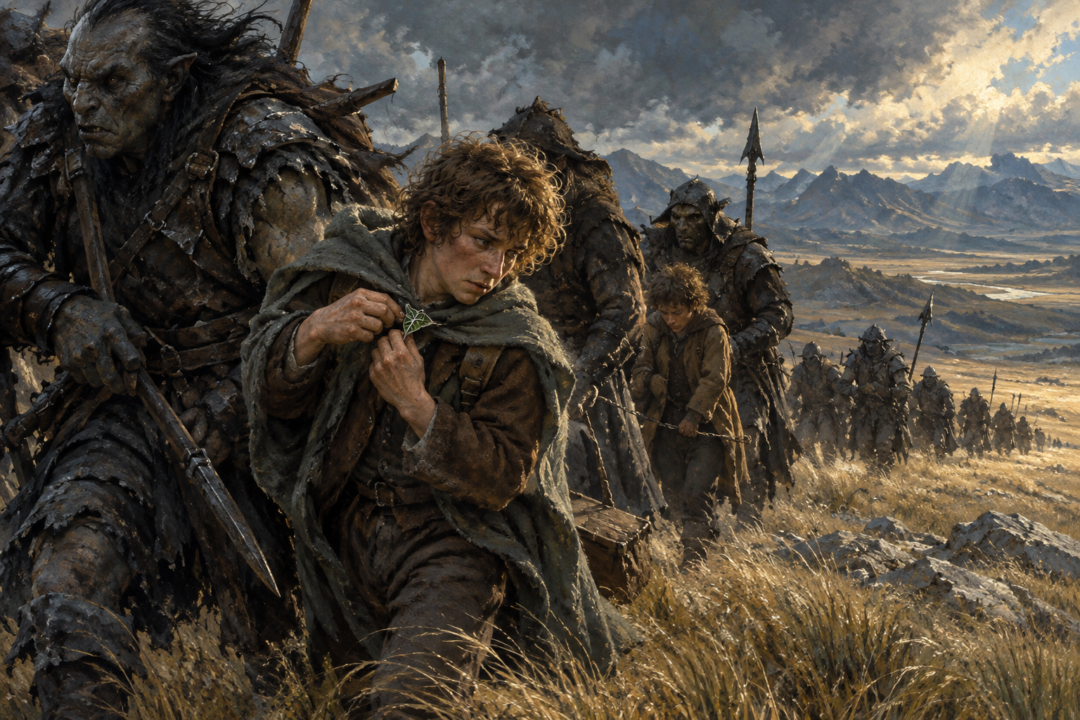
When Peregrin Took is carried away by Orcs across Rohan, he has almost nothing with which to fight back. He cannot overpower his captors. He cannot choose their road. He cannot send a message to Aragorn. Yet somewhere on that brutal march, Pippin manages to leave behind something extraordinarily useful: the brooch from his Elven cloak.
It is not magical. It does not transmit his location. It was never designed as a tracking device.
And yet, in practical terms, that is exactly what it becomes.
The moment is easy to overlook because the object itself is so small. But the brooch works because several independent pieces of Middle-earth’s story suddenly intersect: Galadriel’s gifts, Aragorn’s skill as a tracker, Pippin’s quick thinking, the urgency of the pursuit, and the fact that an apparently insignificant object can carry information simply because the right person knows how to read it.

The Brooch Begins as Part of a Gift
The story of Pippin’s brooch begins far from Rohan, in Lothlórien.
When the Fellowship leaves the Golden Wood, the Elves provide them with cloaks. In The Fellowship of the Ring, these are described as being fastened at the neck by brooches shaped like green leaves veined with silver.
The cloaks themselves are remarkable pieces of Elven craftsmanship. They help their wearers blend with their surroundings, though the Elves do not describe them as magical in the straightforward sense that outsiders might expect. Their usefulness comes from the skill invested in their making.
The leaf-brooches belong to that same gift.
Nothing in the text suggests that the brooches were intended to serve as signals or navigational tools. They are clasps: beautiful, distinctive pieces belonging to the cloaks given to the Fellowship.
That distinction matters.
Pippin does not activate a hidden property in the brooch. He changes its function through circumstance. An object made to fasten a cloak becomes evidence because he deliberately leaves it where a pursuer might find it.
Pippin Has to Communicate Without Being Seen Communicating
After the breaking of the Fellowship at Amon Hen, Merry and Pippin are captured by Orcs and carried westward toward Isengard.
Aragorn, Legolas, and Gimli pursue them.
This creates an unusual problem. The hunters know roughly what has happened, and they can follow the Orc trail, but they do not initially know the condition of the hobbits or whether the captives are still with the Orc-company.
From Pippin’s perspective, the problem is even worse.
He knows that someone may follow, but he cannot rely on that. Nor can he simply stop and construct an obvious sign. He is a prisoner surrounded by enemies.
So he uses what he has.
In The Two Towers, Pippin deliberately lets the brooch from his cloak fall during the forced march. The action is small enough to escape the Orcs’ attention but meaningful enough that, if one of his friends finds it, the object can communicate something.
This is not merely dropping a possession.
It is leaving evidence.
Why the Brooch Carries So Much Information
A random object lying beside an Orc trail might mean almost nothing.
Pippin’s brooch means far more because Aragorn can identify it.
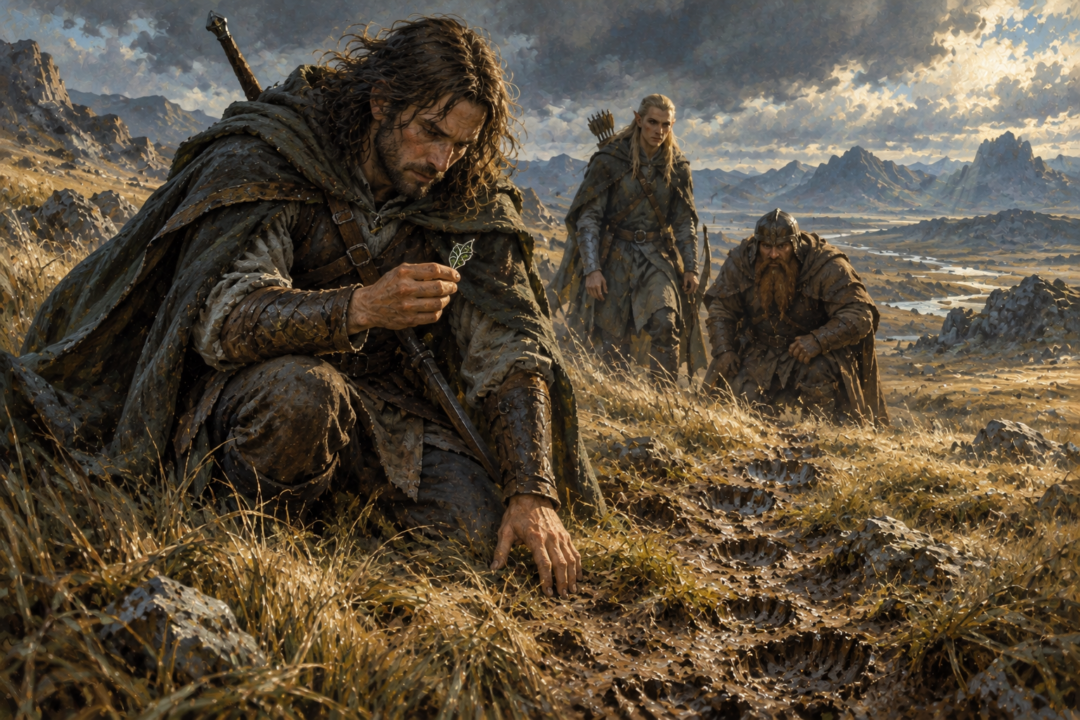
When Aragorn finds the leaf-shaped brooch, he recognizes it as one of the clasps from the Elven cloaks given in Lórien. He also understands that it was unlikely simply to have fallen unnoticed.
The object therefore carries several layers of information.
Most importantly, it confirms that at least one of the hobbits had been on that route. That strengthens the hunters’ understanding that they are following the correct Orc-company.
But Aragorn reads more than mere presence into it. He interprets the brooch as a deliberate sign and praises Pippin for leaving it.
That is the crucial transformation.
The brooch does not contain information inherently. Its meaning comes from shared context.
Aragorn knows where the object came from. He knows who possesses such a clasp. He knows the hobbits are prisoners. And he knows that Pippin would have reason to leave a recognizable sign.
The brooch becomes a message because sender and receiver share the same history.
Aragorn Is the Other Half of the “Tracking Device”
It is tempting to give all the credit to the object, but the brooch would be almost useless without Aragorn.
The pursuit across Rohan repeatedly demonstrates that tracking in Middle-earth is not a supernatural GPS system. Aragorn reads broken plants, footprints, disturbances in the earth, discarded objects, and other traces.
He reconstructs events from evidence.
That matters because Pippin cannot know with certainty that the brooch will be found. He can only increase the possibility that a skilled pursuer will notice it.
Aragorn does.
The scene therefore depends upon two kinds of intelligence working at a distance from one another.
Pippin must imagine what evidence his friends could recognize.
Aragorn must imagine why Pippin would have left that evidence.
Neither has direct communication with the other, yet they briefly establish a chain of meaning across miles of hostile country.
In that sense, the true tracking system is not the brooch alone.
It is Pippin, the brooch, the trail, and Aragorn’s interpretation of them together.
The Sign Also Proves Pippin Is Still Thinking
There is another important message hidden in the brooch.
Pippin is not merely alive enough to be carried by the Orcs. He is conscious, observant, and capable of acting deliberately.
Aragorn’s interpretation of the dropped clasp recognizes Pippin’s intention. The hobbit has understood that pursuit is possible and has tried to help the pursuers.
That is psychologically significant.
Merry and Pippin are captives in an overwhelmingly dangerous situation, but the scene refuses to reduce them to passive cargo. Pippin cannot escape at that moment, yet he can still influence events.
His power is tiny.
That is precisely why the scene works.
The Orcs control the march, the weapons, and the direction of travel. Pippin controls one small brooch and the decision to drop it.
Middle-earth repeatedly gives moral and practical weight to actions that seem disproportionate to the forces surrounding them. Here, the pattern appears in miniature: a hobbit confronted by military power answers with observation and improvisation.

Why the Brooch Works Better Than an Obvious Marker
A deliberate trail marker would have been dangerous.
Had Pippin visibly arranged stones, scratched a message, or attempted some conspicuous signal, his captors might have noticed. A dropped clasp has an advantage precisely because it can look accidental.
To the Orcs, it is potentially meaningless debris.
To Aragorn, it is unmistakable.
That asymmetry makes it an unusually effective signal.
The same object communicates differently depending on who sees it.
This does not require magic. It requires shared knowledge.
The Fellowship knows the significance of the Lórien cloaks and their leaf-shaped clasps because they received them together. An Orc encountering such an object would not necessarily possess the same personal context.
Pippin exploits that difference.
Whether he consciously reasoned through every implication cannot be known, but the text clearly presents the dropping of the brooch as deliberate. The sophistication lies in choosing an object recognizable to his companions while leaving a sign small enough not to draw dangerous attention.
The Brooch Is Not a Magical Beacon
Modern readers can easily describe the brooch as a “tracking device,” but the comparison has limits.
It does not continuously reveal Pippin’s location.
It does not tell Aragorn where Pippin is going.
It does not move with him after being dropped.
Technically, it is closer to a waypoint: evidence that Pippin passed one particular place.
But within the logic of the pursuit, that is enormously valuable.
Aragorn does not need a magical map showing the hobbits as moving points. He needs confirmation that his reading of the trail is correct.
The brooch provides exactly that.
Its effectiveness therefore comes from precision rather than power. It answers one critical question at one critical moment: are the hunters still following the captives?
The answer is yes.
A Gift from Lórien Changes Meaning Again
There is also a beautiful chain of consequences surrounding the object.
The Elves make the cloak and clasp for one purpose. Pippin later uses part of that gift for another. Aragorn then interprets that improvised use correctly.
No prophecy is required. No one in Lórien needs to foresee that Pippin will someday tear loose his brooch while being carried toward Isengard.
The gift becomes valuable in a way its makers did not specifically design.
That pattern fits the larger journey of the Fellowship. Useful things frequently depend less upon overwhelming power than upon whether their bearers understand when and how to use them.
Pippin’s brooch is almost absurdly modest beside the great objects of the story. It has no known destructive power. It does not dominate wills or command armies.
Yet for a few moments on the plains of Rohan, it accomplishes something immensely important.
It connects a prisoner to the people searching for him.

The Smallest Possible Message
What makes the brooch scene memorable is not that Pippin possesses extraordinary technology disguised as Elven jewelry.
It is almost the opposite.
The brooch becomes a tracking device precisely because it was never one.
Pippin recognizes that an ordinary function can be sacrificed for a more urgent purpose. Aragorn recognizes the resulting sign because he understands both the object and the person who dropped it.
The entire communication can be reduced to a tiny green leaf lying on the ground.
Yet the message contained within it is remarkably rich:
I was here.
You are on the right trail.
I am still thinking.
Keep following.
None of those words are literally written on the brooch. The text does not need them to be.
That is what makes the moment such an effective piece of storytelling. A gift becomes evidence. Evidence becomes communication. And communication becomes hope.
For all the great towers, swords, Rings, and armies of Middle-earth, sometimes the difference between losing someone and finding their trail is nothing more than knowing what a fallen leaf really means.
Sources & Notes
- Tolkien Gateway, “Three Hunters” — Aragorn discovers Pippin’s discarded Elven brooch. https://tolkiengateway.net/wiki/Three_Hunters
- Tolkien Gateway, “Elven cloaks” — Galadriel’s cloaks fastened with green leaf brooches. https://tolkiengateway.net/wiki/Elven_cloaks
- Tolkien Gateway, “Peregrin Took” — Pippin’s capture and the trail left for his rescuers. https://tolkiengateway.net/wiki/Peregrin_Took
Sources document Three Hunters, Elven cloaks, Peregrin Took. Interpretive claims remain distinguished from the primary narrative.