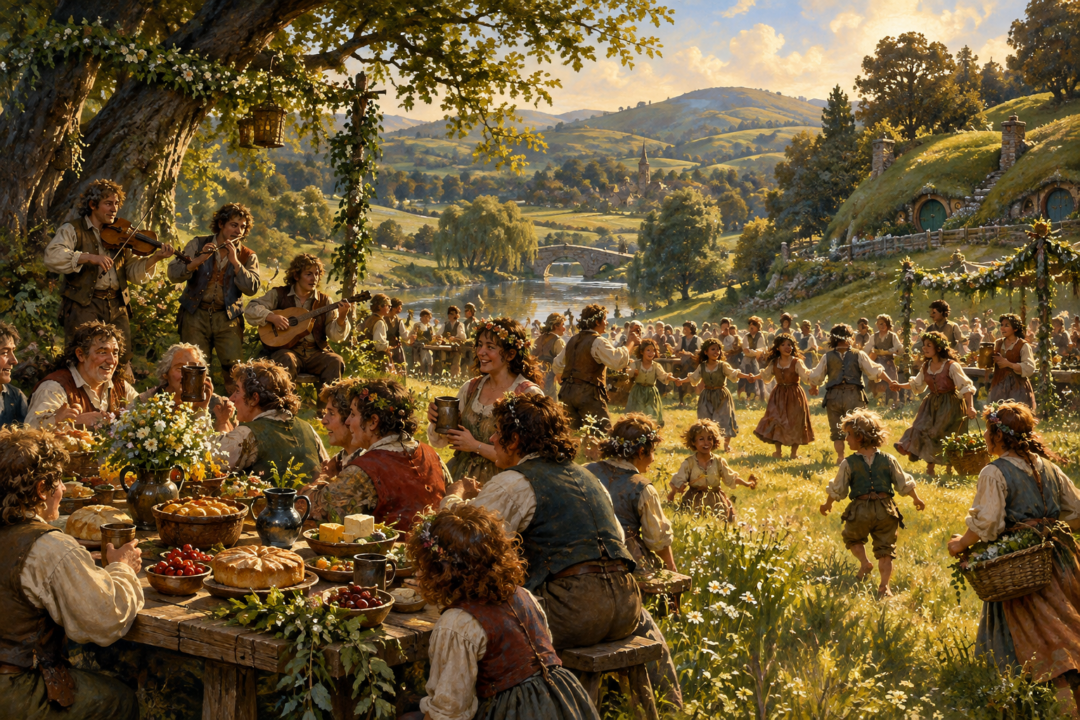
A leap day sounds like bookkeeping. In the Shire, it became a holiday.
The Hobbits’ calendar needed the same basic correction familiar to us: an ordinary year of 365 days does not perfectly match the solar year. But the Shire did not solve that problem by quietly adding a numbered day inside an ordinary month. Its extra day, Overlithe, appeared at midsummer, immediately after Mid-year’s Day and before 2 Lithe. It stood outside the months and, after the Shire-reform, outside the ordinary sequence of weekdays as well.
That placement transformed a necessary calendar correction into something unmistakably Hobbitish: extra time became extra festival.
And in one extraordinary year, S.R. 1420, the arrangement gave the recovering Shire an additional day of merrymaking during one of the happiest summers its people could remember.
The Shire Calendar Was Built Around Festivals
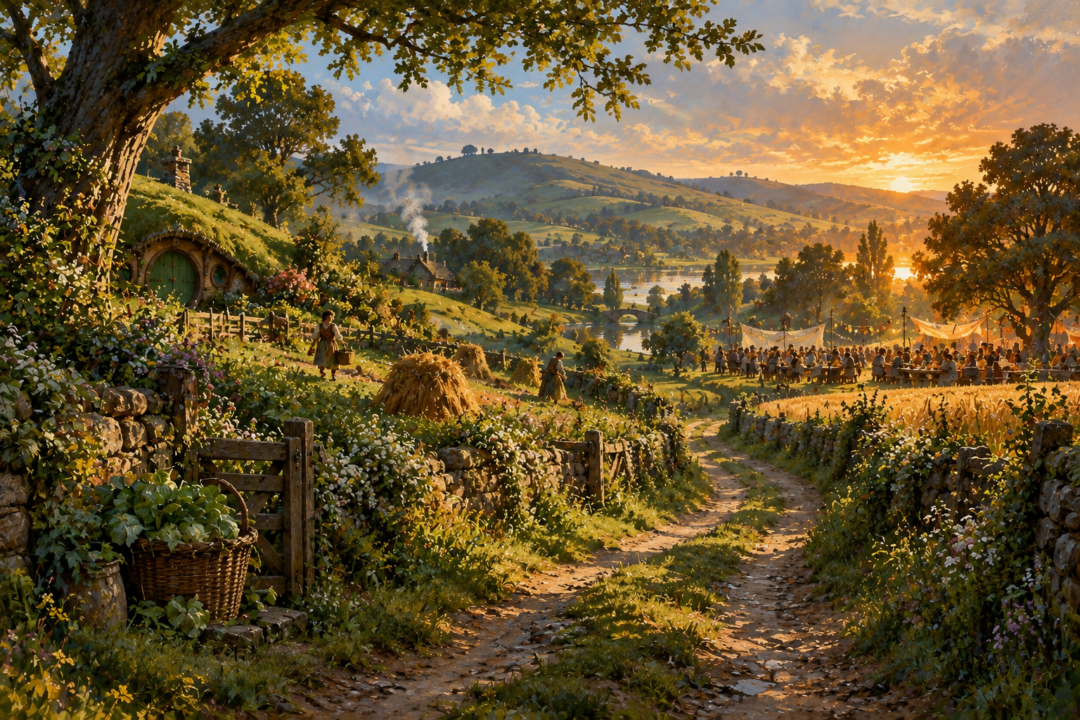
Appendix D of The Lord of the Rings describes a remarkably orderly Shire calendar. The twelve months each contained thirty days, producing 360 ordinary dated days.
The remaining days were placed separately.
At midwinter came the two Yuledays. Around midsummer came 1 Lithe, Mid-year’s Day, and 2 Lithe. These were not merely mathematical leftovers. They were the chief holidays and times of feasting in the Shire calendar.
This matters because it reveals how Hobbit time was organized. The calendar did not simply count agricultural and domestic days from one number to the next. Its structure deliberately gave the turning points of the year a special status.
Midsummer therefore formed a break between Forelithe and Afterlithe. A Hobbit passing through the Lithedays was not simply reaching the end of one month and beginning another. The calendar itself opened a little space between them.
In most years that space contained three days.
In a leap year, it contained four.
Overlithe Was Put Where Hobbits Were Already Feasting
The additional leap day was called Overlithe. Appendix D places it directly after Mid-year’s Day and before 2 Lithe.
That position is more important than it initially appears.
Instead of inserting the correction somewhere within one of the twelve thirty-day months, the Shire calendar enlarged an existing festival period. Overlithe belonged with the midsummer holidays rather than with the normal succession of monthly dates. Reputable summaries of Appendix D accordingly describe it as a special holiday and a day of exceptional merrymaking.
The result was elegant both mathematically and socially.
A normal midsummer ran:
1 Lithe — Mid-year’s Day — 2 Lithe.
A leap-year midsummer ran:
1 Lithe — Mid-year’s Day — Overlithe — 2 Lithe.
Nothing ordinary had to be displaced. The exceptional day appeared inside an already exceptional interval.
It is tempting to imagine elaborate ceremonies attached specifically to Overlithe, but the texts do not give us such details. We should not invent particular dances, foods, rituals, or religious observances. What can safely be said is more interesting anyway: the calendar explicitly turned the correction into a holiday.
The Leap Day Did Not Belong to the Week
The Shire eventually made an additional innovation that changed the experience of its calendar.
During the time of Isengrim Took II, Hobbits adopted what Appendix D calls the Shire-reform. They disliked the way weekday names shifted against calendar dates from year to year. Their solution was to remove Mid-year’s Day—and Overlithe whenever it occurred—from the weekly sequence.
Those days had no weekday name.
That meant the seven-day cycle effectively paused while the midsummer exception passed. When ordinary weekly reckoning resumed, calendar dates continued to fall on the same weekdays every year.
This was not merely a peculiarity of Overlithe. Mid-year’s Day received the same treatment. But leap years made the effect especially striking: an entire additional day could be inserted without shifting every later date onto a different weekday.
The reform made the Shire calendar perennial.
Appendix D even notes the practical consequence that Hobbits seldom bothered to include weekdays in letters or diaries. If a date always fell on the same weekday, the weekday could often be taken for granted.
For a people portrayed as fond of settled habits, familiar meals, birthdays, gatherings, and recurring customs, it is a wonderfully appropriate piece of calendar design.
An Extra Day Without Disrupting the Year
Here lies the deeper significance of Overlithe’s placement.
Imagine adding a normal weekday to the calendar. Everything afterward moves. Anniversaries, market days, recurring appointments, and festivals acquire different weekday relationships from one year to another.
The Shire-reform prevented that.
Mid-year’s Day interrupted the weekday count every year, and Overlithe simply extended that interruption in leap years. Once 2 Lithe arrived, the familiar sequence continued without disturbance.
The leap day was therefore exceptional without being disruptive.
That distinction helps explain why its festival character feels so natural. Overlithe did not invade ordinary Hobbit routine. It occupied a deliberate gap in ordinary routine.
There is a small comic detail in Appendix D that shows how deeply Hobbits appreciated this predictability. Because of the arrangement, the first day of a month never fell on a Friday, or Highday in the translated terminology. Hobbits could therefore joke about “Friday the first” as something impossible or absurd.
Calendar regularity had become part of everyday Shire culture.
Why Midsummer Was the Natural Place
There was also an astronomical purpose behind the arrangement.
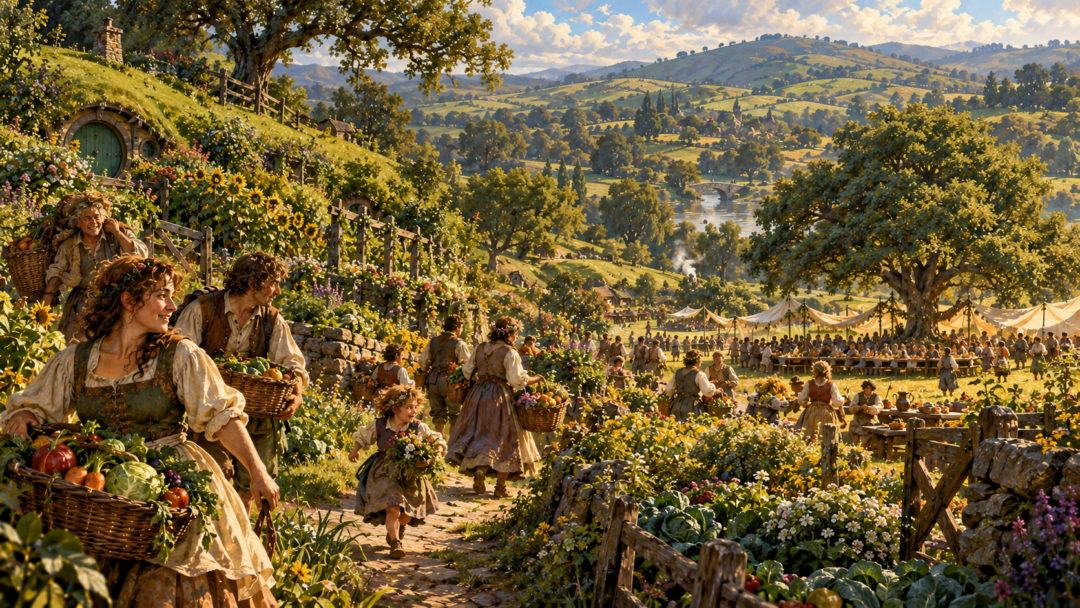
Mid-year’s Day was intended to correspond as closely as possible with the summer solstice. The leap-year system helped prevent the calendar from drifting steadily away from the seasons. The Shire generally added Overlithe every fourth year, with a correction involving the final year of a century.
Placing the adjustment beside Mid-year’s Day therefore joined two functions.
The calendar was being corrected in relation to the solar year precisely at one of the points where seasonal reckoning mattered most visibly: midsummer.
That gives Overlithe a pleasing structural logic. The extra day was not randomly deposited into the year. It appeared beside the day intended to mark the year’s summer turning point.
We should be careful not to claim that Hobbits consciously attached philosophical meaning to this arrangement; the texts do not say so. But structurally, the effect is clear. Seasonal correction and seasonal celebration occupied the same part of the calendar.
The Extraordinary Overlithe of S.R. 1420
The most memorable Overlithe came after the War of the Ring.
S.R. 1420, corresponding largely to T.A. 3020, was a leap year in the Shire. More importantly, it was the remarkable year following the liberation of the Shire from Saruman’s men.
The closing chapter of The Lord of the Rings describes 1420 as a year of extraordinary fertility and abundance. The restoration of the Shire was aided by the precious dust from Galadriel’s garden that Sam Gamgee had brought home. Sam distributed it sparingly during his work of replanting and cast what remained into the air from the Three-Farthing Stone.
What followed was exceptional growth.
Trees and crops flourished. The children born or conceived around that period were remembered for their health and beauty. The year became famous in Shire memory for its plenty.
Against that background came Overlithe.
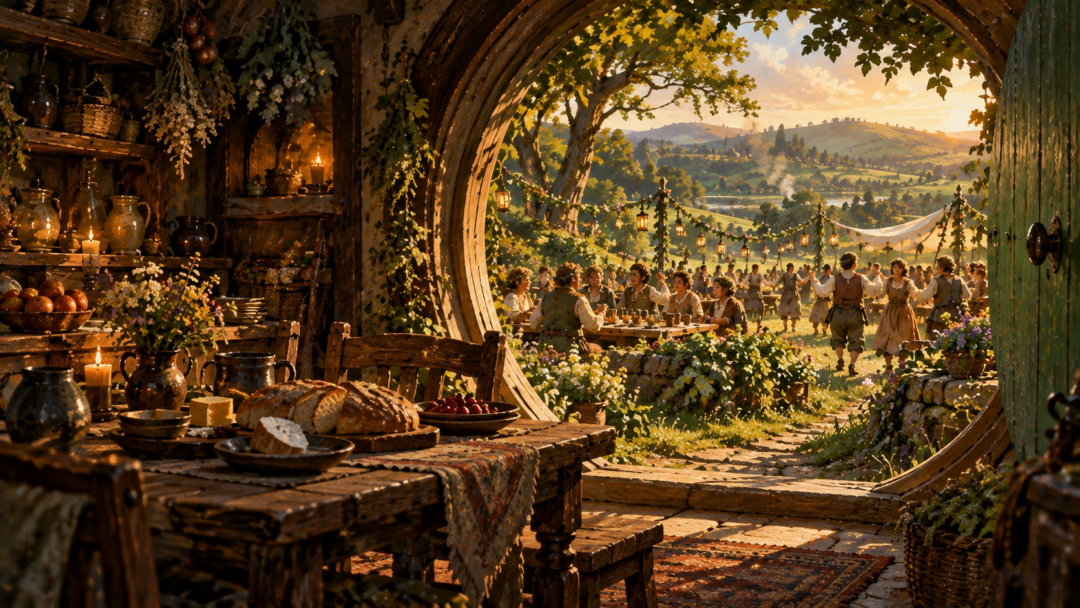
Appendix D specifically records that the Overlithe of 1420 produced the greatest merrymaking in memory.
That detail is easy to overlook because the great battles were finished. Yet it provides a beautiful miniature of the Shire’s recovery.
The leap day was always an extra festival day. In 1420, the calendar happened to give an additional midsummer holiday to a people experiencing extraordinary abundance after occupation, destruction, and fear.
The placement could hardly have been more fitting.
A Calendar Designed to Preserve Ordinary Life
Overlithe reveals something broader about Hobbit culture.
The Shire calendar valued repetition. Months were equal in length. Holidays occupied their own spaces. Dates remained attached to the same weekdays after the Shire-reform. Even the inconvenient fraction hidden inside the solar year was handled without disturbing the familiar pattern.
Yet the system did not eliminate irregularity.
It celebrated it.
Once every four years under the normal rule, an additional day appeared. Instead of being treated as an administrative nuisance, that day became an occasion for greater festivity.
That balance—regularity interrupted by sanctioned merriment—feels particularly suited to the Shire depicted in The Lord of the Rings.
Hobbits love predictable things: meals, gardens, birthdays, inns, family histories, local gossip, and established customs. But their celebrations are interruptions of routine rather than rejections of it. A feast is pleasurable partly because ordinary life will resume afterward.
Overlithe worked in exactly that fashion.
It was a day outside the months and, after the reform, outside the weekday sequence. Then it ended, 2 Lithe arrived, and the familiar calendar continued exactly where it ought to.
The Shire found a way to correct time without allowing the correction to disorder life.
And when time itself gave Hobbits an extra day, their calendar told them what to do with it:
make it a holiday.
Sources & Notes
- Tolkien Gateway, “Shire Calendar” — Leap year Overlithe, named festival days and weekday rules. https://tolkiengateway.net/wiki/Shire_Calendar
- Tolkien Gateway, “Overlithe” — Placement of the extra festival day and the celebration in 1420. https://tolkiengateway.net/wiki/Overlithe
- Tolkien Gateway, “Shire-reform” — Mid-year’s Day and Overlithe outside the weekdays. https://tolkiengateway.net/wiki/Shire-reform
Sources document Shire Calendar, Overlithe, Shire-reform. Interpretive claims remain distinguished from the primary narrative.