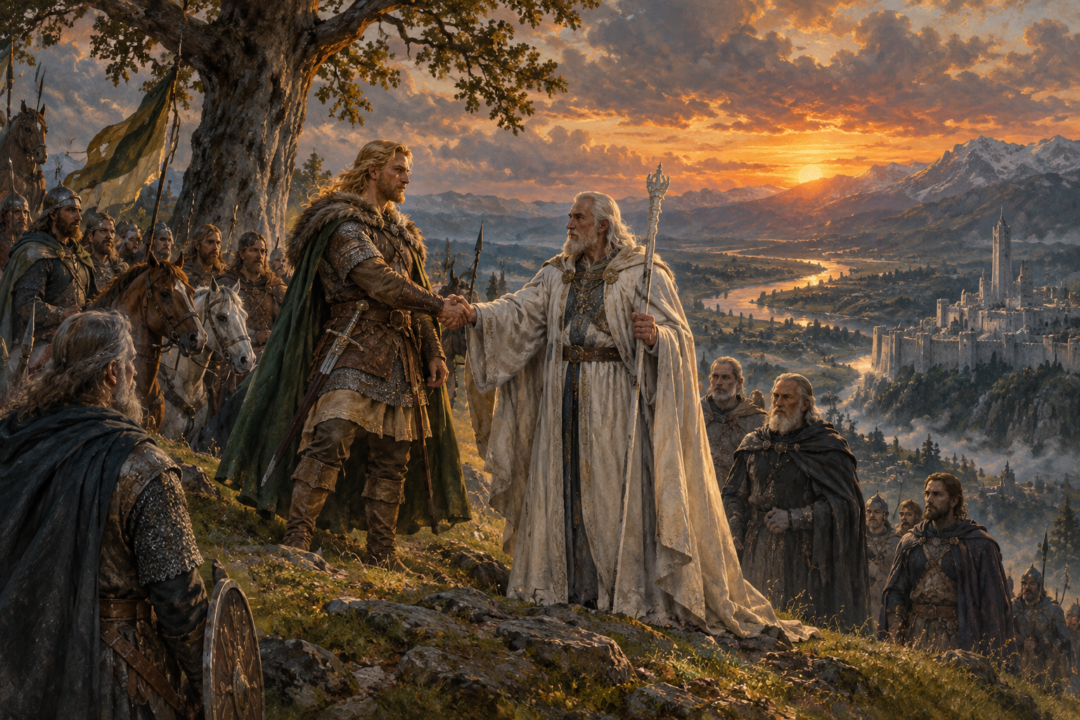
When Éomer stood beside the new King of Gondor after the fall of Sauron, he had every reason to believe that Rohan had already paid its debt in blood.
Théoden was dead. Many Riders lay beneath the grass of the Pelennor. The Rohirrim had answered Gondor’s desperate summons, broken into the battle before Minas Tirith, and then followed Aragorn’s war all the way to the Black Gate. If the ancient alliance between the Mark and Gondor were merely an exchange of services, no reasonable accounting could have demanded more.
Yet that is not how Éomer treated it.
After Aragorn became King Elessar, the ancient relationship was deliberately renewed. Appendix A of The Lord of the Rings records that Elessar renewed to Éomer the gift of Cirion, while Éomer took again the Oath of Eorl. The same account immediately adds that Éomer fulfilled that oath often in the years that followed.
That detail reveals something fundamental about political loyalty in Middle-earth. Victory did not cancel an old promise. Sacrifice did not purchase freedom from future obligation. For Éomer, the end of Sauron was not the moment when Rohan could finally say, “We have done enough.”
It was the moment when a new generation chose the bond again.
The Oath Began With a Rescue
To understand Éomer’s choice, it is necessary to return more than five centuries before the War of the Ring.
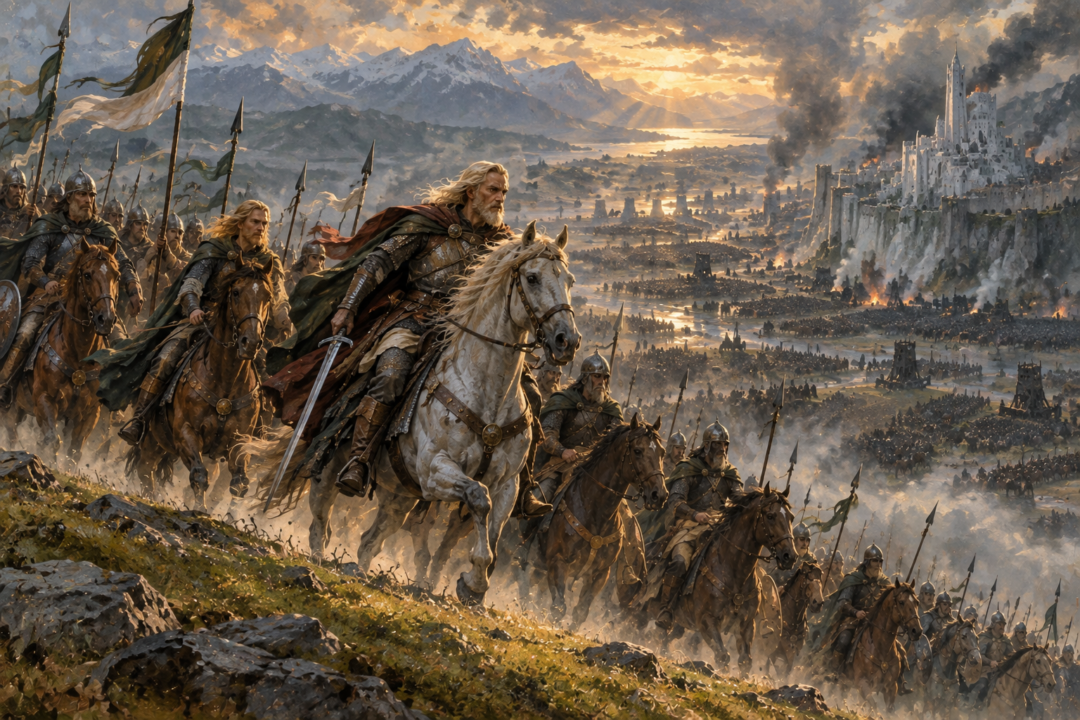
In the year 2510 of the Third Age, Gondor faced a devastating invasion in the north. Cirion, the Ruling Steward, sent for aid from Eorl the Young, lord of the Éothéod. Eorl answered. His horsemen rode south and arrived when Gondor’s northern army was in desperate danger at the Field of Celebrant.
Their intervention transformed the battle.
But what followed is as important as the rescue itself.
Cirion granted Eorl and his people Calenardhon, the largely depopulated territory that would become Rohan. The arrangement was not presented merely as wages for military service. On Amon Anwar, later called Halifirien, Eorl and Cirion established a lasting bond between their peoples.
The account preserved in Unfinished Tales makes the solemnity unusually clear. Eorl pledged friendship with Gondor and aid in its need, binding his heirs to preserve that faith. Cirion answered with a corresponding bond on Gondor’s behalf.
The alliance therefore began with generosity answered by commitment.
Eorl had already saved Gondor before he swore the oath. If victory itself had settled the account, there would have been little need for anything more.
Instead, the victory became the foundation of a future relationship.
That pattern matters enormously when Éomer’s generation arrives.
Théoden Had Already Fulfilled the Ancient Promise
During the War of the Ring, Gondor called upon Rohan in circumstances remarkably suited to test the old alliance.
The Red Arrow reached Théoden as Gondor prepared for siege. Rohan itself had only recently survived war. Théoden had fought at the Hornburg, suffered losses, and still faced uncertainty within his own realm.
He rode anyway.
At the Pelennor Fields, the Rohirrim did not arrive as mercenaries negotiating a price. They came as allies answering need. Théoden died there, and Éomer inherited the kingship amid battle.
By any ordinary calculation, Rohan’s obligation could have seemed fulfilled at that point.
But Éomer did not turn home after the Pelennor.
He joined Aragorn and the Captains of the West in the march to the Black Gate. The purpose of that desperate expedition was to challenge Sauron and draw his attention away from the Ring-bearer. The army that marched into Mordor’s shadow had little expectation of defeating Sauron by conventional force.
Éomer therefore inherited not merely Théoden’s crown but a living tradition of loyalty already being tested at its extreme limit.
Then Sauron fell.
And still the oath was not treated as finished.
The Crucial Detail: Elessar Renewed Cirion’s Gift Too
It would be misleading to describe the renewed oath as Éomer simply placing Rohan beneath Gondor.
The text gives us a more balanced picture.
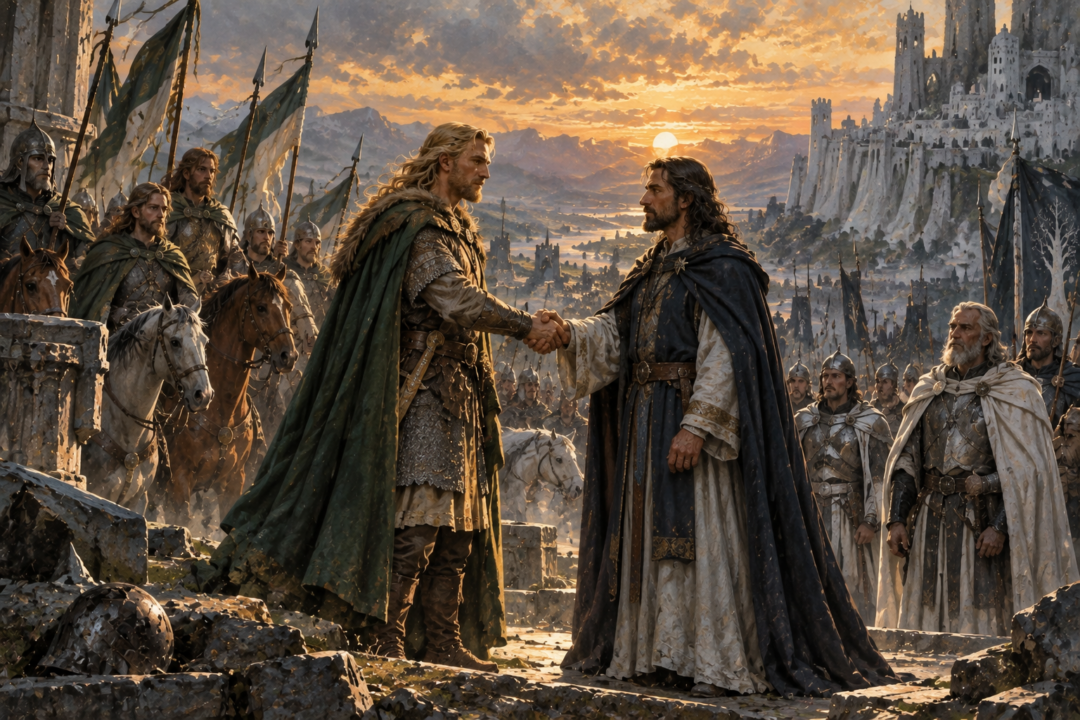
Appendix A states that King Elessar renewed to Éomer the gift of Cirion, and Éomer took again the Oath of Eorl. These actions belong together.
Cirion had granted Calenardhon to Eorl. Elessar, now restored as King of Gondor and Arnor, reaffirmed that ancient settlement rather than using his restored authority to weaken Rohan’s independence.
The appendix explicitly distinguishes Rohan from the lands over which Elessar ruled. Rohan remained its own kingdom.
Éomer’s renewed oath therefore belongs to a reciprocal political relationship. Gondor recognizes the Mark; the Mark renews its friendship and military bond with Gondor.
Neither side behaves as though the upheaval of the War of the Ring has erased the past.
Instead, both rulers deliberately connect their new age to an older act of trust.
That is one reason the renewal carries such weight. Aragorn and Éomer are not merely inheriting institutions passively. They are actively affirming them.
Victory Had Not Ended Every War
There was also an immediate practical reason why friendship between the kingdoms still mattered.
Sauron’s destruction did not instantly pacify Middle-earth.
Appendix A says this directly. Although Sauron had passed, the hatreds and evils he had bred had not died. Elessar still had enemies to overcome before his realm could enjoy peace.
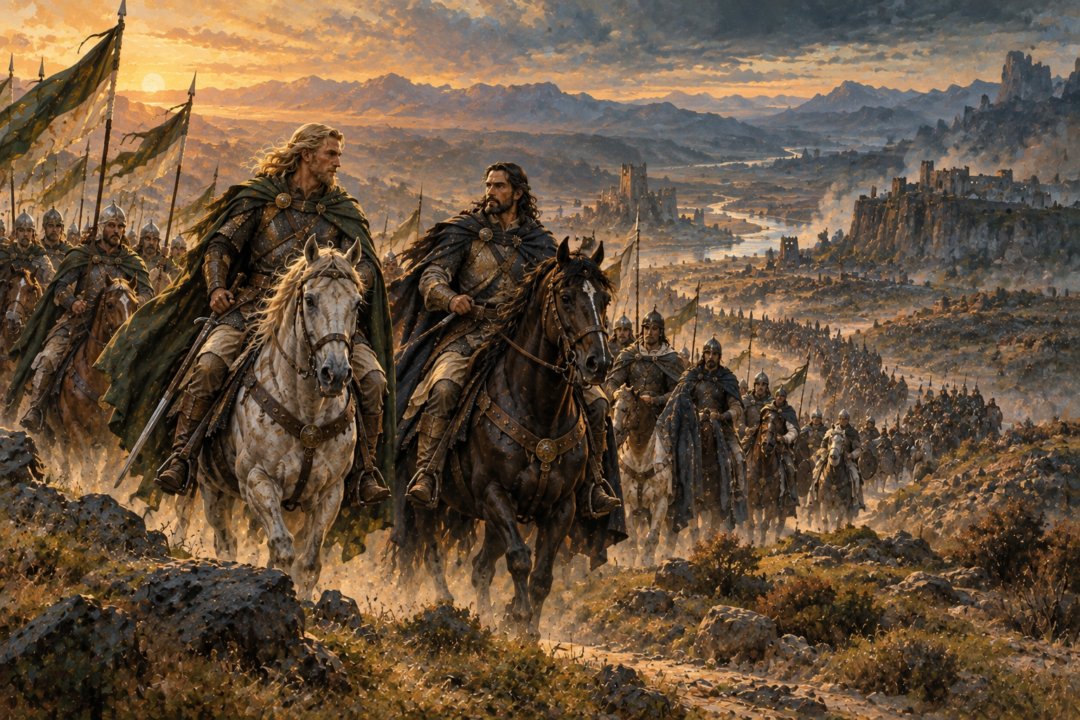
Éomer repeatedly accompanied him in those later wars. The text says that wherever Elessar went with war, Éomer went with him, and it describes campaigning far into the East and South.
This makes the renewed oath more than ceremony.
Éomer was promising something that would cost Rohan further effort after the supposedly final victory.
That is the overlooked point.
The destruction of the Ring defeated the central power behind the great war, but it did not erase every hostile force, every inherited conflict, or every consequence of centuries under the Shadow.
Éomer could not simply declare the old alliance obsolete because its most terrible enemy had fallen.
The Fourth Age still had to be built.
The Oath Was Not a Debt Ledger
One reading of Éomer’s decision is that the oath represents a conception of loyalty fundamentally different from repayment.
Rohan owed Gondor nothing in the crude sense of an unpaid military bill. By the end of the War of the Ring, both kingdoms had repeatedly suffered for one another.
More importantly, the original oath had never been framed as a limited transaction whose obligations would disappear once each side had contributed an equivalent amount.
It concerned enduring friendship and aid in need.
That distinction explains why counting sacrifices misses the point.
Théoden’s death did not purchase the cancellation of Eorl’s promise. Nor did Eorl’s ancient rescue of Gondor make Cirion’s generosity unnecessary. In both generations, an extraordinary act of aid produced renewed relationship rather than separation.
The pattern is almost symmetrical.
Eorl saved Gondor, then bound his people to Gondor.
Théoden and Éomer helped save Gondor again, and Éomer renewed the bond.
The texts do not explicitly tell us Éomer’s private reasoning, so we should not pretend to know his exact thoughts. But his actions fit a consistent political and moral pattern: loyalty is not exhausted by being tested successfully.
Successful loyalty becomes a reason to trust again.
Éomer Was Also Beginning a New Royal Line
There is another important context.
Éomer was not simply continuing Théoden’s reign. Appendix A identifies him as the first king of the Third Line of the House of Eorl.
His accession therefore stood at a genuine dynastic threshold.
At almost the same moment, Gondor experienced an even greater restoration: the long rule of the Stewards ended, and a king returned to the throne.
Two realms were entering a new political era under new rulers.
They could have regarded the ancient settlement as something belonging to dead men and vanished circumstances. Instead, Elessar and Éomer reaffirmed it.
That gives the renewal a significance beyond military necessity.
Éomer linked his new line of kings back to Eorl the Young. Elessar linked the restored kingship of Gondor back to Cirion’s promise rather than overturning it.
The new age began not by discarding inherited obligations, but by deciding which inheritances deserved to survive.
The Alliance Had Already Survived Imperfection
The history of Rohan and Gondor was not a simple story in which each kingdom always arrived whenever summoned.
There were periods when one realm was too hard-pressed to provide the help the other desired. The histories surrounding the Oath of Eorl preserve moments when circumstances prevented effective assistance.
That makes the endurance of the alliance more interesting.
Its strength did not depend on an impossible record of flawless intervention. It depended on a continuing recognition that the two peoples were bound together against common dangers.
By Éomer’s time, that relationship had endured for roughly five centuries.
The War of the Ring could therefore be seen not as the single event that justified the alliance, but as its greatest demonstration.
When Gondor’s need became desperate, Rohan came.
When the Rohirrim rode onto the Pelennor, the ancient promise ceased to be merely remembered history. It became present action.
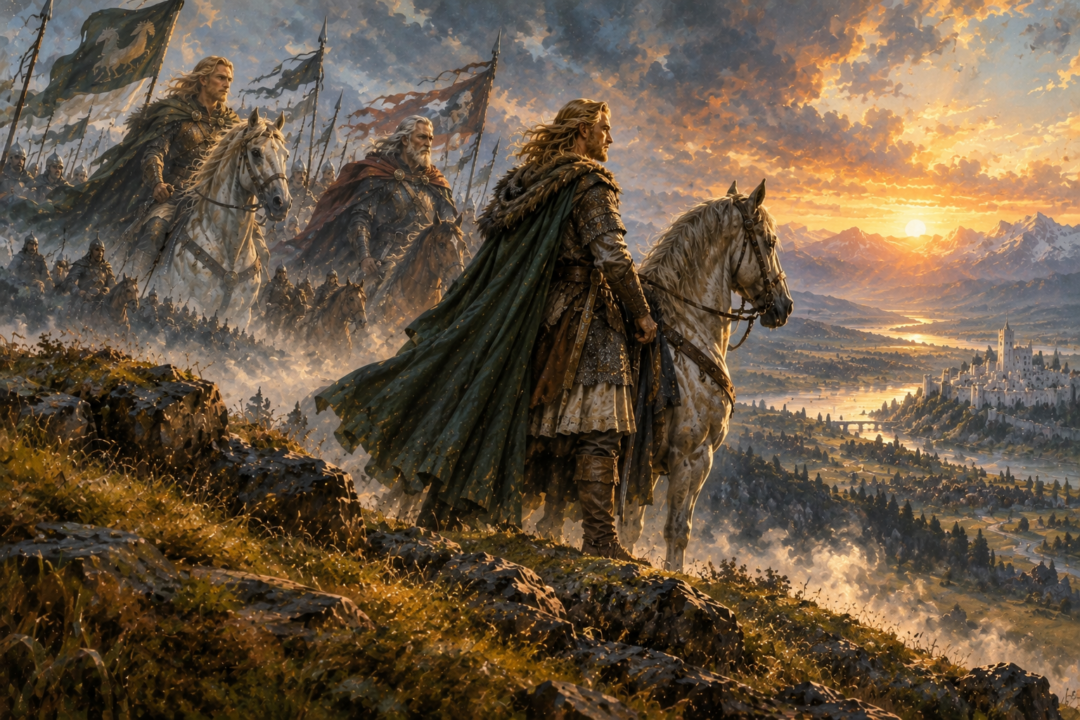
The Deeper Meaning of Éomer’s Choice
There is a quiet irony in Éomer renewing the oath after Sauron’s defeat.
That was precisely when it might have seemed least necessary.
The Dark Lord was gone. The Ring had been destroyed. Gondor had a king again. Rohan had survived. The great emergency that had drawn the free peoples together was over.
Yet durable alliances are revealed most clearly by what happens after the emergency.
Éomer did not make Théoden’s sacrifice the final entry in a ledger and close the account. Elessar did not interpret Gondor’s restored power as permission to absorb or diminish Rohan. Each reaffirmed what his predecessor had given.
The old oath survived because its purpose was larger than a single enemy.
It preserved friendship between two peoples whose histories had become intertwined.
And the appendices give the final proof that the renewal was meaningful: Éomer kept riding with Elessar in the wars that followed.
The victory over Sauron was therefore not the final payment on an ancient debt.
It was evidence that the promise had been worth keeping.
And when Éomer inherited a kingdom purchased at terrible cost, his answer was not to declare Rohan free of its past.
It was to choose the best part of that past again.
Sources & Notes
- Tolkien Gateway — Éomer: renewal of the Oath of Eorl and later campaigns with Elessar — https://tolkiengateway.net/wiki/%C3%89omer
- Tolkien Gateway — Oath of Eorl: Cirion's gift, reciprocal alliance and subsequent history — https://tolkiengateway.net/wiki/Oath_of_Eorl
- The Encyclopedia of Arda — Oath of Eorl: the lasting bond between Gondor and Rohan — https://www.encyclopedia-of-arda.com/o/oathofeorl.html
Primary reading: The Lord of the Rings, Appendix A, 'The House of Eorl'; The Return of the King, 'The Steward and the King'; and Unfinished Tales, 'Cirion and Eorl and the Friendship of Gondor and Rohan'. These are secondary reference links. The renewal and later campaigning are recorded facts within the story; Éomer's unspoken personal motives and the debt-ledger contrast are interpretive.