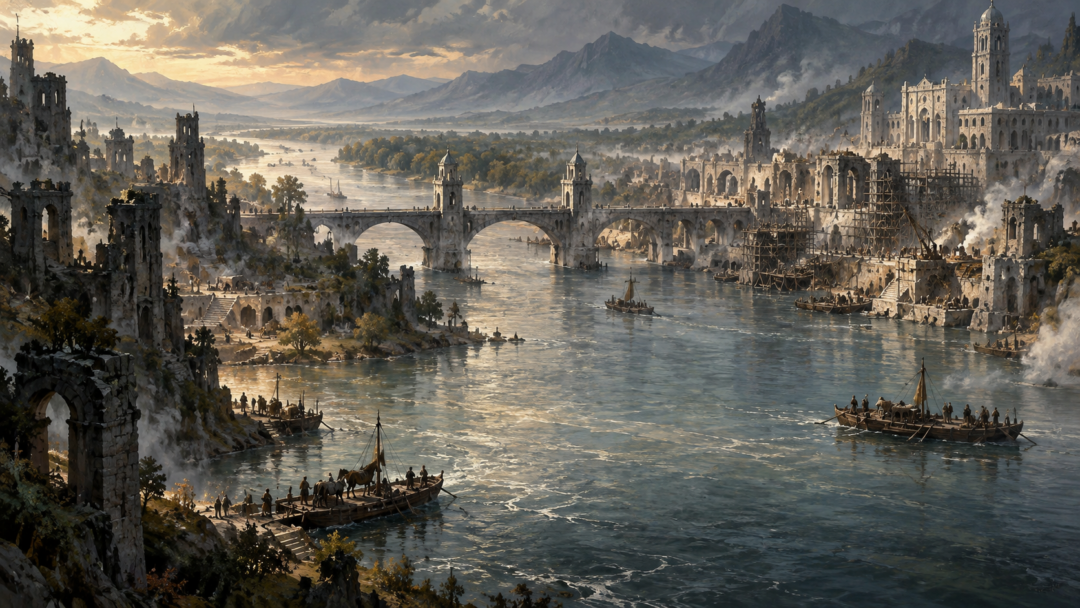
Osgiliath once possessed one of the greatest bridges in Middle-earth. In the city's glory, a mighty stone bridge crossed the Anduin, bearing buildings and towers above the river. It was more than an engineering achievement: it joined the eastern and western halves of Gondor's capital and bound Ithilien to the heartland of the South-kingdom.
So if Osgiliath flourished again after the War of the Ring, why would anyone still need ferries?
The question contains an important assumption that the texts themselves undermine. A bridge solves the problem of crossing a river at one particular place. The Anduin is not one particular place. It is the Great River of Middle-earth, running for immense distances through changing landscapes, and Gondor's history repeatedly shows that controlling one crossing never meant controlling the whole river.
More importantly, the final days of the War of the Ring reveal something surprisingly specific: even at Osgiliath itself, ferries and temporary boat-bridges were useful alongside the city's older infrastructure.
The Great Bridge Was Exceptional for a Reason
The ancient bridge of Osgiliath should not be imagined as an ordinary bridge that Gondor could simply reproduce wherever convenient.
Osgiliath had been the chief city of Gondor, founded across both banks of the Anduin. In its greatness it possessed quays for shipping as well as its famous stone bridge. This was monumental infrastructure belonging to one of the most important places in the realm.
Elsewhere, the geography was very different.
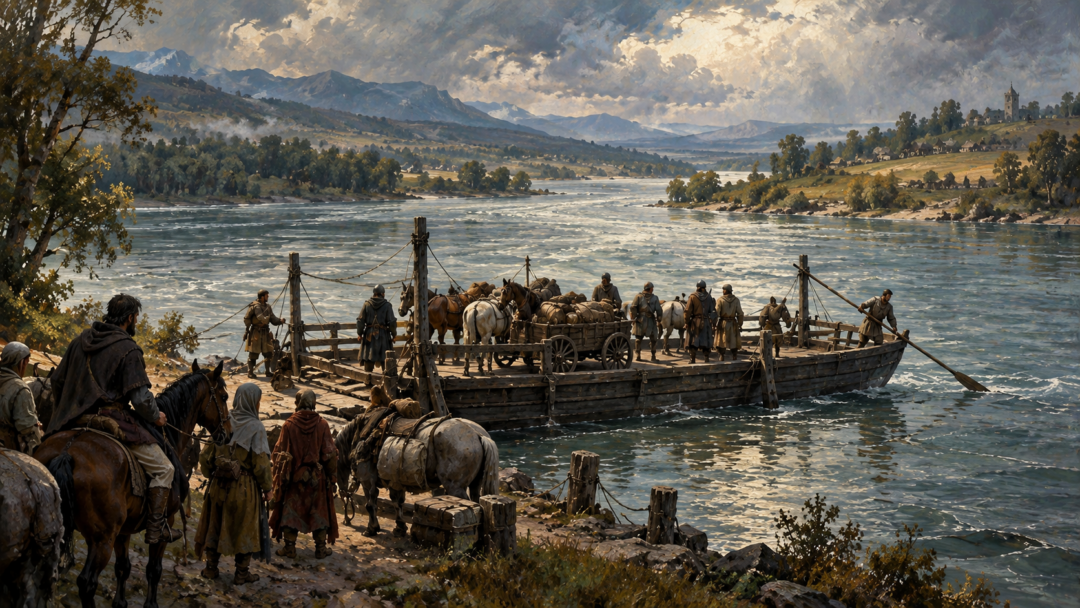
By the end of the Third Age, permanent bridges across the Anduin were conspicuously rare. Far to the north, the old bridge associated with the Forest Road had disappeared long before the War of the Ring. Other crossings depended upon fords, boats, islands, or favorable stretches of the river.
That scarcity matters.
It suggests that bridging the Anduin was not something routinely done wherever a road met the water. The Great River was too formidable, and the places where large forces could cross it were strategically important precisely because there were so few of them.
A rebuilt Osgiliath would restore one enormously important crossing. It would not make the rest of the river disappear.
Cair Andros Proves That One Bridge Was Never Enough
Roughly fifty miles north of Minas Tirith lay Cair Andros, the great ship-shaped island in the Anduin.
Its importance was military as well as geographical.
The island divided the river and provided one of the few practical places where an army could pass the Anduin in that region. Gondor repeatedly fortified it, and its security mattered enough that Amon Dîn, the first of the beacon-hills, had originally served to warn Minas Tirith of danger connected with the crossing there.
That would make little sense if Osgiliath's bridge had rendered other crossings irrelevant.
The two places served different needs.
An enemy approaching the bridge at Osgiliath could meet concentrated resistance. An enemy able to cross farther north might instead enter Anórien and threaten Gondor from another direction. During the War of the Ring, forces from the Morannon captured Cair Andros and crossed into Anórien, demonstrating exactly why Gondor could not think of the Anduin as a wall with a single gate.
In peacetime the same geography works in reverse. Travellers far north of Osgiliath would gain little from a magnificent bridge if reaching it required a huge detour.
The river therefore demands a network of crossings rather than a single masterpiece of engineering.

The War Revealed the Power of Temporary Crossings
The defence of Osgiliath in March 3019 provides an even clearer lesson.
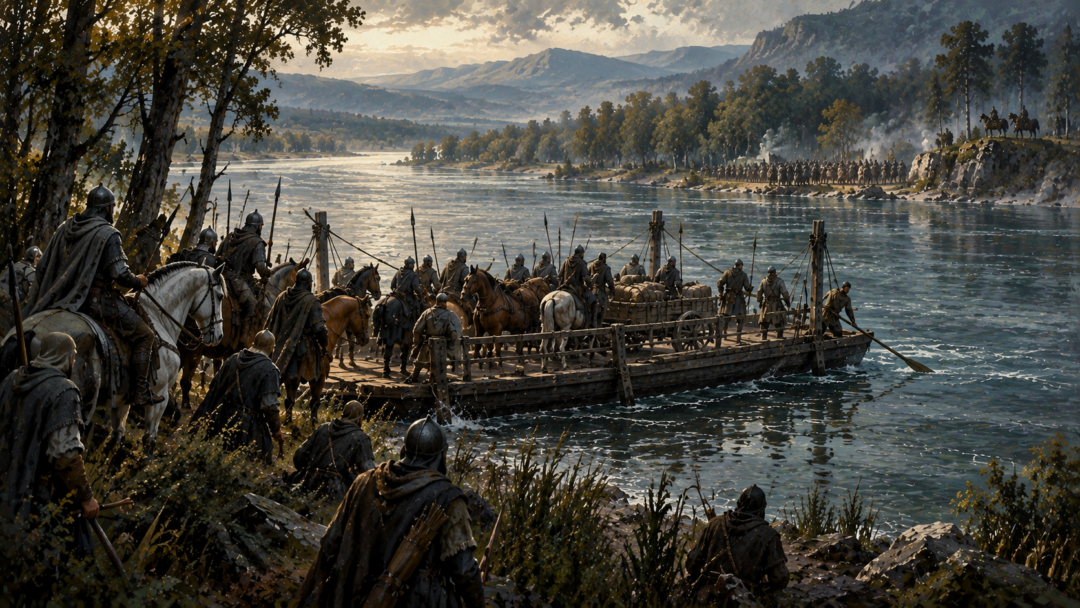
When Sauron's forces prepared their assault, they did not need to reconstruct the ancient bridge before attacking. They secretly accumulated floats and barges on the eastern side of the river. When the attack came, these craft allowed large numbers of troops to cross the Anduin despite Gondor's defence.
The tactical lesson is difficult to miss.
A permanent bridge is powerful, but boats make a river permeable.
After the Battle of the Pelennor Fields, the same principle appears from the opposite direction. As the Captains of the West prepared to march toward the Black Gate, workers at Osgiliath were strengthening the ferries and boat-bridges that the Enemy had made and partly destroyed during its retreat.
That detail is crucial.
The victorious Gondorians did not regard these improvised crossings as worthless simply because Osgiliath had once possessed a magnificent bridge. They repaired and used what was available because armies, supplies, and travellers needed to cross the river immediately.
The episode gives us one of the strongest textual foundations for imagining ferries remaining part of life on the Anduin.
A Rebuilt Osgiliath Would Not Eliminate Distance
The Fourth Age brings renewal to Gondor, but the texts do not provide a detailed civil-engineering history of the restored kingdom. We should therefore be cautious about claiming exactly which bridges were rebuilt, when they were completed, or how river transport was organized under King Elessar.
What can be said is that the geography remained.
Suppose Osgiliath's great crossing were restored. A farmer, messenger, soldier, merchant, or traveller twenty miles upstream would still face a simple calculation: travel south to the bridge, cross it, and then travel north again—or use a local boat crossing if one existed.
At greater distances the argument becomes stronger.
The Anduin passes Cair Andros, Osgiliath, the Harlond region, Pelargir, and ultimately the great delta at its mouths. A bridge at one city cannot serve every movement between its banks.
This is not evidence that ferries existed at every imagined settlement. The texts do not provide such a catalogue.
It is instead a geographical inference grounded in what they do show: boats, barges, temporary crossings, shipping, strategically important crossing places, and remarkably few permanent bridges.
The Anduin Was a Road as Well as a Barrier
There is another reason the "bridge versus ferry" question is slightly misleading.
The Anduin was not merely an obstacle to travel. It was itself a route of travel.
After Sauron's fall, the returning Captains and their forces used ships to journey downriver from Cair Andros toward Osgiliath. Earlier, Aragorn's captured fleet had sailed upriver from Pelargir to the Harlond during the Battle of the Pelennor Fields.
These movements reveal a river deeply connected to transportation.
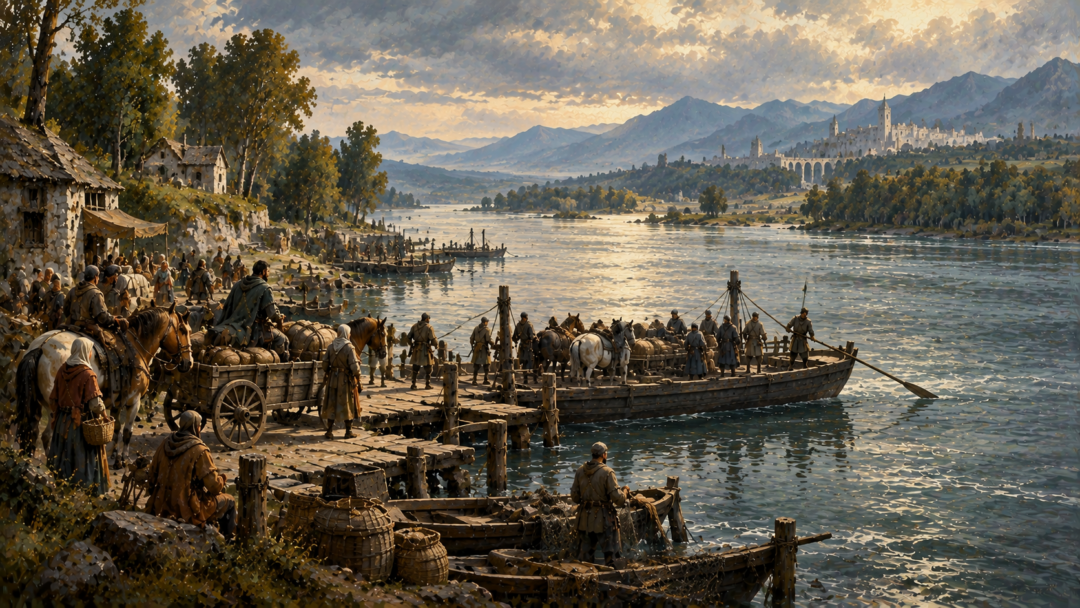
Osgiliath itself had quays in its ancient days, capable of receiving vessels coming upriver. The city's relationship with the Anduin therefore involved far more than getting from one bank to another. The river connected places.
A restored Gondor would have every reason to benefit from that inherited geography.
A ferry fits naturally into such a river system. It does not compete with a bridge in quite the same way a second bridge would. Boats can carry people across the river, move along it, serve temporary needs, and operate where monumental stone construction would be unnecessary.
The surviving texts do not describe a Fourth Age ferry administration, so anything more specific would become invention. But the underlying logic is already present at the end of the Third Age.
Ferries Also Make a Kingdom Less Fragile
Osgiliath's history demonstrates another uncomfortable truth: bridges can become strategic liabilities.
A bridge concentrates movement.
That makes it valuable in peace and dangerous in war.
Osgiliath's crossings were repeatedly fought over because whoever controlled them controlled one of the most important routes across the Anduin. In 3018, when Boromir and Faramir defended the city against Sauron's attack, the last bridge was cast down. Only four defenders, including the brothers, returned by swimming.
Less than a year later, Sauron's army crossed again using boats.
The contrast is revealing. Destroying a bridge can deny an enemy an easy crossing, but it cannot make a great river permanently impassable.
A restored Gondor would know this lesson better than almost any kingdom.
From that history, it is reasonable to infer that maintaining multiple means of river transport would provide resilience. Ferries could supplement permanent crossings, while boats could be shifted or replaced more easily than a destroyed stone bridge.
That does not mean Gondor necessarily developed such a policy; the texts never say so. It means that the historical experience of the kingdom demonstrates why dependence upon one crossing would remain dangerous.
The Anduin Is Too Important to Be Reduced to Osgiliath
The temptation is to think of the restored bridge as the final answer because Osgiliath carries such enormous symbolic weight.
Its rebuilding would represent the healing of Gondor: east and west joined again, Ithilien restored, the ancient capital no longer an abandoned battlefield.
But the Anduin is larger than Osgiliath.
That is perhaps the deeper point.
Gondor's greatest works never abolish geography. Roads must still climb mountains. Beacons must still cross great distances. Fortresses guard passes because armies cannot simply ignore terrain. And the Anduin remains what it has always been: a highway, a frontier, a defence, and an obstacle depending upon where one stands.
The bridge at Osgiliath would master one crossing.
Ferries would answer a different question: how do ordinary people, soldiers, messengers, and goods cross everywhere else?
The surviving narrative never gives us a detailed map of Fourth Age ferry routes, and it would be wrong to invent one. Yet the late Third Age provides the essential evidence. Osgiliath itself relied on ferries and boat-bridges when necessity demanded it. Cair Andros remained strategically vital despite the existence of Osgiliath. Ships routinely moved along the river. And permanent bridges across the Great River were exceptional rather than commonplace.
Rebuilding Osgiliath, then, would not make ferries obsolete.
It would restore one of Gondor's greatest crossings while leaving intact the fundamental truth that shaped the kingdom for thousands of years:
the Anduin was never merely a river to be bridged. It was a vast living artery of Middle-earth, and Gondor had to live with it as much as cross it.
Sources & Notes
- Tolkien Gateway — Osgiliath: the city spanning the river and the history of its bridges https://tolkiengateway.net/wiki/Osgiliath
- Tolkien Gateway — The Black Gate Opens: the Host of the West's march through Osgiliath https://tolkiengateway.net/wiki/The_Black_Gate_Opens
- Tolkien Gateway — Cair Andros: the northern crossing and its strategic importance https://tolkiengateway.net/wiki/Cair_Andros
Primary reading: The Fellowship of the Ring, 'The Council of Elrond'; The Return of the King, 'The Siege of Gondor', 'The Black Gate Opens', and 'The Steward and the King'; Unfinished Tales, 'The Drúedain'. These secondary guides support the river and wartime crossings. Continued Fourth Age ferry use is a geographical inference, not a documented ferry administration or a dated bridge-rebuilding programme.