The Teleri came west because they wanted to see the light of Aman. Yet one of the most consequential moments in their history happened because their king stopped beneath the trees.
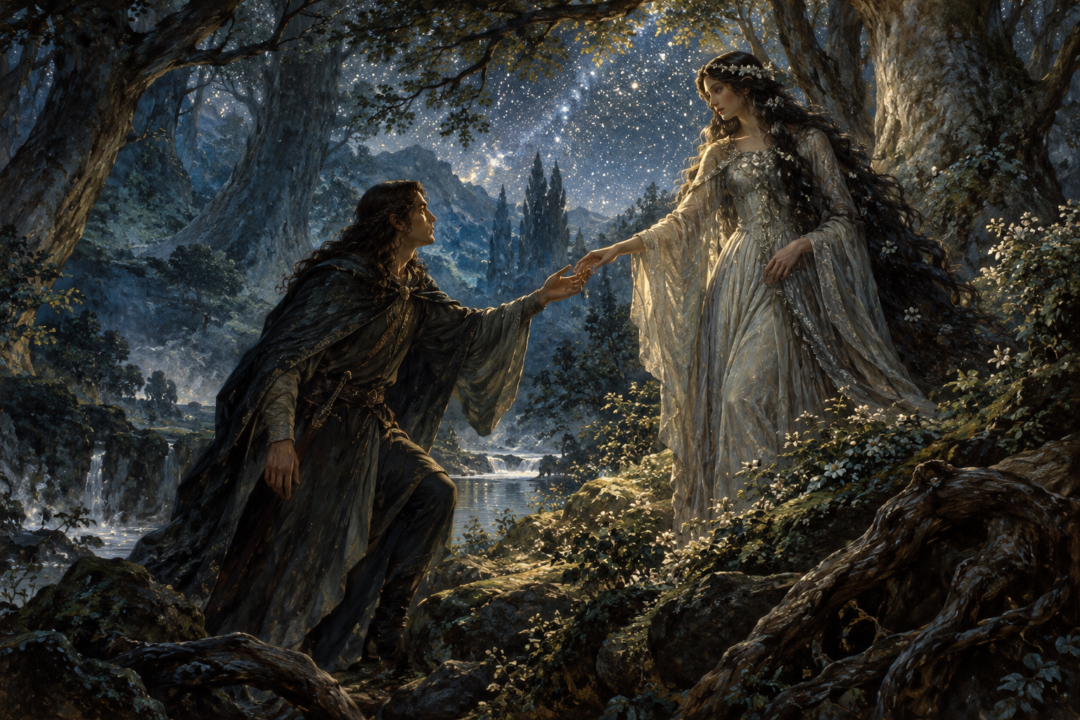
Elwë Singollo was already a leader of the Teleri when he entered the woods of Nan Elmoth and encountered Melian, one of the Maiar. There, according to The Silmarillion, he heard her singing beneath the trees. He approached her, took her hand, and for years beyond ordinary reckoning the two remained together while the world changed around them.
That encounter is usually remembered as a love story: Elwë and Melian become Thingol and his queen, parents of Lúthien and rulers of Doriath. But it is also the moment when the westward migration of the Teleri fractures beyond repair.
Some continue toward Aman. Some remain because they refuse to abandon their missing king. Others linger along the western shores and later become the Falathrim under Círdan. Those divisions eventually produce separate Elven peoples, kingdoms, cultures, and destinies.
Elwë does not deliberately divide his people. Yet his disappearance creates a historical fork from which the Teleri never fully return.
Before Melian, the Teleri Were Already the Slowest Great Kindred
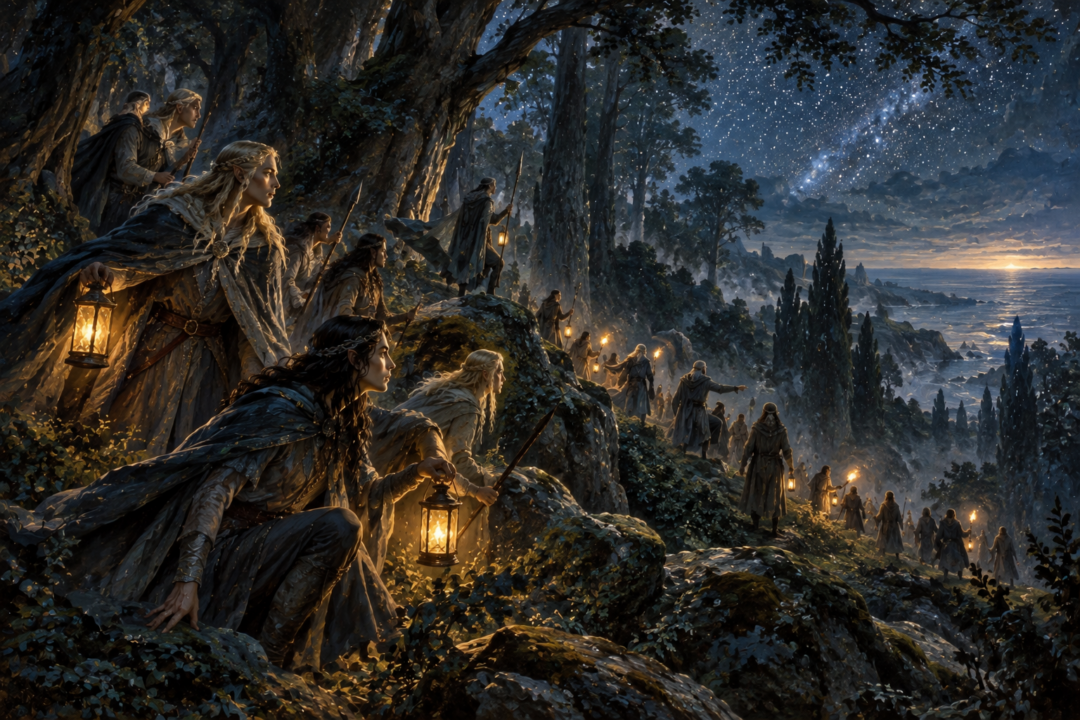
The Teleri were the third and largest of the three great hosts of the Eldar who began the Great Journey from Cuiviénen toward the West. Their leaders were the brothers Elwë and Olwë.
Unlike the Vanyar and Noldor, however, the Teleri repeatedly delayed during the migration. They loved the lands through which they passed, and many were reluctant to leave Middle-earth behind. Their movement westward was therefore never as unified or urgent as that of the other kindreds.
Some Teleri had already been separated from the main host before Elwë met Melian. Those who abandoned the Great Journey east of the Misty Mountains became part of the people later called the Nandor. So Elwë’s disappearance did not create every division among the Teleri.
What it did was fracture the western Teleri at the decisive moment when Aman was finally within reach.
Elwë had already seen the Blessed Realm. He had earlier travelled there with Oromë as one of the ambassadors of the Elves and had returned to encourage his people to make the Great Journey. In other words, the king who vanished in Beleriand was not ignorant of what lay beyond the Sea.
He had seen the destination.
Then he encountered something in Middle-earth powerful enough to stop him.
The Meeting in Nan Elmoth
While the Teleri were dwelling in Beleriand, Elwë went walking in the woods of Nan Elmoth. There he heard the voice of Melian.
Melian was no Elf. She was one of the Maiar, a being of the same broad spiritual order as figures such as Gandalf and Sauron, though her character and purposes were entirely different. Before coming to Middle-earth she had dwelt in Valinor, associated especially with the gardens of Lórien.
When Elwë heard her singing beneath the trees, he was overcome with wonder. He came to her, and when he took her hand, the two stood together while years passed beneath the wheeling stars.
The episode has the quality of enchantment, but it should not be reduced simply to a spell cast upon an unwilling victim. The text presents their meeting as the beginning of a profound union. Melian becomes Elwë’s wife, and through their marriage the bloodline of the Maiar enters the genealogies of Elves and eventually Men.
But Elwë’s people do not know any of this while he is gone.
To them, their king has simply disappeared.
That difference in perspective is crucial. For Elwë, Nan Elmoth becomes the beginning of a new destiny. For the Teleri searching for him, it becomes a crisis of loyalty.
The Teleri Must Choose Between Their King and the West
Elwë’s people searched for him.
But the summons of the Valar and the movement toward Aman had not ceased. Eventually a choice became unavoidable: remain in Middle-earth looking for Elwë, or continue westward.
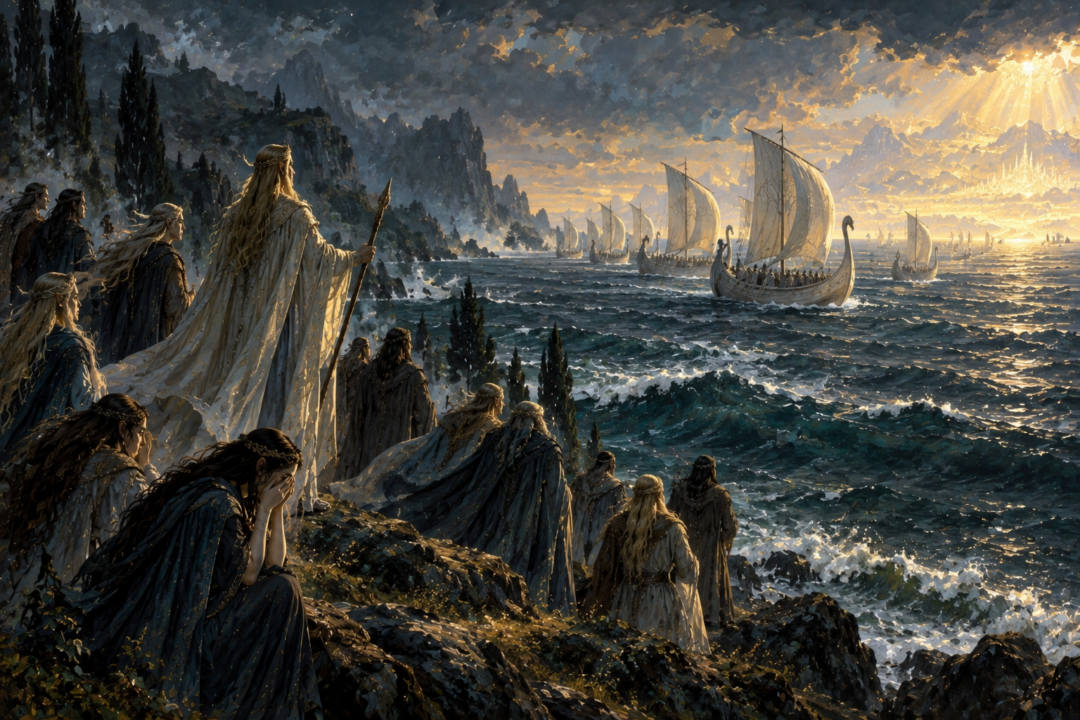
Olwë ultimately became king of those Teleri who departed. They were taken across the Sea and settled in Aman, eventually dwelling at Alqualondë, the famous Haven of the Swans.
Those who remained behind for Elwë became known as the Eglath, the Forsaken People.
The name contains one of the great ironies of the episode.
They stayed because they would not forsake their king, yet they themselves regarded their fate through the language of abandonment. The voyage continued without them. Aman receded beyond the Sea while they remained in Beleriand.
Their loyalty cost them the destination toward which they had crossed much of Middle-earth.
And when Elwë finally returned, he was no longer quite the king who had vanished.
Elwë Returns as Thingol
Elwë emerged from his long encounter with Melian visibly transformed.
Although he had not dwelt permanently in Valinor, he had once seen the light of the Two Trees during his earlier embassy. After his union with Melian, his stature and presence became exceptional even among the Eldar. He became known as Elu Thingol, King Greymantle.
The people who had remained for him now had something those who sailed with Olwë did not: a ruler joined in marriage to one of the Maiar.
From that point, their history ceased to be merely the story of Teleri who had missed the ship.
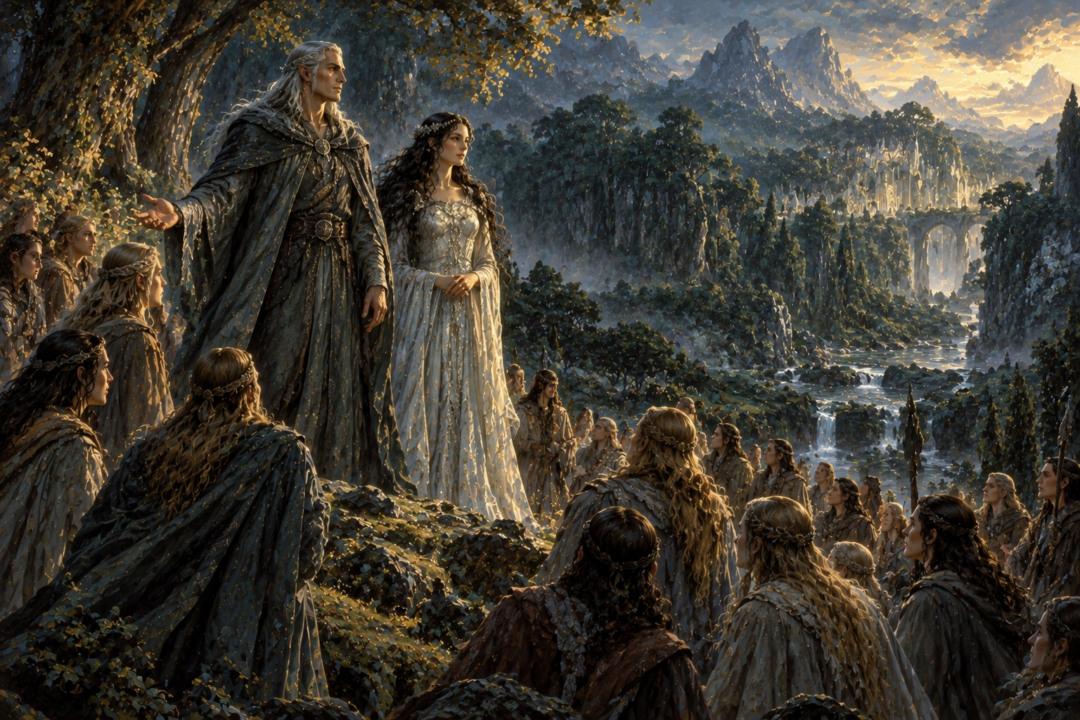
Under Thingol and Melian, a great realm arose in Beleriand. Their people became the Sindar, the Grey-elves. Thingol ruled widely, while Melian’s wisdom and power became central to the protection of Doriath.
Their daughter Lúthien would later become one of the pivotal figures in the entire legendarium.
The division of the Teleri therefore produces something paradoxical. Those who reached Aman gained the Blessed Realm and the light of the Trees. Those who remained lost that opportunity—but their descendants became central to the history of Middle-earth.
There is no simple winning side to the separation.
Círdan Reveals That the Division Was Not Simply Two-Way
It is tempting to describe the event as a clean split: Olwë’s people sail, Thingol’s people stay.
The actual history is more complicated.
Some of the Teleri remained in the coastal regions of Beleriand. Among the most important was Círdan the Shipwright, who became lord of the Falathrim, the Elves of the Falas. The coastal Teleri had their own relationship with the Sea and developed around the havens of Brithombar and Eglarest.
This matters because Elwë’s disappearance did not simply produce two isolated branches. It contributed to a broader fragmentation of Telerin identity in Middle-earth.
There were Teleri in Aman under Olwë. There were Sindar under Thingol. There were the Falathrim associated with Círdan. Earlier divisions had already produced the Nandor, and later movements would create still more complicated identities among the Elves.
The Great Journey had begun as the migration of enormous kindreds.
By the time the Eldar settled into their later histories, geography, loyalty, loss, and individual choices had turned those kindreds into distinct peoples.
The Strange Fate of the Sindar
The Sindar occupy an unusual place among the Elves.
They are counted among the Eldar because they accepted the summons and undertook the Great Journey, but they did not reach Aman during that original migration. They therefore did not live beneath the light of the Two Trees as the Vanyar, Noldor, and the Teleri of Aman did.
Yet their king had seen that light.
Their queen came from the Blessed Realm.
This makes Doriath something extraordinary: a kingdom of Middle-earth shaped by a ruler who had witnessed Valinor and a Maia who had actually dwelt there.
Melian brought knowledge and power into Beleriand that profoundly affected Thingol’s realm. Later, when Morgoth’s shadow spread across the north, she established the protective enchantment known as the Girdle of Melian around Doriath.
The Teleri who stayed behind therefore did not simply become a lesser reflection of their relatives in Aman.
They became something different.
Their separation created one of the defining cultures of the First Age.
The Consequences Reach Far Beyond the Teleri
The importance of Elwë’s meeting with Melian becomes clearer when we follow its consequences.
Without their union there is no Lúthien as the texts know her. Without Lúthien, the story of Beren changes completely. Their line leads through Dior and Elwing to Eärendil, and from there into the ancestry of Elrond and Elros.
That means the encounter beneath the trees of Nan Elmoth eventually touches both the immortal and mortal lines that shape the later Ages.
This does not mean every later event was mechanically predetermined at that moment. Tolkien’s histories repeatedly leave room for choice, chance, providence, courage, and failure.
But genealogically and politically, the consequences are immense.
A king pauses during a migration.
A people wait for him.
A ship leaves without them.
From that separation eventually emerge Doriath, Lúthien’s lineage, and connections reaching into the histories of Númenor and the rulers of Men.
A Division That Is Never Truly Repaired
The most important point is that the Teleri do not simply reunite once Elwë returns.
By then, the decisive crossing has happened.
Olwë’s people are in Aman. Thingol’s people remain in Beleriand. The Sundering Seas are no ordinary border, and the two groups develop under radically different conditions.
The Teleri of Aman become associated above all with Alqualondë and their swan-ships. Their later history intersects catastrophically with that of the Noldor when Fëanor demands their ships and the First Kinslaying follows.
The Sindar, meanwhile, experience the wars and tragedies of Beleriand directly. Doriath becomes one of the great realms resisting Morgoth, but it too eventually falls amid conflicts involving the Silmaril, the Nauglamír, and the sons of Fëanor.
The descendants of the same migrating people thus inherit different tragedies.
One branch suffers violence in the Blessed Realm.
Another builds a protected kingdom in Middle-earth only to see it destroyed.
Their separation is geographical at first, but history makes it cultural and political.
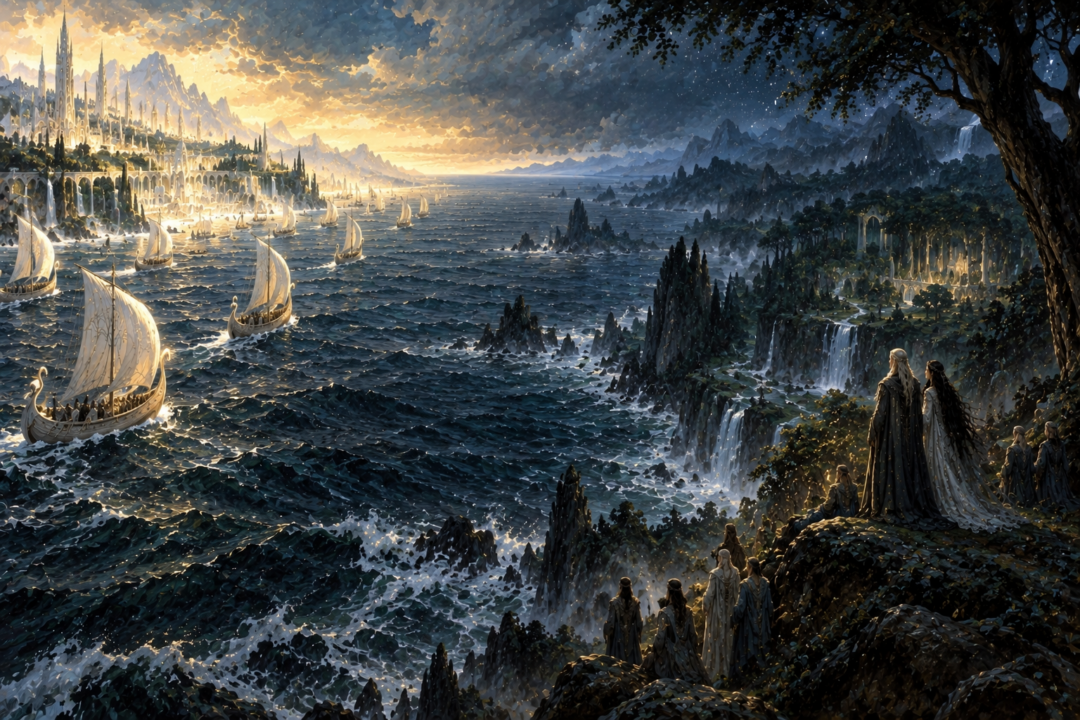
The Deeper Meaning of Elwë’s Choice
Strictly speaking, the texts do not present Elwë standing in Nan Elmoth and consciously choosing Melian over his people. He does not announce that he is abandoning the Great Journey, nor is the encounter framed as a calculated rejection of Aman.
That distinction matters.
The division comes through consequence rather than deliberate policy.
Yet this is precisely what makes the episode so powerful. Middle-earth repeatedly turns on choices whose full consequences cannot be seen when they are made—or on moments that are not experienced as choices at all by everyone involved.
Elwë’s encounter with Melian gives Middle-earth Lúthien and the extraordinary lineage that follows her.
It also leaves part of the Teleri behind.
Those two truths cannot be separated.
The Teleri who wait for their king lose the chance to make the original crossing into Aman, but through that loss they become the foundation of a new civilization. Elwë loses the path he had once urged his people to follow, yet gains a queen whose presence transforms both him and his realm.
The result is neither simply tragedy nor reward.
It is a sundering.
And long after Elwë finally walks out of Nan Elmoth, the Teleri remain divided by the consequences of the years he spent beneath its trees.
Sources & Notes
- Tolkien Gateway — Thingol: Elwë's encounter with Melian and return to his remaining people https://tolkiengateway.net/wiki/Thingol
- Tolkien Gateway — Eglath: the Teleri who stayed behind searching for their king https://tolkiengateway.net/wiki/Eglath
- Tolkien Gateway — Teleri: Olwë's voyage, the coastal Elves, and the wider sundering https://tolkiengateway.net/wiki/Teleri
Primary reading: The Silmarillion, 'Of the Coming of the Elves and the Captivity of Melkor', 'Of Thingol and Melian', 'Of Eldamar and the Princes of the Eldalië', and 'Of the Sindar'. These are secondary reference guides. Elwë's absence contributed to the western Telerin divisions but did not originate the earlier Nandorin separation or constitute a deliberate policy of abandoning his people.