For days, the boats of Lórien seem almost like an answer to the Fellowship’s problems.
They carry Frodo and his companions swiftly south on the Anduin, spare them the exhaustion and exposure of travelling on foot, and postpone a decision nobody wants to make: whether the Company will turn toward Minas Tirith or continue toward Mordor.
Then, in the darkness of 23 February 3019, the river itself takes that choice away.
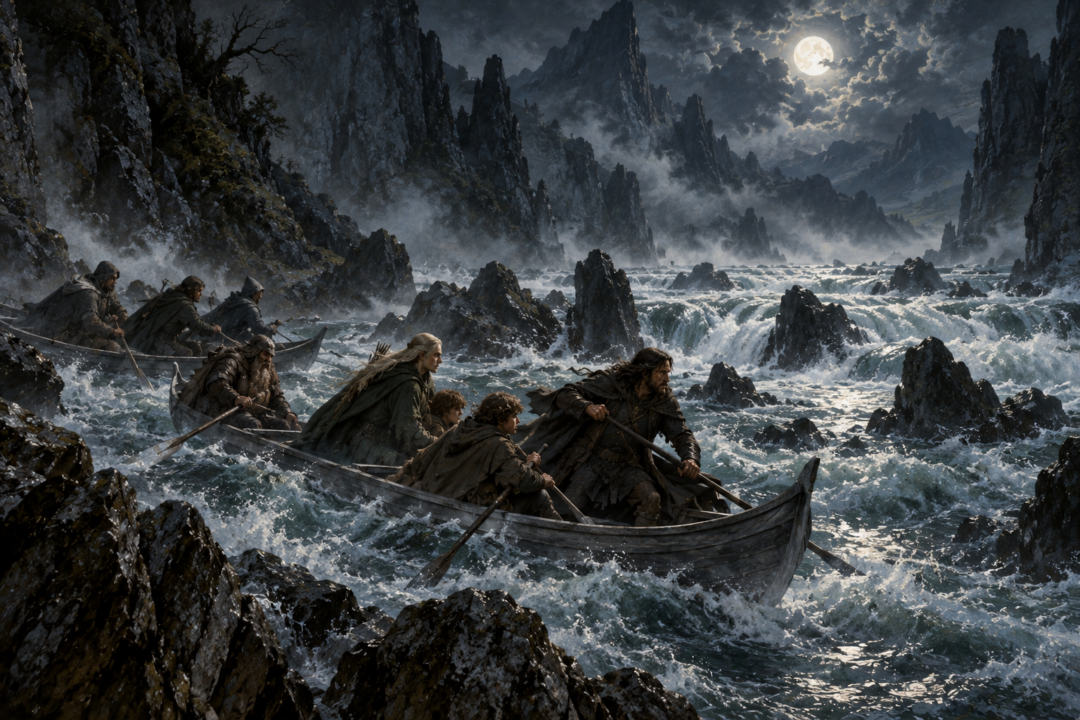
The Fellowship hears a growing roar ahead. The current quickens. Dark shapes appear in the water. Aragorn realizes too late that they have reached Sarn Gebir, the rapids of the Anduin, sooner than he expected.
It raises an obvious question. The Fellowship possesses three remarkably light boats made in Lothlórien, and the Anduin is carrying them in exactly the direction they want to travel. Why not simply remain aboard and ride through the rapids?
Because Sarn Gebir is not merely fast water. It is a genuine break in the navigable river, dangerous enough that travellers had already created an overland route specifically to avoid it.
And the Fellowship nearly discovers that fact in the worst possible way.
The River Changes Beneath Them
The journey south from Lórien initially encourages confidence.
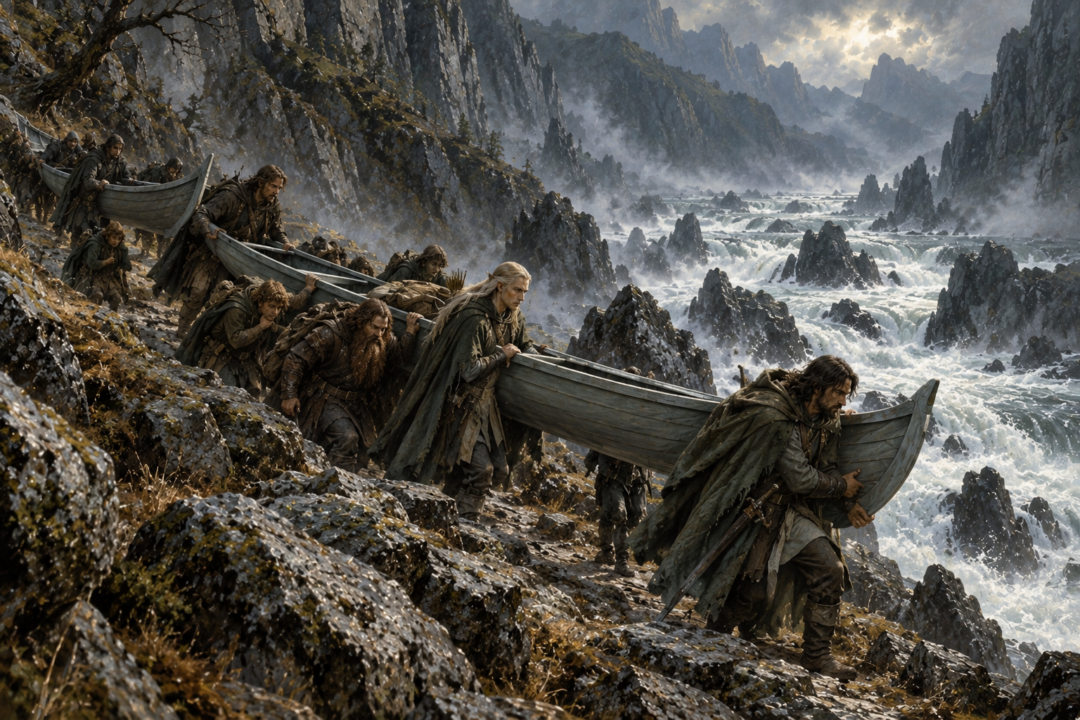
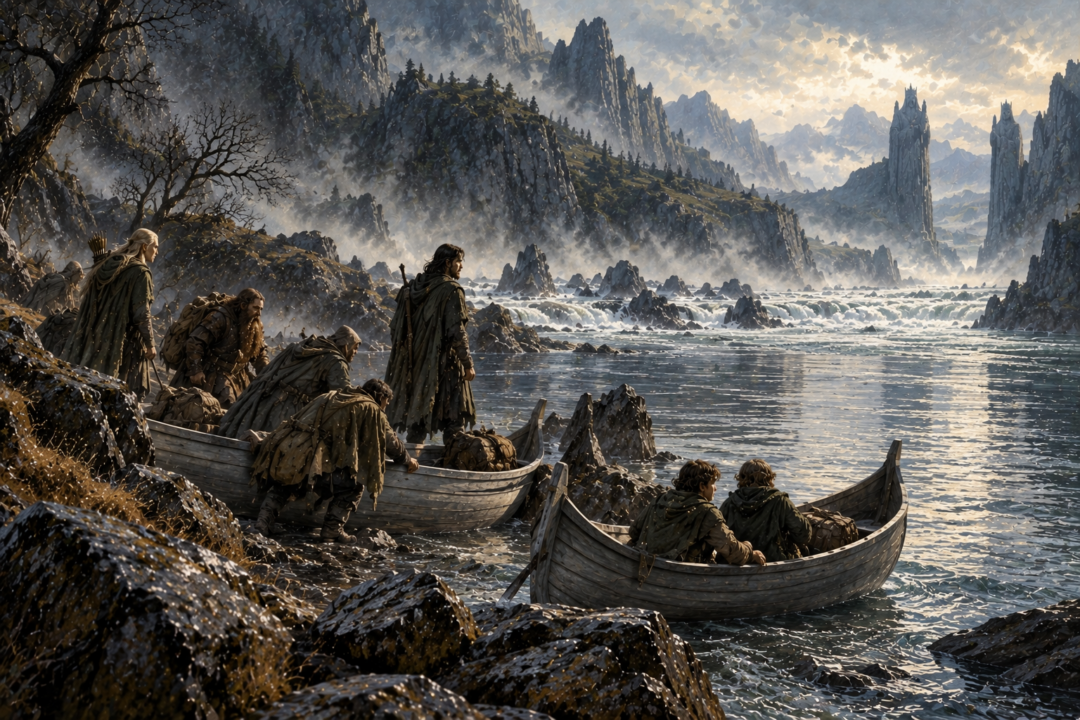
The Company departs in three boats provided by the Galadhrim. They are travelling downstream, and for much of the journey the Great River does a considerable portion of the work. But as the Fellowship enters the Emyn Muil, the character of the Anduin changes.
The banks become increasingly rocky and confining. The river runs among harsh hills, and Aragorn knows that dangerous water lies ahead.
What catches the Company off guard is not ignorance of Sarn Gebir but timing.
Aragorn expects the rapids. He simply does not expect to reach them when they do.
At night the Fellowship suddenly hears the sound of rushing water growing louder. The current begins carrying the boats more swiftly forward. Aragorn recognizes the danger and orders the Company to turn back.
This is crucial.
Their problem is not that the boats are incapable of floating on rough water. Their problem is that the river ahead contains obstacles through which they cannot safely navigate.
Sarn Gebir is associated with rocky eyots and sharp stones breaking the current. Its name is generally rendered in the sense of “stone-spikes,” an unusually literal warning about what lies in the water.
A boat carried helplessly into such a channel could be driven against rock, overturned, trapped, or smashed. Downstream speed becomes a liability because every moment reduces the travellers’ ability to retreat.
The Fellowship therefore paddles desperately against the current.
They are not trying to make progress.
They are trying not to be swept into the rapids.
Boromir Is the One Who Sees the Immediate Danger
There is an easily overlooked detail in this episode: Boromir plays an important role in preventing disaster.
As the boats are being pulled toward danger, Boromir cries out that there are rocks ahead.
Aragorn immediately responds by ordering the boats to turn.
This is one of those small moments that complicates the tragedy surrounding Boromir. His temptation by the Ring is already growing, and his behaviour during the river journey has begun troubling Merry and Pippin. Yet he remains an experienced warrior and traveller, alert to danger around the Company.
At Sarn Gebir, that alertness matters.
The boats manage to fight their way away from the worst danger, but the Fellowship's troubles are only beginning.
They have reached one of the places where geography, enemy movement, and their own uncertain purpose all collide.
Sarn Gebir Was Already Known to Be Impassable by Boat
The strongest evidence that the Fellowship cannot simply run the rapids is the existence of the portage-way.
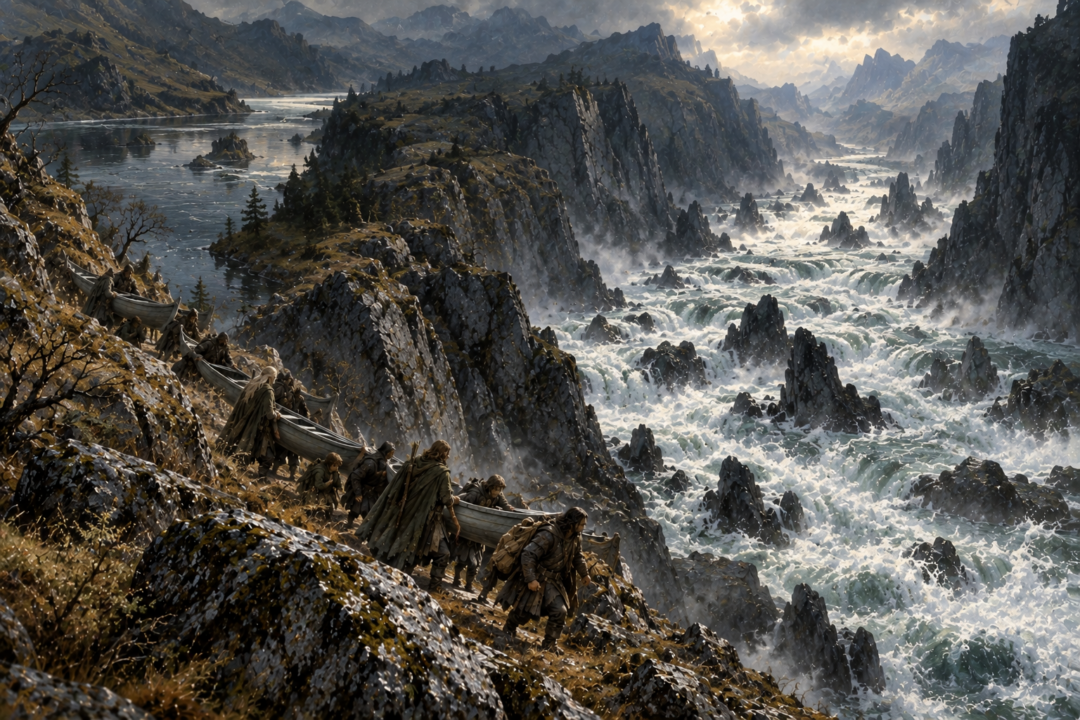
Travellers had dealt with Sarn Gebir long before Frodo ever reached the Anduin. A path had been made along the western side of the river so that boats could be carried around the dangerous stretch.
That tells us something important about the normal use of the Great River.
Sarn Gebir was not treated as an exciting but manageable rapid for skilled boatmen. River traffic bypassed it on land.
The old way runs beside the rapids toward a landing below them. The Fellowship eventually uses precisely this solution. Their Elven boats are light enough to be carried, which proves unexpectedly important. Instead of abandoning the vessels, the companions can transport them and their baggage overland and return to the river below the obstruction.
In other words, the boats of Lórien are extremely useful at Sarn Gebir precisely because the Fellowship can take them out of the water.
Their light construction does not make the rapids safe.
It makes the portage possible.
The Orc Attack Makes a Bad Situation Worse
The Fellowship reaches this obstacle at night, but the rapids are not the only threat.
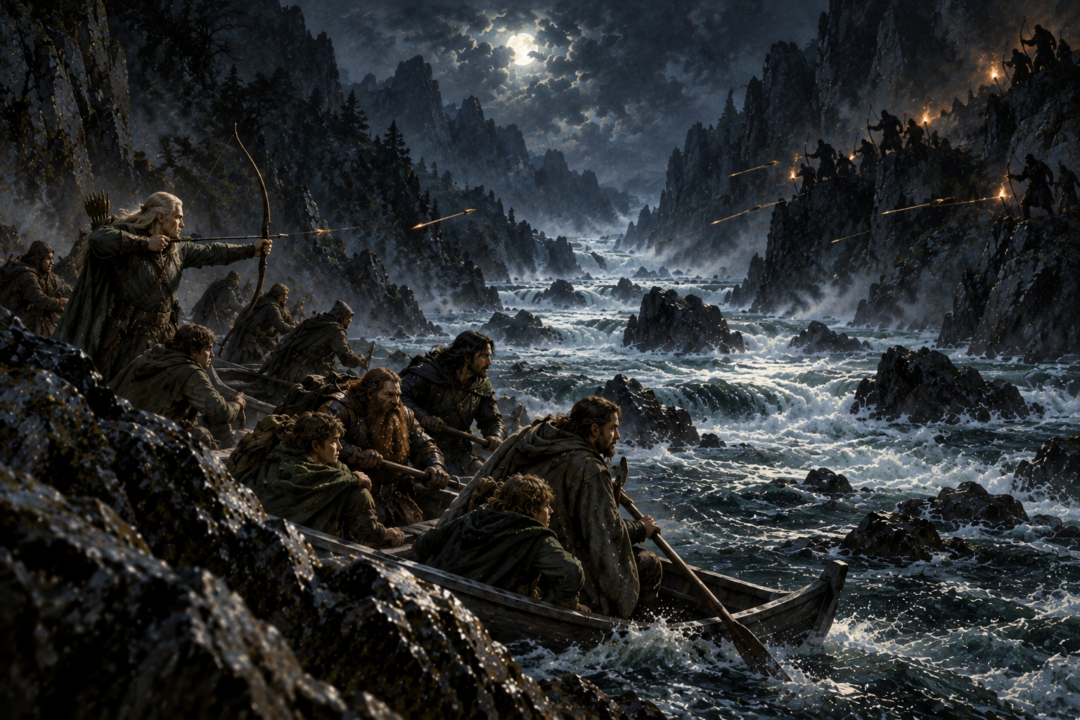
Orcs are waiting on the eastern side of the river.
Arrows begin flying toward the boats while the Company is attempting to escape the current. The Fellowship is caught in an unusually dangerous tactical position: remaining exposed on the water invites enemy fire, while drifting farther downstream risks Sarn Gebir itself.
Their grey Elven cloaks help conceal them in the darkness, frustrating the Orcs' aim, but the attack makes clear that this stretch of river is no longer simply a natural obstacle.
The enemy is moving through the region.
Then something even more ominous appears.
A vast winged shape approaches out of the southern darkness, bringing with it a terror Frodo recognizes without fully understanding its source. Legolas shoots at it with the great bow given to him in Lórien and brings the creature down, though at this stage the Company cannot identify what he has struck.
Later events make the implication clear: the Shadow has begun using winged mounts for the Nazgûl.
So the Fellowship arrives at Sarn Gebir at exactly the wrong moment. The river ahead cannot safely be navigated, Orcs threaten one bank, and a new terror of Mordor is appearing overhead.
The apparently easy river journey is ending.
Why Not Abandon the Boats Entirely?
After such a night, another solution might seem sensible: leave the boats and continue overland.
Boromir would certainly welcome a change of route, because the unresolved argument over the Fellowship’s destination is becoming increasingly urgent.
But abandoning the boats would sacrifice one of the Company's greatest practical advantages.
Once below Sarn Gebir, the Anduin becomes useful again.
The old portage therefore offers a better answer. The Fellowship can carry the boats around the dangerous water and relaunch them afterward.
This distinction matters because Sarn Gebir is an obstacle within the river journey, not necessarily the end of that journey.
The Company spends the next day carrying the boats and baggage along the portage. They eventually reach a small landing-place below the rapids. From there they can return to the Anduin and continue south.
Soon afterward they pass between the Argonath and enter Nen Hithoel.
Only then does an even greater barrier loom ahead: Rauros.
Sarn Gebir and Rauros Are Different Problems
It is easy to blur together the hazards of this section of the Anduin because Sarn Gebir, Nen Hithoel, and the Falls of Rauros lie relatively close together.
But they are distinct geographical features.
Sarn Gebir is a stretch of dangerous rapids north of the Argonath. The Fellowship bypasses it using the western portage and then returns to the river.
Farther south, beyond the Argonath and Nen Hithoel, the Anduin reaches Rauros.
There the situation is even more final.
The great waterfall prevents continued ordinary navigation downstream, and the Fellowship must again contemplate leaving the river. Aragorn and Legolas investigate the route while the Company camps at Parth Galen.
But the Fellowship never completes that planned portage as a united Company.
Boromir attempts to take the Ring from Frodo. Frodo decides to leave alone. Sam follows him. Orcs attack, Boromir is killed, Merry and Pippin are captured, and Aragorn, Legolas, and Gimli begin their pursuit.
The river journey effectively ends with the breaking of the Fellowship.
Sarn Gebir therefore foreshadows what is coming. It is the first major point where simply allowing the Anduin to carry them south ceases to be possible.
Even Gollum Cannot Follow Through the Rapids
There is another revealing detail.
Gollum has been following the Fellowship down the Anduin, using the river in his own furtive fashion. Yet Sarn Gebir interrupts his pursuit as well.
He cannot simply continue through the rapids on the water.
Instead, his path diverges into the Emyn Muil before he eventually finds Frodo and Sam again after the Fellowship has broken.
That reinforces the basic geographical reality of Sarn Gebir. The obstruction is not a problem peculiar to the Fellowship's boats or to Aragorn's caution. It genuinely interrupts movement along the river.
Anyone following the Anduin south must deal with it.
The Deeper Problem Is That the River Has Been Delaying a Decision
Sarn Gebir matters for more than navigation.
Ever since Lórien, the Fellowship has been able to postpone its most dangerous internal question.
Where are they actually going?
Boromir wants the Company to go to Minas Tirith. Frodo knows that his own road ultimately leads toward Mordor. Aragorn is carrying the burden of leadership after Gandalf's fall and has not yet forced the choice.
The boats create temporary unity because everyone can travel south together.
For a while, geography allows them to avoid deciding.
Sarn Gebir begins to destroy that illusion.
The Fellowship must stop. They must leave the water. They must carry their possessions and boats through hostile country. Orcs are near. Mordor's power is visibly reaching across the river. And every mile south makes the question of the Company's destination harder to postpone.
The river can no longer provide effortless momentum.
Soon the Fellowship itself will lose its momentum too.
Why They Cannot Simply Stay in the Boats
The answer, then, is surprisingly concrete.
The Fellowship cannot stay in its boats through Sarn Gebir because Sarn Gebir is effectively unnavigable. Sharp rocks and violent water make continuing downstream extraordinarily dangerous, and the established way past the obstacle is an overland portage on the western bank.
The Company does exactly what earlier river travellers had done: they remove the boats from the water, carry them around the rapids, and launch them again below.
There is no hidden rule preventing the Elven boats from entering rough water. Nor is the decision merely excessive caution.
The geography itself dictates the route.
Yet the episode also works as a turning point in the journey. Until Sarn Gebir, the Anduin has allowed the Fellowship to remain together while postponing the choice between Gondor and Mordor. At the rapids, forward movement suddenly requires effort, exposure, and decision.
They successfully carry their boats around Sarn Gebir.
What they cannot carry much farther is the fragile unity of the Company itself.
Within only a few days, beneath the shadow of Rauros, that finally breaks.
Sources & Notes
- Tolkien Gateway — Sarn Gebir: unnavigable rapids and the Fellowship's western-bank portage https://tolkiengateway.net/wiki/Sarn_Gebir
- Tolkien Gateway — The Great River: chapter guide to the Anduin journey and route decisions https://tolkiengateway.net/wiki/The_Great_River
- The Encyclopedia of Arda — Sarn Gebir: stone-spikes and the landing below the portage-way https://www.encyclopedia-of-arda.com/s/sarngebir.html
Primary reading: The Fellowship of the Ring, 'The Great River' and 'The Breaking of the Fellowship'; Appendix B, 'The Great Years'. These secondary guides support the navigation obstacle and portage. Sarn Gebir's rapids are distinct from the later Falls of Rauros; the parallel with the Fellowship's weakening unity is literary interpretation.