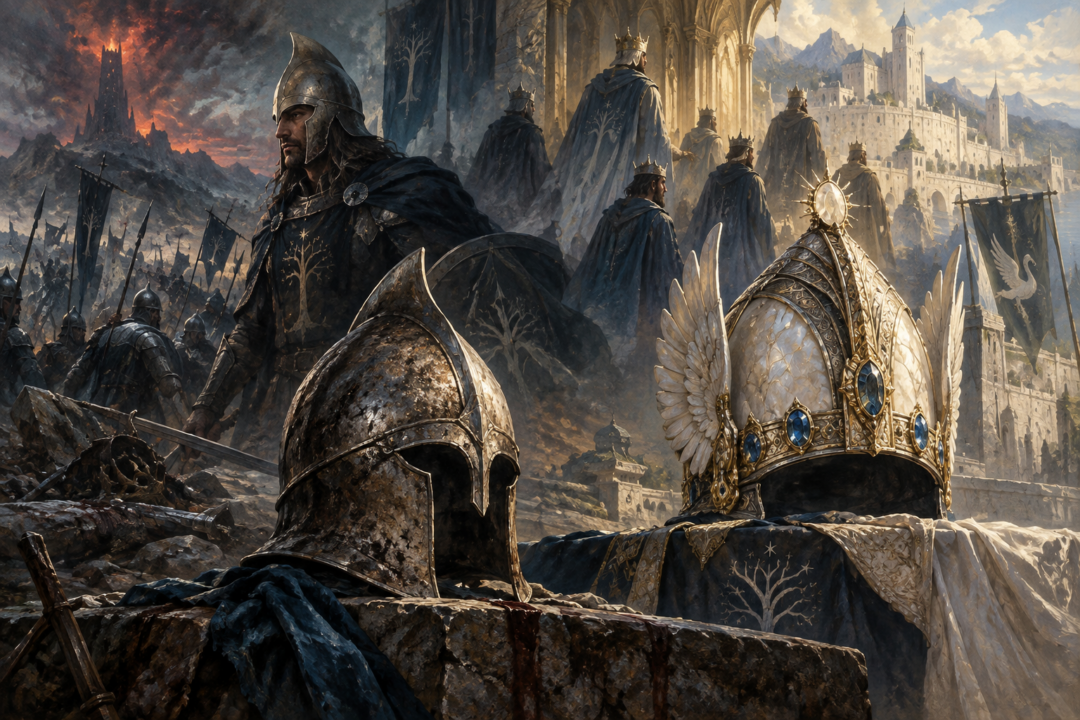
When Aragorn stands before the gates of Minas Tirith to be crowned, the object brought to him seems almost impossibly ancient. Faramir has it carried from Rath Dínen, the silent city of tombs where Gondor’s dead kings lie. The crown belongs to a royal tradition stretching back toward Númenor, Elendil, Isildur, and the founding of the kingdoms in exile.
It is easy, then, to imagine that Aragorn is simply receiving Isildur’s own crown after three thousand years.
But that is not what happens.
The distinction is small enough to hide in the appendices, yet it changes the meaning of Aragorn’s coronation. The crown placed upon him is connected to Isildur, but it is not the ancient war-helm Isildur once wore. That original object had been replaced many centuries earlier.
Aragorn is therefore not merely recovering a relic belonging to his ancestor.
He is inheriting the accumulated kingship of Gondor.
Gondor’s First Crown Was Actually a War-Helm
The earliest Crown of Gondor was remarkably austere.
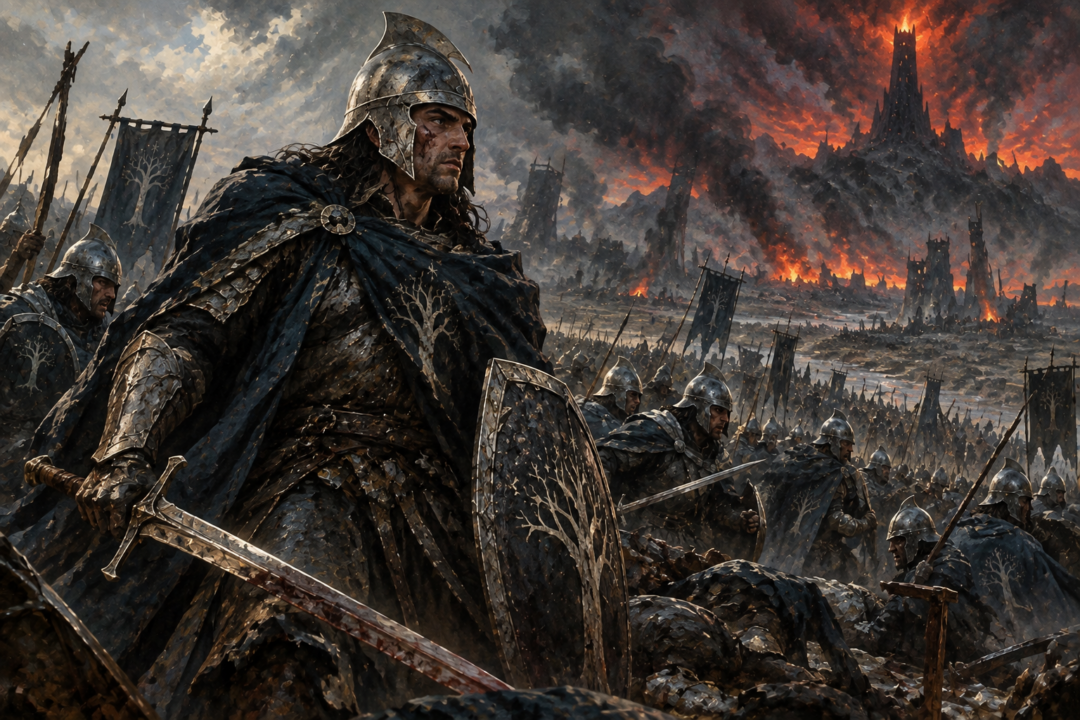
Appendix A explains that the crown’s form came from a Númenórean war-helm. In the beginning, the royal crown was actually a plain helmet, traditionally identified as the helm worn by Isildur at the Battle of Dagorlad during the War of the Last Alliance.
There was a grim reason Isildur’s helm became important.
Anárion, Isildur’s brother and fellow ruler of Gondor, was killed during the siege of Barad-dûr when a stone cast from the fortress struck him. His own helm was crushed. According to the tradition preserved in Gondor, Isildur’s surviving war-helm consequently became the crown used by the kings.
That origin says something important about early Gondor.
Its kingship did not begin with a delicate ceremonial circlet. Its crown was rooted in warfare, exile, and survival. The founders of Gondor were survivors of Númenor’s destruction who had immediately been forced into another catastrophic struggle against Sauron.
The earliest royal symbol reflected that world.
But it did not remain unchanged forever.
Atanatar II Replaced Isildur’s Helm
The crucial detail appears in the history of Gondor’s crown: during the reign of Atanatar II Alcarin, the old helm was replaced.
Atanatar ruled Gondor in the Third Age, more than a thousand years after the War of the Last Alliance. His surname, Alcarin, means “the Glorious,” and his reign belonged to the period when Gondor had become enormously wealthy and powerful.
During his days, the plain ancient helm ceased to serve as the royal crown.
A jewelled helm replaced it.
This later crown was the one that endured through the subsequent kings of Gondor and ultimately became the crown used at Aragorn’s coronation.
That means the physical chain is quite clear.
Isildur’s war-helm became Gondor’s early crown.
Centuries passed.
Atanatar II replaced it with a new, more splendid crown based upon the older tradition.
And it was this later crown—not Isildur’s original helmet—that eventually came to Aragorn.
The fate of Isildur’s actual helm after its replacement is not stated. There is no textual basis for claiming that Aragorn recovered it.
The Crown Aragorn Sees Is Far More Elaborate
The difference becomes unmistakable when the crown is revealed during “The Steward and the King.”
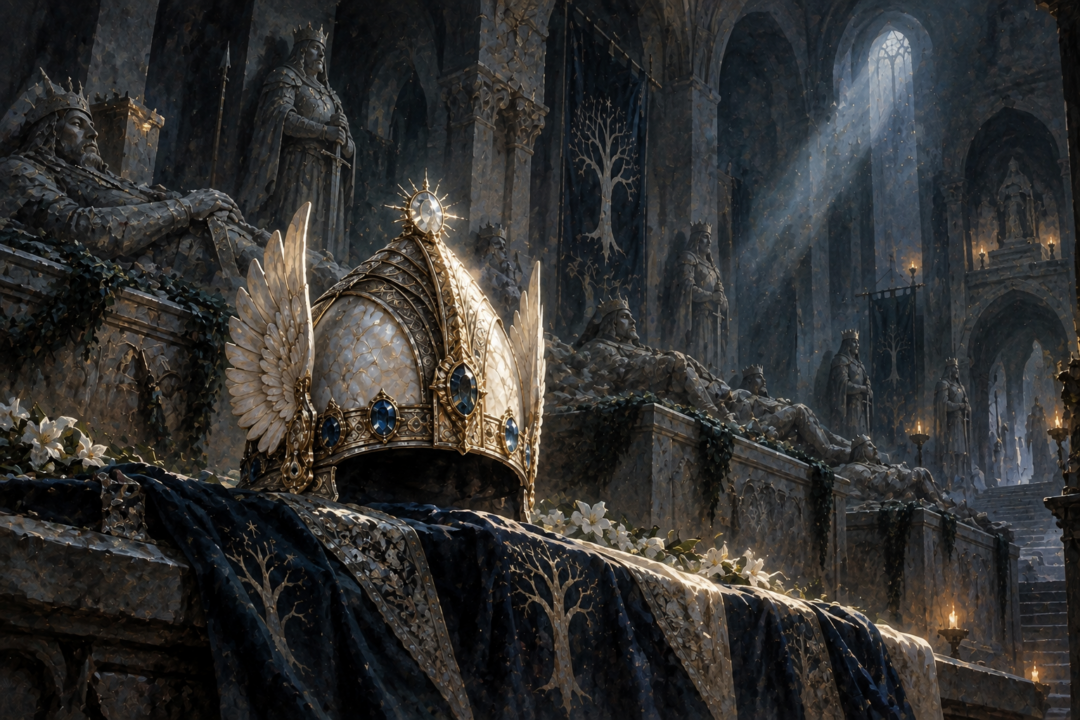
Faramir has the ancient royal crown brought from Rath Dínen. Its appearance is described in considerable detail.
It resembles the high helmets worn by the Guards of the Citadel, but it is taller and entirely white. Wings extend from either side, fashioned from pearl and silver in the likeness of a sea-bird. Seven adamant gems are set around its circlet, while another jewel shines from its summit like a flame.
This is no plain battlefield helmet.
Its sea-bird wings deliberately recall the kings who came over the Sea. The crown therefore transforms the old Númenórean military form into something ceremonial and historical.
The basic shape remembers the war-helm.
The ornamentation remembers Númenor.
And centuries of royal use have made the object something greater than either alone.
Why It Can Still Be Called the Crown of Elendil
The terminology can make the history confusing.
The royal crown is sometimes associated with Elendil even though the surviving jewelled crown was created long after Elendil’s death—and even though Gondor’s original crown was traditionally Isildur’s helm rather than Elendil’s.
The explanation lies in what Elendil represented.
Elendil was the High King of the Dúnedain kingdoms founded after the Downfall of Númenor. The royal imagery of Gondor looked beyond any single physical object toward the legitimacy of his house.
This is especially important because northern and southern royal traditions were not identical.
In Arnor, the principal sign of royalty inherited from Númenórean tradition was the Sceptre of Annúminas, while the northern kings wore the Elendilmir, a white jewel bound upon the brow. Gondor developed the winged crown derived from the Númenórean war-helm.
Aragorn ultimately inherited both traditions.
That matters enormously.
He was not simply restarting the old southern monarchy.
The Crown Had Already Become an Heirloom of Gondor
By the time the kingship failed in Gondor, the jewelled crown had accumulated its own history.
The last King, Eärnur, accepted the Witch-king’s renewed challenge and prepared to ride to Minas Morgul in Third Age 2050. Before leaving, he laid aside the crown. He never returned.
No new king followed him.
Instead, the Ruling Stewards governed Gondor while preserving the monarchy rather than formally replacing it. Even the physical arrangement of Minas Tirith expressed this distinction: the Steward used his own chair while the King’s throne remained empty.
The crown likewise survived.
For nearly a thousand years it remained associated with the vanished kingship.
Therefore, when Faramir produces it for Aragorn, he is not unveiling something recently discovered in forgotten ruins. Gondor knew what the crown was and had preserved it through the long centuries without a king.
That makes the moment more powerful.
The crown was not lost.
The king was.
Aragorn Does Not Simply Claim an Ancestor’s Possession
Aragorn’s relationship with the crown is consequently more complicated than inheritance by blood.
He certainly descends from Isildur. But Gondor’s royal line after Isildur continued primarily through Anárion’s descendants. Indeed, an earlier claim by Aragorn’s ancestor Arvedui to the southern throne had been rejected.
Aragorn arrives at the end of the Third Age carrying the inheritance of the northern line, but his acceptance in Gondor is tied to much more than possessing Isildur’s blood.
He has fought for Gondor. He has commanded its forces. He has entered Minas Tirith as a healer after the Battle of the Pelennor Fields. His identity and lineage are known to important figures in the realm, and Faramir publicly recognizes him at the coronation.
The old crown therefore becomes a point where two histories meet.
Aragorn brings the surviving line of Isildur.
Gondor brings the preserved kingship of the South.
Neither simply absorbs the other.
Even the Coronation Breaks With the Old Custom
Faramir explains that the kings traditionally received the crown from their fathers before death, or otherwise took it from the father’s tomb.
Neither possibility exists for Aragorn.
His father Arathorn died when Aragorn was only two years old, and the crown before Minas Tirith is not a personal heirloom passed down through Aragorn’s immediate ancestors. It belongs to Gondor’s separate royal succession.
So the ceremony changes.
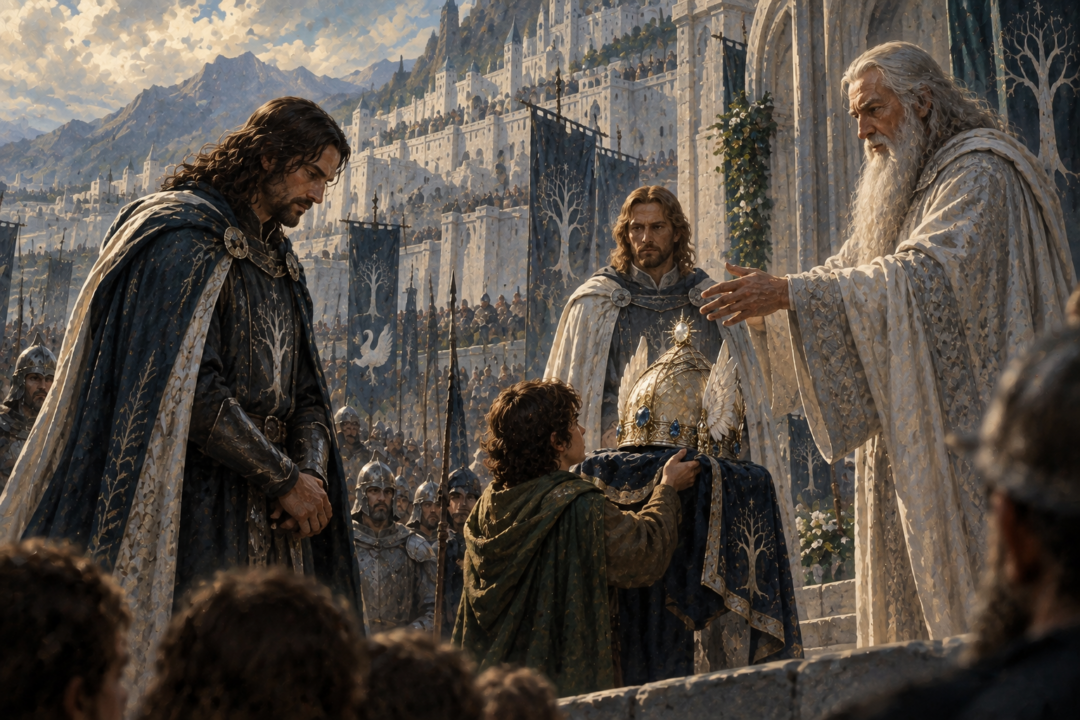
Faramir brings the crown under his authority as Steward. Aragorn receives it, but he does not simply place it upon his own head. Instead, Frodo carries it forward at Aragorn’s request, and Gandalf sets it upon him.
The scene quietly connects several different sources of Aragorn’s restored kingship: ancestry, Gondor’s recognition, victory over Sauron, the deeds of the Ring-bearer, and the wider struggle in which many peoples participated.
The crown is ancient, but the ceremony is deliberately adapted to an unprecedented restoration.
Aragorn Inherits More Than Gondor
The final distinction appears when Aragorn’s northern inheritance is restored openly.
The Sceptre of Annúminas—the ancient silver rod of the Lords of Andúnië and the chief token of royal authority in the North—is later delivered to Aragorn by Elrond.
This gives Aragorn two great royal symbols with very different histories.
The Crown of Gondor represents the South-kingdom and the line of kings that ruled there.
The Sceptre represents the northern inheritance that survived through the descendants of Isildur.
Aragorn possesses both because his reign reunites histories that had been divided for roughly three thousand years.
That is why reducing his coronation to “Isildur’s heir gets Isildur’s crown back” misses the deeper structure of the story.
The bloodline of Isildur returns.
But the physical crown waiting in Gondor belongs to the long history of Gondor itself.
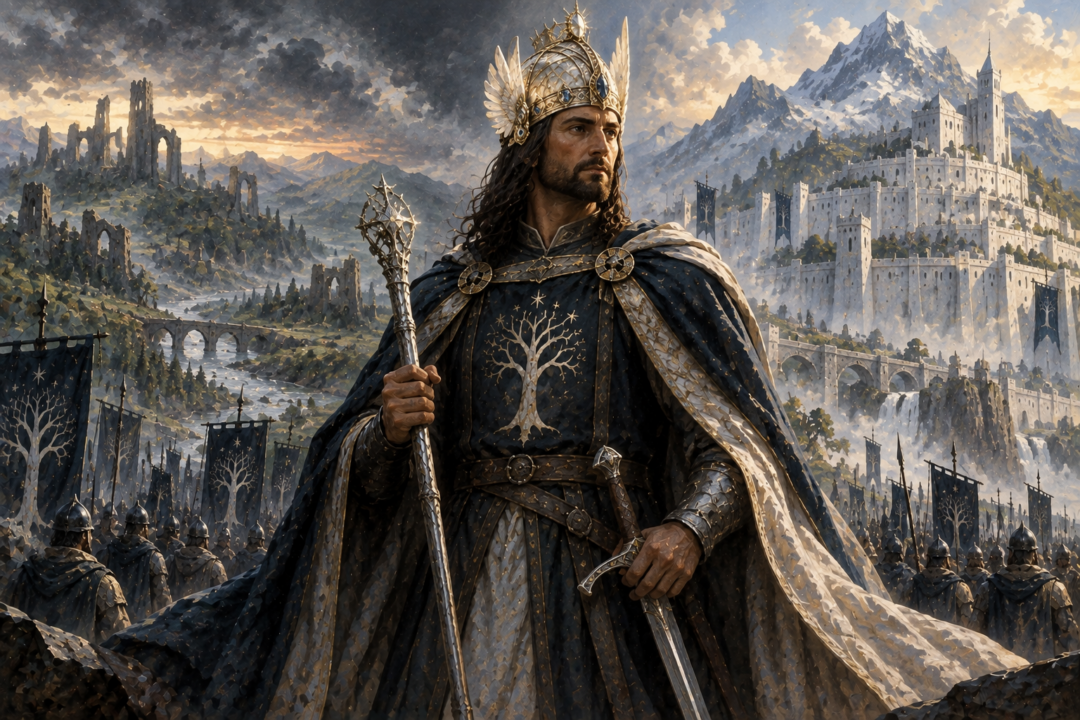
The Crown Is a Symbol of Continuity, Not a Frozen Past
Aragorn’s kingship repeatedly balances restoration with renewal.
Andúril is reforged from the shards of Narsil rather than simply preserved as a broken relic. The White Tree found on Mindolluin replaces the dead tree standing in the Citadel. Arnor and Gondor are brought together again, but under circumstances unlike those of the Second Age.
The crown follows the same pattern.
Its form remembers ancient Númenórean warfare, yet the original plain helm was replaced by later kings. The newer crown accumulated centuries of Gondorian history before disappearing into the silence of Rath Dínen during the rule of the Stewards.
Then Aragorn receives it.
Not because history has somehow reversed itself.
Not because every object has returned unchanged to its original owner.
But because the broken lines of the past have finally converged.
Isildur’s actual war-helm belongs to the beginning of Gondor’s royal story.
The jewelled crown placed upon Aragorn belongs to everything that came afterward.
And when that crown rests upon the head of Isildur’s distant heir, it represents something no earlier king of Gondor had possessed in quite the same way: the restoration of the House of Elendil across both North and South.
The crown is ancient.
The kingship it inaugurates is both restored and new.
Sources & Notes
- Tolkien Gateway — Crown of Gondor: Isildur's war-helm, Atanatar II's replacement, and the preserved royal crown https://tolkiengateway.net/wiki/Crown_of_Gondor
- Tolkien Gateway — Atanatar II: replacement of the original crown with a jewelled helm https://tolkiengateway.net/wiki/Atanatar_II
- Tolkien Gateway — The Steward and the King: Faramir brings the crown and Gandalf crowns Aragorn https://tolkiengateway.net/wiki/The_Steward_and_the_King
Primary reading: The Lord of the Rings, Appendix A, 'Gondor and the Heirs of Anárion' and 'The North-kingdom and the Dúnedain'; The Return of the King, 'The Steward and the King'. These are secondary reference guides. The replacement crown and coronation are recorded in the texts; continuity and renewal are the article's interpretation. The fate of Isildur's original helm is not established.