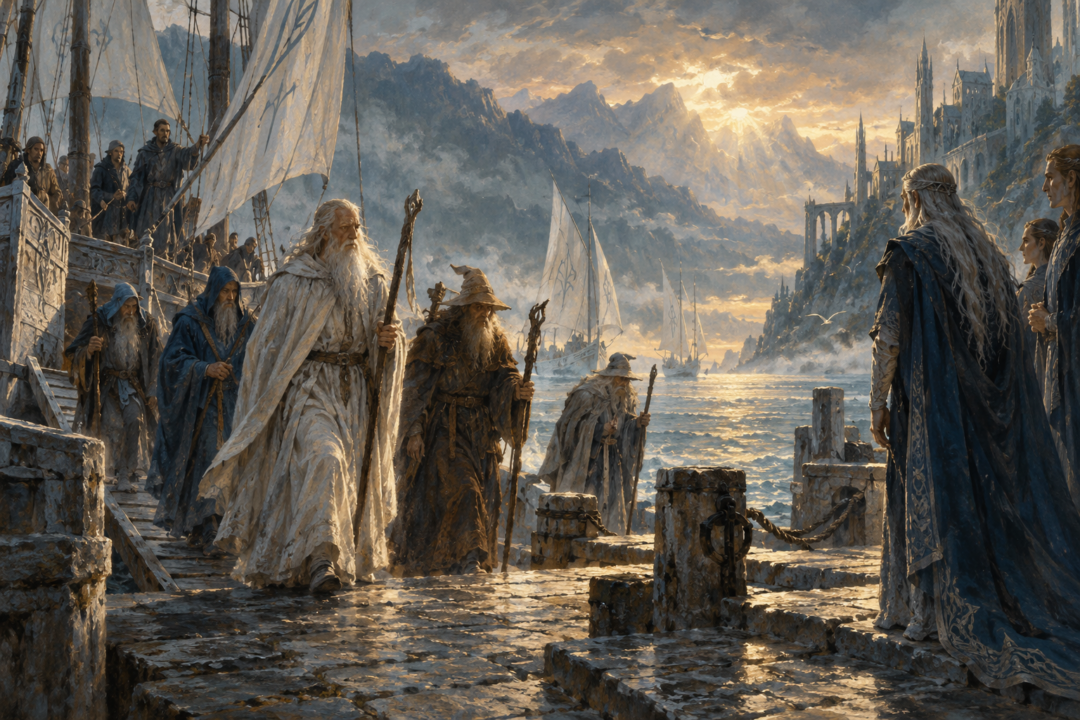
Gandalf feels almost timeless in Middle-earth. By the time Bilbo meets him, he is already an old wanderer known to Dwarves, Elves, Men, and Hobbits. Saruman has long been counted among the Wise. Radagast has disappeared into his quieter concerns. The Wizards seem woven into the Third Age itself.
Yet when Appendix B of The Lord of the Rings turns back to their beginning, its language is surprisingly cautious.
The Tale of Years does not simply say that the Istari arrived in the year 1000 of the Third Age. It says that “when maybe a thousand years had passed” the Wizards appeared in Middle-earth.
That “maybe” matters.
Other writings tell us considerably more about the Istari: that they came from the West, that they were embodied emissaries sent against Sauron, that Saruman was the foremost of their order, that Gandalf came last in one important account, and that Círdan perceived something extraordinary in him. But the surviving traditions do not combine into a perfectly precise arrival schedule.
The closer we look, the less secure the familiar date “T.A. 1000” becomes.
The Tale of Years Gives Us a Period, Not a Date
Appendix B associates the appearance of the Istari with the first millennium of the Third Age and with the return of a shadow to Greenwood the Great.
That is an important chronological anchor, but it is deliberately approximate.
The chronology soon becomes much more exact. The Tale of Years records, for example, that by T.A. 1050 a shadow had fallen upon Greenwood and the forest began to be called Mirkwood. In T.A. 1100 the Wise discovered that an evil power had established itself at Dol Guldur, although they initially believed it to be one of the Nazgûl.
Against entries like these, the introductory statement about the Istari stands out. Their appearance belongs broadly to this era, but no exact year is supplied.
This means that the commonly repeated statement “the Wizards arrived in T.A. 1000” is useful shorthand, not a precision actually guaranteed by Appendix B.
The text gives us something more atmospheric and historically plausible: after roughly a millennium of the Third Age, as darkness began returning to Greenwood, the mysterious figures later called Wizards appeared.
Even “Appeared” Is an Interesting Choice
There is another subtle uncertainty in the wording.
The Tale of Years says that the Istari “appeared in Middle-earth.” It does not, in that sentence, provide a detailed account of five Wizards stepping from the same ship on the same day.
Its following explanation is framed almost like recovered historical tradition: it was “afterwards said” that they had come from the Far West and were messengers sent to contest Sauron.
That perspective matters because the Istari were not publicly announcing their true identities.
They looked like Men, though they were never young and aged only slowly. Their mission was not to arrive as unveiled supernatural powers and openly challenge Sauron. They were forbidden to dominate Elves and Men through force and fear or simply to answer Sauron’s power with equivalent power.
Their task was fundamentally indirect: to encourage resistance and help unite those willing to oppose the Shadow.
So “appeared” suits the nature of their mission. To most inhabitants of Middle-earth, these strange old wanderers did not come bearing a public declaration from the Valar.
Their true nature was hidden.

Unfinished Tales Gives a More Detailed Arrival Tradition
The account collected in Unfinished Tales supplies details that Appendix B does not.
There the Istari are identified as beings of the same high spiritual order to which Sauron belonged, though they had been sent under restrictions and embodied in forms that could experience the burdens of the world. The text also gives an order of arrival.
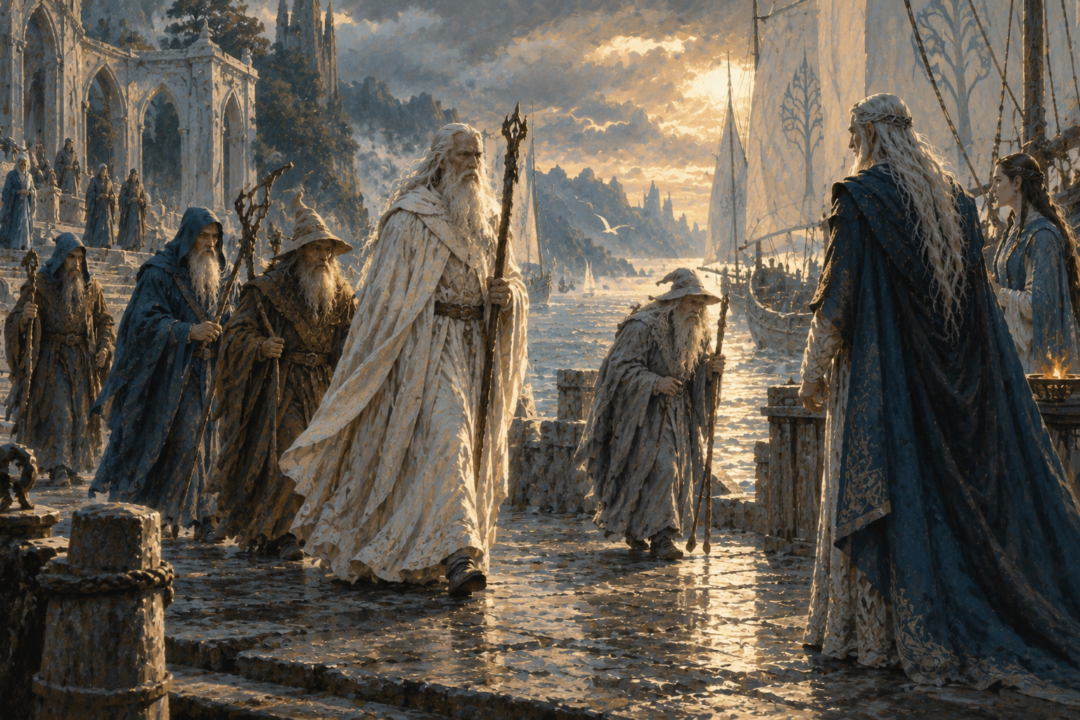
The first is the imposing figure later known as Saruman. Others follow, including the two associated with blue and the brown-clad Radagast. Gandalf comes last, looking less impressive than the others: grey-haired, grey-clad, leaning upon a staff.
This scene is crucial because Círdan sees beyond appearances.
Círdan, lord of the Grey Havens, recognizes in Gandalf a greatness not immediately obvious from his outward form. He secretly gives him Narya, the Red Ring, urging him to use it in the labours ahead.
This account therefore supports something more specific than Appendix B alone: at least in this version, the Istari did not simply arrive as an indistinguishable group. Gandalf was the last to come.
But it still does not give us a calendar entry such as “Gandalf landed at Mithlond on this exact date in T.A. 1000.”
The chronology remains approximate.
Were All Five Wizards Even Part of the Same Arrival?
This is where the problem becomes more complicated.
The familiar Third Age account treats the Istari as an order whose appearance belongs around the beginning of the second millennium. But later writings reconsider the history of the two Blue Wizards.
In one late conception, the Blue Wizards came to Middle-earth much earlier, during the Second Age, apparently around the period when Sauron’s power posed a grave threat and resistance to him needed support in eastern lands.
Their names and mission also changed in these late notes. Instead of simply being obscure Wizards who vanished into the East, they were given names translated as Darkness-slayer and East-helper, and their work was connected with opposition to Sauron among peoples far beyond the main geographical focus of The Lord of the Rings.
This creates a genuine textual difficulty.
If the Blue Wizards came in the Second Age in this later conception, then the statement that the Istari appeared after roughly a thousand years of the Third Age cannot straightforwardly describe the first arrival of every member of the order.
There is no need to force these traditions into a single artificial chronology. They represent different conceptions preserved in the writings.
The safest conclusion is narrower: the published Tale of Years associates the coming of the Wizards with roughly T.A. 1000, while other material both expands that account and, in the case of the Blue Wizards, preserves a significantly different later chronology.

The Shadow in Greenwood Is More Important Than the Number 1000
The strongest anchor may therefore be not a number but a crisis.
The Tale of Years connects the appearance of the Istari with the first returning shadow in Greenwood.
This was the beginning of a terrifying historical misunderstanding. Sauron had survived the overthrow of his realm at the end of the Second Age. Eventually he took shape again and established himself secretly at Dol Guldur.
But the Wise did not immediately know that the hidden power there was Sauron himself.
The Wizards consequently enter the Third Age narrative during a period when the Enemy is returning but has not yet openly revealed himself.
That is exactly the kind of crisis for which the Istari were suited.
They were not an invading army sent after Sauron had declared himself. They were counsellors entering a world in which evil was gathering gradually, uncertainty was widespread, and the free peoples were divided.
Their arrival belongs to the long preparation for the War of the Ring rather than to its final explosion.
Gandalf’s Arrival Already Foreshadows His Method
The uncertainty surrounding the date also draws attention toward something more important than chronology: what happened once the Wizards were there.
Gandalf arrived, in the Unfinished Tales account, looking least imposing. Yet Círdan recognized his inner strength and gave him the Ring of Fire.
That contrast anticipates Gandalf’s entire career.
He rarely behaves like a conventional ruler. He travels. He counsels. He befriends people whom greater powers might overlook. His eventual importance depends not on establishing a kingdom of his own but on awakening courage in others.
Saruman’s tragedy moves in the opposite direction.
The leader of the order increasingly desires control. His study of Sauron and the Rings leads him toward imitation of the very methods his mission was supposed to oppose. By the War of the Ring he has fortified Isengard, gathered armies, manipulated others, and sought the One Ring.
The mission of the Istari was therefore dangerous in a deeper sense than physical combat. They were sent near the power they were forbidden to imitate.
Not all of them endured that test equally.
Why the Uncertainty Should Be Preserved
It is tempting to turn Middle-earth into a perfectly synchronized database.
“T.A. 1000: the five Wizards arrive” is wonderfully convenient.
But it says more than the Tale of Years actually says.
Appendix B gives an approximate period. Unfinished Tales gives a richer account in which the Wizards have an order of arrival and Gandalf comes last. Late writings move the Blue Wizards into the Second Age altogether.
Those differences should not be treated as gaps that require invented dates.
They are part of the surviving textual picture.
What can be said confidently is that the major Third Age tradition places the appearance of the Istari roughly a thousand years after the beginning of the Age, as the Shadow was returning to Greenwood. They came from the West to aid resistance against Sauron, under restrictions that prevented them from simply becoming rival Dark Lords.
Beyond that, precision quickly becomes interpretation.
And perhaps that is appropriate.
The people of Middle-earth did not receive the Wizards as entries in a cosmic timetable. They encountered mysterious old travellers whose origins were known only to a few of the Wise. Their significance became clear slowly, through centuries of choices.
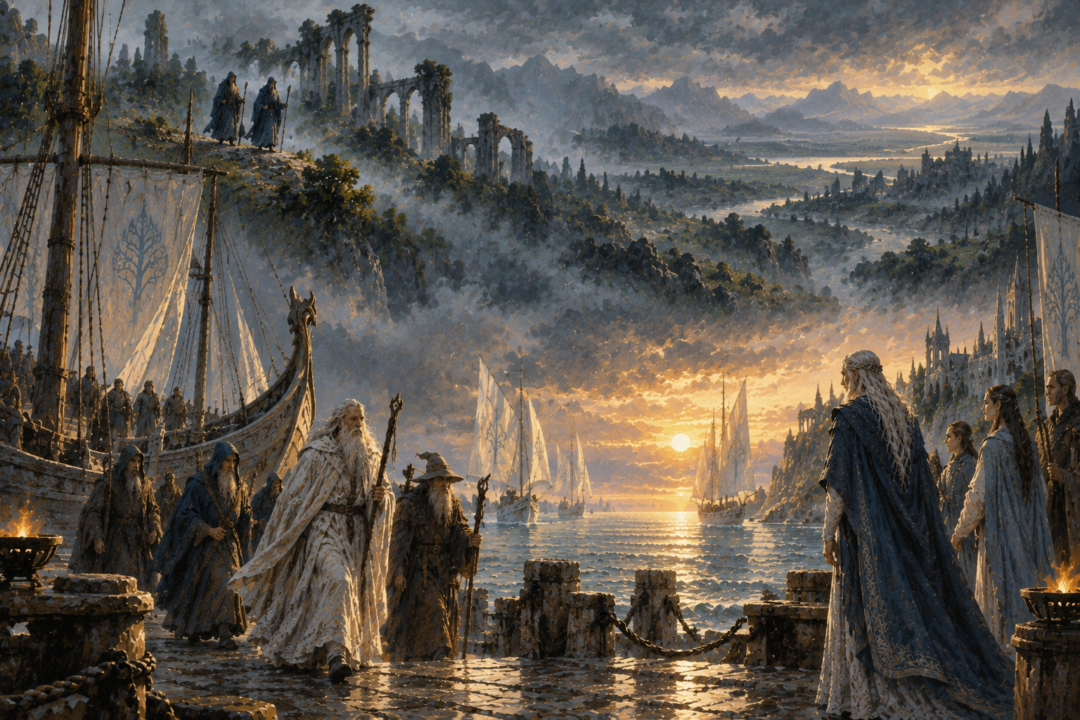
The Tale of Years remembers their arrival in much the same way: not with the certainty of a coronation date or a recorded battle, but as the moment, somewhere around the turning of the millennium, when strange old men from beyond the Sea began walking the roads of a world in which the Shadow was rising again.
Sources & Notes
- Tolkien Gateway — Wizards: their mission, approximate Third Age appearance, and restrictions https://tolkiengateway.net/wiki/Wizards
- Tolkien Gateway — Blue Wizards: contrasting Third Age and later Second Age arrival traditions https://tolkiengateway.net/wiki/Blue_Wizards
- Tolkien Gateway — Gandalf: arrival at the Grey Havens and Círdan's gift of Narya https://tolkiengateway.net/wiki/Gandalf
Primary reading: The Lord of the Rings, Appendix B, 'The Third Age'; Unfinished Tales, 'The Istari'; The Peoples of Middle-earth, 'Last Writings'. These secondary guides describe different textual traditions. Around T.A. 1000 is approximate, not an exact shared landing date; the late Second Age account of the Blue Wizards should not be silently merged with the earlier chronology.