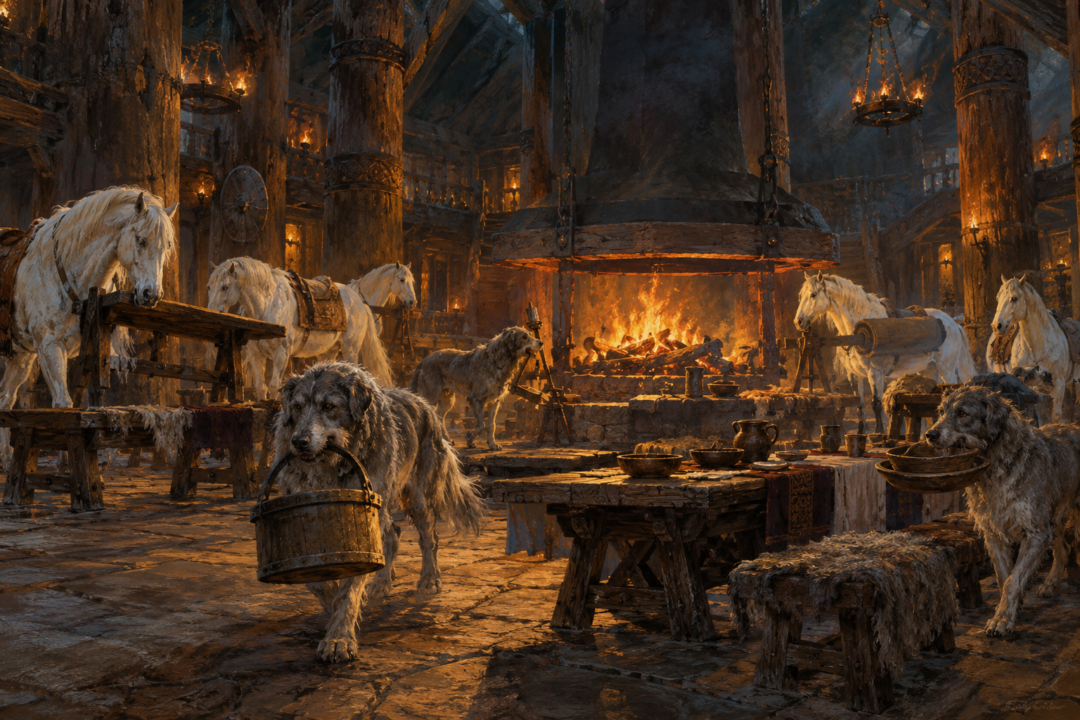
When Bilbo enters Beorn’s great wooden hall in The Hobbit, one of the strangest things about the place is not Beorn himself. It is the dinner service.
There is no line of human servants. Instead, white ponies, large grey dogs, and sheep move through the hall carrying light, furniture, tableware, and other necessities. They do not behave like decorative pets wandering through a feast. They perform different jobs in coordination, apparently understanding what Beorn wants and how the household is supposed to function.
That small domestic scene tells us something important about Beorn’s isolated estate. His animals are not merely inhabitants of it. They form part of its working household.
The text never explains exactly how this arrangement became possible, and it would be a mistake to invent a magical system behind it. What it does show, however, is surprisingly specific: communication between Beorn and his animals, division of tasks among different species, a hall physically suited to their work, and a household capable of continuing its routine even while its master is absent.
The Horses Who Notice Strangers
The system becomes visible before Bilbo even reaches Beorn’s door.
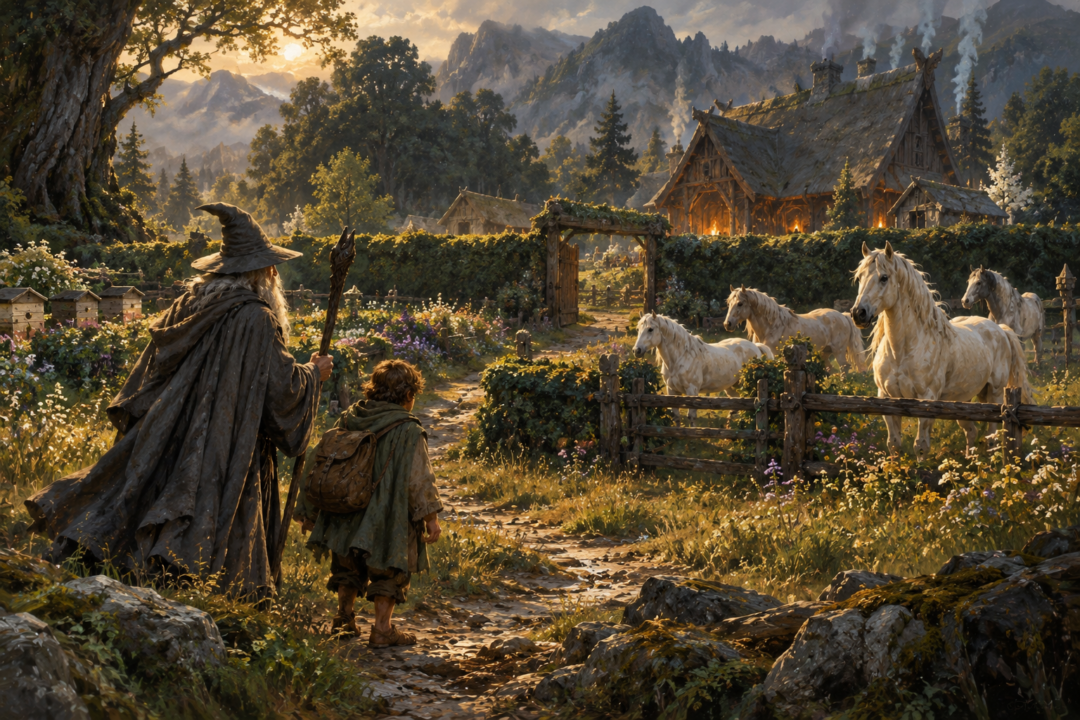
As Gandalf and Bilbo approach the house, horses come across the grass and inspect the strangers. They then gallop back toward the buildings, and the narration presents them as going to tell Beorn that visitors have arrived.
That is an extraordinary detail because it places animals inside the estate’s information network.
Beorn lives in a dangerous region east of the Misty Mountains and west of Mirkwood. He is suspicious of strangers, and Gandalf carefully manages the introduction of Thorin’s company because simply arriving as a large group would be unwise.
Yet Beorn’s isolation does not mean that nobody watches his land.
The horses notice newcomers before those newcomers reach him. Whatever precise form their communication takes, Beorn can receive useful information from them. The chapter therefore establishes more than unusual animal intelligence. It shows communication functioning across species as part of ordinary life on the estate.
That matters when we consider what happens inside the hall.
Beorn Gives Instructions, and the Animals Understand
After Gandalf finishes his story, Beorn decides to feed his unexpected guests.
He claps his hands. Four white ponies and several large grey dogs enter. Beorn then speaks to them in what the narration describes as a strange language resembling animal sounds turned into speech.
The mechanism is deliberately left unexplained.
We are not told that every animal in Middle-earth possesses such abilities. We are not given a grammar for this language, nor are we told whether Beorn taught the animals, whether their abilities are connected with something unusual about Beorn himself, or whether some other explanation applies.
What is certain is simpler and more useful: communication occurs.
The animals receive Beorn’s instructions and respond with organized action. They leave the hall and return carrying what is required.
That makes the scene fundamentally different from animals merely obeying simple signals. The tasks that follow involve several stages, different objects, and cooperation between different kinds of animals.
The estate works because instructions can cross the boundary between Man and animal.
The Dogs Do the Work That Requires Dexterity
The large grey dogs perform some of the most physically complicated household tasks.
They bring torches into the hall, and the torches are lit from the fire and placed in brackets around the central hearth. The dogs can also stand upon their hind legs and use their forefeet to carry things.
They retrieve boards and trestles stored along the walls and arrange them near the fire.
Later, when the sheep bring tableware, the dogs take the objects from them and lay them on the tables.
There is a recognizable logic to this allocation of work.
The dogs are not simply assigned everything. They handle jobs suited to the abilities the narrative specifically gives them: carrying objects with their forefeet, manipulating household equipment, and transferring items from one stage of the service to another.
This produces something surprisingly close to a domestic workflow.
One group brings materials. Another handles them. Furniture is assembled. Lighting is prepared. The table is laid.
The wonder of the scene comes partly from seeing animals do these things, but its deeper significance lies in how orderly the process is.
The Sheep Form Part of the Supply Chain
Then the sheep enter.
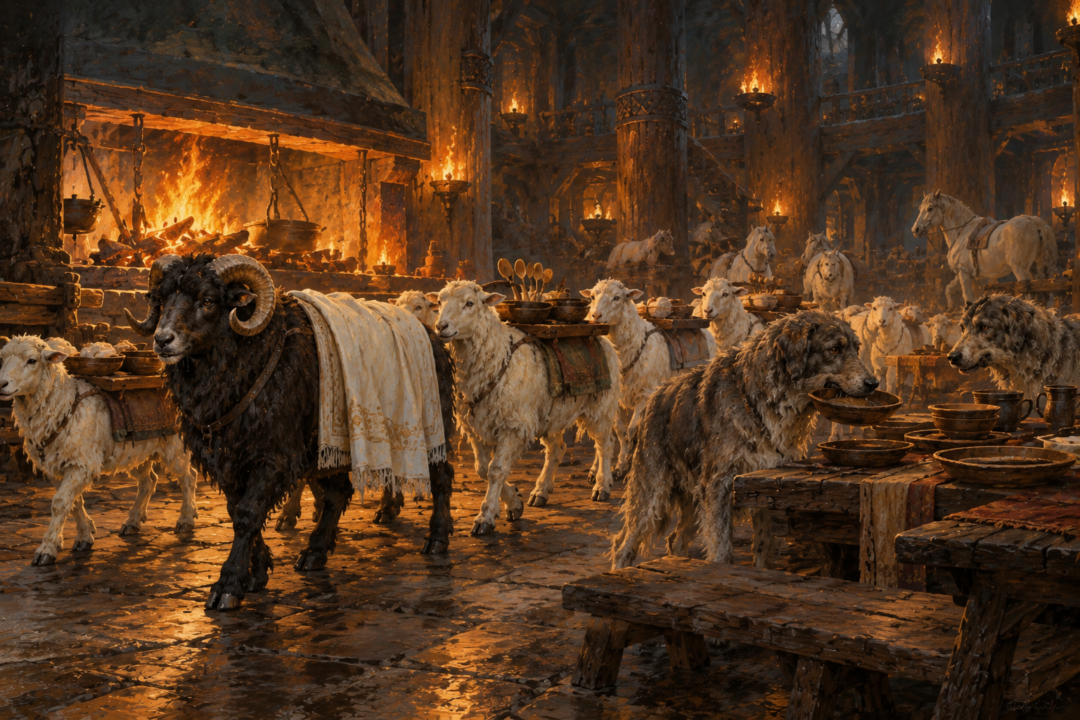
They are snow-white and led by a large black ram. One carries the tablecloth. Others bear trays loaded with the bowls, platters, knives, and wooden spoons required for supper.
The sheep therefore perform a different role from the dogs.
They function as carriers.
Their broad backs transport the objects into the dining area, while the more dexterous dogs unload and arrange them. The distinction is easy to overlook because the entire episode passes quickly, but it provides some of the strongest evidence that Beorn’s household has an actual division of labor.
Different animals are performing different parts of the same job.
Nothing in the chapter requires us to imagine formal ranks or elaborate rules behind this arrangement. The observable evidence is already remarkable enough. Beorn has organized his domestic life so that several species can contribute according to their abilities.
His household is not simply a man commanding interchangeable animal servants. It is a cooperative system in which different bodies are suited to different tasks.
Even the Furniture Fits the Household
The furniture provides another clue.
The trestle tables are low. So are the seats. Ponies push benches into position for Gandalf and Thorin, while Beorn has his own large chair. Other ponies roll in polished sections of logs for the remaining guests to sit upon.
The narrator explicitly suggests that the low tables and chairs may be designed that way for the convenience of the animals that wait upon Beorn.
That possibility changes how we should picture the hall.
Its animal household is not an improvised spectacle produced for Bilbo and the dwarves. The physical environment itself appears adapted to the creatures who routinely work there.
The height of the furniture reduces the difficulty of service. Storage along the walls allows boards and trestles to be brought out when needed. Ponies can push or roll seating into place. Dogs can reach the working surfaces.
In other words, Beorn has not forced an ordinary human household to function awkwardly with animals replacing servants.
His hall appears to have developed around the household he actually has.
The Household Works When Beorn Is Gone
The clearest evidence that this is a functioning domestic system comes the following day.
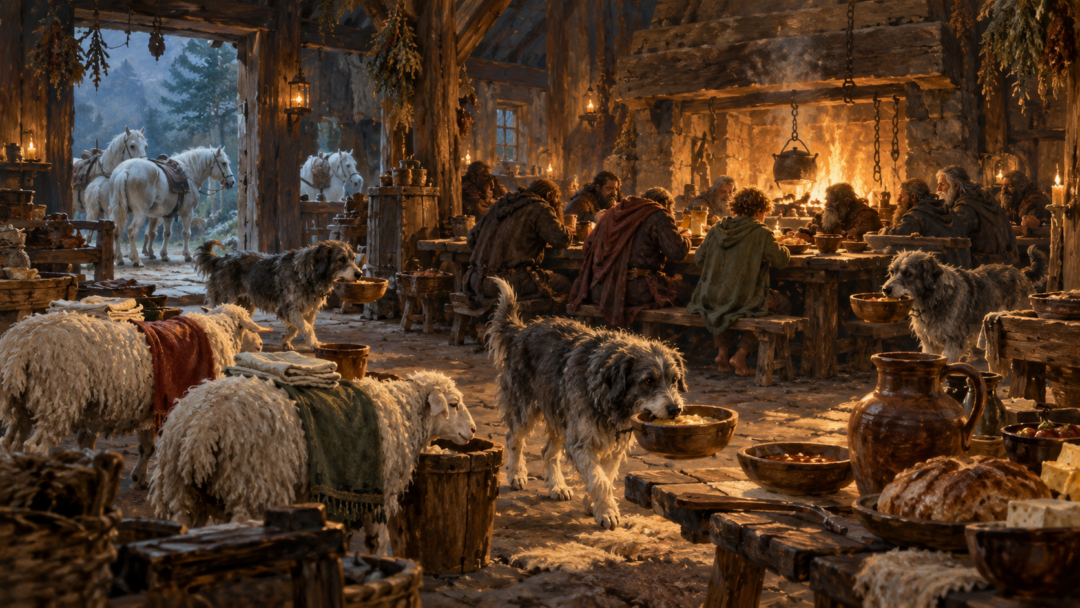
Beorn disappears, and Gandalf is also absent for much of the day. Bilbo wakes late and learns that breakfast had already been laid out. Later, when Gandalf finally returns near sunset, Bilbo and the dwarves are eating supper while Beorn’s animals wait upon them.
The animals have been caring for the guests during Beorn’s absence.
This is crucial.
If their abilities extended only to responding immediately to Beorn’s commands, the household would depend upon his constant supervision. Instead, ordinary hospitality continues while he is elsewhere.
The text does not tell us how much independent planning this requires, and we should not pretend that it does. We cannot reconstruct an unseen schedule or decide exactly how the animals know when each meal should be served.
But the visible result is unambiguous: Beorn can leave his home for an extended period without the domestic machinery simply stopping.
His guests are fed.
That suggests a household based not merely on moment-to-moment commands but on established routines the animals understand well enough to carry out.
The Ponies Connect the Household to the Road
The animals’ usefulness extends beyond the hall.
Once Beorn has verified Gandalf’s account and decides to help Thorin’s company, he lends them ponies and a horse for the journey toward Mirkwood. He also provides food intended to last for weeks if carefully used, including nuts, flour, dried fruit, honey, and durable cakes, along with water-skins and weapons.
Here the estate’s domestic resources become expeditionary resources.
The same broad animal world that supports life around Beorn’s hall also provides transport beyond it.
Yet Beorn sets a clear limit. The travelers must send his animals back when they reach the forest. The ponies are assistance, not gifts.
This tells us something practical about the estate. Its animals are valuable members of a system to which they are expected to return.
Beorn can support travelers precisely because his household possesses resources worth lending—but those resources remain attached to his home.
A Household Without the Usual Human Boundary
The most revealing thing about Beorn’s estate may therefore be what is missing.
There is no ordinary human servant class presented in the hall.
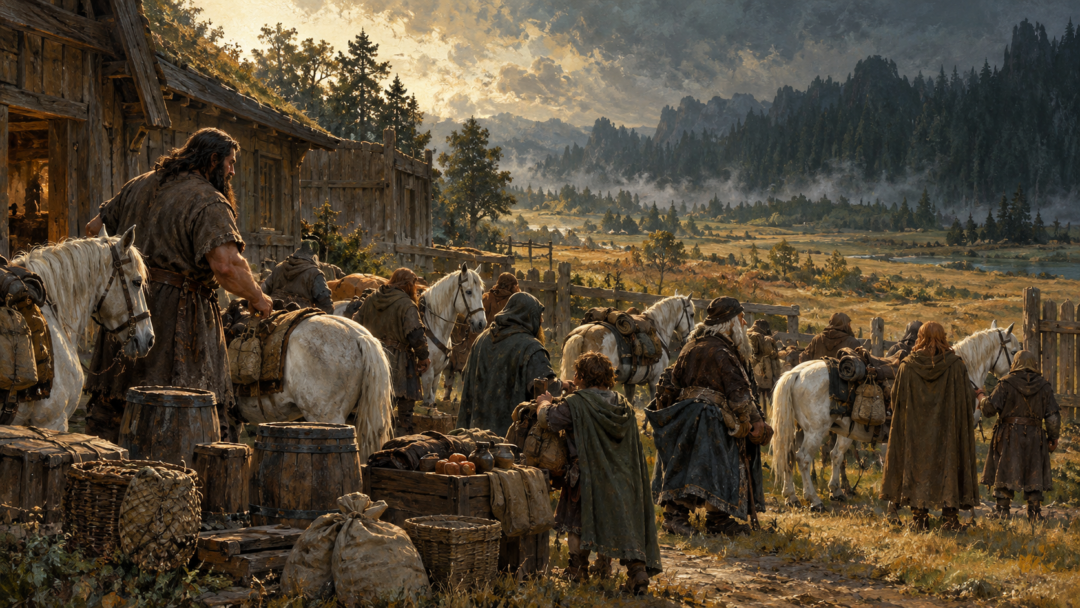
Instead, animals notice arrivals, communicate information, respond to instructions, illuminate the hall, assemble tables, transport dishes, arrange tableware, move seating, serve guests, and provide transport beyond the boundaries of the property.
The text never asks us to solve the mystery of how all this is possible.
That restraint matters.
Turning Beorn’s household into a detailed magical theory would actually make it less interesting, because the chapter treats the extraordinary as domestic routine. Bilbo is astonished; the animals are not. They simply know what to do.
And that may be the central clue to how Beorn’s estate works.
It is isolated, but not understaffed. It lacks ordinary servants, but not organized labor. It is inhabited by several species, yet communication between them is sufficiently reliable for complex household routines.
Most importantly, the architecture, habits, and division of tasks all fit together.
Beorn’s animals are not curiosities added to his home.
They are part of what makes it a home.
Sources & Notes
- Penguin Random House — The Hobbit teacher’s guide — Chapter 7’s visit to Beorn and the help provided for the next stage of the journey. https://www.penguinrandomhouse.com/books/179206/the-hobbit-by-jrr-tolkien/teachers-guide/
- LitCharts — The Hobbit, chapter 7, Queer Lodgings — Beorn’s house, his relationship with animals and the loan of ponies. https://www.litcharts.com/lit/the-hobbit/chapter-7-queer-lodgings
- The Encyclopedia of Arda — Beorn — His dwelling, skin-changing identity and bee-pastures, with Tolkien’s clarification that he is a Man. https://www.encyclopedia-of-arda.com/b/beorn.html
Primary passage: The Hobbit, chapter 7, “Queer Lodgings.” The animals’ household tasks and Beorn’s instructions are narrative details. Division of labour is interpretation; the text supplies no formal magical mechanism, employment system or complete estate economy.