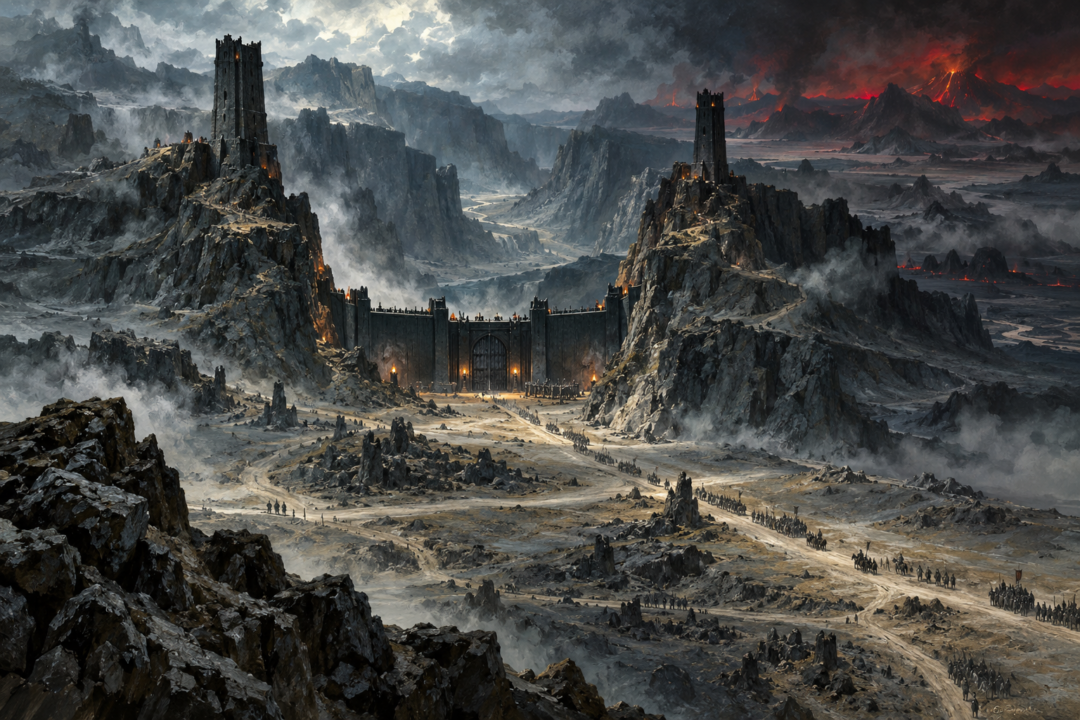
When Frodo, Sam, and Gollum finally reached the Black Gate, the problem was immediately obvious: this was not merely a door that happened to stand in their way. The entire landscape had been turned into a system of control.
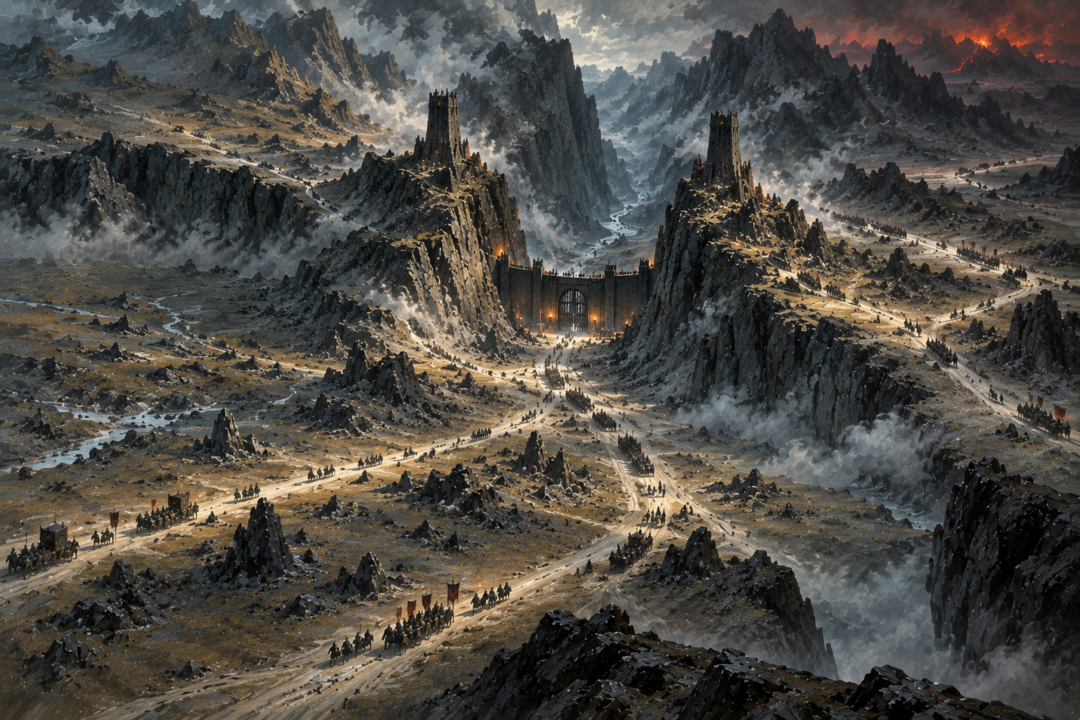
Cirith Gorgor narrowed the approach between mountain ranges. The Morannon closed that opening. The Towers of the Teeth watched from the sheer hills flanking it. Roads converged on the entrance, while sentinels and troops guarded the passage.
That combination explains why Frodo could not simply wait for darkness and slip through.
More importantly, it reveals something easy to miss about Mordor's northern entrance. The strength of the Morannon did not depend upon one gigantic fortification. Its defensive value came from several elements reinforcing one another: terrain restricted movement, fortifications commanded the restricted ground, roads concentrated traffic, and troops could respond to anyone attempting the crossing.
The result was less a wall than a controlled gateway into Mordor.
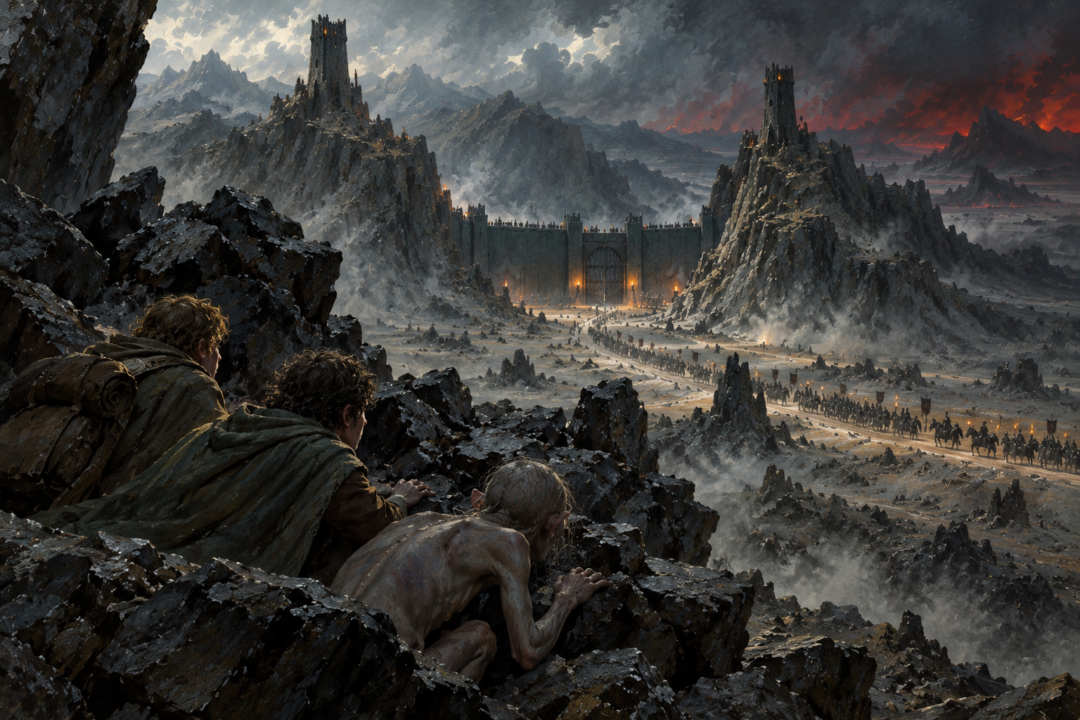
Cirith Gorgor Was the First Defense
Mordor was already protected before anyone laid stone across Cirith Gorgor.
The Ephel Dúath formed its great western barrier, while the Ered Lithui enclosed much of the north. Near Mordor's northwestern corner the ranges approached one another, leaving the deep pass of Cirith Gorgor between them.
That geography mattered.
An attacker approaching from the northwest could not simply choose any convenient point along a broad open frontier. The mountains restricted large-scale movement and made the pass an obvious route of entry. The Morannon therefore occupied a naturally important bottleneck.
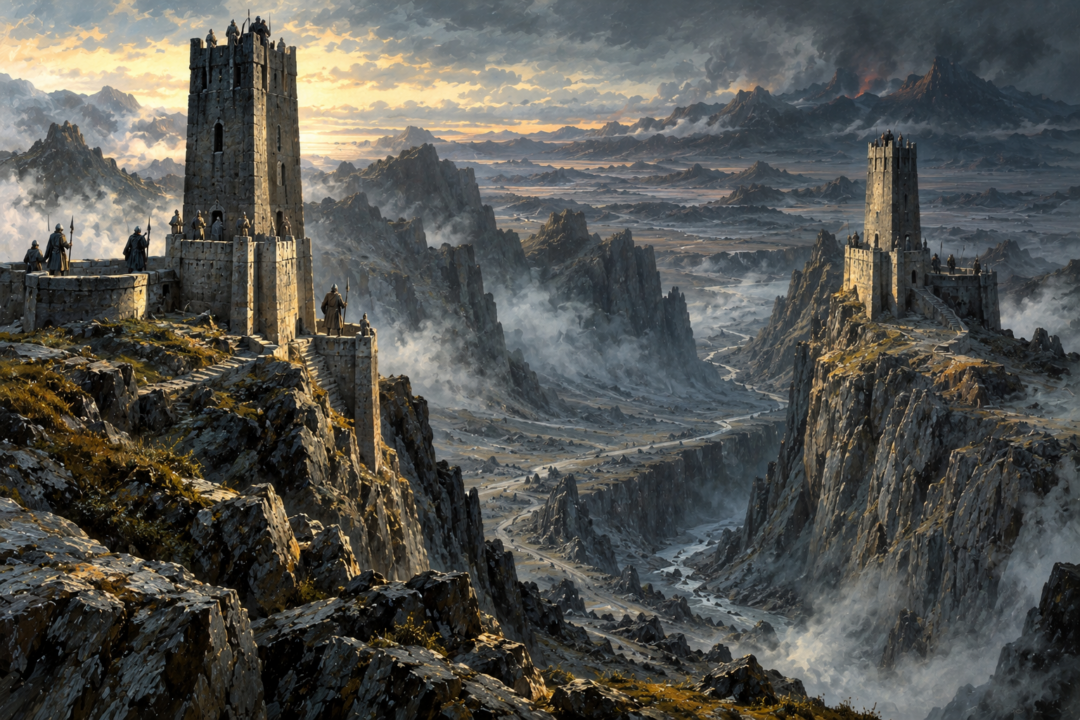
The terrain also gave the fortifications depth in height as well as width. Two sheer, bare hills projected from the mouth of the pass. Upon these stood the Towers of the Teeth.
This is the first key to understanding the Morannon: Sauron's defenses did not have to manufacture a choke point from nothing. The landscape had already created one.
The fortifications exploited it.
The Black Gate Closed the Gap
Across the mouth of Cirith Gorgor stood the actual Morannon, the Black Gate.
The narrative describes a stone rampart stretching across the pass from cliff to cliff, with an iron gate set into it. Sentinels continually guarded its battlements when Frodo observed it.
That placement is more important than speculative measurements of the structure. The text gives no reliable basis for reconstructing exact wall heights, thicknesses, troop capacities, or siege-engine requirements, and none are necessary to understand the design.
The essential fact is spatial.
The mountains constrained the route. The rampart closed the remaining opening.
Someone attempting the obvious northern entrance into Mordor therefore had to confront a defended barrier positioned exactly where geography forced movement to converge.
For Frodo, this destroyed the possibility of treating the Morannon like an ordinary guarded road. Gollum understood the danger immediately. Whatever chance secrecy offered elsewhere, the Black Gate was under direct observation.
Yet the gate itself was only part of the system.
The Towers of the Teeth Were Originally Gondorian
One of the Morannon's greatest ironies is that two of its most memorable fortifications were not originally raised for Sauron.
After Sauron's defeat at the end of the Second Age, Gondor maintained a watch upon Mordor. The Towers of the Teeth belonged to that system. They were built by Gondor to guard the entrance and watch against the return of evil from the Black Land.
Their later appearance as fortresses of Mordor therefore represents a reversal of purpose.
The watch had failed.
As Gondor's strength declined, its vigilance over Mordor weakened. The guarding of the land could not be maintained indefinitely. By the time Sauron's power openly returned to Mordor, defenses once intended to contain his realm had passed into the possession of his servants.
This distinction matters because it prevents a misleading picture of the Morannon as a single fortress conceived all at once by one builder.
The gate and the towers had different histories.
By the end of the Third Age, however, Sauron had incorporated the inherited towers into the defenses of his northern entrance. What Gondor had built to watch Mordor now helped Mordor watch the outside world.
The Towers Watched the Approaches
The two towers stood upon the sheer hills flanking the mouth of Cirith Gorgor. Their dark window openings faced north, east, and west.
That description gives them an obvious observational role without requiring us to invent elaborate systems of signaling or command that the text does not specify.
From their elevated positions, the towers overlooked the country and approaches outside the gate.
Their relationship with the road network is particularly important.
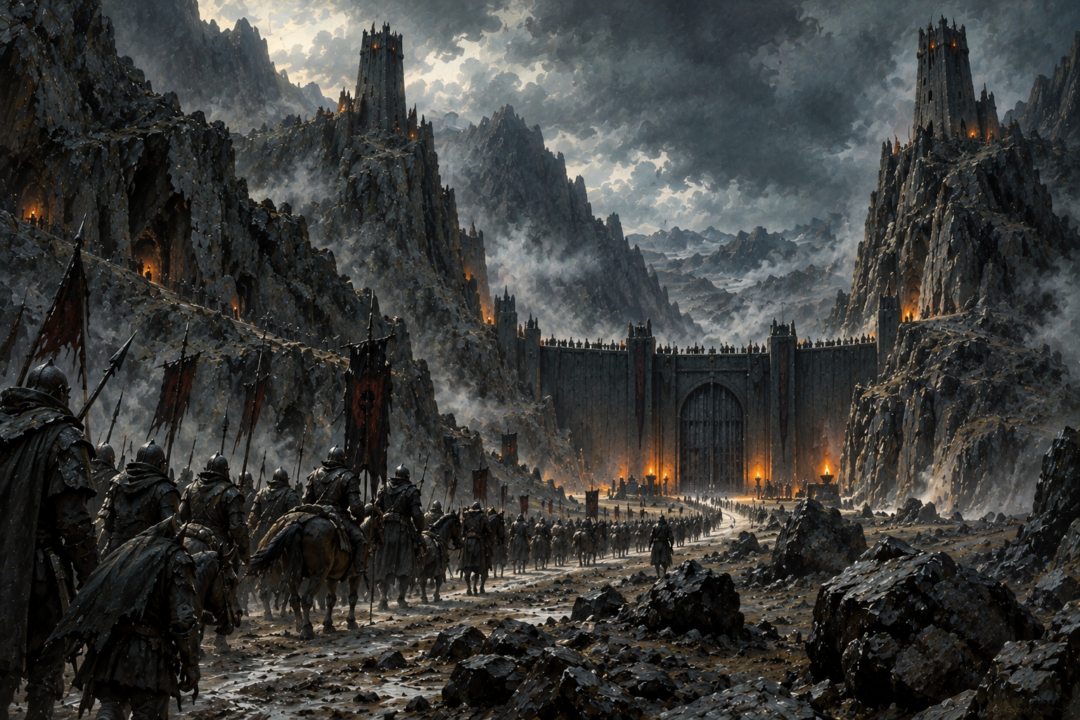
When Frodo's company reached the area, they saw roads converging toward the Morannon. Traffic associated with Sauron's war preparations was moving toward the entrance, including forces arriving from distant regions under his domination or influence.
The roads therefore did more than connect Mordor to the outside world. At the gateway, they concentrated movement into observable channels.
This is what made the Morannon so dangerous to infiltrators. Frodo and Sam were not approaching an isolated castle surrounded by wilderness. They were approaching an active military entrance connected to the wider movement of Sauron's forces.
Roads Made the Gate More Than a Barrier
A fortress guarding a road serves two purposes.
It can stop movement, but it can also permit movement selectively.
That second function is crucial at the Morannon.
Sauron could not simply seal Mordor completely. His armies needed routes by which forces could move outward and reinforcements could enter. Messengers, troops, and supplies required connections between Mordor and territories beyond its mountain walls.
The northern entrance therefore had to remain usable while still being guarded.
The texts do not provide an administrative manual explaining precisely how passage through the Morannon was regulated, so claims about checkpoints, documentation, inspection routines, or formal traffic procedures would go beyond the evidence.
But the broader structure is clear.
There was a gate. It was guarded. Roads led toward it. Military forces passed through the area. The towers overlooked the approaches, and troops were stationed around the fortifications.
This created controlled access in the most basic military sense: Sauron's forces could use the route, while an enemy attempting the same passage faced observation and interception.
The Hidden Strength Was the Garrison
Frodo's view of the Morannon also reveals why the visible masonry should not be treated as the whole defense.
The cliffs and hills around the gate contained numerous excavations where Orcs were concealed. The narrative explicitly presents a force waiting to emerge when summoned.
That changes the tactical meaning of the gate.
A traveler did not merely have to evade sentries standing upon a wall. The surrounding terrain contained troops capable of responding to an alarm.
The system therefore had several layers: watchers could detect danger, the gate could deny passage, the terrain restricted alternative movement, and nearby forces could reinforce the defended point.
We should not invent exact garrison strengths or response times. The text does not provide them.
But Frodo's conclusion requires no such numbers.
He looked upon the entrance and recognized that attempting to pass it secretly was effectively hopeless.
Why an Army Could Use the Gate but Frodo Could Not
There is a useful paradox here.
The Morannon was crowded with military movement, and crowds can sometimes offer concealment. Yet Frodo could not simply merge into that traffic.
The approaching forces were part of Sauron's war machine. Frodo and Sam were two Hobbits carrying the object upon which the entire war ultimately depended. Discovery anywhere was dangerous; discovery at the principal defended northern entrance to Mordor would have been catastrophic.
Their mission required secrecy more than speed.
That made the very features that supported Sauron's military logistics hostile to them. Roads made movement efficient, but also predictable. A gate created passage, but placed passage beneath guard. Towers expanded observation. A concentrated garrison made a detected intrusion difficult to escape.
The Morannon's effectiveness against Frodo therefore did not depend upon proving that it was physically impossible to breach.
It only had to make the probability of undetected entry intolerably low.
The Defense Was Strong Because Its Parts Reinforced One Another
The Morannon is sometimes imagined primarily as an enormous gate, but the text presents something more interesting.
Terrain determined where movement could occur.
The rampart blocked that movement.
The Towers of the Teeth overlooked the approaches.
Roads brought traffic toward the defended entrance.
Sentinels maintained the watch.
Nearby troops gave that watch the power to respond.
None of those elements alone explains the problem Frodo faced. Together, they do.
This also clarifies what cannot safely be claimed. Tolkien does not provide enough information to calculate how long a conventional siege of the Morannon would take, how many defenders normally occupied it, how much food they stored, or exactly how its internal command arrangements worked. Later events outside the gate should not be retrofitted into a detailed engineering specification.
The evidence supports a spatial argument rather than a numerical one.
Cirith Gorgor concentrated access. The Morannon closed it. The towers watched it. Roads organized movement around it. Troops defended it.
That was enough.
The Bitterest Detail Was Who Built the Towers
The Towers of the Teeth give the whole system a final historical irony.
They embodied two completely opposed strategic purposes across their long existence.
Gondor built them as part of the watch upon Mordor after Sauron's overthrow. Their purpose was containment: to help prevent the evil inside the Black Land from returning unchecked.
Under Sauron's renewed power, those same towers became part of the machinery protecting Mordor from its enemies.
The geography had not changed. The hills still dominated the pass. Cirith Gorgor remained a natural gateway. What changed was who controlled the fortifications.
That may be the most important lesson of the Morannon.
Fortifications possess no permanent allegiance.
A tower commands ground for whoever holds the tower.
By the War of the Ring, Sauron had taken a landscape already difficult to penetrate, added his gate across its narrow entrance, occupied Gondor's old watchtowers, filled the surrounding defenses with troops, and tied the position into roads carrying the forces of his growing war.
Frodo did not turn away because the Black Gate looked frightening.
He turned away because he saw how the system worked.
At Cirith Gorgor, mountain, road, tower, gate, watcher, and soldier all served the same purpose: nearly every practical way through the northern entrance to Mordor passed beneath the Enemy's control.
Sources & Notes
- The Encyclopedia of Arda — Black Gate — The Morannon’s fortified northern entrance to Mordor. https://www.encyclopedia-of-arda.com/b/blackgate.html
- The Encyclopedia of Arda — Towers of the Teeth — Narchost and Carchost, built by Gondor and later occupied by Sauron. https://www.encyclopedia-of-arda.com/t/towersoftheteeth.html
- The Encyclopedia of Arda — Cirith Gorgor — The meeting of the mountain ranges, the guarded pass and the gate sealing it. https://www.encyclopedia-of-arda.com/c/cirithgorgor.html
Primary passages: The Two Towers, “The Black Gate Is Closed”; The Return of the King, “The Black Gate Opens.” The gate, watchtowers and enclosing terrain are textual. Their combined function as an access-control system is interpretation, not a documented traffic-management plan.