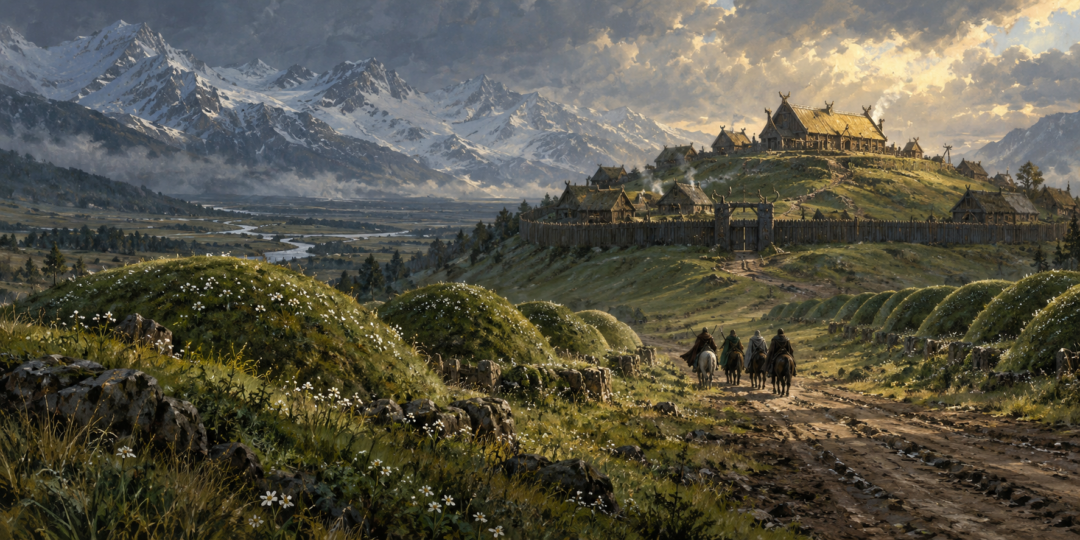
Before anyone reaches Théoden’s doors in Meduseld, the road to Edoras makes them pass the dead.
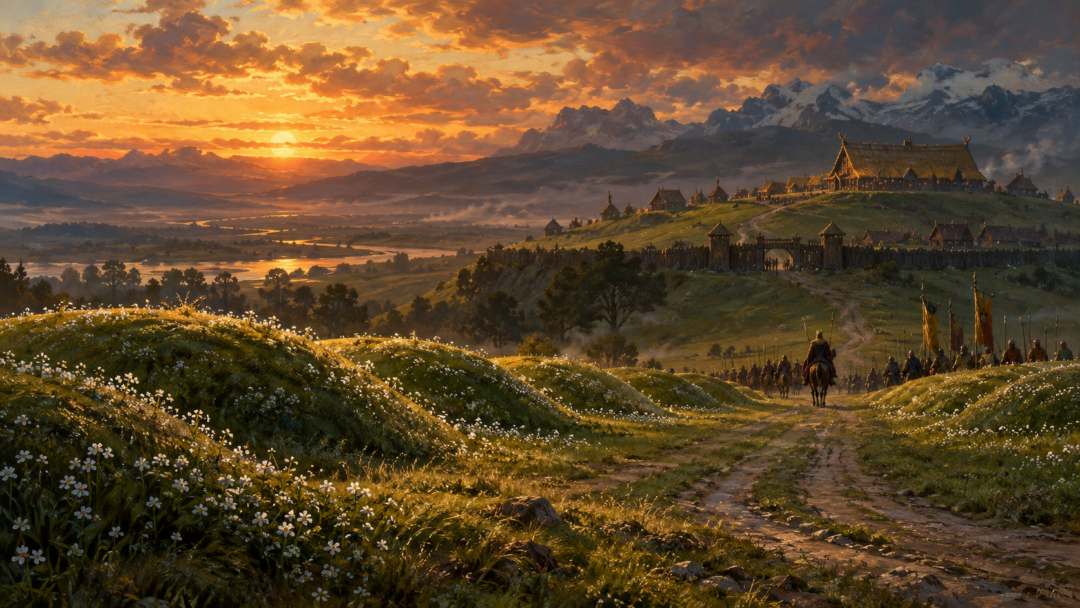
That detail matters. The royal barrows are not hidden in some distant cemetery, nor confined within a sanctuary known only to the king’s household. They stand beneath Edoras, beside the approach to the city. When Gandalf, Aragorn, Legolas, and Gimli ride toward the Golden Hall, they pass between green burial mounds covered with the small white flowers called simbelmynë.
Aragorn counts what he sees: seven mounds on one side and nine on the other.
By the end of The Lord of the Rings, that landscape has changed. Théoden has been buried, and there are now eight mounds on the east side.
The difference of a single mound contains an extraordinary idea. In Rohan, royal succession is not preserved only in names, songs, or genealogies. It has been built into the earth. The history of the kings can be seen simply by riding toward their hall.
The Road to Edoras Is Also a Road Through Memory
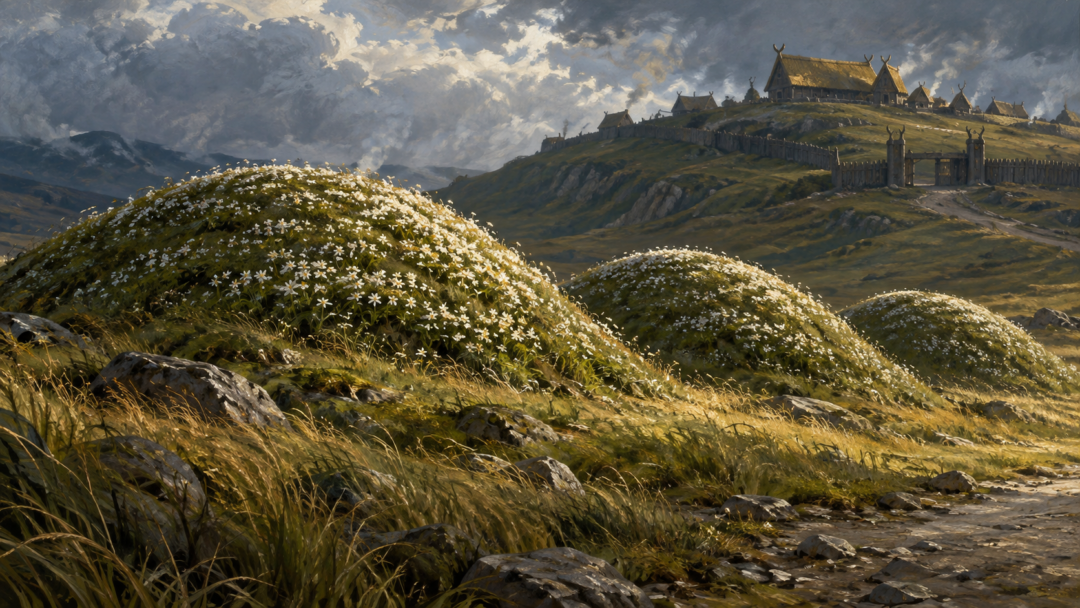
Edoras stands on its green hill beneath the White Mountains, with Meduseld crowning the settlement. Yet the approach does not begin with the living king. It begins with his predecessors.
The barrows stand outside the gates along the road. In The Two Towers, Gandalf identifies them as the resting places of Théoden’s forefathers, while Aragorn observes seven mounds on the left and nine on the right.
At this point Théoden is still alive, so the eastern sequence is incomplete.
The arrangement makes the approach to royal authority unusually physical. A visitor going to the king must travel through evidence that kingship existed before the present ruler. Théoden may occupy the Golden Hall, but the road beneath it is bordered by those who occupied his place before him.
The effect does not require inscriptions or monuments explaining themselves. The repeated shape of the mounds does the work. One ruler follows another, and the succession becomes a sequence of rises in the earth.
For the people of Rohan, memory is therefore not merely something recalled. At Edoras, it has geography.
Why There Are Two Lines of Mounds
The division of the Barrowfield is not decorative. It records a dynastic break.
The first royal line begins with Eorl the Young. Appendix A gives the succession through Brego, Aldor, Fréa, Fréawine, Goldwine, Déor, Gram, and finally Helm Hammerhand.
That makes nine kings.
Helm died during the terrible crisis of the Long Winter, and his sons had already died. With no surviving son to inherit from him, the direct succession of that line ended. The kingship passed to Fréaláf, the son of Helm’s sister Hild.
Appendix A makes the physical consequence explicit: Helm was laid in the ninth mound, and when Fréaláf later died, a new line of mounds was begun.
This is the key to understanding the Barrowfield.
The two groups are not merely a collection of royal graves. Their separation records a change in the genealogy of the monarchy. The first sequence ends because Helm’s line ends. Fréaláf begins another royal line, and the burial landscape begins again with him.
The terrain therefore distinguishes continuity from rupture.
A written genealogy might express that distinction with branches on a family tree. Rohan expresses it with earth.
Nine Mounds in the West, a Growing Line in the East
The funeral feast of Théoden in The Return of the King removes any ambiguity about how the arrangement should be read.
After Théoden’s burial, a minstrel and loremaster names the rulers in their order. The first sequence runs from Eorl to Helm, ending with the nine mounds of the west side. The account then explicitly connects the change to the breaking of the line.
The eastern sequence begins with Fréaláf and continues through the kings who followed him: Brytta, also called Léofa, Walda, Folca, Folcwine, Fengel, Thengel, and finally Théoden.
Théoden is therefore the eighth king represented in that second sequence.
This explains the apparently simple count when the travellers first approach Edoras. They see seven mounds on the side belonging to the Second Line because Théoden, its eighth king, is still living.
The landscape is unfinished because history is unfinished.
Later, after the War of the Ring, the count changes.
That change is one of the quietest but most exact pieces of environmental storytelling in the entire history of Rohan.
Théoden Literally Changes the Landscape
Théoden dies far from Edoras on the Pelennor Fields, but his final burial is not there.
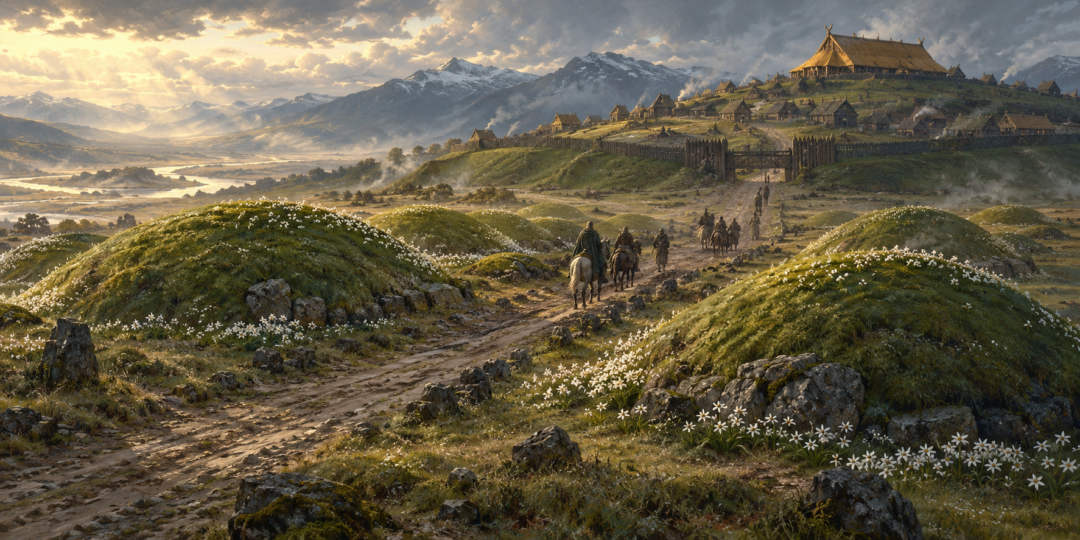
His body is eventually borne home. At Edoras he is laid in a stone house with his possessions and arms, and a great mound is raised above him, covered with green turf and white evermind.
The narrative then gives the new count: eight mounds stand on the east side of the Barrowfield.
That numerical detail is enormously important.
When Gandalf’s company arrived, the Barrowfield visually expressed Théoden’s position among the living. Seven predecessors of his line were buried there while he ruled above them in Meduseld.
After his death, Théoden joins their sequence.
The king who had once ridden past the ancestral mounds becomes one of the mounds.
His political life has ended, but his place in the succession has become permanent landscape.
The funeral therefore does more than dispose of Théoden’s body or commemorate a beloved ruler. It completes the visible form of the Second Line.
Simbelmynë Makes Memory Look Alive
The barrows are green rather than bare, and among their grass grows simbelmynë, the white flower called evermind.
When Gandalf notices it on the approach to Edoras, he explains that it blossoms through all seasons and grows where dead men rest. Appendix A gives an especially striking detail about Helm: simbelmynë grew so thickly upon his mound that it appeared snow-covered.
The flower strengthens the connection between landscape and remembrance without requiring us to invent a formal religious meaning for it.
The texts do not describe an elaborate Rohirric cult of the dead at the Barrowfield. Nor do they provide enough evidence to reconstruct rituals beyond those actually narrated.
What they do give us is more restrained and perhaps more powerful: graves visibly marked by a flower whose Rohirric name carries the sense of enduring memory.
The kings have returned to the earth, but their resting places remain distinguishable features of the inhabited world.
Every season renews the flowers.
Memory appears to grow from the graves themselves.
The Dead Stand Between the World and the King
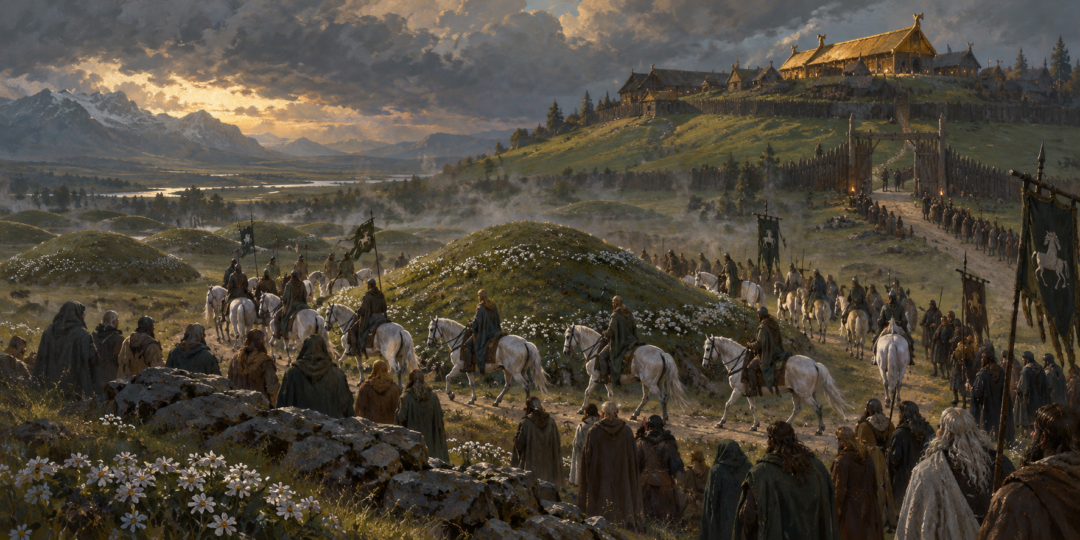
There is another spatial detail worth noticing: the road runs between the mounds.
That means the Barrowfield is not simply visible from Edoras. It structures the experience of approaching Edoras.
Anyone following the main road toward the gates passes through the royal past before reaching the present seat of government.
The symbolism here should be described cautiously, because the text does not stop to explain a political philosophy behind the layout. Yet the physical arrangement allows a strong reading.
The reigning king does not appear as an isolated source of authority. He sits beyond a sequence of predecessors whose presence is materially visible below his hall.
The Golden Hall represents the living household. The barrows represent the succession that made the current kingship possible.
And because the rows preserve the break between Helm and Fréaláf, they do not present that succession as falsely seamless. Rohan’s landscape remembers a dynastic failure as clearly as it remembers continuity.
That is an important distinction. The land does not merely glorify the dynasty.
It records where one line stopped.
The Funeral Feast Turns Geography Back Into Genealogy
Théoden’s funeral produces an especially elegant movement between place and spoken memory.
First his body is placed beneath a new mound. The physical sequence is extended.
Then the people gather in Meduseld, where the kings are named in order.
The spoken genealogy matches the geography outside.
Eorl through Helm correspond to the western sequence. Fréaláf through Théoden correspond to the eastern one. The division between the lists corresponds to the division between the rows.
In other words, the Rohirrim can tell their royal history in at least two mutually reinforcing ways.
They can recite it.
Or they can walk past it.
The Barrowfield makes genealogy legible even when nobody is speaking. The funeral feast then gives names and historical meaning back to those shapes in the ground.
That relationship between landscape and song is especially appropriate to Rohan, where the remembered past so often survives through names, verse, and inherited story.
At Edoras, however, remembrance has also acquired mass and location.
Théoden’s Eighth Mound Is Also an Ending
There is a final complication.
Théoden leaves no surviving son to succeed him. His son Théodred has already died, and the kingship passes to Théoden’s nephew Éomer, son of his sister Théodwyn.
Appendix A identifies Éomer as the beginning of the Third Line of the kings of the Mark.
That means Théoden’s new mound does two things at once.
It completes the Second Line physically, and it marks the historical moment after which kingship passes into a Third Line.
The text is clear about the genealogical transition. It is not equally explicit about how the later kings of the Third Line were spatially arranged in the Barrowfield, so it is safer not to invent a third row or assign later graves positions that the narrative does not establish.
What can be said firmly is that Théoden’s burial leaves the Second Line complete at eight mounds.
Éomer lives and reigns beyond that completed sequence.
Once again, the boundary between dead king and living successor is visible.
What the Barrows Ultimately Preserve
The immediate mechanism is simple.
Royal bodies are buried beneath mounds beside Edoras. Separate sequences correspond to separate lines of kings. The road passes between them. Simbelmynë covers the dead with a recurring sign of remembrance. When Théoden dies, one new mound changes the eastern count from seven to eight.
The aftermath is more complex.
A king’s body enters the earth, but his place in the succession becomes more visible, not less. His individual life ends, while his name remains part of the ordered memory of the Mark. Théoden’s spirit and ultimate fate lie beyond anything the Barrowfield can explain; the mound concerns the mortal body and the memory preserved by those who remain.
That is the limit of what the landscape can do.
It cannot defeat death.
It can give death a place.
And beneath Edoras, Rohan gives its kings places so carefully that the rise, break, renewal, and ending of royal lines can be read in the ground itself. The Barrowfield is therefore more than a cemetery beside the capital.
It is succession made visible.
To ride toward the Golden Hall is to see that no king of the Mark stands alone. Before the living ruler comes the long green evidence of those who ruled before him—and eventually the king in the hall will descend from the hill and take his own place among them.
Sources & Notes
- The Encyclopedia of Arda — Barrowfield — The two rows of royal graves outside Edoras and the first and second lines of kings. https://www.encyclopedia-of-arda.com/b/barrowfield.php
- The Encyclopedia of Arda — Simbelmynë — The evermind flowers growing on the kings’ burial mounds. https://www.encyclopedia-of-arda.com/s/simbelmyne.html
- The Thain’s Book — Théoden — Théoden’s burial as the eighth mound in the eastern row. https://thainsbook.minastirith.cz/theoden.html
Primary passages: The Two Towers, “The King of the Golden Hall”; The Return of the King, “Many Partings”; Appendix A, “The House of Eorl.” Seven eastern mounds before Théoden’s burial become eight afterwards; the nine western mounds belong to the first line. The visible-dynasty reading is interpretation of the described landscape.