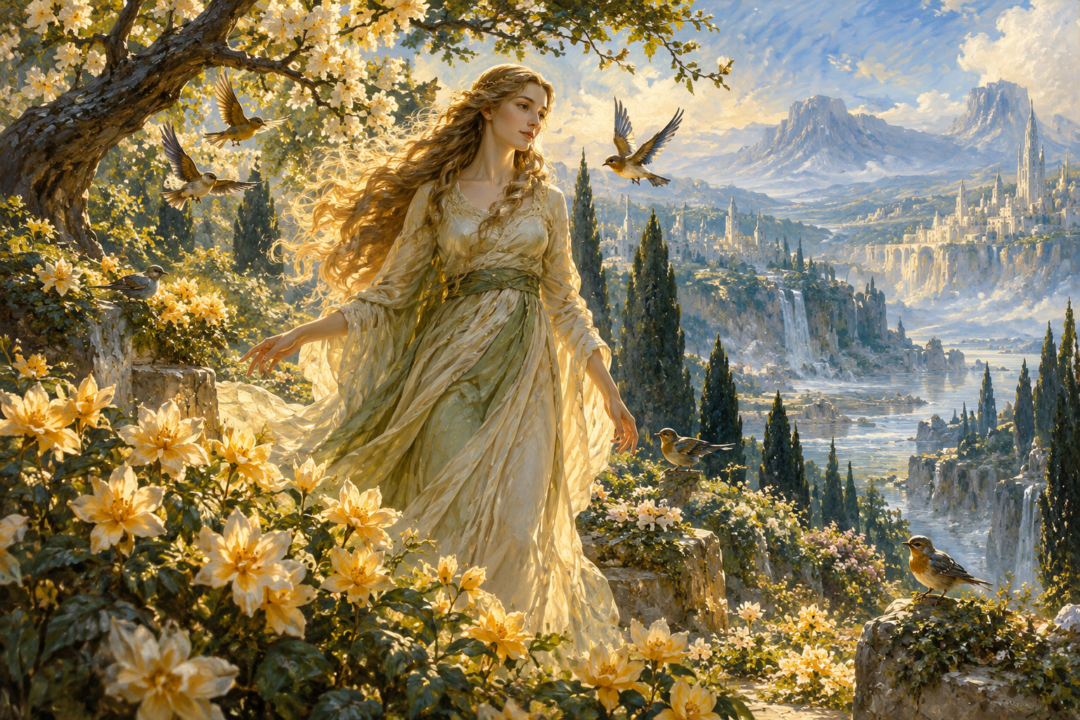
In Valinor, flowers open at the glance of Vána, and birds answer her coming with song. It is one of the most vivid descriptions of any of the Valar: life seems to awaken simply because the Ever-young has drawn near.
That image makes an obvious question surprisingly difficult. If Vána has such an intimate connection with flowers, birds, youth, and flourishing life, what distinguishes her from her elder sister Yavanna, the great Valië associated with the growing things of Arda?
The answer lies less in drawing hard borders around their powers than in noticing how differently the texts portray them. The Valar are not presented as officials administering neatly separated departments of creation. Their concerns can overlap. Yet Yavanna and Vána are given strikingly different emphases.
Yavanna's thought reaches across the immense diversity of things that grow from the earth. Vána, by contrast, is repeatedly imagined through freshness: flowers opening, birds singing, golden gardens, beauty, and perpetual youth.
Vána does not simply appear to be a smaller version of Yavanna. She represents another aspect of living Arda—the moment when life is fresh, beautiful, and flourishing.
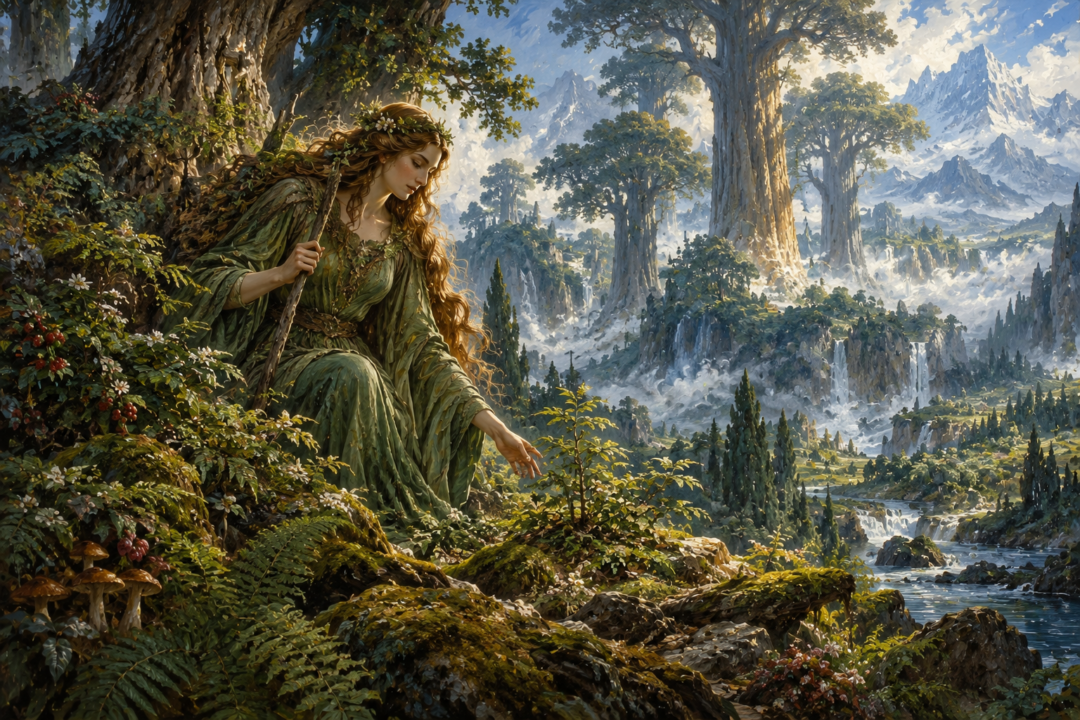
Yavanna's Vision Reaches from Towering Trees to Hidden Growth
The Valaquenta gives Yavanna one of the broadest descriptions associated with the natural world. She loves the things that grow in the earth and holds their innumerable forms in her mind.
The scale matters.
Her concern stretches from immense trees to moss and the smallest growth hidden in the soil. She is called Kementári, Queen of the Earth, as well as the Giver of Fruits. When the Valar first shape Arda, Yavanna plants the seeds she has devised. After the destruction of the Lamps and the establishment of Valinor, she brings forth new growth there. Later, through her song upon Ezellohar, the Two Trees arise, with Nienna's tears watering the mound.
Yavanna's relationship with growing things is therefore not expressed merely through beauty. It encompasses their forms, their fruitfulness, their establishment in the world, and their vulnerability.
That last point becomes especially clear in her conversation with Aulë after she learns of the coming of the Dwarves. She fears what axe-bearing peoples may do to trees, which cannot flee. Her concern eventually leads into the revelation that some trees will have spirits capable of defending the olvar.
This is a remarkably different narrative function from anything assigned to Vána.
Yavanna thinks about what grows, what threatens it, and how it will endure within Arda.
Vána Is Defined by What Happens When She Arrives
Vána receives much less narrative attention, but the language surrounding her is unusually concentrated.
She is the Ever-young. She is Yavanna's younger sister and the spouse of Oromë. Flowers spring as she passes and open beneath her glance; birds sing when she comes.
The emphasis is not on cataloguing everything under Vána's care. It is on response.
She passes: flowers spring.
She looks: flowers open.
She comes: birds sing.
That pattern makes Vána's portrait intensely immediate. Yavanna's description expands outward toward the countless forms of growth. Vána's gathers around moments of awakening and delight.
Elsewhere the same imagery continues. Vána has gardens filled with golden flowers, and she often goes to Oromë's forests. Arien, before becoming the guide of the Sun, tended Vána's flowers in Valinor and watered them with the bright dews of Laurelin.
These details reinforce Vána's association with flourishing beauty. They do not establish that every flower belongs exclusively to her, still less that she created all flowers or commands all birds.
The texts never give us that kind of formal division.
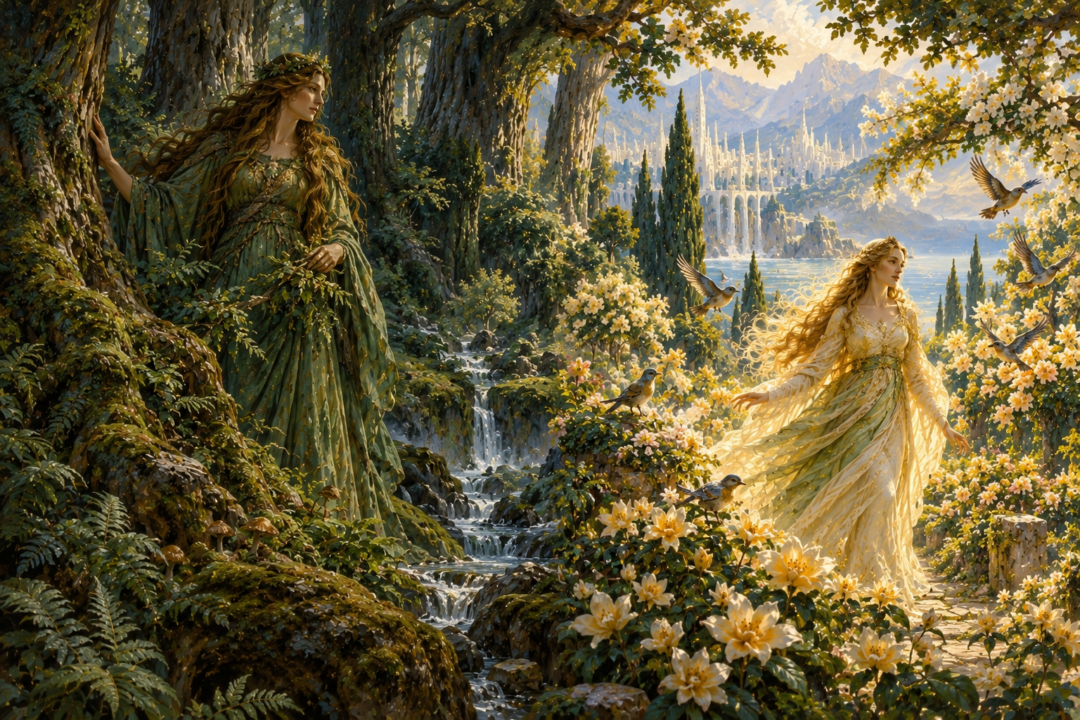
Ever-young Means More Than Simply Looking Young
Vána's title is perhaps the strongest clue to her distinctive place among the Valier.
She is not merely called beautiful. She is the Ever-young.
In a mythology deeply concerned with change, fading, loss, and the preservation of beauty, perpetual youth carries considerable thematic weight. Vána's accompanying images make that youth feel almost botanical: opening flowers, singing birds, golden blossoms, and gardens continually expressive of living beauty.
It is tempting to call her simply a goddess of spring. That comparison captures something of the imagery, but it can become misleading if treated as a precise Tolkienian office. The published Silmarillion does not formally assign Vána control over the season of spring.
A safer description is that she embodies qualities we associate with spring: freshness, opening, renewal, youth, and abundant flourishing.
This distinction matters because something can flourish without representing the totality of biological growth.
A flower suddenly opening is one moment in the life of a plant. A bird breaking into song is one expression of living vitality. Youth itself is a condition or phase rather than the entirety of life.
Vána's imagery repeatedly gathers around those radiant moments.
Yavanna Is Concerned with Continuity as Well as Beauty
Yavanna's stories have a different weight because they repeatedly confront the problem of life continuing in a damaged world.
Her seeds must grow in an Arda contested by Melkor. The things she loves can be injured. Trees can be felled. Even the Two Trees, among the greatest works associated with her, can be poisoned by Melkor and Ungoliant.
After their destruction, Yavanna examines them and declares that their life cannot simply be recreated as though nothing has happened. With Nienna's aid, the dying Trees finally yield the last flower of Telperion and the last fruit of Laurelin, from which the Moon and Sun are prepared.
Yavanna's relationship with growth therefore includes tragedy.
She does not merely represent vegetation at its loveliest. Her narratives involve planting, fruitfulness, preservation, destruction, and what may still be saved after catastrophe.
This helps explain why reducing Yavanna to "plants" and Vána to "flowers" misses the deeper distinction.
Flowers plainly belong among the growing things Yavanna loves. Vána's connection to them does not remove them from that wider vision. Instead, the same living world can express different aspects of Valarin concern.
Yavanna's portrait is comprehensive.
Vána's is concentrated.
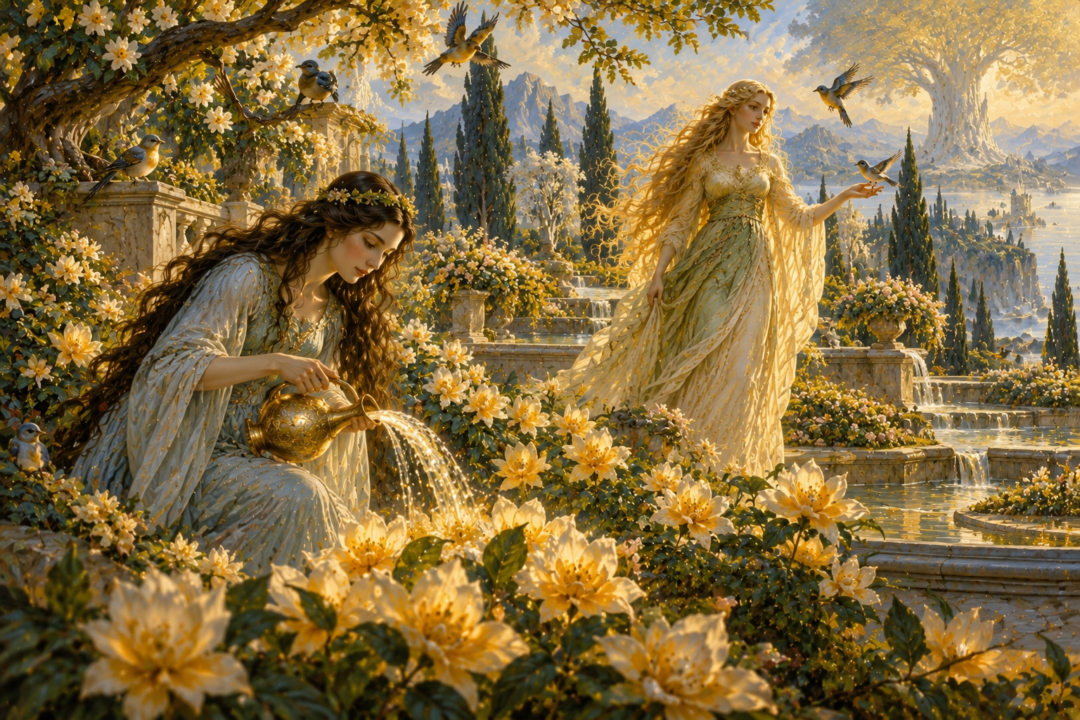
Their Overlap Is Not a Contradiction
Modern readers are accustomed to fictional systems in which powers require exact boundaries. If one divine being controls plants, another apparently cannot possess plant-related powers without creating a contradiction.
The Valar do not fit comfortably into that model.
They are angelic beings who entered Arda and participated in shaping it according to their knowledge of the Music. Their relationships with the world are personal and thematic as much as functional. Several of their concerns naturally touch one another.
Ulmo's waters nourish the earth. Manwë's airs interact with clouds and weather. Yavanna's growing things depend upon both. Oromë delights in forests and beasts, while Vána, his spouse, is greeted by birds and surrounded by flowers.
Overlap is therefore unsurprising.
What matters is the particular character of each portrait.
Nothing in the published account requires us to imagine Yavanna surrendering flowers to Vána as a separate jurisdiction. Nor does Vána's affinity with birds mean that every bird in Arda must be placed under her exclusive authority.
Those conclusions impose a system more rigid than the texts provide.
Earlier Traditions Make the Boundary Even More Important
The earliest forms of the mythology sometimes gave Vána a more active part in the coming of vegetation and in the story that eventually became the making of the Two Trees.
Those materials are valuable for understanding how the mythology developed, but they should not simply be combined with the later published account. Roles, relationships, and events changed substantially across the long evolution of the legendarium.
In the mature published Silmarillion, it is Yavanna whose song brings forth the Two Trees upon Ezellohar, while Nienna waters the mound with her tears. Vána's surviving portrait is narrower and more evocative.
That development makes it especially risky to inflate scattered associations into claims that Vána created all flowers, governed all birds, or possessed an equal general authority over living nature.
The later portrait gives us something subtler.
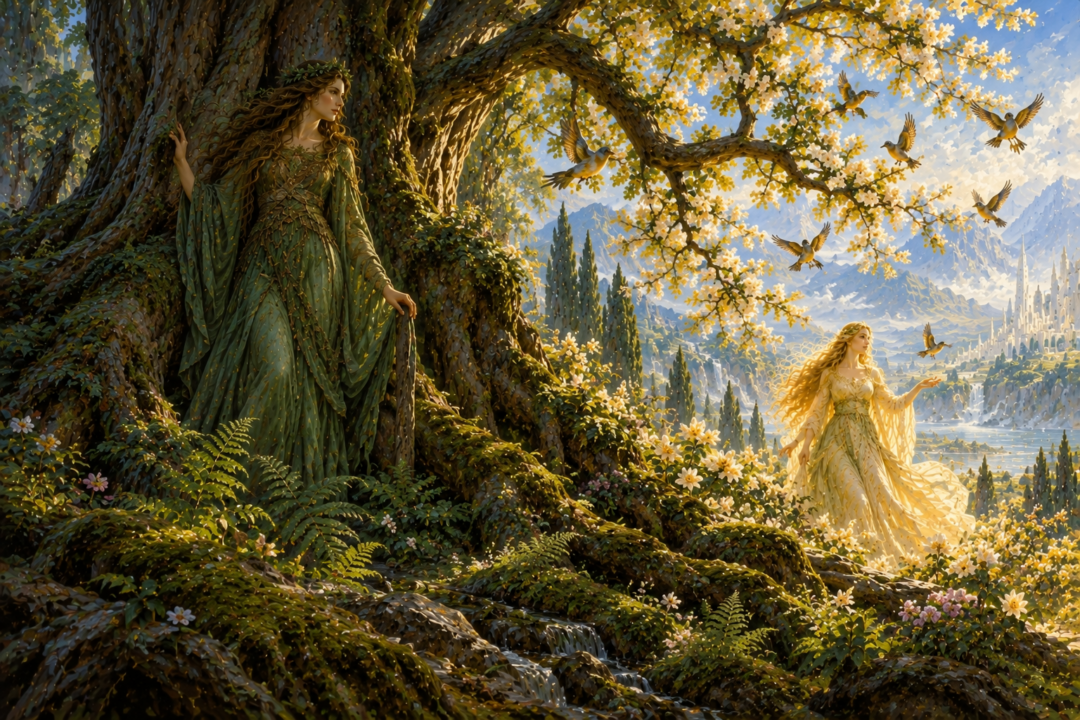
Two Ways of Seeing the Same Living World
Imagine a forest in Valinor.
To speak of it through Yavanna is to think of the trees themselves: their forms, their roots, their growth, their place among the innumerable living things conceived in her thought, and their need to survive within Arda.
To speak of that landscape through Vána is to notice another quality: flowers suddenly opening, birds filling the branches with song, and the sensation of life appearing perpetually fresh.
The forest does not need to belong exclusively to either.
That is the crucial distinction.
Yavanna's textual portrait encompasses the astonishing breadth and persistence of growing life. Vána's concentrates on its ever-renewed loveliness.
One concerns the deep continuity of growth.
The other reveals what growth looks and feels like at the instant of flourishing.
And that makes Vána's seemingly smaller role far from redundant. In a world destined to experience marring, death, fading, and loss, the Ever-young embodies a quality that cannot be measured merely by how many living things fall within her concern.
She is the image of life forever seeming newly opened.
Sources & Notes
- The Encyclopedia of Arda — Vána — The Ever-young, Yavanna’s sister and the spouse of Oromë. https://www.encyclopedia-of-arda.com/v/vana.html
- The Encyclopedia of Arda — Yavanna — The Giver of Fruits and her concern for growing things. https://www.encyclopedia-of-arda.com/y/yavanna.html
- The Encyclopedia of Arda — Arien — Arien’s work in Vána’s gardens using the dews of Laurelin before guiding the Sun. https://www.encyclopedia-of-arda.com/a/arien.html
Primary passages: The Silmarillion, “Valaquenta,” “Of the Beginning of Days,” “Of Aulë and Yavanna” and “Of the Sun and Moon and the Hiding of Valinor.” Freshness versus wider guardianship is interpretation of these portraits, not an exclusive division of flowers and plants into separate jurisdictions or a stated office as ruler of spring.