Bilbo’s mithril coat is one of the most famous pieces of armor in Middle-earth. It is astonishingly light, immensely valuable, and strong enough to turn weapons that would otherwise kill its wearer. Yet its form is surprisingly ordinary: it is still a coat of mail.
That detail points toward a much larger pattern.
Across The Hobbit, The Lord of the Rings, and the histories of the Elder Days, exceptionally well-equipped warriors repeatedly appear in mail: Dwarves, Elves, Rohirrim, Gondorians, and great captains alike. Their armor may be ancient, beautifully made, inherited from earlier kingdoms, or forged from extraordinary materials, but the texts do not replace linked rings with the full articulated plate harness familiar from later medieval warfare and much modern fantasy.
That does not mean Middle-earth knows nothing of rigid metal protection. Helms certainly exist. Prince Imrahil wears a vambrace. Scale-like defenses appear. Dwarven masks provide specialized protection. The important distinction is narrower: in the main published narratives, full articulated plate armor is not the normal culmination of elite military equipment.
Why? The safest answer begins not with something Middle-earth supposedly cannot make, but with what its greatest armorers demonstrably choose to make.
Mail Is Not the Cheap Alternative
Modern fantasy can encourage a technological ladder: leather at the bottom, mail in the middle, plate at the top. Tolkien’s descriptions do not operate so neatly.
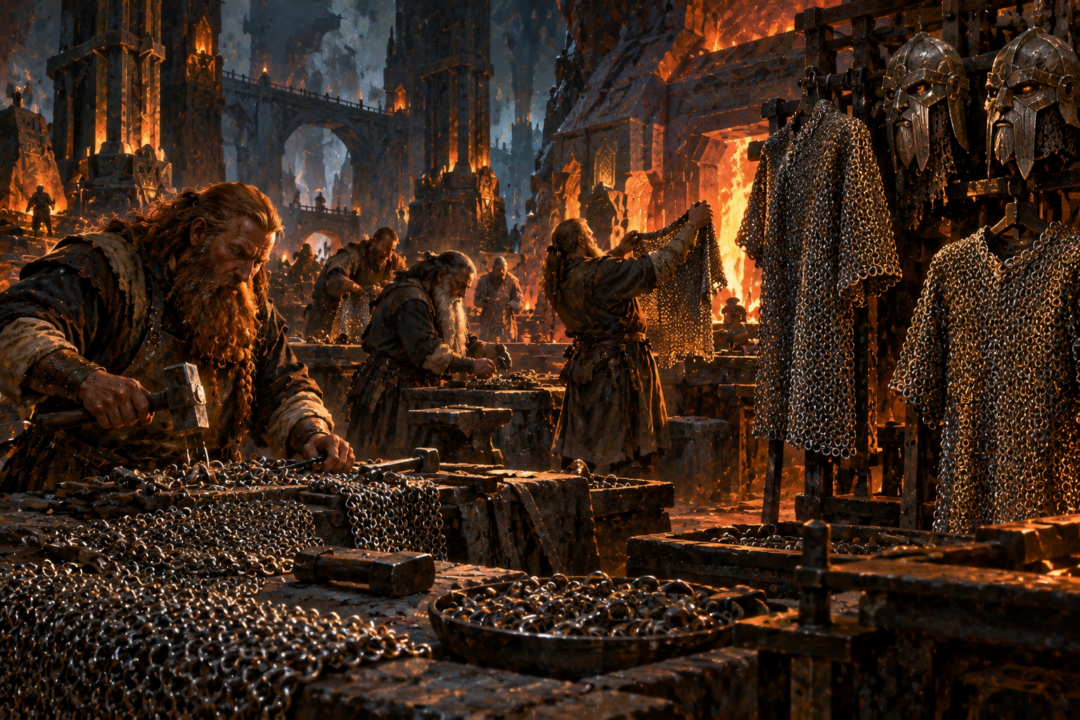
In The Silmarillion, the smiths of Belegost are credited with first devising mail made from linked rings. Their work in this craft has no rival. This matters because Dwarves are hardly portrayed as technically primitive metalworkers. Their superiority in tempering steel is explicitly praised, and their weapons and defensive works can become treasures remembered across ages.
Mail therefore enters the history of Middle-earth as a major smithcraft achievement.
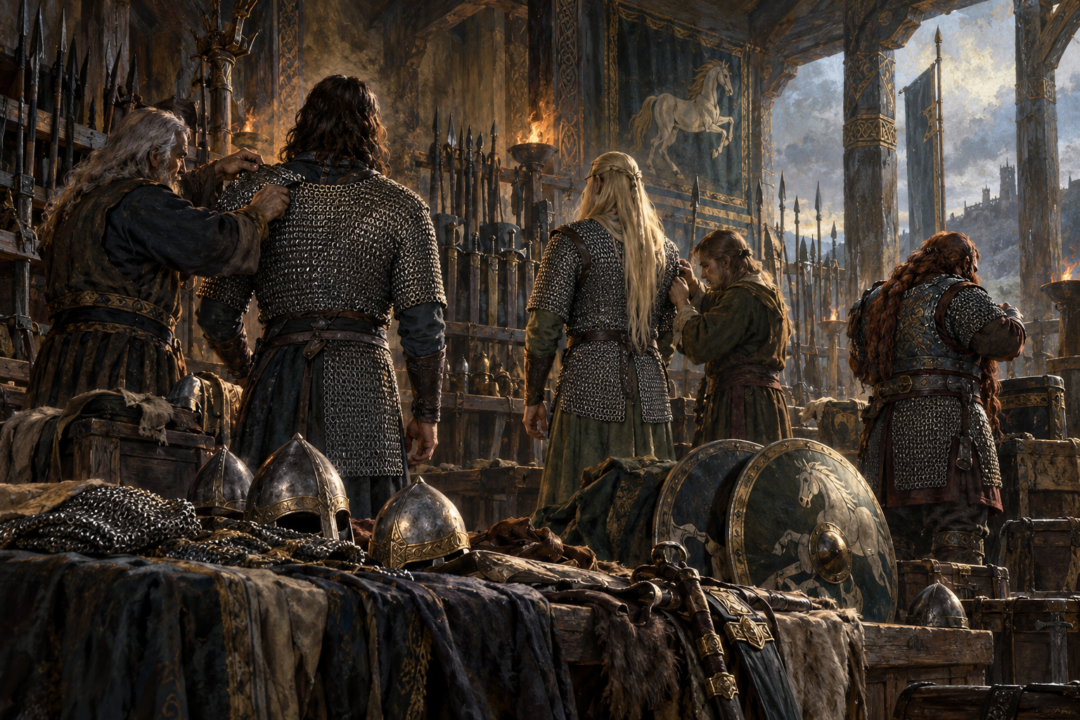
That prestige survives into later ages. When Théoden opens his armory at Edoras, Aragorn and Legolas are equipped in shining mail, together with helms and shields. Gimli does not need another coat because his own short corslet, forged beneath the Mountain, is better than any suitable hauberk in Théoden’s stores.
The hierarchy is one of workmanship, provenance, material, and preservation—not a simple progression from rings to plates.
The Dwarves Establish the Pattern
The First Age provides perhaps the clearest foundation.
The Dwarves of Belegost become renowned for mail of linked rings. Elves acquire Dwarven-made armor, and Dwarven smithcraft helps arm the Sindar as danger grows in Beleriand. In later traditions surrounding Túrin, Dwarf-made defensive equipment remains associated with exceptional craftsmanship.
Dwarves also possess defenses that should prevent us from making the opposite mistake and imagining that every armored surface must consist of mail. At the Nirnaeth Arnoediad, the Dwarves of Belegost are notably equipped with great masks that help them endure the assault of Glaurung. These are specialized rigid defenses associated with a particular battlefield threat.
The evidence therefore does not support the claim that Dwarven smiths were somehow incapable of making substantial metal forms.
What it does support is more interesting: when the texts identify their supreme contribution to personal body armor, they specifically celebrate linked mail.
Erebor Shows How Valuable Great Mail Could Become
The Hobbit carries that tradition forward.
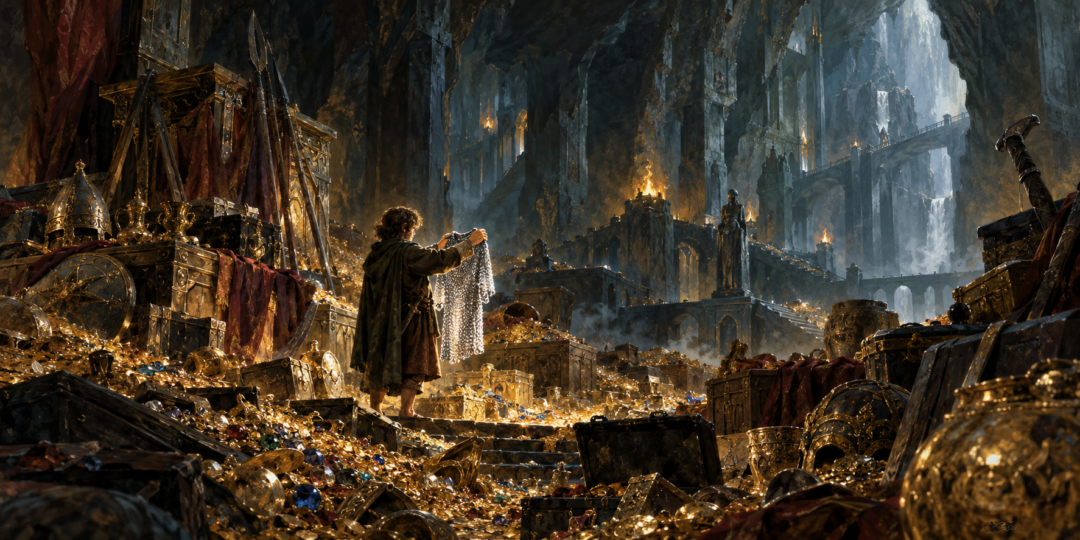
When Thorin and Company recover the treasure of Erebor, Bilbo receives a small coat of mail from the hoard. In the later text it is made of mithril, and The Lord of the Rings makes its extraordinary value explicit. Gandalf reveals that Bilbo’s coat was worth more than Frodo had imagined, while Gimli treats it as a gift fit for a king.
The form remains a mail-shirt.
The same Erebor tradition appears in another treasured coat associated with the royal house of Dale. Girion had given a necklace of emeralds in payment for a coat of Dwarf-made linked rings made for his eldest son. Again, elite status is expressed through the quality and cost of mail rather than through a transition into a full plate harness.
Glóin later tells the Council of Elrond that the Dwarves can still make good armor and keen swords, but cannot equal the mail and blades made before Smaug came.
That is a revealing measure of decline. The lost standard is superior mail.
Rohan’s Royal Armory Tells the Same Story
Rohan provides an especially useful test because Théoden is a king preparing companions for open war.
At Edoras, his hoard contains helms and coats of mail described as cunning work, including gifts inherited from Gondor. Aragorn and Legolas receive shining mail. Gimli already possesses a superior Dwarf-forged corslet. Shields complete the equipment.
Later, when Merry needs armor, Éowyn explains that there is no mail fitted to him and no time to forge an appropriate hauberk. He therefore receives a stout leather jerkin along with a helm, shield, belt, and knife.
That scene quietly shows what the Rohirrim consider proper battlefield protection. Given time and the right fit, mail would have been the desirable body armor.
Nothing in this requires us to conclude that Rohan lacked knowledge of every other armor form. It simply demonstrates what the narrative identifies as valuable war gear in a royal military context.
Gondor Does Not Introduce a Plate-Armed Elite
One might expect Gondor, heir to Númenórean civilization, to break the pattern. Instead, its most prestigious surviving equipment reinforces it.
The Guards of the Citadel wear black mail beneath their black surcoats. Their helms are particularly remarkable: the guards possess ancient helms associated with Gondor’s earlier glory, wrought of mithril rather than merely ordinary steel.
Here again, technological and social prestige does not demand a complete rigid shell. Precious material is concentrated where the inherited equipment calls for it, while mail remains the body defense.
Yet Gondor also supplies an important warning against overstatement.
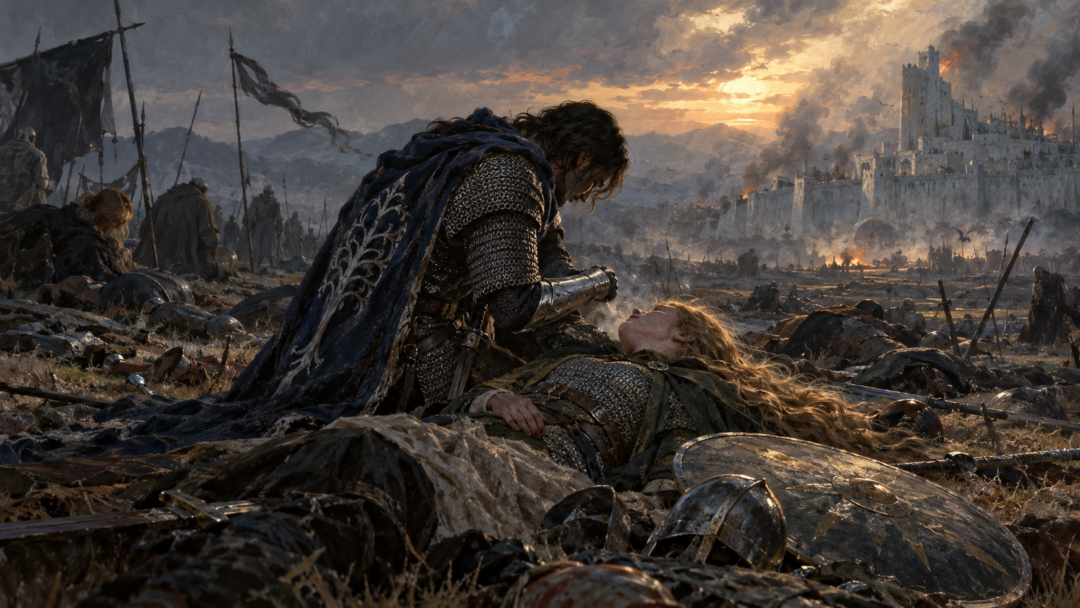
During the Battle of the Pelennor Fields, Prince Imrahil discovers that Éowyn is still alive when her breath leaves a faint mist upon his polished vambrace. A vambrace is rigid protection for the forearm. The text therefore gives us no basis for saying that rigid pieces of armor simply do not exist.
The distinction is between individual rigid components and the full articulated plate harness familiar from later medieval imagery.

Even the Enemy Complicates Any Simple Rule
Other armor descriptions broaden the vocabulary further.
The fallen Southron seen by Sam in Ithilien wears a corselet involving overlapping brazen plates. This is clearly not an ordinary shirt of linked rings. It demonstrates another form of metal body defense within the world.
There are also repeated references to helms, shields, corslets, hauberks, and other protective equipment across different peoples. Earlier ages include the fearsome Dwarf-masks of Belegost. The equipment of Middle-earth is therefore more varied than “everyone wears chainmail.”
But variation is not the same thing as evidence for a late-medieval plate harness.
The published narratives repeatedly describe elite mail and several kinds of rigid or overlapping protection without clearly presenting the familiar head-to-foot articulated plate suit as their dominant high-status armor.
That absence should be preserved rather than filled automatically by modern fantasy expectations.
Material Matters as Much as Shape
Mithril reveals why judging Middle-earth armor purely by silhouette can be misleading.
The material is extraordinarily light and exceptionally hard when worked by the Dwarves. Bilbo’s coat combines those qualities with the flexibility of mail. Its greatness lies not in looking technologically later than ordinary armor, but in what it is made from and who made it.
The same principle applies more broadly.
A Dwarf-forged corslet can outrank the mail in a king’s armory. Ancient Gondorian equipment can remain prestigious generations later. A coat recovered from Erebor can represent wealth beyond the comprehension of its Hobbit owner.
Middle-earth repeatedly attaches value to maker, material, age, lineage, and craft.
The best armor is often not the newest type. It may be the surviving work of a greater past.
Armor Is Also an Inherited Resource
This becomes especially important in the late Third Age, a world filled with remnants.
Théoden’s armory contains gifts from Gondor. Gondor’s guards preserve heirlooms from older days. Bilbo’s coat survives in Smaug’s hoard before passing from Thorin to Bilbo and then to Frodo. Ancient weapons and defensive objects continually move between owners, kingdoms, treasure-hoards, and generations.
Armor is therefore not merely manufactured and discarded as military fashion changes. Exceptional pieces can have long custodial histories.
That does not prove why no culture developed full articulated plate armor. The texts never provide a technical essay explaining such an absence.
But it does explain why a modern assumption of constant technological replacement fits Middle-earth poorly. Superior artifacts survive. Lost workmanship matters. Decline can mean that present craftsmen struggle to equal what earlier smiths already achieved.
What the Texts Do Not Tell Us
This is where certainty must stop.
The narratives do not state that articulated plate armor is physically impossible to manufacture. They do not say that Dwarves attempted and failed to invent it. They do not establish a universal law forbidding plate. Nor does the presence of mail prove that every warrior everywhere uses identical equipment.
Likewise, rigid metal armor is not absent in the broader sense. Helms, vambraces, masks, and overlapping plates prevent such a claim.
What can safely be said is narrower and stronger.
Across major published narratives, mail is repeatedly the body armor of prestigious warriors and the product of celebrated smithcraft. Dwarven masters are famous for it. Kings store it. Gondor preserves it. Heroes receive it. Mithril reaches one of its most memorable martial forms as linked mail.
Meanwhile, the texts do not clearly install the full articulated plate harness as the superior equipment that replaces this tradition.
That difference matters visually as well as historically. A fully plate-armored Aragorn, Théoden, or Gondorian captain may satisfy a familiar fantasy vocabulary, but it can quietly overwrite the vocabulary of the books.
Middle-earth’s elite armor tells a different story. Its greatness is often hidden in thousands of linked rings: in the metal, the smith who shaped it, the kingdom that guarded it, and the generations fortunate enough to inherit what an older world knew how to make.
Sources & Notes
- TheOneRing.net — Middle-earth Arms and Armour — A text-based discussion of mail, scale-like armour and the rarity of plate harness. https://www.theonering.net/torwp/2000/11/27/27680-middle-earth-arms-and-armour-3/
- The Encyclopedia of Arda — Mithril — The material and Bilbo’s celebrated coat of mail. https://www.encyclopedia-of-arda.com/m/mithril.html
- The Thain’s Book — Thorin Oakenshield — Bilbo’s mithril coat and the Dwarves’ recovered war equipment. https://thainsbook.minastirith.cz/thorin.html
- The Thain’s Book — Legolas — Legolas receives mail from the Rohirrim before the war against Saruman. https://thainsbook.minastirith.cz/legolas.html
Primary passages include The Hobbit, “Not at Home,” The Fellowship of the Ring, “A Journey in the Dark,” The Two Towers, “The King of the Golden Hall” and The Silmarillion’s accounts of Dwarven smithcraft. “Plate absent” means the lack of a clearly described full articulated plate harness, not the absence of helms, vambraces, masks or overlapping plates. No technological inability to make plate is established.