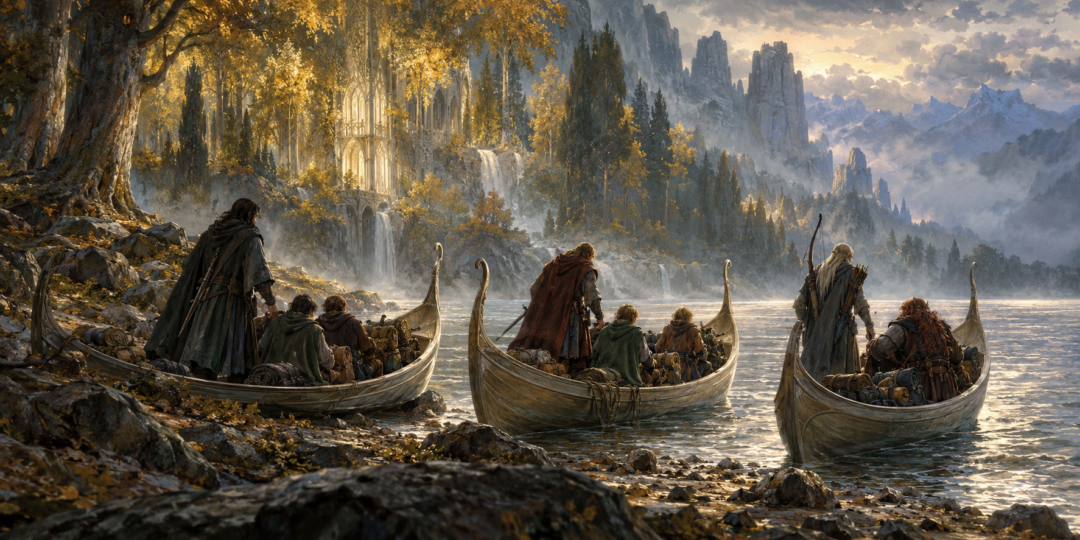
When the Fellowship leaves Lothlórien, it does so with one member already missing. Gandalf has fallen in Moria, leaving eight travellers to continue south. Yet the Elves provide three light boats, and the Company does not divide itself into anything resembling equal crews.
The arrangement given in “Farewell to Lórien” is precise: Aragorn travels with Frodo and Sam; Boromir with Merry and Pippin; Legolas with Gimli. That produces crews of three, three, and two.
At first glance, the last boat looks oddly underfilled. But person-count alone is a poor way to understand the arrangement. The Fellowship consists of Men, hobbits, an Elf, and a Dwarf, all travelling with equipment and provisions. More importantly, the boats are not simply seats. They are a transport system carrying both people and the possessions needed for an uncertain journey.
The text never gives us weights, capacities, or a formal loading plan. It does, however, give enough information to see that three unequal crews are entirely sensible—and that the arrangement was flexible enough to survive changes in the Company.
Eight Travellers, Three Boats
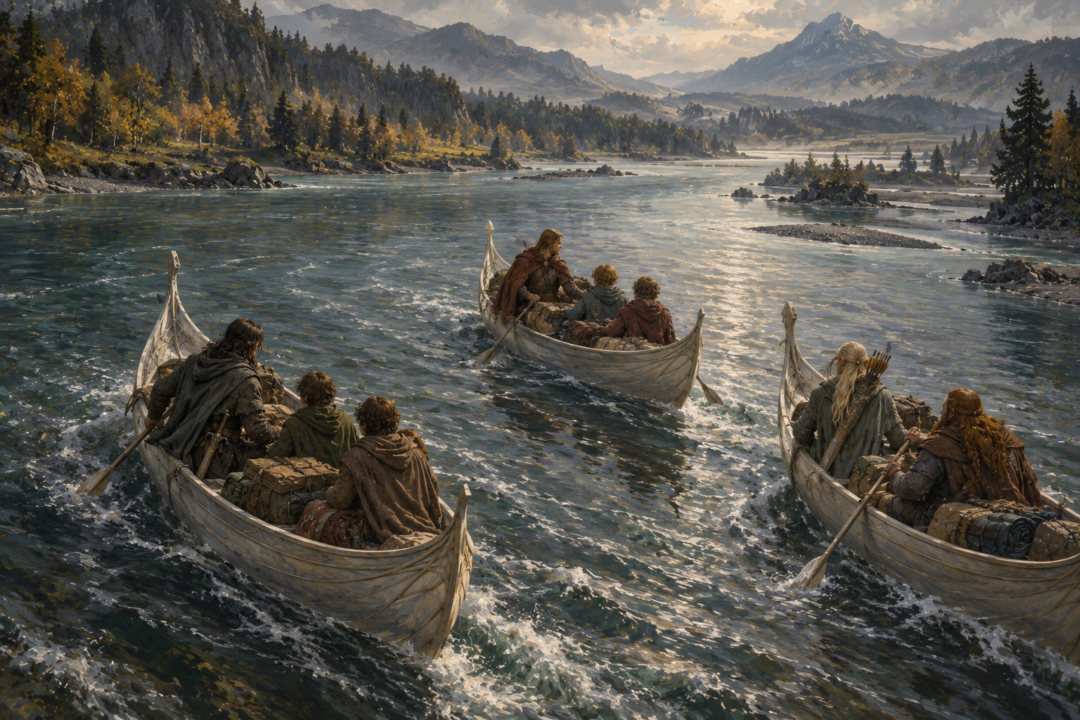
The boats are prepared for the Fellowship by the Galadhrim near the confluence of the Silverlode and Anduin. The Company first stows its belongings and then tries the craft on the water.
The crews are explicitly identified.
Aragorn is with Frodo and Sam. Boromir is with Merry and Pippin. Legolas and Gimli occupy the third boat.
That 3/3/2 distribution matters because it prevents a misleading assumption: the Fellowship was not trying to put approximately the same number of bodies in every craft.
Nor should we expect it to.
Four of the eight travellers are hobbits. Two are full-grown Men. Gimli is a Dwarf, while Legolas is an Elf. Tolkien gives no numerical body weights for any of them, so attempts to reconstruct exact loads in modern units would go beyond the evidence. Nevertheless, three occupants do not necessarily constitute a heavier load than two occupants when the occupants themselves differ substantially in stature and when baggage can also be distributed among the boats.
The visible inequality in headcount therefore tells us very little about the actual inequality of the loads.
The Two Three-Person Crews Have the Same Basic Shape
There is a striking symmetry between the two larger crews.
Aragorn’s boat contains one Man and two hobbits: Aragorn, Frodo, and Sam.
Boromir’s contains one Man and two hobbits: Boromir, Merry, and Pippin.
That is a much more useful comparison than simply saying that both boats hold three people. Each places one of the two Men with a pair of hobbits.
The text does not say that this arrangement was chosen specifically to balance weight, so that should not be turned into an asserted Elvish loading rule. But as a practical consequence, the two boats have broadly comparable crew structures.
They also place Aragorn and Boromir—the two Men of the surviving Company—in separate boats.
During the journey down Anduin, Aragorn and Boromir are among those who handle the boats, while the Company as a whole must paddle and manage its passage downstream. Again, the narrative does not provide a formal rowing roster. It would therefore be unsafe to invent one.
What we can say is simpler: neither three-person boat consists merely of three interchangeable passengers. The composition gives each a powerful and experienced traveller alongside two smaller companions.
Why Legolas and Gimli Do Not Make the Third Boat “Empty”
Legolas and Gimli travel together.
This is narratively significant because by this point their earlier hostility has changed into friendship. “Farewell to Lórien” explicitly notes that they have become fast friends.
Logistically, however, their two-person boat also shows why headcount is an inadequate measure of loading.
The Fellowship has possessions to transport. The Company has its weapons and personal equipment, the Elven rope supplied with the boats, and provisions including lembas. Sam also carries the small box given to him by Galadriel, while the other members possess their own equipment and gifts.
The text does not provide an inventory showing which specific packs were placed in which craft. We therefore cannot claim that Legolas and Gimli’s boat was deliberately designated as a cargo boat.
But a boat containing only two people plainly leaves more scope for baggage than one containing three comparable occupants. That makes flexible distribution of goods a plausible practical consequence of the arrangement, even though Tolkien does not specify the exact distribution.
This distinction is important. The evidence establishes the crews. It does not establish a hidden quartermaster’s manifest.
The Boats Were Light Craft, Not Fixed Compartments
The Company’s later experience reinforces this flexibility.
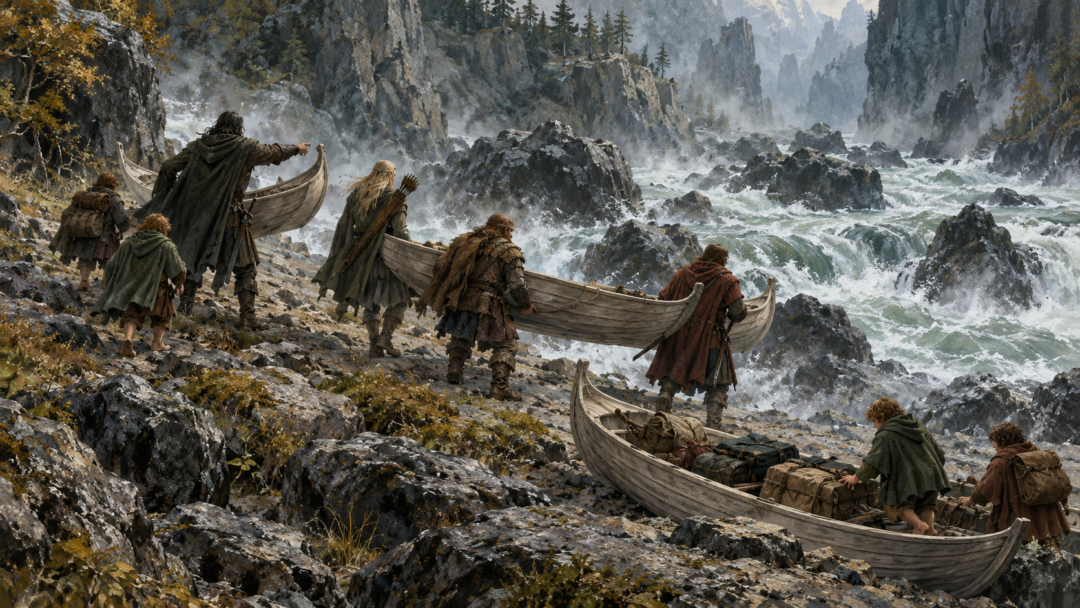
The boats can be carried when necessary. At Sarn Gebir the Fellowship discovers that continuing through the dangerous rapids is not a matter of simply trusting the craft to survive. Aragorn recognizes the danger, and the Company ultimately carries the boats and its goods around the obstruction before returning them to the river.
That episode tells us something useful about the transport system without requiring invented specifications.
These are portable boats being used by an expedition. People, packs, provisions, and craft can be separated and rearranged whenever the route demands it.
Their usefulness lies partly in that adaptability.
Nothing in the text suggests that each traveller has an assigned permanent seat or that every item must remain in one particular boat. The initial crews are named, but the journey itself requires the Company to land, unload, carry, camp, reload, and continue.
So the 3/3/2 arrangement should be understood as an operating arrangement, not as three sealed units.
Boromir Was Not Necessarily Going Where Everyone Else Was Going
There is another complication built into the journey from its beginning: the Fellowship has not settled on one final destination for every member.
Boromir has always intended to return toward Minas Tirith. The central unresolved question on Anduin is whether Frodo will turn east toward Mordor while others go toward Gondor.
Celeborn’s geographical advice makes the coming decision unavoidable. The Company can travel together down Anduin for a time, but eventually its purposes may divide.
That matters for Boromir’s boat.
His initial companions are Merry and Pippin. If Boromir had departed from the Ring-bearer’s road while the others continued together, his boat crew could not simply remain unchanged unless the hobbits accompanied him. The text never supplies a hypothetical redistribution plan because events overtake the question.
Therefore we should not claim that Aragorn had already decided who would take Boromir’s place, which boat Merry and Pippin would enter, or how baggage would be rearranged.
But the three-boat system did not require a permanent 3/3/2 division. A change in membership could be accommodated by moving people or goods between craft.
The spare flexibility visible in the two-person boat becomes particularly relevant here.
The Breaking of the Fellowship Proves How Flexible the System Is
At Parth Galen, careful planning gives way to crisis.
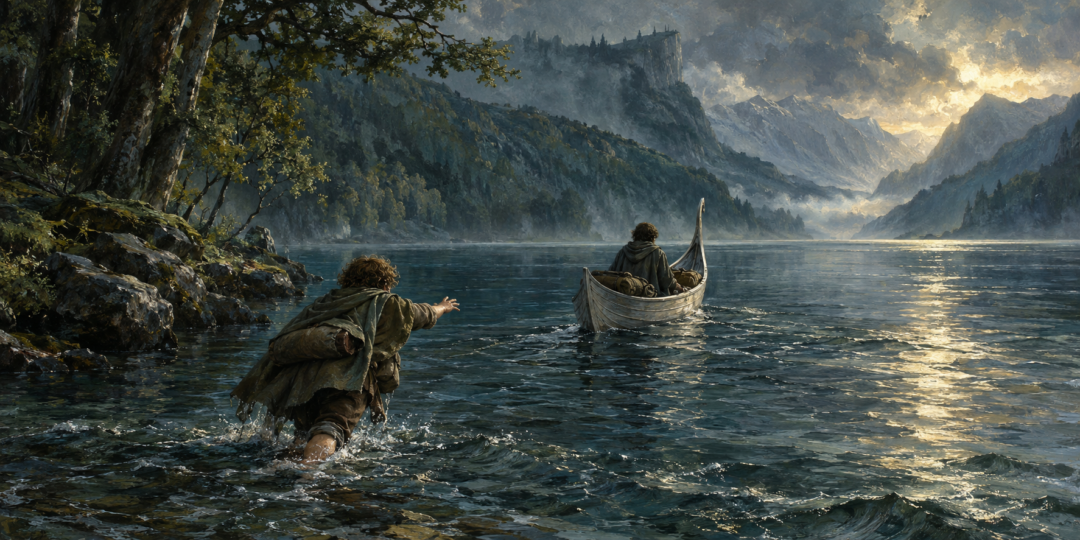
Frodo decides to leave the Company and continue toward Mordor alone. He takes one of the boats. Sam realizes what has happened, follows him into the water, and ultimately goes with him.
The result is a two-person expedition: Frodo and Sam in a craft originally belonging to a transport system for eight.
No special replacement boat is required. No minimum three-person crew prevents them from departing. The craft can serve a radically smaller party.
Meanwhile, the Company itself collapses under attack. Merry and Pippin are captured, and Boromir is mortally wounded defending them. Aragorn, Legolas, and Gimli later use another of the Elven boats for Boromir’s funeral, placing him in it with his weapons and the weapons of defeated enemies before sending the vessel toward Rauros.
The boats have therefore changed roles completely.
One has become the means by which Frodo and Sam begin the next stage of the Ring-quest. Another becomes Boromir’s funeral vessel. Aragorn, Legolas, and Gimli abandon river travel altogether and pursue the Orcs on foot.
The original 3/3/2 arrangement has vanished because it was never an immutable structure.
What We Can—and Cannot—Reconstruct
There is a tempting modern question here: were the three boats deliberately balanced by total weight?
Possibly, in ordinary practical terms. But the text never says so.
We cannot calculate the Fellowship’s loads in kilograms. We do not know the carrying capacity of the boats. We do not know how the baggage was divided between them. We cannot demonstrate that Legolas and Gimli carried a particular quantity of extra provisions to compensate for having only two occupants.
What we can reconstruct is more modest and more secure.
The Fellowship has eight travellers and three boats. Two boats contain one Man and two hobbits each. The third contains Legolas and Gimli. Goods are also being transported, and the expedition repeatedly has to handle both boats and baggage as circumstances change.
That creates ample practical room for sensible load distribution without requiring equal headcounts.
And because the Company’s future route is unresolved, rigid allocation would have been of little value anyway.
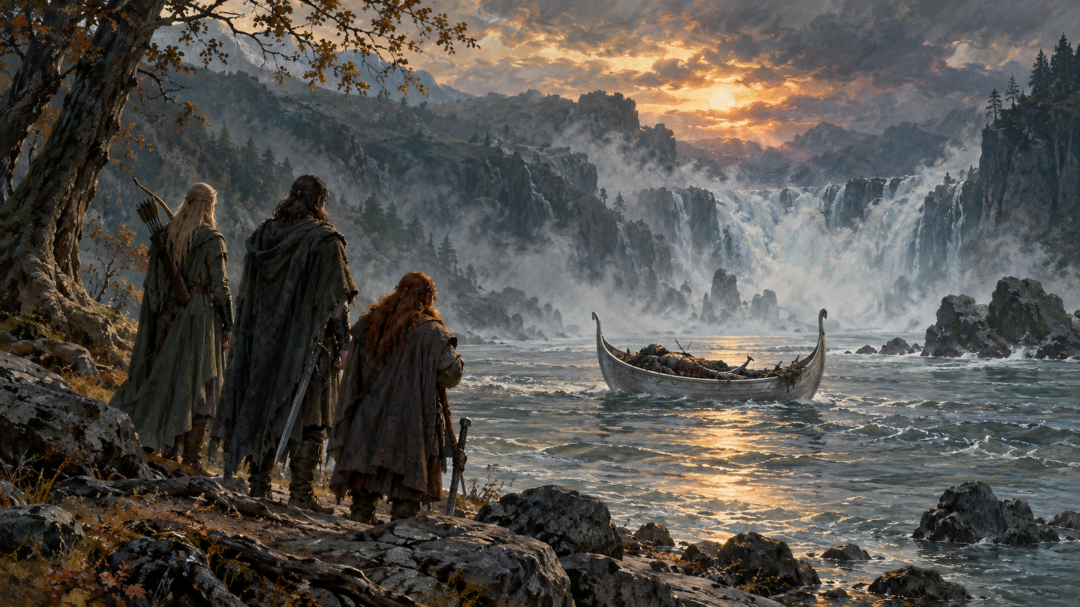
Three Boats for a Fellowship Already Beginning to Divide
The most revealing thing about the boat arrangement may therefore be its lack of mathematical neatness.
The Fellowship left Rivendell as Nine Walkers. By Lothlórien it is already eight. It enters three boats in groups of three, three, and two. Before those boats have finished serving the Company, Frodo separates himself, Sam follows him, Merry and Pippin are taken, Boromir dies, and Aragorn, Legolas, and Gimli choose a completely different road.
The river journey sits between two forms of the Fellowship: the company that walked south together and the scattered groups that will carry the story forward.
Its transport reflects that unstable moment perfectly.
The three boats do not reveal a secret numerical formula. They reveal something more practical. The Fellowship’s loads did not have to be equal in people because people were only part of what the boats carried, and the arrangement did not have to remain fixed because the travellers themselves might not remain together.
The named crews are firm textual evidence. Precise weight balancing is not.
Yet the unequal 3/3/2 distribution shows exactly why those distinctions matter: three boats were enough not because eight travellers could be divided neatly, but because a flexible expedition could distribute people and possessions according to circumstances—and change that distribution when the journey changed with them.
Sources & Notes
- LitCharts — The Fellowship of the Ring, Book II, chapter 8 — Celeborn’s three boats and supplies for the journey down the Anduin. https://www.litcharts.com/lit/the-fellowship-of-the-ring/book-2-chapter-8
- The Thain’s Book — Boromir — Boromir shares a boat with Merry and Pippin. https://thainsbook.minastirith.cz/boromir.html
- The Thain’s Book — Legolas — Legolas shares a boat with Gimli. https://thainsbook.minastirith.cz/legolas.html
- LitCharts — The Two Towers, Book III, chapter 1 — The remaining companions use a boat for Boromir’s funeral after Frodo’s departure. https://www.litcharts.com/lit/the-two-towers/book-3-chapter-1
Primary passages: The Fellowship of the Ring, “Farewell to Lórien” and “The Great River”; The Two Towers, “The Departure of Boromir.” The crews are textual. Cargo distribution and expected loads are interpretation; Tolkien supplies no numerical weights, capacity calculation or explicit loading manifest.