When Bilbo Baggins opens his door in “An Unexpected Party,” he faces a storytelling problem almost as quickly as a hospitality problem: Dwarves keep arriving.
First Dwalin appears. Then Balin. Then Fíli and Kíli. Five more follow together. Finally Bifur, Bofur, Bombur, Thorin, and Gandalf complete the gathering. By the time Bilbo’s hall is crowded, the reader has been introduced to thirteen Dwarves in remarkably little space.
Yet the scene rarely feels like the arrival of thirteen interchangeable names.
One reason is surprisingly simple: hoods.
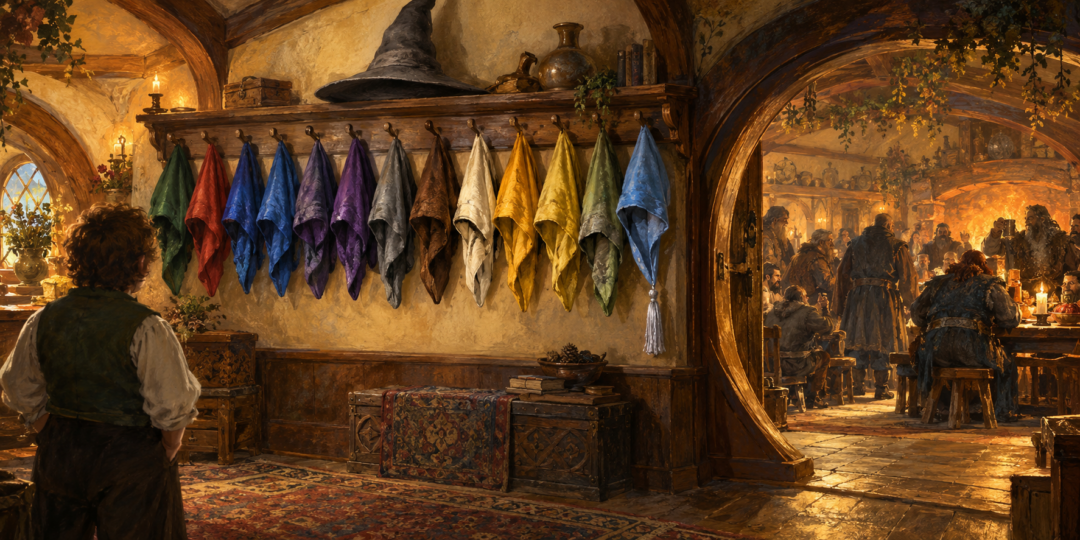
Dark green, scarlet, blue, purple, grey, brown, white, yellow, pale green, and finally Thorin’s sky-blue hood with its long silver tassel accumulate in Bilbo’s entrance hall. The colors do not provide secret heraldry, and the text never establishes a Dwarven system in which particular colors identify clans or ranks. Their importance is primarily narrative.
Before most members of Thorin’s Company receive substantial characterization, the hoods help turn a potentially confusing procession into a sequence of memorable entrances.
Dwalin Arrives as a Picture Before He Becomes a Character
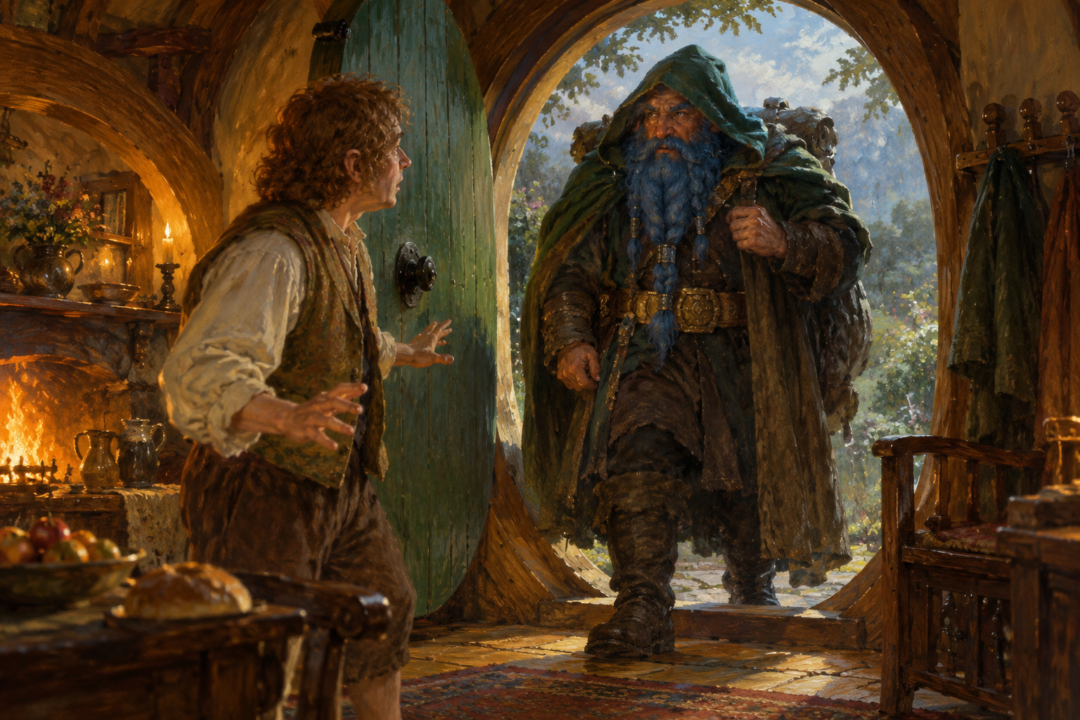
Dwalin is the first Dwarf Bilbo meets. His introduction is unusually visual: he has a blue beard tucked into a golden belt, bright eyes, and a dark-green hood.
At this point the reader knows almost nothing about his history or personality. But Dwalin already has a recognizable silhouette in the imagination.
That matters because the first chapter must perform several tasks simultaneously. It has to preserve Bilbo’s bewilderment, introduce an entire company, establish the comic disruption of his ordered household, and eventually reveal the serious purpose beneath the party.
There is little room for thirteen miniature biographies.
Instead, the narrative gives the reader quick identifying details. Dwalin becomes the dark-green-hooded first arrival before his place in the wider history of Durin’s Folk matters to the story.
The method resembles stage blocking. Someone enters, a vivid visual detail registers, a name is spoken, and the action continues.
Balin Immediately Changes the Pattern
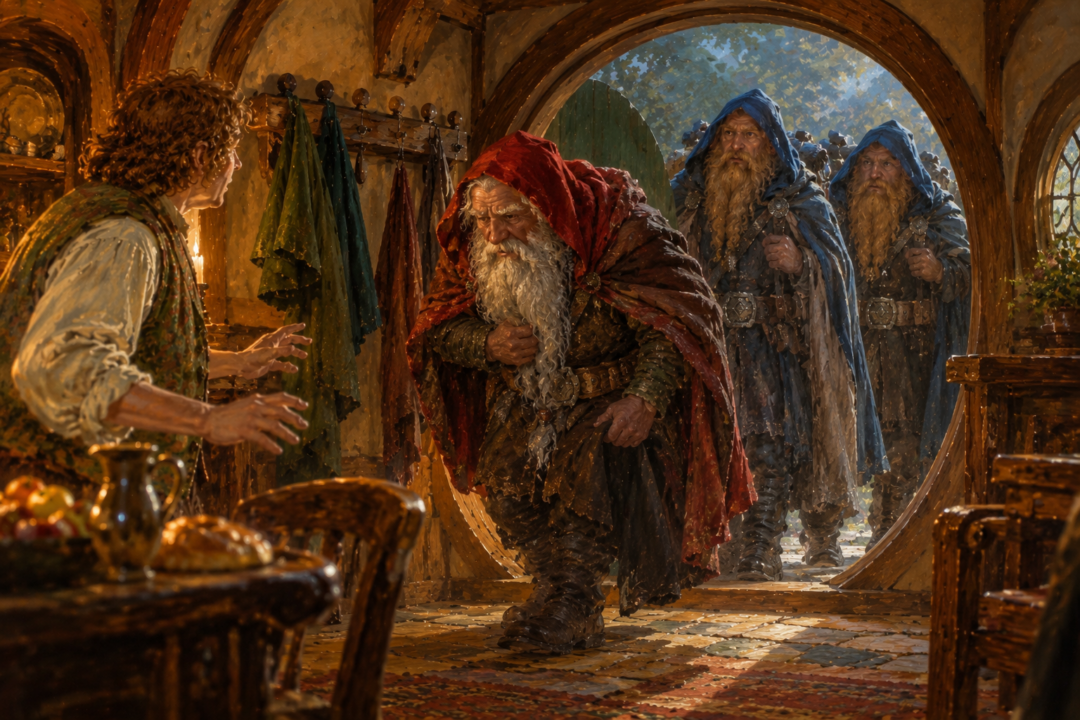
The second arrival is Balin, and the visual contrast is immediate.
Where Dwalin has a dark-green hood and blue beard, Balin is presented as very old-looking, with a white beard and scarlet hood.
This is economical characterization. The contrast between the brothers does not require a paragraph explaining how to distinguish them. The reader receives different colors, different beard descriptions, and a difference in apparent age.
Balin later becomes one of the Company members with whom Bilbo develops a particularly warm relationship. But that fuller identity emerges gradually.
At Bag End, he first needs to become recognizable.
The scarlet hood helps accomplish that.
Importantly, this does not mean scarlet possesses some established symbolic meaning in Dwarven culture. Nothing in the chapter tells us that Balin wears scarlet because of his family, profession, status, or temperament. Assigning such a system would go beyond the evidence.
The secure observation is simpler: color separates one arrival from another in the reader’s mind.
Fíli and Kíli Are Introduced as a Pair
The next knock produces two Dwarves rather than one: Kíli and Fíli.
They have blue hoods, silver belts, and yellow beards.
Here the method changes. Instead of differentiating the brothers visually from each other, the text visually binds them together.
That pairing proves appropriate. Fíli and Kíli repeatedly function as a pair throughout the journey, and their kinship is important: they are Thorin’s nephews, the sons of his sister Dís, as Appendix A of The Lord of the Rings makes explicit.
Their shared appearance therefore performs a different function from the contrast between Dwalin and Balin.
Some hoods distinguish individuals. Others help establish small units within the larger Company.
The reader is not simply memorizing thirteen separate figures. The arrivals are being organized into manageable patterns.
Then the Individual Mapping Deliberately Becomes Less Precise
One of the most important details is also one frequently flattened in summaries.
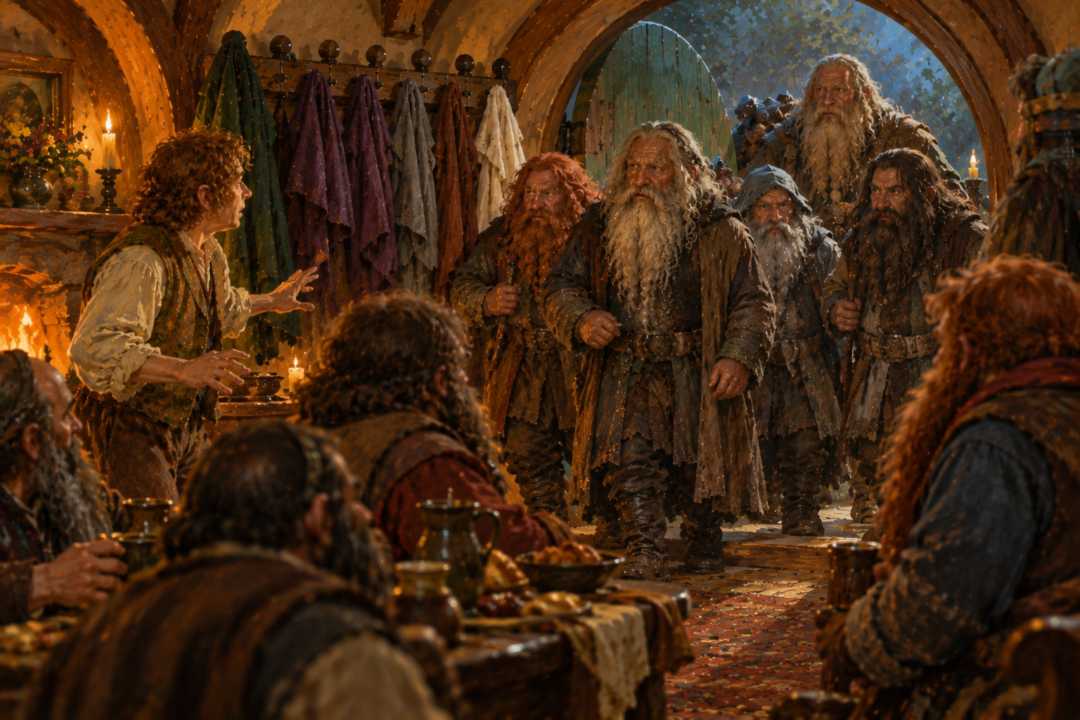
Dori, Nori, Ori, Óin, and Glóin arrive together. The text names all five and then describes two purple hoods, a grey hood, a brown hood, and a white hood hanging on Bilbo’s pegs.
But in that passage, it does not explicitly tell us which named Dwarf owns which individual hood.
That distinction matters.
Later reference lists sometimes assign those colors individually, but the first chapter itself does not provide that one-to-one mapping. What it securely gives us is a named group associated with a visible cluster of colors.
And that actually strengthens the larger narrative effect.
Bilbo is being overwhelmed.
The arrivals have accelerated from one Dwarf, to another Dwarf, to a pair, and now to five at once. Individual introductions are giving way to a throng. The narration mirrors that escalation: the reader receives names and colors, but less time to attach every visual detail neatly to a single person.
The slight loss of precision belongs naturally to the scene.
Bilbo’s orderly world is filling faster than he can process it.
Bifur, Bofur, and Bombur Arrive as Another Visual Group
The final Dwarven arrival produces another carefully staged cluster.
Bifur, Bofur, and Bombur come in with Thorin. The three ordinary members of that arrival group hang up two yellow hoods and a pale-green one. Again, the passage does not explicitly assign the pale-green hood to one of those three by name.
What matters immediately is their grouping.
They arrive together. They stand together. Their hoods form another recognizable cluster on the pegs.
Soon afterward they begin to acquire individual touches through their food requests: Bifur asks for raspberry jam and apple-tart, Bofur for mince-pies and cheese, and Bombur for pork-pie and salad.
That progression reveals how the chapter works.
Visual grouping comes first. Small behavioral distinctions follow. More substantial characterization develops later when the journey gives individuals opportunities to act.
The Company is not introduced through thirteen dossiers. It is assembled before Bilbo’s eyes.
Thorin’s Hood Breaks the Pattern
Then comes the most clearly individualized hood of all.
Alongside the two yellow hoods and the pale-green hood is a sky-blue hood with a long silver tassel. The narration explicitly states that this one belongs to Thorin.
That certainty is significant because Thorin is not merely another member of the Company.
He is its leader.
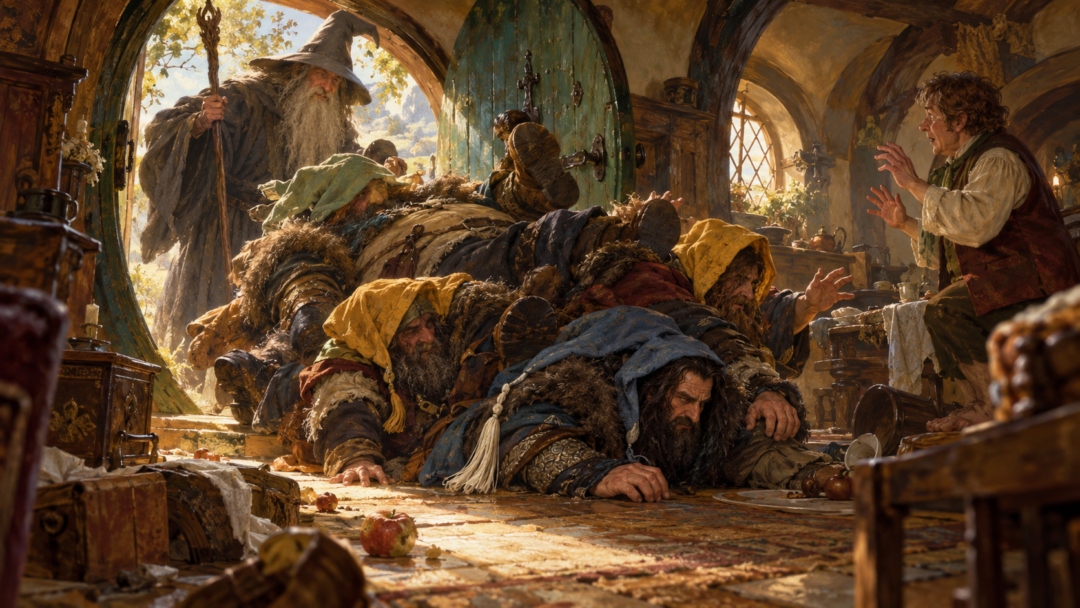
His behavior also separates him from the others. While the other Dwarves repeatedly offer the courteous formula “at your service,” Thorin initially does not. He has just been knocked into Bilbo’s hallway beneath the others and is displeased. The narration stresses his importance and pride.
The distinctive tasselled hood reinforces that separation visually without requiring invented heraldry.
There is no need to claim that sky blue is a royal color among Dwarves. The text never establishes such a rule.
What it does establish is that Thorin’s particular hood is visually more elaborate and specifically identified as his. Costume, narration, and behavior converge to make him stand apart.
The Row of Hoods Becomes a Picture of the Whole Company
Once everyone has arrived, Gandalf looks toward the pegs.
There are thirteen detachable party hoods hanging there.
It is a wonderfully compact image.
At the beginning of the evening, Bilbo’s hall belongs entirely to him. By this point, the pegs themselves testify that his private home has been occupied by an unexpected company.
The hoods have changed function.
At first, they help mark arrivals: dark green, scarlet, blue, and so on.
Now they form a collective image.
Thirteen separate visitors have become one Company.
That movement from individuality to fellowship anticipates the structure of the adventure itself. Bilbo will gradually learn which Dwarves are impatient, skeptical, helpful, vulnerable, courageous, or affectionate. Some will remain much less developed than others. But before the journey can differentiate them through action, the party scene must first assemble them convincingly as a group.
The row of hoods accomplishes this almost visually.
Clothing Works Together With Ritual
The hoods are only one part of the introduction system.
Repeated bows and declarations of service create a social ritual. Bilbo opens the door; another visitor enters; the visitor identifies himself; the hooded cloak comes off; hospitality is assumed; Bilbo becomes increasingly flustered.
Repetition allows the reader to learn the pattern.
Variation makes each repetition memorable.
Dwalin is not Balin. The brothers Fíli and Kíli form their own pair. Five Dwarves suddenly become a crowd. Bifur, Bofur, and Bombur arrive in another cluster. Thorin appears last among the Dwarves and receives special narrative emphasis.
The costumes therefore work with arrival order, group size, manners, food requests, instruments, age, beard descriptions, and later actions.
No single device carries all thirteen characters.
The chapter layers small distinctions until the Company becomes manageable.
What the Hood Colors Do Not Tell Us
The restraint is important because these details invite overinterpretation.
The text does not explain the colors as clan heraldry.
It does not say that purple, yellow, green, scarlet, or blue indicates social rank.
It does not provide a symbolic color code for Dwarven houses.
Nor does every named Dwarf receive an individually assigned hood color in the first chapter.
The safest interpretation is literary rather than heraldic: the colors make the arrivals vivid, organize the Company into memorable visual patterns, and help the reader experience the gathering from Bilbo’s overwhelmed perspective.
Thorin’s more distinctive tasselled hood does coincide with his emphasized importance, but even there the text gives no general rule from which a hierarchy of Dwarven clothing can be reconstructed.
The detail is powerful precisely because it does not need such a system.
Before We Know Their Histories, We Know Who Just Walked Through the Door
Much later, names such as Balin, Fíli, Kíli, and Thorin carry emotional weight that no colored hood could provide.
That weight has to be earned through the journey.
At Bag End, however, the narrative has a more immediate problem. Thirteen Dwarves must enter one small hobbit-hole without dissolving into a wall of unfamiliar names.
So characterization begins with what Bilbo can see.
A dark-green hood. A scarlet hood. Two blue hoods. A sudden collection of purple, grey, brown, and white. Yellow and pale green. Then sky blue and a silver tassel.
The method is modest, almost playful, but extremely efficient. Color creates recognition before history creates attachment. Pairings reduce complexity. Repetition establishes ritual. Thorin’s variation announces importance. Finally, thirteen garments hanging together turn a procession of strangers into a Company.
The hoods do not secretly explain Dwarven society.
They do something more useful to the story.
They let thirteen unexpected guests become recognizable before Bilbo—or the reader—has had enough time to truly know them.
Sources & Notes
- Penguin Random House — The Hobbit teacher’s guide — The company’s introduction and Bilbo’s unexpected gathering in chapter 1. https://www.penguinrandomhouse.com/books/179206/the-hobbit-by-jrr-tolkien/teachers-guide/
- Valar Guild Tolkien Encyclopedia — Dwalin — His blue beard and dark-green hood at the first arrival. https://valarguild.org/tolkien/encyc/articles/d/Dwalin/DwalinV.htm
- The Thain’s Book — Balin — His red hood and early arrival at Bag End. https://thainsbook.minastirith.cz/balin.html
- The Thain’s Book — Thorin Oakenshield — His distinctive sky-blue hood with a silver tassel. https://thainsbook.minastirith.cz/thorin.html
Primary passage: The Hobbit, chapter 1, “An Unexpected Party.” Colour and arrival order support the literary reading; they do not establish clan heraldry. The chapter does not explicitly assign every hood in the grouped arrivals to an individual Dwarf, even where later reference lists do.