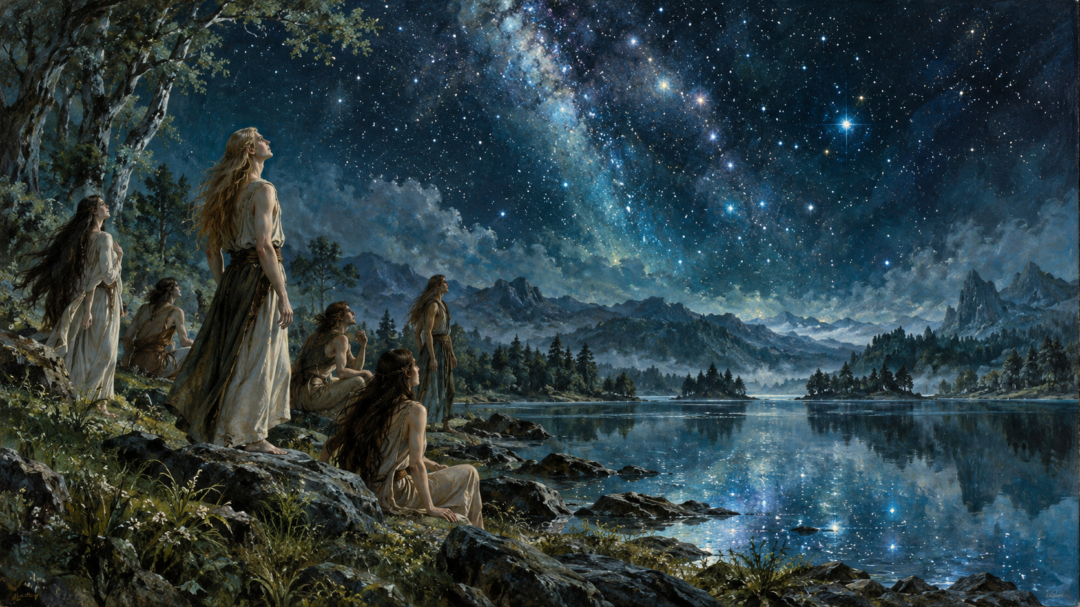
Before the Sun ever rose over Middle-earth, the Elves opened their eyes beside a silent lake and looked upon the stars.
Long afterward, when the first sunrise finally appeared, Men awakened in the distant East.
These two moments in The Silmarillion are separated by immense stretches of history, but their contrast is more than chronological. The Firstborn entered a world illuminated by starlight, while the Aftercomers began their lives beneath the first dawn.
Why should the two kindreds of Ilúvatar encounter such different skies?
The answer lies partly in the history of Arda, but also in the different relationships Elves and Men would develop with the world. One people would remain bound to its life until its end. The other would live briefly within it before passing beyond its known boundaries.
Their first encounters with light offer a powerful way of understanding that difference.
The Firstborn Awakened in a World Without Sunrise
In the published Silmarillion, the Elves awaken at Cuiviénen, the Water of Awakening, in the eastern regions of Middle-earth.
At that time, the Sun and Moon had not yet appeared.
The Two Trees illuminated Valinor in the distant West, but Middle-earth remained beneath the stars. Its lands were ancient, its waters already existed, and Melkor had long been active in the world.
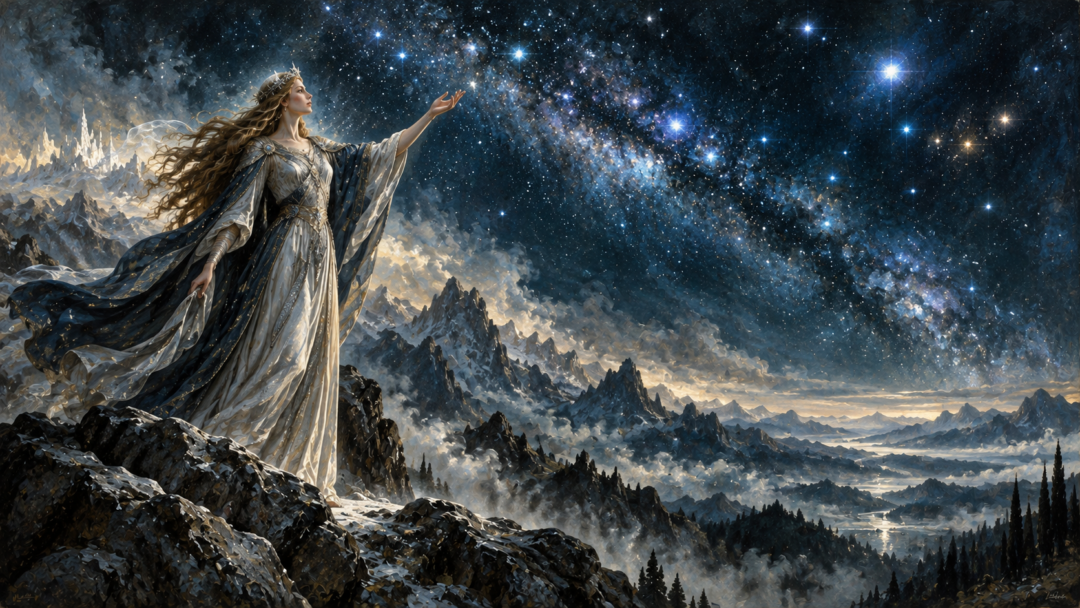
The awakening of the Elves occurred after Varda, Queen of the Stars, had undertaken a great labor of kindling and brightening the heavens.
Among the celestial lights associated with this moment were Menelmacar and Helluin.
Beside Cuiviénen, the Firstborn emerged from the sleep of Ilúvatar and beheld the stars.
The significance of this moment is explicitly established in The Silmarillion, in the chapter “Of the Coming of the Elves and the Captivity of Melkor.”
The Elves’ first sight of the heavens explains their enduring love of starlight and their particular reverence for Varda.
Their attachment to the stars was therefore not merely a cultural preference acquired over centuries.
It belonged to the earliest remembered moment of their existence.
Before they had kingdoms, written histories, or knowledge of the Valar, they had looked upward into the night.
Why the Stars Were Not Simply a Symbol of Darkness
It is tempting to imagine the awakening of the Elves as a scene of darkness awaiting the arrival of light.
But that interpretation misses an important distinction.
The darkness of the world before the Sun was not identical to the darkness associated with Morgoth.
Melkor had corrupted and damaged Arda, yet the stars themselves were works of beauty within the created world.
Varda’s lights offered wonder rather than terror.
This distinction matters because the Elves did not awaken into a world that was spiritually empty until daylight arrived.
They awakened beneath a heaven already filled with signs of beauty and order.
Their earliest experience was not the triumph of the Sun over night, but the discovery that the night itself could contain splendor.
This helps explain why starlight remains so important throughout Elven history.
Even after the Sun and Moon appear, the stars retain an emotional and spiritual significance that daylight never replaces.
For the Elves, the oldest light is not necessarily the brightest.
It is the light they first loved.
Varda and the Memory of the First Light
The Elves’ reverence for Varda provides one of the clearest connections between their awakening and their later culture.
Varda is called Elentári, the Queen of the Stars, and Elbereth in Sindarin.
Her name continues to carry extraordinary significance among the Elves of Middle-earth.
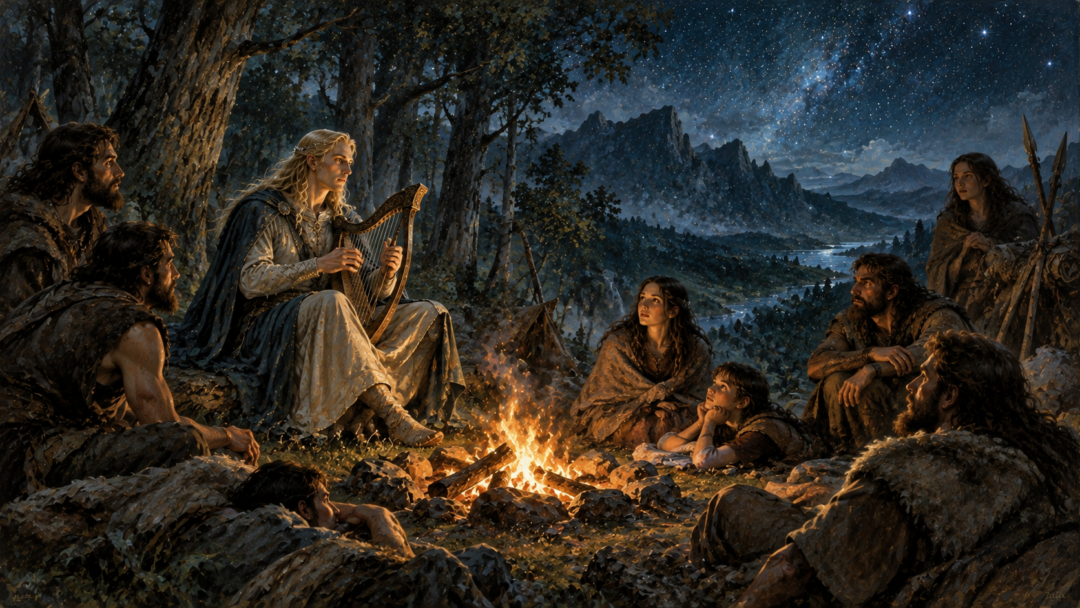
In The Fellowship of the Ring, Frodo encounters Elven singing beneath the stars, and the name of Elbereth appears repeatedly during his journey.
At Weathertop, Frodo cries out her name when confronted by the Nazgûl.
Later, in the darkness of Shelob’s lair, the invocation of Elbereth again becomes associated with resistance to evil.
These moments do not mean that the stars possess some automatic power over every darkness.
Rather, they demonstrate the continuing importance of Varda within the spiritual imagination of the Elves and those influenced by them.
The connection reaches back to Cuiviénen.
The first light the Elves beheld became associated with one of the greatest powers of the West.
What began as wonder endured as reverence, memory, and hope.
Men Awakened When the First Sun Rose
The awakening of Men presents a strikingly different image.
In the chapter “Of Men,” The Silmarillion places their beginning in Hildórien, in the eastern regions of Middle-earth.
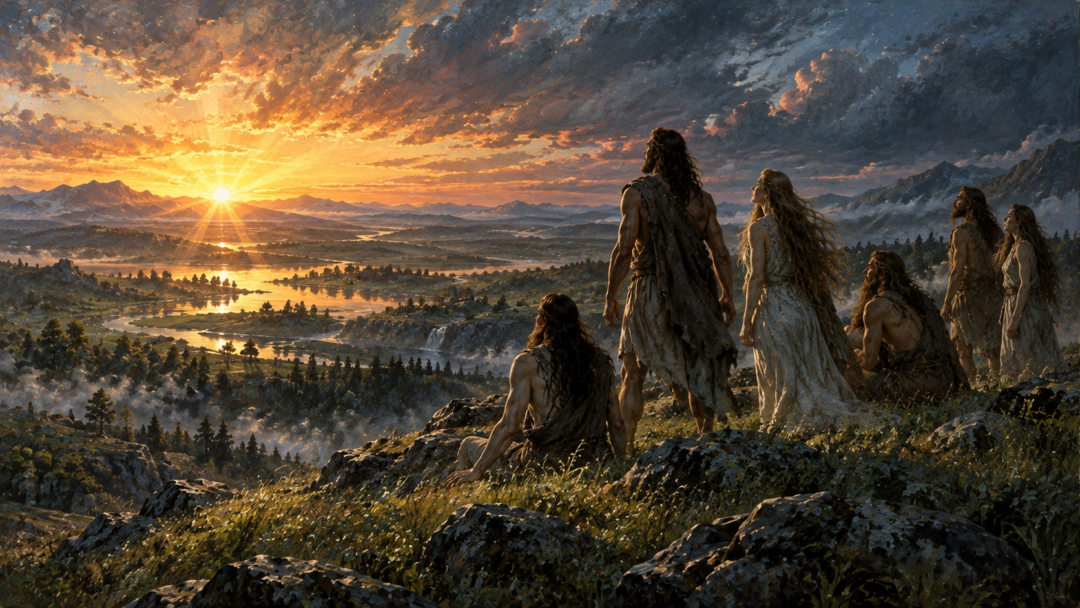
Their awakening coincides with the first rising of the Sun.
The Sun itself had emerged from the last fruit of Laurelin, the golden Tree of Valinor, after Morgoth and Ungoliant destroyed the Two Trees.
Its appearance transformed the visible world.
For the first time in this account, the lands of Middle-earth experienced sunlight.
The first sunrise was especially remarkable because the Sun initially rose in the West.
The newly awakened Men looked toward that light, and the narrative connects their westward orientation with their later wandering.
Their beginning was immediately associated with looking beyond the place where they stood.
Yet the published account does not establish that sunlight created their mortality or determined their nature.
Men were already intended to possess a fate different from that of the Elves.
The sunrise marks their entrance into the world; it does not manufacture the essential difference between the two kindreds.
Why Men Were Called the Children of the Sun
The Elves possessed several names for Men, reflecting both their understanding of the younger kindred and their uncertainty about them.
Among these were the Aftercomers, the Mortals, and the Children of the Sun.
The last name directly recalls the circumstances of their awakening.
The contrast with the Elves is deliberate within the published narrative.
The Firstborn remembered a world before the Sun.
Men entered a world in which its light had already begun to transform the lands.
The Elves had witnessed ages of history before the younger kindred appeared.
Men inherited a world already burdened with ancient conflicts, lost possibilities, and powers they scarcely understood.
This difference would shape their encounters.
When Men eventually reached Beleriand, they entered lands where Elven rulers had established kingdoms and fought against Morgoth for generations.
To the Elves, Men were newcomers.
To Men, the Elves could appear as beings possessing astonishing knowledge, beauty, and longevity.
The imagery of stars and sunrise therefore offers a useful symbolic contrast.
The Deeper Difference: Two Relationships with Time
The distinction between Elves and Men becomes more profound when their different fates are considered.
Both are Children of Ilúvatar.
Both possess freedom, dignity, and the capacity for good or evil.
But their relationships with Arda are not the same.
The Elves are bound to the life of the world.
Although they can be slain or die through grief and weariness, their spirits remain connected to Arda, and their ultimate destiny is tied to its existence.
Men possess the Gift of Ilúvatar: death.
Their spirits depart the world, and their final destination is not fully known to the Elves or the Valar.
In The Silmarillion, this difference is presented as part of Ilúvatar’s design rather than an accidental consequence of the Sun’s appearance.
The symbolic contrast between the two awakenings becomes especially meaningful here.
The stars suggest continuity across immense ages.
They shine above the changing kingdoms, forests, and peoples of Middle-earth.
Sunrise, by contrast, naturally evokes beginnings, movement, and the passage of days.
This does not establish a literal rule that Elves belong to night or Men belong to daylight.
It is a literary interpretation of two carefully distinguished beginnings.
Neither destiny is presented as simple superiority.
Both contain beauty, and both contain sorrow.
Why Immortality Became a Burden for the Elves
The Elves’ long existence allows them to preserve memories that would otherwise disappear.
But endurance also exposes them to repeated loss.
They witness forests diminish, kingdoms collapse, and beloved places change beyond recognition.
Their connection to the world is both a blessing and a source of grief.
This becomes especially visible in The Lord of the Rings.
Lothlórien appears almost untouched by ordinary time, yet its beauty cannot remain unchanged forever.
Galadriel understands that the destruction of the One Ring will also bring an end to the sustaining power of the Three Rings.
The passing of Elven realms becomes part of the victory over Sauron.
The Elves can resist domination, but they cannot preserve every beautiful thing indefinitely.
Seen in this context, the starlight of Cuiviénen becomes more than an image of beginnings.
It also represents a memory reaching backward across ages.
The Elves remember a world that Men never knew.
And eventually, they must accept that the world will continue changing without their great kingdoms.
Why Mortality Was Not a Punishment from the Sun
The association between Men and sunrise can easily lead to a mistaken conclusion: that the arrival of the Sun somehow made Men mortal.
The published mythology does not support this.
The mortality of Men belongs to their nature as the Secondborn.
Morgoth’s influence would later distort humanity’s understanding of death.
In traditions explored more fully in writings such as the Athrabeth Finrod ah Andreth, the relationship between death, fear, and the corruption of humanity becomes a difficult theological question.
Those writings introduce complications and perspectives that should not be flattened into a single explanation.
What remains clear is that the first sunrise should not be treated as the physical cause of human mortality.
Its significance in the published awakening story is narrative and symbolic.
Men arrive with a new light, but their deeper destiny comes from Ilúvatar.
Their lives are shorter than those of the Elves, yet their departure from the world also represents a freedom the Elves do not possess.
That difference is one of the great mysteries of Arda.
The Westward Journey Hidden in the First Sunrise
One of the most intriguing details in the awakening of Men is the direction of their first gaze.
The Sun rises in the West, and the opening eyes of Men are turned toward it.
Their later westward movement is associated with that beginning.
This creates a connection between the first human awakening and the journeys that eventually bring some Men into Beleriand.
The Edain, ancestors of the Númenóreans, come westward and enter the great struggles against Morgoth.
Yet the journey is not simply a straightforward pursuit of sunlight.
The histories of Men also involve fear, displacement, conflict, and the desire to escape the Shadow.
Their movement westward acquires different meanings in different generations.
For some, it becomes a search for safety.
For others, an encounter with the Eldar.
For the Edain, it eventually leads to friendship, sacrifice, and participation in the wars of the First Age.
The first sunrise does not explain every later human decision.
But it establishes a memorable beginning: humanity opens its eyes toward a light beyond its homeland.
Did Later Writings Change the Story?
The published Silmarillion presents a clear contrast between the starlit awakening of the Elves and the sunlit awakening of Men.
However, the wider legendarium contains alternative cosmological ideas.
In later writings collected in Morgoth’s Ring, particularly the material known as Myths Transformed, a different conception of Arda’s early history is explored.
These revisions consider a world in which the Sun existed from a much earlier period.
Related material published in The Nature of Middle-earth also explores alternative chronologies for the awakening of the Children of Ilúvatar.
Some of these conceptions place the awakening of Men earlier than the account familiar from the published Silmarillion.
They should not be silently combined with the traditional narrative.
A cosmology featuring an ancient Sun cannot be treated as identical in every detail to the account in which the Sun first appears after the destruction of the Two Trees.
The later materials demonstrate that the chronology and physical structure of Arda remained subjects of revision.
For the specific contrast between the two awakenings, the published Silmarillion remains the clearest narrative foundation.
Its imagery is powerful without requiring every later cosmological question to have a single settled answer.
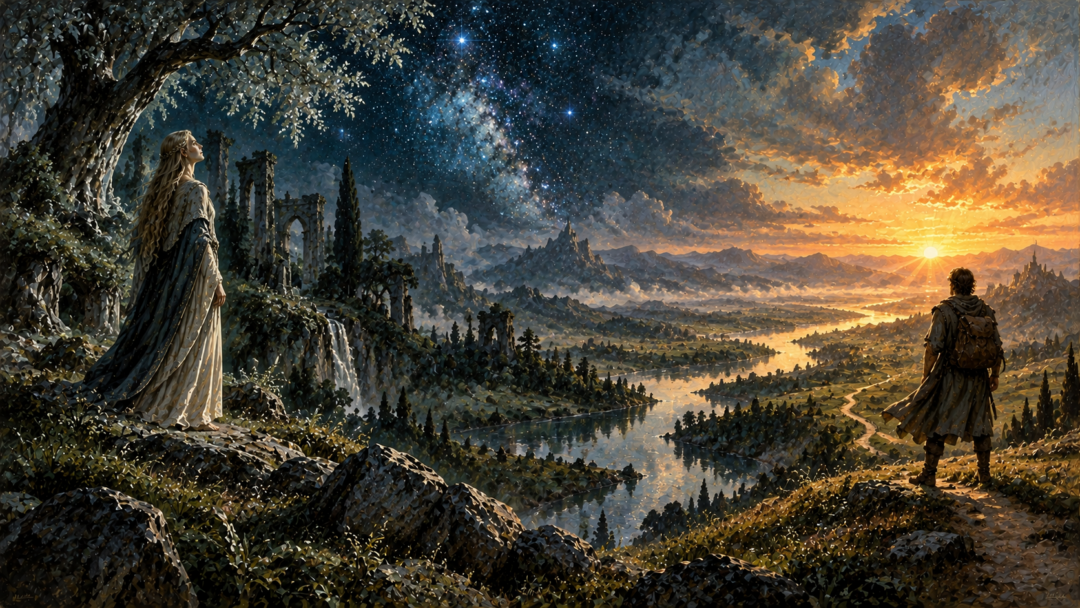
Two Beginnings, One World
The awakening of the Elves beneath the stars and the awakening of Men at sunrise are among the most beautiful contrasts in the early history of Middle-earth.
Both peoples enter the same created world.
Both encounter light before they understand the history surrounding them.
Yet the character of their beginnings differs.
The Elves first behold the stars, and that wonder becomes part of their enduring relationship with Varda, memory, and the ancient beauty of Arda.
Men awaken with the first sunrise, their eyes directed toward a distant light as their shorter and more uncertain history begins.
The distinction does not mean that Elves belong exclusively to the past or that Men possess some automatic right to the future.
Their histories are more complicated, and their destinies remain intertwined.
But the two images illuminate a fundamental difference.
The Elves are destined to remain within the world and experience its long changes.
Men are destined to pass beyond it.
At Cuiviénen, the Firstborn opened their eyes beneath lights that would accompany them through the ages.
At Hildórien, the Aftercomers opened theirs toward a new dawn.
One beginning suggests the wonder of enduring within the world.
The other suggests the mystery of eventually leaving it.
And together, they reveal that the deepest difference between Elves and Men was never simply how long they lived.
It was what their lives meant in relation to the world itself.
Sources & Notes
- Tolkien Gateway — Cuiviénen. https://tolkiengateway.net/wiki/Cuivi%C3%A9nen
- Tolkien Gateway — Hildórien. https://tolkiengateway.net/wiki/Hild%C3%B3rien
- Tolkien Gateway — Varda. https://tolkiengateway.net/wiki/Varda
Primary text: The Silmarillion, “Of the Coming of the Elves and the Captivity of Melkor,” “Of the Sun and Moon and the Hiding of Valinor,” and “Of Men.” This article follows the published Silmarillion chronology; its comparison of the two awakenings is interpretive, not a claim that all later cosmological drafts agree.