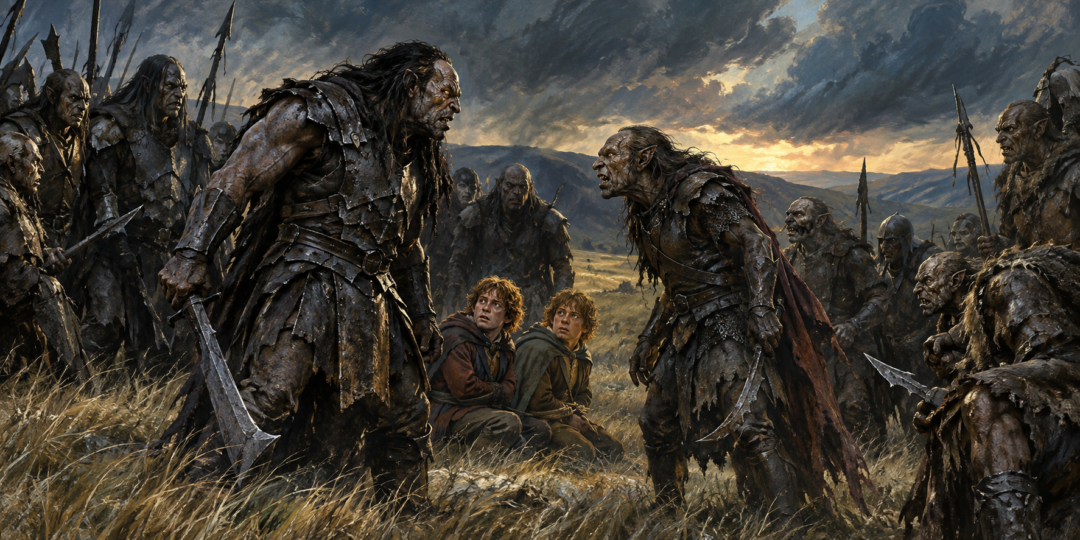
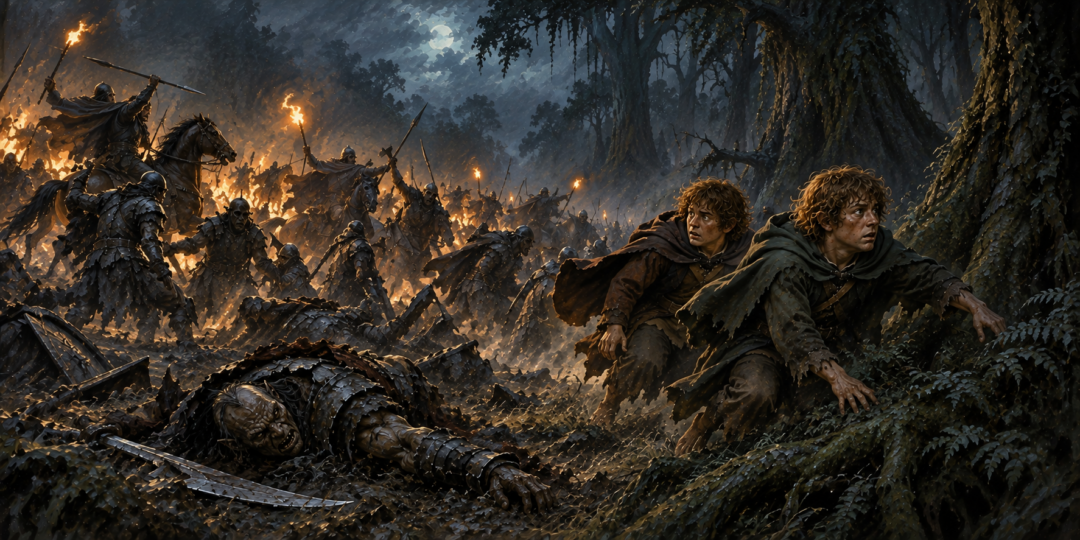
Merry and Pippin are prisoners of the Orcs, but their captors cannot agree on what should happen to them.
After the breaking of the Fellowship at Amon Hen, the two hobbits find themselves among enemies who seem, at first, to belong to one pursuing force. They are surrounded by armed Orcs, threatened with death, and driven across Rohan toward an uncertain fate.
Yet the danger is more complicated than it appears.
Some of their captors serve Saruman. Others answer to Mordor. A third group has come from the northern mountains seeking vengeance. All have fought against the Fellowship, but they have not come for the same reason.
Their disagreement is not merely about which road to take. It concerns who has authority over the prisoners, which master should receive them, and whether the captives should remain alive at all.
In The Two Towers, the chapter “The Uruk-hai” reveals something important about the armies of the Shadow: enemies can cooperate in violence without sharing a common purpose.
For Merry and Pippin, that division becomes both a deadly threat and an unexpected opportunity.
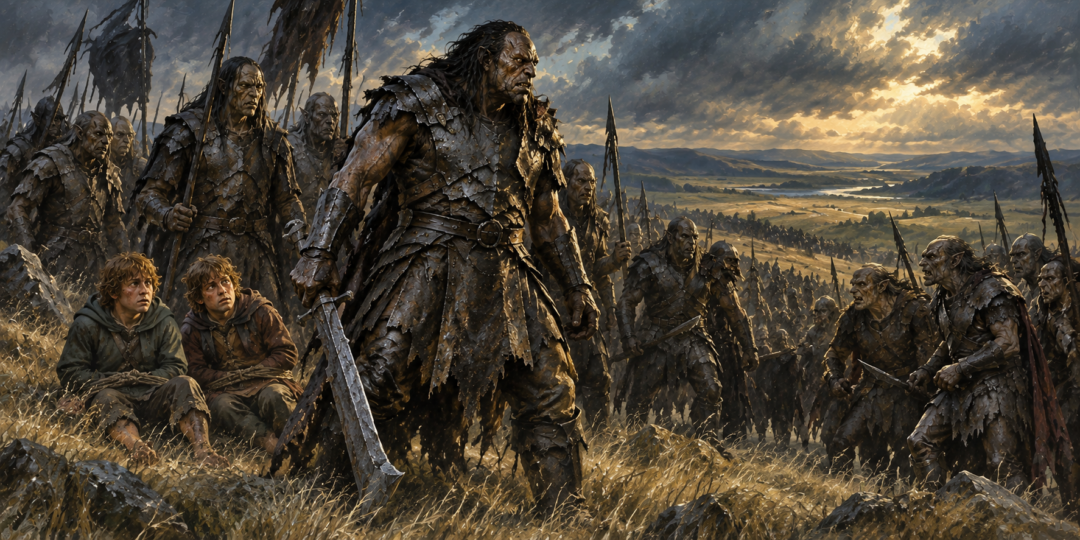
Three Orc Companies, Three Different Objectives
The Orcs involved in the capture of Merry and Pippin are not a single, unified military company.
The most powerful contingent consists of the Uruk-hai of Isengard, commanded by Uglúk. These Orcs serve Saruman and have orders concerning the hobbits.
A second contingent comes from Mordor and is represented by Grishnákh. His allegiance lies with Sauron, whose interests are not identical to Saruman’s.
The third group consists of northern Orcs from the Mines of Moria. Their participation is driven by a more immediate desire for revenge.
The distinction matters because the three groups disagree about the prisoners’ ultimate fate.
Uglúk intends to deliver the hobbits to Isengard. Grishnákh argues for taking them toward Mordor. The northern Orcs are chiefly interested in killing enemies and returning home.
These objectives cannot all be fulfilled.
The same two prisoners cannot be delivered independently to rival masters, while the northern Orcs’ desire for vengeance threatens the requirement that the captives survive.
Their temporary cooperation therefore rests on a contradiction.
They have fought together, but victory has left them competing over the meaning of their success.
Uglúk: The Commander Who Claims the Prisoners
Uglúk is the strongest immediate authority among the captors.
His position rests on the fighting strength of the Isengarders, their role in taking the prisoners, and his willingness to enforce orders through violence.
His instructions are specific.
The halflings are to be captured alive and brought to Isengard. They are not to be searched or robbed.
This last restriction is especially revealing.
The prisoners possess something potentially important to Saruman, but Uglúk’s orders do not require him to discover it. His responsibility is to deliver the captives without allowing his soldiers to interfere with whatever their master hopes to obtain.
This makes Uglúk a disciplined servant of Saruman’s interests, though not a merciful one.
He protects Merry and Pippin from certain dangers because they are valuable prisoners, not because he recognizes any obligation toward them.
His authority is repeatedly challenged.
When other Orcs question the destination, Uglúk insists that his company has earned the right to decide. He invokes the strength of the Uruk-hai and the authority of the White Hand.
The argument exposes the political character of the expedition.
Uglúk does not regard the Mordor Orcs as equal partners whose orders deserve accommodation. He treats the prisoners as a prize secured by his own company.
For him, cooperation means accepting Isengard’s command.
Grishnákh: A Servant of Mordor With Another Destination
Grishnákh represents the competing authority of Sauron.
He challenges the decision to take the hobbits westward and argues that they should be brought toward the Great River, where a winged Nazgûl could assist in delivering them to Mordor.
His proposal is not a minor adjustment to Uglúk’s plan.
It would transfer control of the captives from Saruman’s servants to Sauron’s.
The disagreement reflects a larger tension within the War of the Ring.
Saruman has entered into dealings with Mordor, but he is not content merely to serve Sauron. His pursuit of the One Ring is bound to his own desire for power.
The rival objectives of their Orcs expose that conflict at ground level.
Nevertheless, Grishnákh should not be treated as someone who possesses complete knowledge of his master’s designs.
The chapter establishes his allegiance and his insistence upon Mordor as the destination. It does not provide a full account of everything he has been told about the Ring.
His later behavior suggests that he knows, or strongly suspects, that the hobbits may possess an object of extraordinary importance.
That is different from knowing exactly where the Ring is, which hobbit carried it, or the full circumstances of the Fellowship.
Indeed, the two prisoners are not the Ring-bearer and his companion.
Frodo and Sam have already departed separately.
The Orcs are fighting over captives whose true significance they do not fully understand.
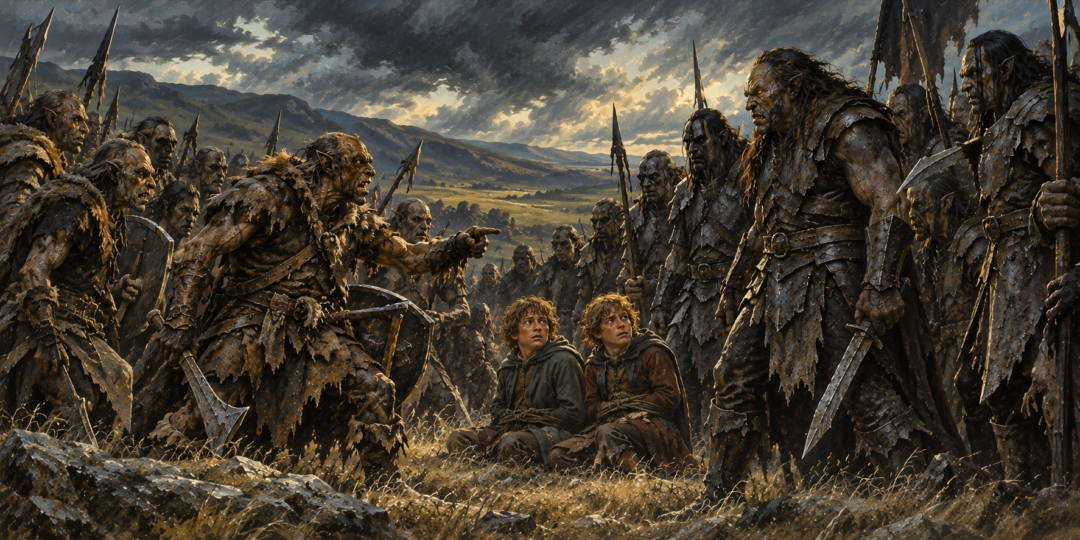
The Northern Orcs: Revenge Without a Shared Mission
The northern Orcs introduce a third and less ambitious objective.
They have come from the Mines of Moria seeking vengeance for their own people.
Unlike Uglúk and Grishnákh, their spokesman does not argue for delivering the hobbits to a distant master.
He wants to kill and return north.
This distinction is essential.
The northern Orcs are enemies of the Fellowship, but their immediate purpose is not necessarily the same as the purpose of the great powers directing the war.
Their grievance is local and personal.
The Fellowship passed through Moria, fought its way out, and left dead Orcs behind. The northern company now seeks repayment in blood.
Once the hobbits have been captured, however, the northerners’ aims become inconvenient to their allies.
Killing the prisoners would satisfy vengeance but destroy the prize demanded by Isengard and Mordor.
Their desire to return home also conflicts with Uglúk’s determination to continue toward Isengard.
As danger from the Rohirrim grows, the northern Orcs become increasingly concerned with their own survival.
Their willingness to remain with the larger company is therefore conditional.
They have joined a common attack, not committed themselves to an unquestioned chain of command.
Why the Orcs Do Not Simply Separate
Given these disagreements, why does the company remain together for so long?
The answer lies partly in power and partly in circumstances.
Uglúk possesses the stronger immediate position. He has the prisoners under his control and commands formidable Isengarders.
Grishnákh cannot simply declare that the hobbits belong to Mordor and expect Uglúk to obey.
The dispute becomes violent, and Grishnákh temporarily withdraws.
Yet the disagreement does not end there.
The Mordor Orcs subsequently rejoin the larger force, while the threat of pursuit makes separation increasingly dangerous.
The Rohirrim are approaching, and the Orcs must contend with an enemy capable of destroying them in open country.
This creates a practical reason to cooperate even when their purposes remain incompatible.
Their combined strength may improve their chances of surviving, but it cannot settle the question of who should ultimately possess the captives.
Uglúk’s leadership is consequently based on coercion and immediate necessity rather than genuine agreement.
Grishnákh continues to challenge him, while the northern Orcs remain anxious about the dangers ahead.
The apparent unity of the company is fragile because its underlying conflict has never been resolved.
Grishnákh’s Private Interest in the Hobbits
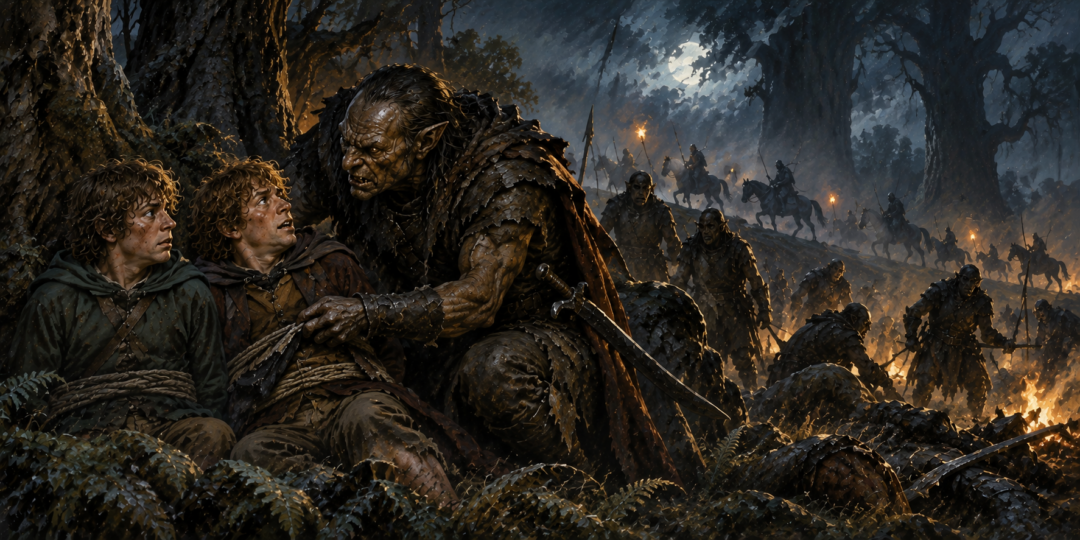
The most revealing development comes after the Orcs have been surrounded near Fangorn.
During the confusion, Grishnákh gets possession of Merry and Pippin.
He searches them, and Pippin begins to understand what the Mordor Orc may be seeking.
Pippin then takes an extraordinary risk.
He imitates Gollum’s manner of speaking and hints at something precious.
Grishnákh’s reaction strongly suggests that the suggestion has touched upon a subject he recognizes.
The exchange changes the immediate relationship between captor and prisoners.
Until this point, the conflict has largely concerned competing orders from distant masters.
Now Grishnákh appears personally interested in obtaining whatever the hobbits might possess.
Pippin attempts to exploit that interest by suggesting a bargain.
But Grishnákh does not simply release them.
Instead, he takes both hobbits away from the main company.
His conduct is consistent with an attempt to seize a valuable object for himself, although the text does not fully disclose his intended final use of it.
This uncertainty matters.
It would be too strong to claim that Grishnákh possesses complete knowledge of the One Ring or a fully developed plan to overthrow Sauron.
What the scene establishes is narrower and more compelling: he is willing to act secretly on his suspicions, departing from the collective handling of the prisoners.
The same Orc who argued for Mordor’s authority now behaves in a way that raises questions about his own private ambitions.
The Ring Creates Suspicion Even When It Is Absent
There is a bitter irony in Grishnákh’s attempted seizure.
Neither Merry nor Pippin possesses the One Ring.
Their value to the rival powers rests upon incomplete information.
Saruman’s forces have captured two halflings, but not the one carrying the object their master covets.
Grishnákh’s suspicions lead him to search prisoners who cannot provide what he seeks.
The Ring nevertheless influences events without being physically present.
Its importance shapes the orders given to the Orcs, the rivalry between their commanders, and the dangerous possibilities that Pippin recognizes.
One reading of the episode is that the Ring’s corrupting influence is reflected in the desire for possession surrounding it.
That interpretation should not be confused with direct evidence that Grishnákh has experienced the Ring’s supernatural influence.
He never handles it.
His behavior can also be understood through ordinary Orcish greed, ambition, fear, and suspicion.
The distinction strengthens the scene rather than weakening it.
The Shadow’s servants are already capable of betraying one another without needing the Ring itself to be present.
How the Rivalry Helps Merry and Pippin Escape
Grishnákh’s attempt to remove the hobbits from the main company creates a new danger.
He is stronger than either prisoner, and his intentions are threatening.
Yet his actions also separate Merry and Pippin from Uglúk’s organized guards.
The surrounding Rohirrim become decisive.
As Grishnákh attempts to carry the hobbits away, he is discovered and killed by the riders.
The hobbits survive and are able to escape into Fangorn Forest.
Their freedom is not simply the result of the Orc companies disagreeing.
The intervention of the Rohirrim, Pippin’s quick thinking, and the confusion of the fighting are all essential.
Nevertheless, the divisions among their captors help create the circumstances in which escape becomes possible.
Had every Orc accepted a single unquestioned objective, Grishnákh would have had less reason to seize the prisoners independently.
Instead, his private action breaks the control that Uglúk has struggled to maintain.
The coalition’s weakness becomes visible at the very moment when its members most urgently need to act together.
What the Quarrel Reveals About the Armies of the Shadow
The conflict between Uglúk, Grishnákh, and the northern Orcs offers a revealing contrast with the Fellowship.
The Fellowship also contains people from different lands, with different histories and loyalties.
Its members do not always agree.
But their cooperation is founded upon a shared undertaking that demands trust and sacrifice.
The Orc companies possess no comparable unity of purpose.
Their cooperation is sustained by orders, intimidation, immediate advantage, and fear of stronger enemies.
Even the authority of Sauron does not erase every competing ambition among those who serve the Shadow.
Saruman seeks power for himself. His soldiers insist upon his claims. Mordor’s servants resist them. The northern Orcs pursue vengeance and survival.
Each group can recognize the others as allies against a common enemy while remaining unwilling to surrender its own objectives.
This does not make the Orcs incapable of discipline or effective warfare. Uglúk demonstrates considerable authority and determination.
It does mean that their cooperation has limits.
When possession of something valuable becomes more important than obedience, those limits become dangerous.
Two Hobbits, Three Purposes, and One Broken Alliance
Merry and Pippin’s captivity is often remembered as a desperate journey toward Fangorn.
But the deeper drama lies in the argument surrounding them.
Uglúk wants to deliver valuable prisoners to Saruman.
Grishnákh wants Mordor to receive them, while his later actions suggest a more private interest.
The northern Orcs want vengeance and, increasingly, a way to survive and return home.
Their enemies are the same, but their intended rewards are not.
That is why the company can fight together without agreeing on what victory should mean.
The two hobbits become the center of a struggle between rival authorities, competing desires, and incomplete knowledge.
Ultimately, none of the three groups obtains the prisoners.
Uglúk’s company is destroyed. Grishnákh dies attempting to take the hobbits away. The northern Orcs gain neither the vengeance nor the safe return they sought.
Merry and Pippin escape into Fangorn, where their unexpected arrival will help set other events in motion.
The episode reveals a weakness within the Shadow that military strength alone cannot overcome.
The Orcs can agree upon whom they wish to capture, but they cannot agree upon who should possess the captives afterward.
And in that difference between a common enemy and a common purpose, two seemingly helpless hobbits find their chance of freedom.
Sources & Notes
- Tolkien Gateway — The Uruk-hai. https://tolkiengateway.net/wiki/The_Uruk-hai
- Tolkien Gateway — Uglúk. https://tolkiengateway.net/wiki/Ugl%C3%BAk
- Tolkien Gateway — Grishnákh. https://tolkiengateway.net/wiki/Grishn%C3%A1kh
Primary text: The Two Towers, Book III, “The Uruk-hai.” These reference pages document the rival captor companies and their commanders; the discussion of competing authority is interpretation of that episode.