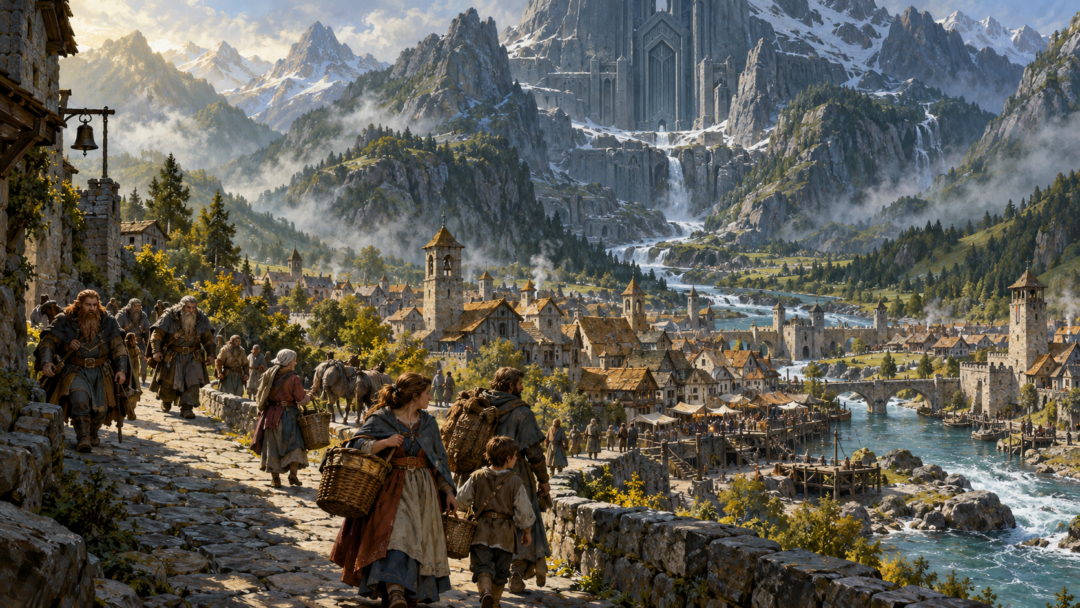
Before Smaug descended upon the Lonely Mountain, Dale stood beneath its southern slopes as one of the most fortunate towns in northern Middle-earth. Above it, the Dwarves of Erebor fashioned extraordinary objects from metal and precious materials. Below it, human communities lived beside the River Running and the Long Lake, connected to lands beyond the Mountain.
Yet the wealth of Erebor and the prosperity of Dale were not quite the same thing.
The Dwarves possessed remarkable craftsmanship, accumulated treasure, and a great underground kingdom. Dale possessed something different: a position between those skilled makers and the wider world that could use, admire, and exchange their work.
That geographical relationship helps explain why Dale became prosperous before Smaug destroyed both kingdoms.
The answer was not simply that a rich Dwarven kingdom happened to have a human town nearby. Dale stood at the meeting point of mountain industry, human settlement, and a river system reaching southward. Its location made it a natural place where the wealth created inside Erebor could become part of a broader regional economy.
Two Kingdoms, Two Different Sources of Strength
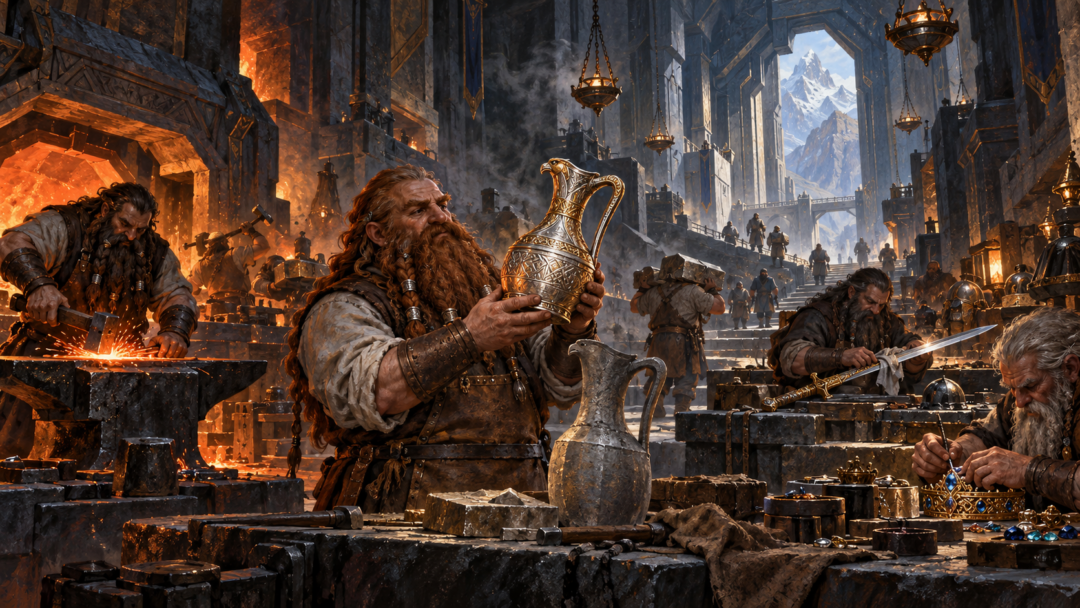
Erebor's prosperity rested upon skills that the Dwarves had developed over generations. Their people were renowned for working stone and metal, producing weapons, ornaments, and objects of exceptional quality.
Under Thrór, the Kingdom under the Mountain became wealthy and celebrated. In The Hobbit, Thorin's account of Erebor's earlier greatness describes not merely treasure stored away, but the Dwarves' productive abilities and their dealings with other peoples.
Thorin recalls that the Dwarves became wealthy, that other peoples rewarded their work, and that even the poorest among them had money to spend and lend. His recollection also connects the fortunes of the Dwarves with the growing prosperity of the neighbouring human town.
Dale, meanwhile, was not another underground workshop. It was a settlement of Men situated outside the Mountain, close enough to benefit directly from the presence of skilled Dwarven craftsmen.
Erebor concentrated specialised craft, materials, and accumulated wealth. Dale offered a neighbouring human population and access to the surrounding country.
The books do not provide a detailed account of Dale's occupations, workshops, or commercial institutions. Nevertheless, the relationship described in Thorin's memories strongly supports the conclusion that Dwarven production and human prosperity reinforced one another.
Why the Southern Side of Erebor Mattered
The Lonely Mountain stood apart from the larger mountain ranges of northern Middle-earth. Its southern face overlooked the country where Dale was situated, while the River Running emerged from the Mountain and flowed south toward the Long Lake.
This placed Dale close to both the Dwarven kingdom and a natural route into the surrounding region.
The proximity was significant. Dwarven craftsmen did not need to be imagined as travelling enormous distances simply to encounter human customers or neighbouring communities. The Men of Dale lived immediately below their kingdom.
A person seeking Dwarven metalwork could approach the Mountain through a settled human landscape rather than crossing a remote wilderness without a nearby centre of habitation.
Similarly, Dwarves dealing with the outside world had a human town at their doorstep.
The precise streets, markets, and commercial arrangements of ancient Dale are not described. We cannot identify particular trading squares or claim that every transaction passed through the town.
But its position created an obvious geographical advantage: it connected the enclosed productive world of Erebor with the open country beyond.
The River Running Connected Dale to a Larger World
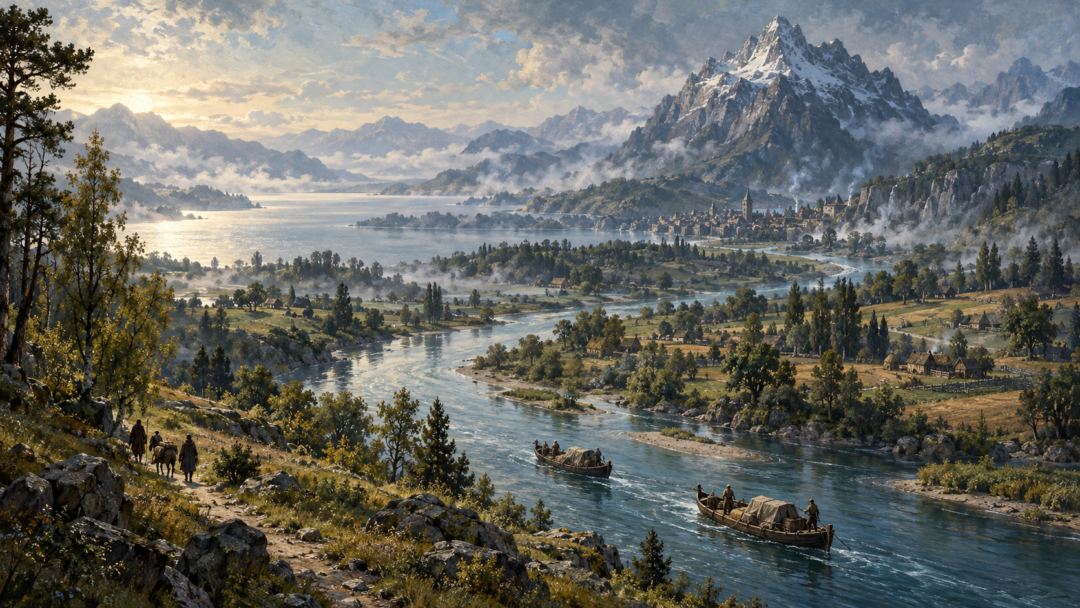
The River Running, also called the Celduin, is one of the most important geographical features in the history of Dale.
It flowed from the Lonely Mountain southward into the Long Lake and continued beyond it toward more distant lands.
The river therefore linked the immediate surroundings of Erebor to a much larger geographical system.
This mattered because Dale was not isolated at the foot of the Mountain. It stood near a watercourse leading toward other human settlements, most notably the community later known as Lake-town.
In The Hobbit, Lake-town is portrayed as a place with a strong trading tradition. Its inhabitants understand commerce, and the settlement maintains connections with peoples farther south.
That description belongs to the period after the destruction of old Dale, so it cannot be used as a precise record of how trade operated in Dale's greatest days.
It does, however, establish the wider geographical and commercial possibilities of the region.
The Long Lake was not a meaningless body of water at the end of an isolated valley. It formed part of a connected river landscape in which goods and people could move between communities.
It is reasonable to infer that Dale's proximity to this network strengthened its position as an outlet for Erebor's products.
Such an interpretation does not require imagining enormous fleets of merchant vessels or elaborate river ports for which no evidence survives.
Dale stood near the source of valuable craftsmanship, while the river led toward people living beyond the Mountain's immediate surroundings.
That combination gave Dwarven goods the possibility of reaching a wider world.
How Dwarven Craft Could Become Human Prosperity
The difference between producing wealth and spreading its benefits is easy to overlook.
Imagine an exceptional object fashioned in Erebor: a finely worked vessel, a piece of jewellery, or a weapon made with Dwarven skill.
Its creation required craftsmanship, tools, materials, and knowledge. The value of that work originated with its makers.
But the object's usefulness did not end inside the Mountain.
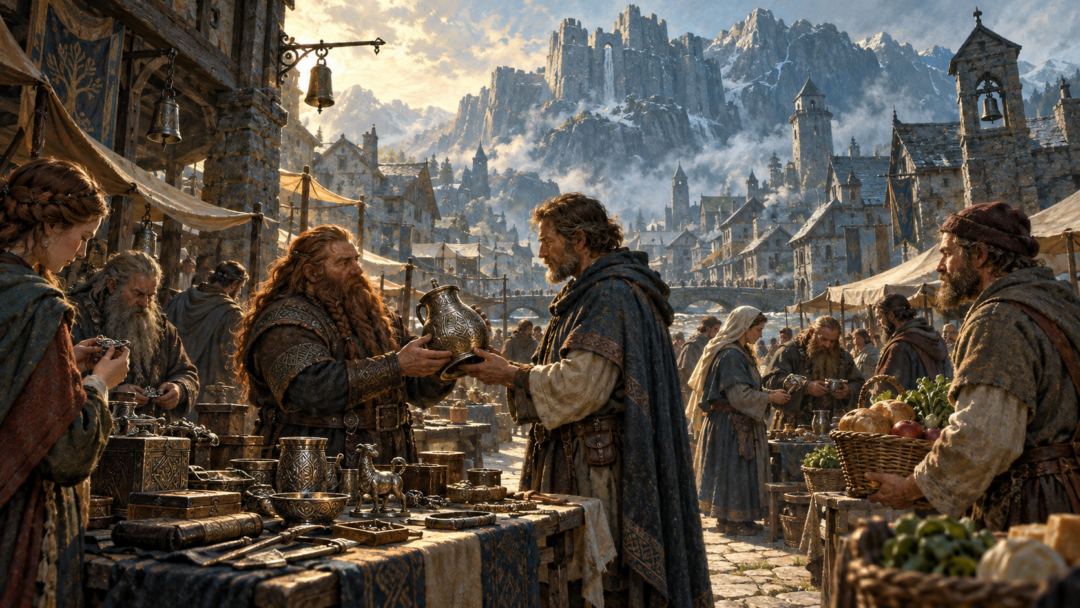
Someone outside Erebor might want to acquire it. A human household might treasure it. Another community might offer something in exchange.
The texts establish that Dwarven work attracted rewards and that Erebor had dealings with neighbouring peoples. They do not identify the exact commercial path of any particular object, so this example illustrates a plausible mechanism rather than a documented transaction.
Once exchange occurred, however, its effects could extend beyond the original craftsman.
A human trader who acquired a Dwarven object might exchange it again. A visitor attracted by Dwarven goods might also seek food, shelter, or other supplies from nearby inhabitants. Wealth received by the Dwarves could return to surrounding communities through further purchases.
These are economic possibilities consistent with the relationship described in The Hobbit, not a surviving ledger of Dale's business life.
What the narrative makes clear is the larger result: the prosperity of Erebor and that of Dale were closely associated.
The town occupied the human side of a valuable relationship. It was close enough to Erebor for its inhabitants to participate in the Dwarves' commercial world, while remaining connected to communities outside the Mountain.
Craftsmanship created desirable goods. Geography helped those goods become part of regional exchange.
What Smaug's Destruction Reveals About the Old Prosperity
When Smaug attacked the Lonely Mountain, he did more than seize a treasure hoard.
His coming brought disaster to the neighbouring human kingdom as well.
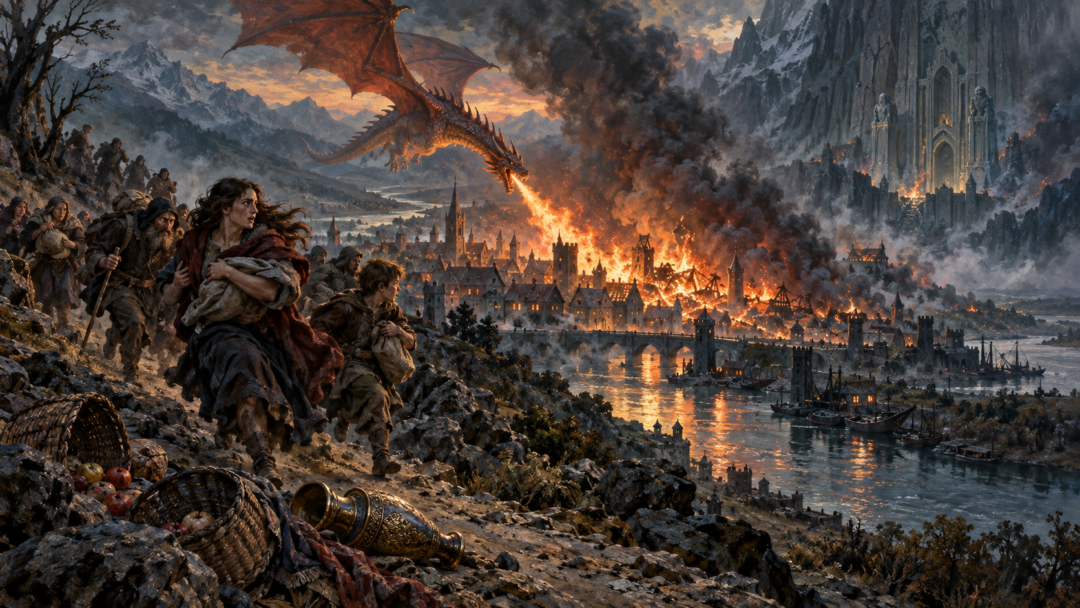
In The Hobbit, the destruction of Dale is remembered alongside the ruin of Erebor's former greatness. The dragon's occupation of the Mountain ended the old relationship between the Dwarves and the surrounding human world.
Dale was not simply a distant town that happened to suffer from a dragon's violence. It stood directly beneath the kingdom whose wealth had helped sustain the prosperity of the region.
When the Mountain ceased to be an active centre of Dwarven craftsmanship and exchange, the conditions that had supported Dale's earlier flourishing disappeared.
The dragon could possess the treasure of Erebor, but possession was not the same as productive prosperity.
Gold and crafted objects remained beneath the Mountain, yet the living system of makers, neighbours, and exchange had been shattered.
The wealth still existed as a hoard. Its earlier ability to support communities had been interrupted.
This is not to suggest that all of Dale's prosperity depended upon a single source, or that the town possessed no independent economic life.
The books do not give us enough information to make either claim.
But the contrast is powerful: under the Dwarves, Erebor's wealth was associated with craftsmanship and flourishing neighbours. Under Smaug, the Mountain became a place of guarded treasure and desolation.
Dale's True Advantage Was Being Between Worlds
Dale's prosperity before Smaug was rooted in a fortunate combination of geography and human activity.
The town stood beneath a Mountain whose Dwarven inhabitants produced objects of exceptional quality. It occupied the neighbouring human landscape, close to the River Running and the route toward the Long Lake. And it belonged to a region where communities could exchange goods and maintain connections beyond their immediate homes.
No surviving account gives us a complete economic history of old Dale.
There are no reliable figures for its trade, no description of a customs system, and no evidence that every Dwarven treasure passed through its hands.
Erebor was a centre of specialised production. Dale was a nearby human settlement ideally placed to connect with that production. The river country opened the possibility of wider exchange.
Together, those circumstances help explain why Dwarven craftsmanship could contribute to prosperity beyond the halls where it was created.
The deeper lesson of Dale is that wealth becomes something more consequential when it moves between communities.
A master craftsman may create a beautiful object in a hidden chamber. A kingdom may accumulate treasure behind stone gates. But the benefits of that work can spread only when there are people willing and able to exchange with its makers.
Its greatest geographical gift was not gold beneath its streets, nor the skill of its own inhabitants alone.
It was standing between the wealth of the Mountain and the wider world that could share in it.
Sources & Notes
- Tolkien Gateway — Dale. https://tolkiengateway.net/wiki/Dale
- Tolkien Gateway — Lonely Mountain (Erebor). https://tolkiengateway.net/wiki/Lonely_Mountain
- Tolkien Gateway — River Running (Celduin). https://tolkiengateway.net/wiki/River_Running
- Tolkien Gateway — Long Lake. https://tolkiengateway.net/wiki/Long_Lake
- Tolkien Gateway — Lake-town (Esgaroth). https://tolkiengateway.net/wiki/Esgaroth
- Tolkien Gateway — Thrór. https://tolkiengateway.net/wiki/Thr%C3%B3r
- Tolkien Gateway — Smaug. https://tolkiengateway.net/wiki/Smaug
- The Encyclopedia of Arda — Dale. https://www.encyclopedia-of-arda.com/d/dale.html
- The Encyclopedia of Arda — River Celduin. https://www.encyclopedia-of-arda.com/c/celduin.html
Primary text: The Hobbit — Thorin's account of the former greatness of the Kingdom under the Mountain and of the neighbouring town of Dale before Smaug's descent, and the later chapters describing Lake-town's trading character. Tolkien Gateway's Dale entry carries the geographical detail the article rests on: Dale as the valley between the south-western and south-eastern arms of the Lonely Mountain, with the town set near the southern end of that valley within the great eastward loop of the River Running on its western side; the river springing from beneath the Mountain and issuing from the Front Gate to fall into the valley; the old road running from the Front Gate along the eastern bank down into the valley and east toward the Iron Hills, with a branch west to a bridge. The same entry states that Dale 'was known as a merry town that traded, mainly in food-supplies, for the skills and craft-pieces of the Dwarves', that fathers from Dale paid handsome amounts to apprentice their sons to the Dwarves, and that trade flowed up and down the River Running to and from Lake-town on the Long Lake and beyond — precisely the maker/neighbour/exchange relationship the article argues. Tolkien Gateway's Lonely Mountain entry supplies the Dwarven side: a great solitary mountain in the north-east of Rhovanion and the source of the River Running, housing the Kingdom under the Mountain, which 'became a centre of trade and craftsmanship, maintaining close ties with the neighbouring Men city of Dale' and reached its height under King Thrór, whose wealth drew Smaug. Its Thrór entry records the re-establishment of the Kingdom under the Mountain in T.A. 2590 and the prosperity of his reign, and its Smaug entry confirms that the dragon attacked the Lonely Mountain and the town of Dale in T.A. 2770 and drove Thrór's people into exile. Tolkien Gateway's River Running (Celduin) entry fixes the wider exchange route: a river some 600 miles long pouring out of the Front Gate, descending over two falls and swirling around Dale, turning west beyond Ravenhill and then east and south to the Long Lake, and continuing through the eastern outskirts of Mirkwood to the inland Sea of Rhûn, with the Forest River as a tributary of the Long Lake. Its Long Lake entry records that Lake-town, 'home of the trading people of the Lake-men', grew up near the inflow of the River Running only after the founding of the Kingdom under the Mountain and the city of Dale — the sequence the article insists on — and its Lake-town (Esgaroth) entry describes the town built on wooden pillars over the lake, with its market-place, quays and bridge. The Encyclopedia of Arda corroborates the frame independently: its Dale entry places the town in the valley of the Running River on the southern side of the Lonely Mountain, dates it to soon after the refounding of Erebor in III 2590, its destruction by Smaug in III 2770 and its rebuilding by Bard in III 2941–2944, and notes that Dale's power later extended east and south of the Mountain; its River Celduin entry gives the Elvish name for the river Men called the River Running, rising at the gates of Erebor and flowing to the Sea of Rhûn. Caveats honoured rather than smoothed over: no source gives figures for Dale's trade in its greatest days, describes a customs system or identifies river ports, so the article's mechanism is offered as inference consistent with the texts rather than as documented transactions; the statement that Dale traded mainly in food-supplies for Dwarven craft-pieces is a general characterisation, not a ledger for any particular object; Lake-town's trading character belongs to the period after old Dale's destruction and is used only to establish the wider commercial possibilities of the region; the town's foundation is not dated beyond settlement after the re-establishment of the Kingdom under the Mountain in T.A. 2590 and its sack in T.A. 2770; and nothing from the film adaptations or The Lord of the Rings Online is treated as canon — the article's reading of geography as Dale's true advantage is marked as interpretation.