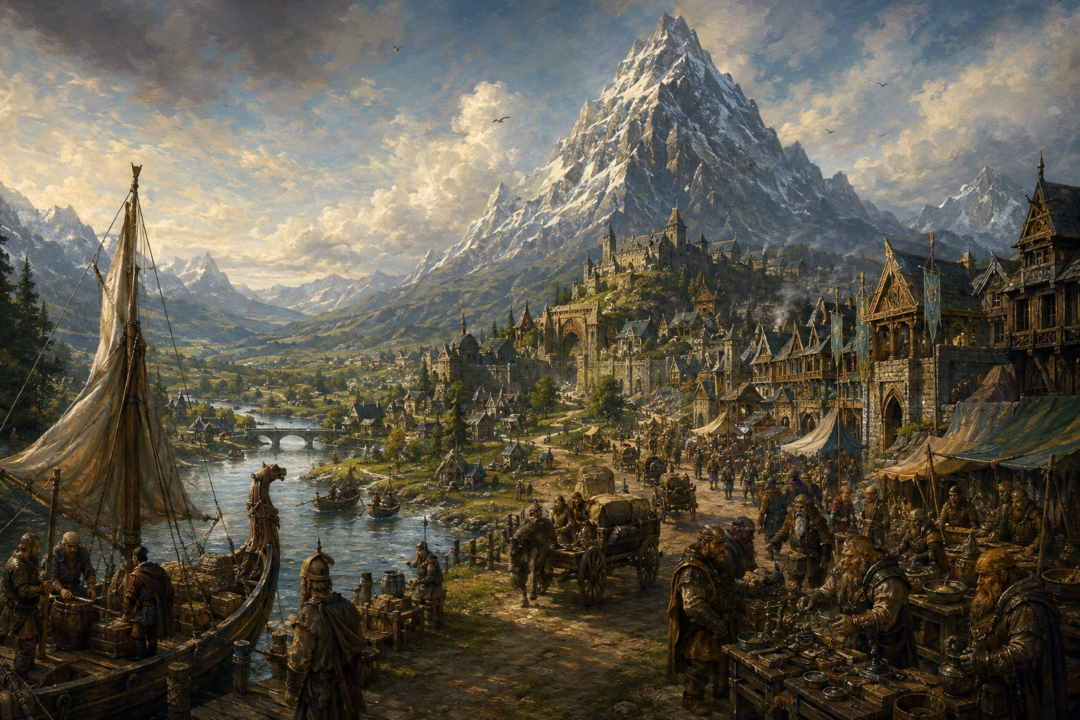
When Bilbo first reached Lake-town, the Lonely Mountain was still occupied by Smaug. Dale was a ruin. Erebor’s halls were silent except for a dragon sleeping on stolen wealth. Yet one thing had never entirely died: the movement of goods along the waterways of the North.
Lake-town still lived by trade coming up the great river from the South. The Forest River still linked the Wood-elves to the Long Lake. Men still remembered, however dimly, that when Dale had prospered beneath the Mountain, their own settlement had once been richer and more powerful.
That detail changes the meaning of Erebor’s restoration.
The recovery of the Mountain was not simply the return of a Dwarven kingdom or the reopening of mines and workshops. Once Smaug was gone, the political and economic blockage at the northern end of the River Running disappeared. Dale returned. Lake-town expanded its commerce. Men arrived from beyond the immediate region. Dwarves, Men, and Elves entered a period of friendship.
Erebor became wealthy again, but its importance was larger than the treasure stored beneath its stone. It restored one of northern Middle-earth’s great networks of exchange.
Erebor Had Always Depended on the World Outside
The old Kingdom under the Mountain had immense mineral wealth and extraordinary craftsmanship, but it was never economically isolated.
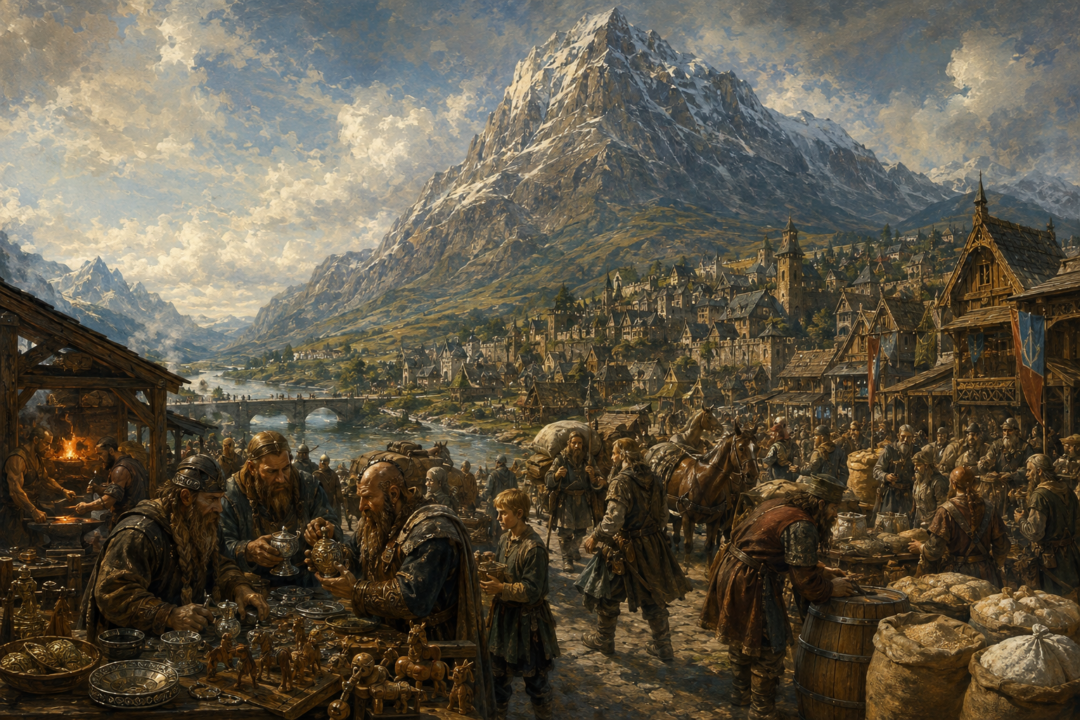
Thorin’s own account of the kingdom before Smaug makes this unusually clear. The Dwarves mined, worked metal, made armour, jewels, carvings, cups, and remarkable toys. Kings sought their smiths. Men paid to have their sons apprenticed to Dwarven craftsmen. Yet Thorin also admits that his people did not trouble themselves greatly with producing their own food. Food-supplies were among the things outsiders provided in exchange for Dwarven skill. hugi.is
That creates an important distinction.
Erebor possessed treasure, but treasure alone could not sustain Erebor.
Its prosperity depended on specialization. The Dwarves produced things that surrounding peoples valued; surrounding peoples supplied things the Dwarves required. Dale became the immediate human partner in that system, growing beneath the Mountain during the prosperous reign of Thrór.
The famous toy-market of Dale therefore represented more than local colour. It was evidence of an economy in which Dwarven craft passed outward through a human settlement while food, money, labour, and other goods moved back toward the Mountain.
The wealth beneath Erebor mattered because there was a living world around Erebor able to exchange with it.
Dale Was the Missing Link
Dale stood immediately south of the Mountain beside the River Running. Before Smaug, it shared directly in Erebor’s prosperity. The text describes Men spreading northward along the river until they established the town beneath the Mountain, where Dwarven craftsmanship and human commerce became closely connected.
This explains why Smaug’s attack was economically devastating far beyond the chambers he seized.
The dragon did not merely remove the Dwarves from their mines. He destroyed Dale as a functioning settlement.
The northern anchor of the entire system vanished.
Lake-town survived farther south, but when Bilbo arrived there its inhabitants were living beneath the shadow of a diminished past. They still benefited from trade coming northward from the South, yet the narrative specifically contrasts their condition with the greater wealth and power they had possessed when Dale was prosperous. Old remains of a larger settlement could still be seen when the lake waters were low. studylib.net
In other words, commerce continued after Smaug.
What disappeared was one of its most important destinations.
A dragon sitting on Erebor’s hoard had effectively removed a major producer, consumer, and political centre from the economy of northern Rhovanion.
The River Running Was the Real Artery
The geography is crucial.
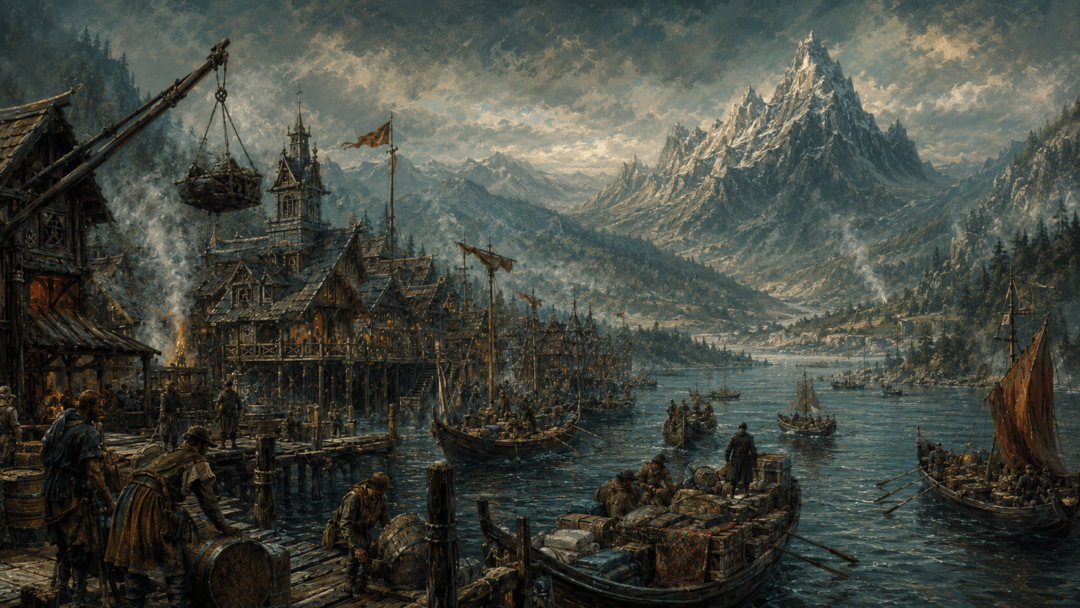
The River Running flowed from the Front Gate of Erebor through Dale and south into the Long Lake. From the southern end of the lake, the combined waters continued onward toward lands farther south. The Forest River entered the lake from the west, connecting the region with the Woodland Realm.
The waterways therefore joined several different societies.
Even while Smaug lived, Bilbo overheard discussion among the Wood-elves about trade on the rivers and about increasing river traffic. The roads from the East toward Mirkwood had declined, making the waterways increasingly significant. ae-lib.org.ua
Lake-town occupied a strategic position inside that system.
Goods arriving from the South could move toward the Long Lake. The Wood-elves had access through the Forest River. Dale and Erebor stood at the northern end of the River Running. Roads also connected the Mountain toward the Iron Hills, where Dáin’s people lived.
The texts do not provide anything like a complete commercial map, so it would be too strong to claim a formally organized international trading system with known routes and institutions.
But the pattern is unmistakable: Erebor belonged to an interconnected regional economy rather than an isolated mountain kingdom.
Smaug Did Not Merely Steal Wealth — He Froze It
This is one of the great ironies of Smaug’s hoard.
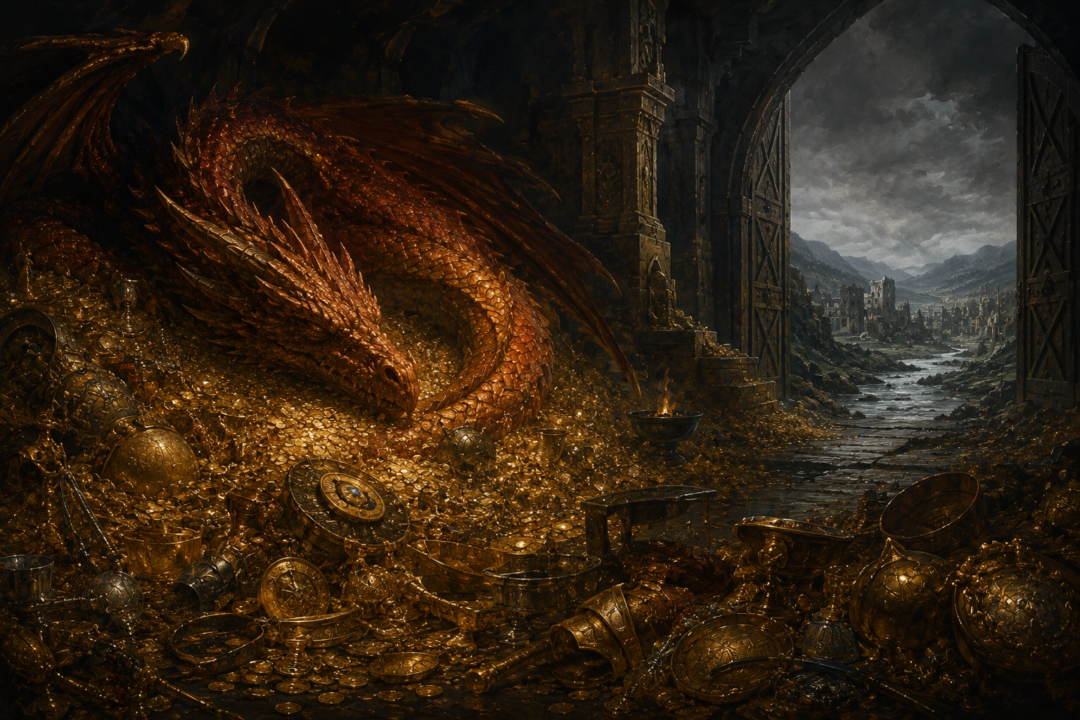
The dragon possessed enormous riches, yet he did almost nothing economically productive with them.
Gold that had once passed between smiths, merchants, kings, craftsmen, farmers, and townspeople lay beneath him in the dark.
The contrast becomes especially powerful because The Hobbit repeatedly distinguishes treasure from useful prosperity. Smaug guards wealth obsessively, but the lands around him are diminished. Dale is dead. Erebor produces nothing. Lake-town survives, but remembers a richer age.
Once Smaug dies, the same treasure immediately begins moving again.
Bard claims a share both because of the destruction suffered by the Lake-men and because part of the wealth of Dale had entered Smaug’s hoard long before. After the Battle of Five Armies, treasure is distributed among the surviving parties, and reconstruction begins.
Not all wealth produces prosperity simply by existing.
In the dragon’s possession, the treasure is accumulation without exchange. Once released, part of it becomes reconstruction, compensation, alliance, and renewed commerce.
That difference is central to what happens next.
The Rebuilding of Dale Changed Everything
Three years after the Battle of Five Armies, Bilbo receives news from Balin about the lands around the Mountain.
The transformation is extraordinary.
Bard has rebuilt Dale. Men have gathered to him not only from the Long Lake but from the South and West. The valley is cultivated again and has become rich. Lake-town has been rebuilt and is described as more prosperous than before. Most significantly, wealth is once again moving extensively along the River Running. Paperzz
That is larger than an Erebor recovery.
It is regional recovery.
Dale supplies a restored human kingdom at the Mountain’s doorstep. Lake-town profits from intensified river commerce. Erebor again possesses craftsmen, wealth, and demand for outside supplies. The Wood-elves are no longer part of a hostile confrontation over the Mountain. The final report emphasizes friendship among Elves, Dwarves, and Men. Paperzz
The Battle of Five Armies had temporarily brought those peoples together against a common enemy. What followed was more enduring: cooperation became commercially and politically useful.
The restored Mountain created demand.
Dale created population and production around it.
Lake-town moved goods.
The rivers connected them to peoples beyond the immediate valley.
Dale Eventually Became a Kingdom Far Larger Than the Old Town
By the time of the War of the Ring, the consequences were no longer merely commercial.
Glóin tells Frodo at Rivendell that the Bardings are exceptionally friendly toward the Dwarves and that Brand, Bard’s grandson, rules a realm extending far south and east of Esgaroth. The exact borders are not given, so their extent should not be reconstructed too confidently. But Dale had plainly become more than a rebuilt town beneath Erebor. Imgur
This growth matters because it shows that the post-Smaug settlement endured for generations.
Dwarven Erebor and the Mannish kingdom of Dale developed beside one another rather than competing for the same political identity. Their alliance became strong enough that during the War of the Ring they fought together against Sauron’s eastern allies.
King Brand of Dale and King Dáin Ironfoot both fell in the Battle of Dale. Their peoples then withdrew together into Erebor and resisted siege until Sauron’s downfall changed the wider war.
The commercial partnership restored after Smaug had, by the end of the Third Age, become a strategic partnership.
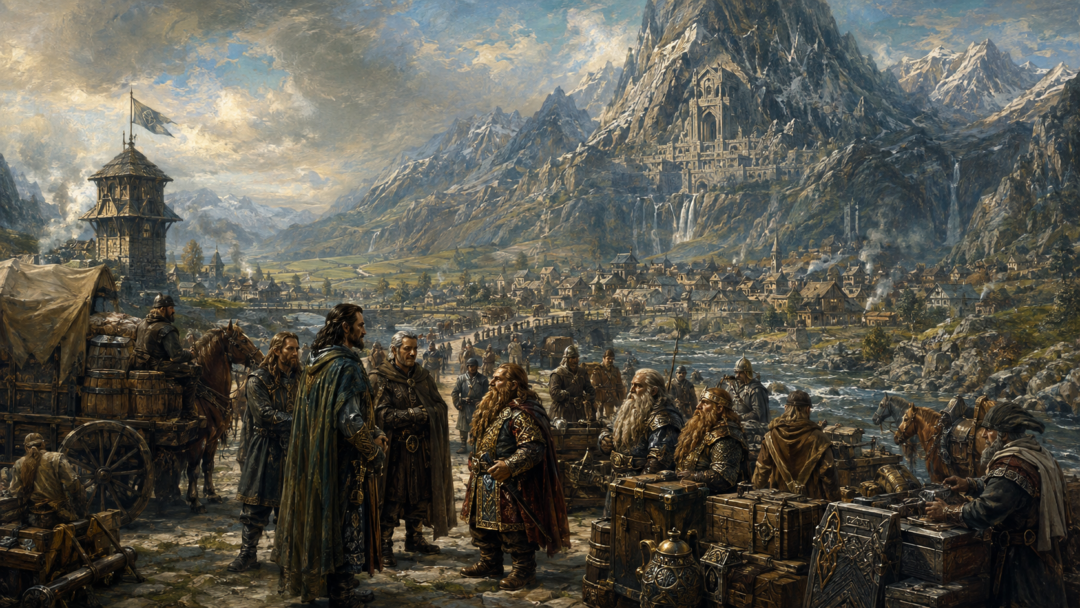
The Mountain Was Valuable Because the Roads and Rivers Led Away From It
It is easy to imagine Erebor’s restoration as the recovery of a treasure chamber.
The texts suggest something much more interesting.
The Mountain mattered because it drew people toward it.
Craftsmen worked there. Men rebuilt beside it. Farmers cultivated the valley. Merchants carried wealth along the river. Lake-town prospered again. People came from South and West. Friendship replaced part of the old mistrust between neighbouring peoples.
Even before Smaug, Erebor’s richest period had depended on exchange with those beyond its gates. After Smaug, the same principle returned on a larger and more visible scale.
The gold did not need to flow literally in rivers for the old songs to come true.
The real fulfilment was that wealth began moving again.
Smaug had possessed almost everything beneath the Mountain and made the surrounding land poorer. Dáin, Bard, and their neighbours possessed less individually, but rebuilt something the dragon never could: a network in which prosperity spread beyond the hoard itself.
Erebor was restored beneath the Mountain.
Its consequences travelled down the River Running.
Sources & Notes
- The Encyclopedia of Arda — Erebor: the Kingdom under the Mountain before Smaug and after its restoration — https://www.glyphweb.com/arda/e/erebor.php
- The Encyclopedia of Arda — Dale: the human city whose prosperity was tied to Dwarven craft and restored under Bard — https://www.glyphweb.com/arda/d/dale.php
- The Encyclopedia of Arda — Esgaroth: Lake-town’s commercial position and trade with Elves and lands to the south — https://www.glyphweb.com/arda/e/esgaroth.php
- The Encyclopedia of Arda — River Running: the waterway linking Erebor and Dale to Long Lake and the wider East — https://www.glyphweb.com/arda/r/running.php
- The Encyclopedia of Arda — Forest River: the route connecting the Woodland Realm with Long Lake — https://www.glyphweb.com/arda/f/forestriver.php
- The Encyclopedia of Arda — Long Lake: the junction of the Forest River, River Running, and Lake-town — https://www.glyphweb.com/arda/l/longlake.php
Background references for Erebor and Dale’s restored prosperity and the river network linking Dwarves, Men, and Wood-elves. Primary narratives: J.R.R. Tolkien, The Hobbit; The Lord of the Rings, Appendix B.