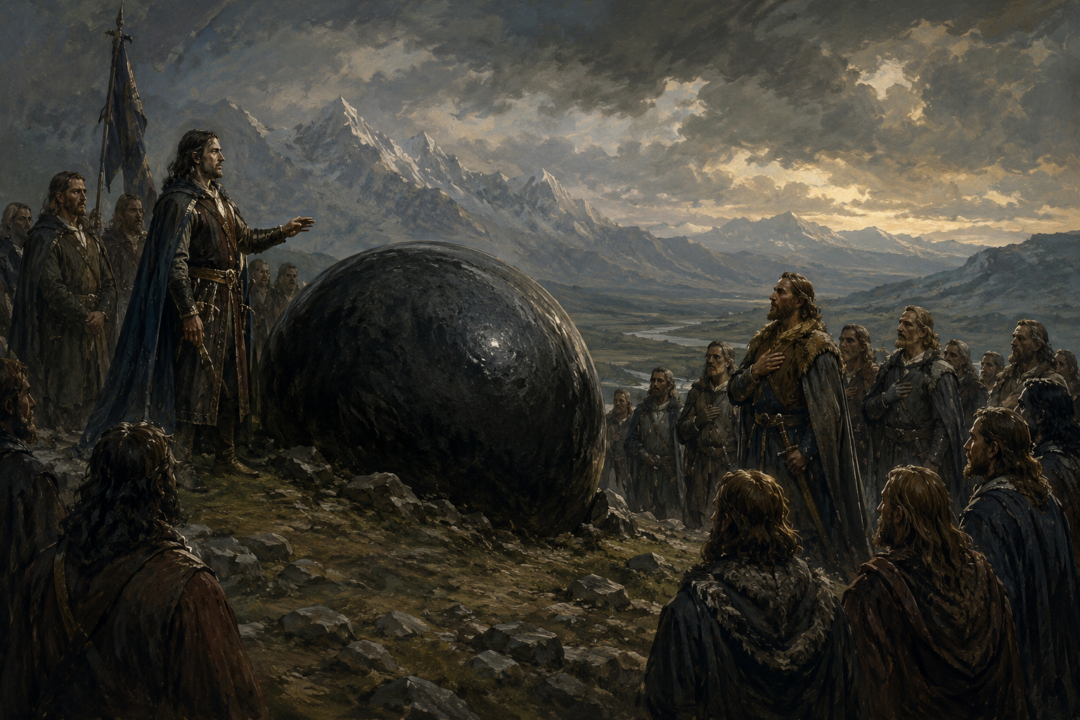
When Aragorn reaches the Stone of Erech, the object itself does almost nothing.
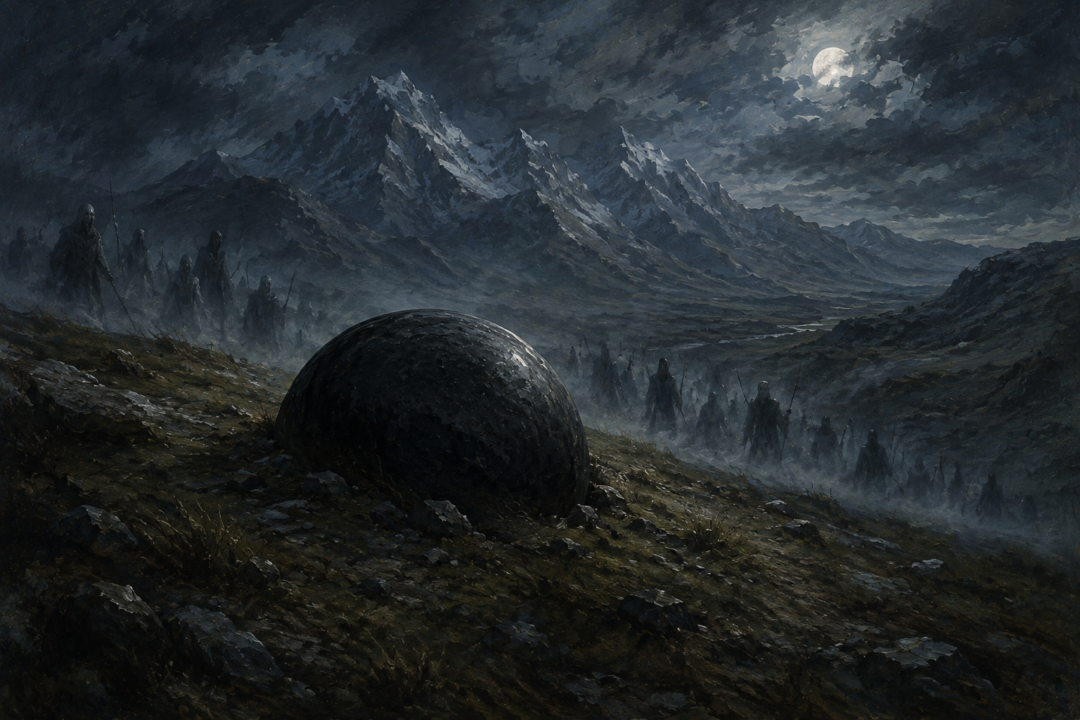
It does not speak. It does not blaze with power. No weapon is drawn from it, and no hidden door opens. It is simply an enormous black stone, half-buried on a lonely hill, carried long ago from Númenor and set there by Isildur.
Yet one of the oldest debts in Middle-earth is brought to judgment beside it.
That makes the Stone of Erech easy to misunderstand. Its importance is not exhausted when the Dead fulfill their oath and are released at Pelargir. The Stone remains significant because it marks something larger than a haunted meeting place. It connects the downfall of Númenor, the founding authority of Gondor, the failure of the Men of the Mountains, and Aragorn's eventual restoration of the kingship.
The ghosts disappear. The meaning of the Stone does not.
A Black Stone Carried Out of a Lost World
In The Return of the King, Aragorn explains that the black Stone at Erech was said to have been brought from Númenor by Isildur. He set it upon a hill in the early days of Gondor, and there the King of the Mountains swore allegiance to him.
Its Númenórean origin matters.
Númenor itself was destroyed at the end of the Second Age. Elendil and his sons escaped the catastrophe and founded the Realms in Exile in Middle-earth. The Stone therefore belongs to the same broad historical movement as Gondor itself: something carried out of a fallen civilization and planted in a new land.
It is not described as one of the palantíri, nor does the narrative attribute to it the powers of those Seeing-stones. Its function at Erech is different. It is associated with meeting, allegiance, and oath.
That distinction is important. The Stone does not need to possess an obvious supernatural mechanism to matter. It is the physical place at which a political and moral promise was made.
And unlike almost everyone who originally stood around it, the Stone survives.
The Oath Was About Sauron
The haunting of the Men of the Mountains began with a specific betrayal.
Their king had sworn allegiance to Isildur. When Sauron returned and Isildur summoned these Men to fight, they refused. Aragorn explains that they had worshipped Sauron during the Dark Years.
Isildur then pronounced their doom: they would have no rest until their oath was fulfilled, and they would be summoned again before the war against Sauron finally ended.
This makes the Stone of Erech more than the location of a broken promise. It marks a choice made when allegiance became costly.
Swearing loyalty while Gondor was being established was one thing. Answering that oath when Sauron was powerful enough to inspire terror was another.
The Men of the Mountains failed at precisely that moment.
They apparently did not then march openly for Sauron either. Instead they fled, withdrew into the mountains, and dwindled. But neutrality could not undo the oath they had already sworn. Their failure was not merely that they feared Sauron; it was that fear overruled an obligation they had accepted.
For generations afterward, the consequences remained.
Erech Becomes a Place of Memory and Fear
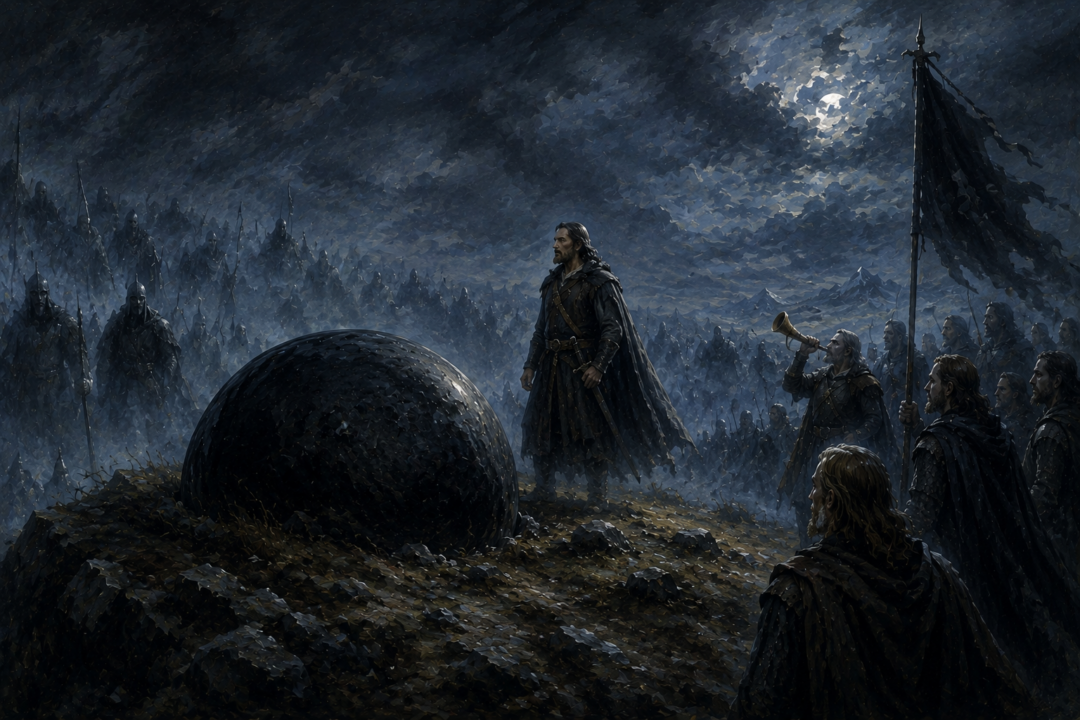
By Aragorn's time, the people living around Erech avoid the Stone.
The local tradition recorded in The Passing of the Grey Company treats the hill as a place haunted by the Shadow-men. The terror surrounding the Dead has survived long after the original political world of Isildur and the mountain king vanished.
Encyclopedia of Arda
That creates one of the most powerful ironies surrounding Erech.
The oathbreakers tried to escape their obligation by withdrawing from history. Instead, their failure became the thing history remembered about them.
Their kingdom disappeared. Their king died. Even their ordinary identity faded until they became the Sleepless Dead, a forgotten people feared by those living near their former lands.
But the Stone remained.
It effectively became a landmark of unfinished business.
The living might no longer remember every detail of the ancient covenant, but the consequences of breaking it were still present in the landscape. Erech shows how Middle-earth repeatedly preserves the past physically: in ruins, tombs, roads, swords, stones, and places whose original builders have vanished.
At Erech, the past is not merely remembered.
It is waiting.
Aragorn Does Not Simply Command the Dead Anywhere
The prophecy of Malbeth the Seer specifically points toward Erech. The oathbreakers are to stand again at the Stone, summoned by the heir of the man to whom they swore their oath.
That detail gives the confrontation its extraordinary sense of legitimacy.
Aragorn passes through the Paths of the Dead and commands the following host to come to Erech. At midnight, beside the Stone, the Dead gather around the hill. A horn is sounded. Aragorn asks why they have come, and their answer is that they have come to fulfill their oath and gain peace.
This is not portrayed as Aragorn discovering a convenient supernatural army and taking control of it.
He can summon them because he is Isildur's heir.
The place matters because this is where the original allegiance was sworn.
The identity of the claimant and the location of the oath meet at the same point.
That is why Erech functions almost like a bridge across three thousand years. Isildur is long dead, but his heir stands beside the same Stone before the descendants—or lingering spirits—of those who failed him.
The ancient obligation has finally reached the generation capable of resolving it.
Aragorn's Greatest Power Here Is the Power to Release
There is another detail that makes the episode more revealing than a simple display of kingly authority.
Aragorn does not keep the Dead.
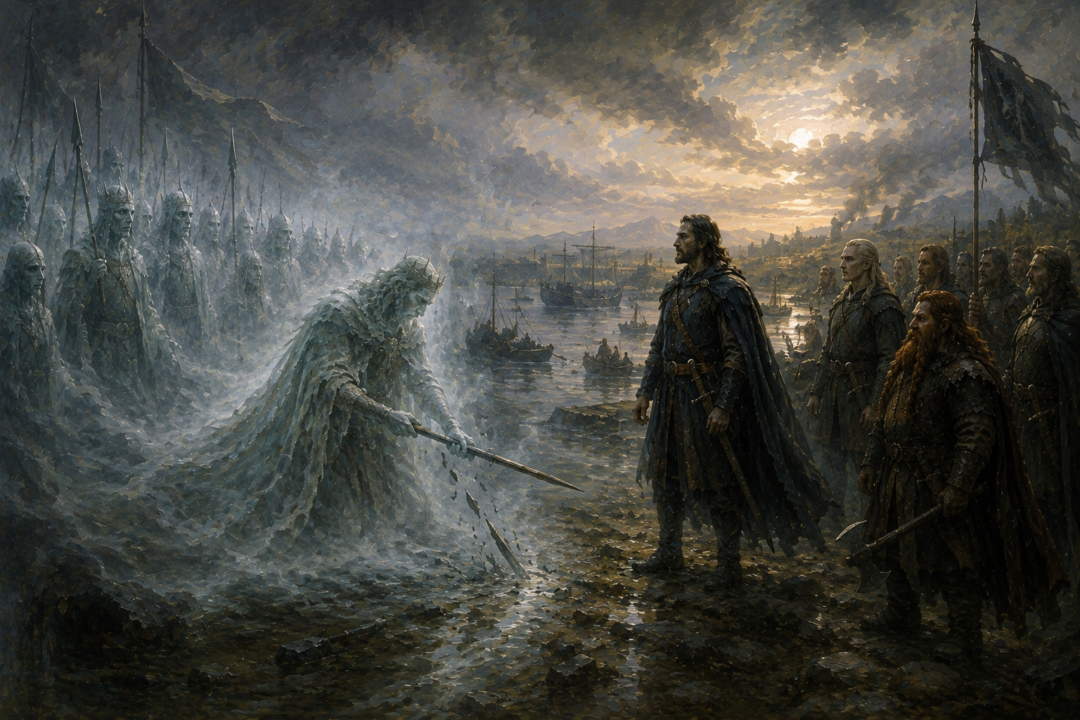
At Erech, he tells them what fulfillment will require: they must follow him toward Pelargir, and when the servants of Sauron have been driven from the land, he will consider their oath fulfilled.
They obey.
At Pelargir their terror proves decisive against Sauron's allies and the Corsairs. After victory, Aragorn declares the oath fulfilled. The King of the Dead breaks his spear and bows, and the host disappears.
The scene matters because Aragorn's authority is demonstrated not merely by compelling service but by recognizing when the debt has been paid.
He could not credibly restore the meaning of an ancient oath while refusing to honor his own promise concerning its completion.
So the story that begins with broken faith ends with fulfilled faith.
The Dead answer the ancient summons.
Aragorn gives them the peace he promised.
And their long punishment ends.
The Stone Connects Isildur and Aragorn Without Making Them Identical
Aragorn's descent from Isildur is essential to the episode, but the parallel between them is more interesting than simple inheritance.
Isildur stands at the beginning of the story. Aragorn stands at its end.
One receives the oath.
The other receives its fulfillment.
One pronounces the doom after the oath is broken.
The other releases the oathbreakers when their duty is finally accomplished.
This gives the Stone a special place in Aragorn's journey toward kingship. Before he enters Minas Tirith as king, he is already exercising a form of inherited authority that depends upon memory, obligation, and judgment.
Yet he does not merely imitate his ancestor.
At Erech and Pelargir, inheritance becomes responsibility. Aragorn accepts the authority attached to Isildur's name, but that authority also requires him to settle what Isildur left unresolved.
Kingship here is therefore not simply possession of a bloodline.
It is accepting the debts of history along with its privileges.

Why the Stone Still Matters Once the Ghosts Are Gone
After Pelargir, the supernatural crisis attached to Erech is over.
The Dead are released, and Aragorn commands them to depart and trouble the valleys no more. The text does not give the Stone a new magical function afterward. Tolkien never states that it becomes a monument visited by Aragorn's subjects, nor does he describe some later Fourth Age ceremony there.
Anything more specific would be speculation.
But within the history told in The Lord of the Rings, its symbolic importance remains clear.
The Stone has witnessed the entire shape of the oath: allegiance, betrayal, punishment, return, fulfillment, and release.
It also survives the destruction of the civilization from which it came. Númenor sinks beneath the sea. Isildur dies. The mountain kingdom dwindles. Gondor loses its kings for centuries. Sauron rises again.
Still the Stone waits on its hill.
Then Isildur's heir returns.
That is why Erech belongs to one of the deepest patterns running through Middle-earth: the past is never entirely dead simply because the people who made it are gone. Old choices continue forward through descendants, kingdoms, objects, songs, ruins, and promises.
Sometimes that inheritance is glorious.
Sometimes it is terrible.
At Erech, it is both.
The Stone matters after the Dead are released precisely because release completes its meaning. For thousands of years, it stood beside an unresolved oath. After Pelargir, that oath is unresolved no longer.
The haunting ends.
The Stone remains—a silent survivor of Númenor, a witness to the cost of faithlessness, and a reminder that Aragorn's return is not only about reclaiming a crown.
It is also about bringing ancient things to their rightful end.
Sources & Notes
- The Encyclopedia of Arda — Stone of Erech: Númenórean origin, Isildur’s covenant, and Aragorn’s summons — https://www.glyphweb.com/arda/s/stoneoferech.php
- The Encyclopedia of Arda — Oathbreakers: the Men of the Mountains and the broken oath that bound them — https://www.glyphweb.com/arda/o/oathbreakers.php
- The Encyclopedia of Arda — Erech: the hill and settlement associated with the Stone and the Dead — https://www.glyphweb.com/arda/e/erech.php
- The Encyclopedia of Arda — Isildur: founder of Gondor who received the mountain king’s oath — https://www.glyphweb.com/arda/i/isildur.php
- The Encyclopedia of Arda — Paths of the Dead: Aragorn’s journey to summon the oathbreakers — https://www.glyphweb.com/arda/p/pathsofthedead.php
Background references for the Stone’s Númenórean origin, Isildur’s covenant, and Aragorn’s summoning of the Oathbreakers. Primary narrative: J.R.R. Tolkien, The Return of the King, ‘The Passing of the Grey Company.’