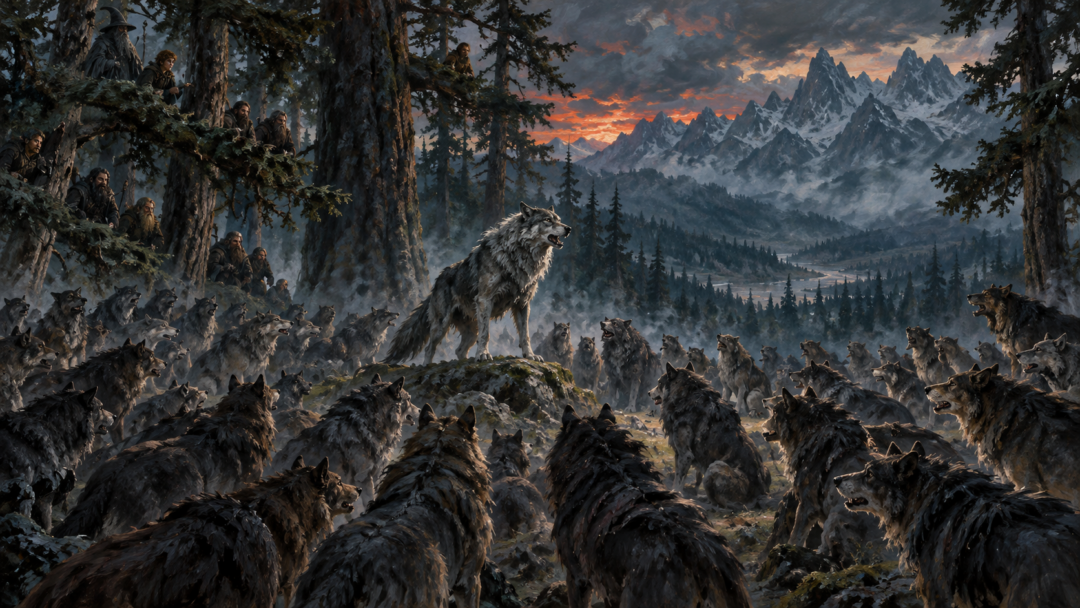
Bilbo Baggins had escaped the goblins beneath the Misty Mountains, only to find himself trapped in a pine tree with wolves gathering below. It was a miserable turn of fortune. Yet the most frightening thing about those wolves was not their teeth, their numbers, or even their hunger.
It was that they were holding a meeting.
In The Hobbit, the Wargs are not simply savage animals waiting for goblins to command them. They speak their own language, gather around a leader, discuss their intentions, and arrange joint attacks with the goblins of the mountains.
The Wargs and goblins cooperate because they are separate, organized groups whose violent interests overlap. Goblins sometimes ride wolves, but the relationship described in the book is much more than a master controlling an animal.
The clearest evidence comes from a single terrifying night in the woods, when Bilbo accidentally witnesses the workings of an alliance.
The Night Bilbo Discovered That Wolves Could Plan
After escaping the tunnels of Goblin-town, Bilbo, Gandalf, and Thorin's company travel down the eastern slopes of the Misty Mountains.
They are exhausted, hungry, and still in danger of pursuit.
As darkness approaches, the travelers hear wolves howling. Gandalf recognizes the danger, and the company scrambles into trees before the animals arrive.
These are Wargs, the evil wolves inhabiting the wild country beyond the mountains.
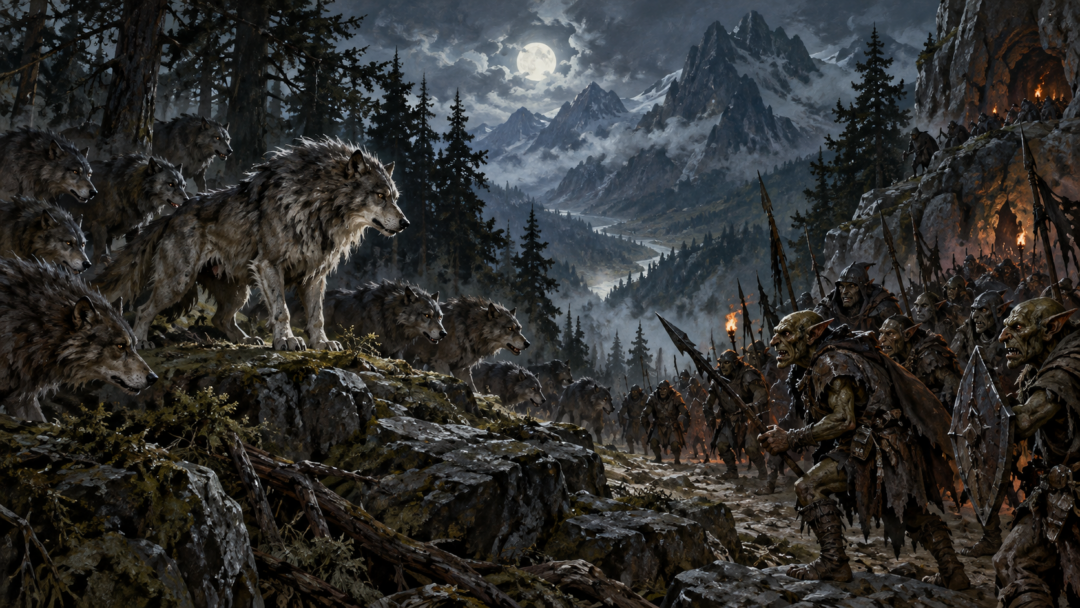
At first, their behavior resembles that of ordinary predators. They smell the travelers, discover which trees contain fugitives, and station guards beneath them.
Then something remarkable happens.
The wolves gather in a great circle within the clearing. At its center stands a large grey wolf, their chief, who addresses the others in the language of the Wargs.
The assembled wolves answer him together.
Bilbo cannot understand their speech, but Gandalf can. Through the wizard's understanding, the reader discovers that the gathering has a purpose far beyond hunting.
The Wargs are waiting for goblins.
A joint raid has been arranged, and the wolves have arrived at the meeting place before their allies.
The Wargs have not been brought into the clearing by goblin handlers. They have assembled there themselves, under their own leadership, expecting another group to arrive.
The clearing is therefore not merely a hunting ground. On this occasion, it functions as a meeting place for an organized force preparing to cooperate with another.
And the intended victims are not Bilbo and his companions.
They are nearby human settlements.
Why Goblins and Wargs Work Together
Goblins sometimes leave their mountain strongholds to conduct raids, particularly when seeking food or captives.
During such expeditions, they often obtain assistance from Wargs and share the plunder.
The Wargs are not described as creatures that simply obey because they have been trained. They participate in attacks from which they also benefit.
The goblins gain the assistance of dangerous wolves capable of tracking, pursuing, and attacking their enemies.
The Wargs gain opportunities to participate in raids and receive a share of what is taken.
The narrative does not specify every kind of reward the wolves receive, so it would be misleading to invent a detailed system of payment or distribution.
A wolf can pursue prey that might escape a goblin on foot. A goblin can use weapons, carry prisoners, and perform tasks that wolves cannot accomplish in the same way.
These are complementary abilities, although the chapter does not lay out a formal military doctrine.
Their cooperation combines different strengths without requiring the two groups to become a single kind of creature.
The Planned Attack on the Woodmen
The raid planned for that night reveals the alliance at its most sinister.
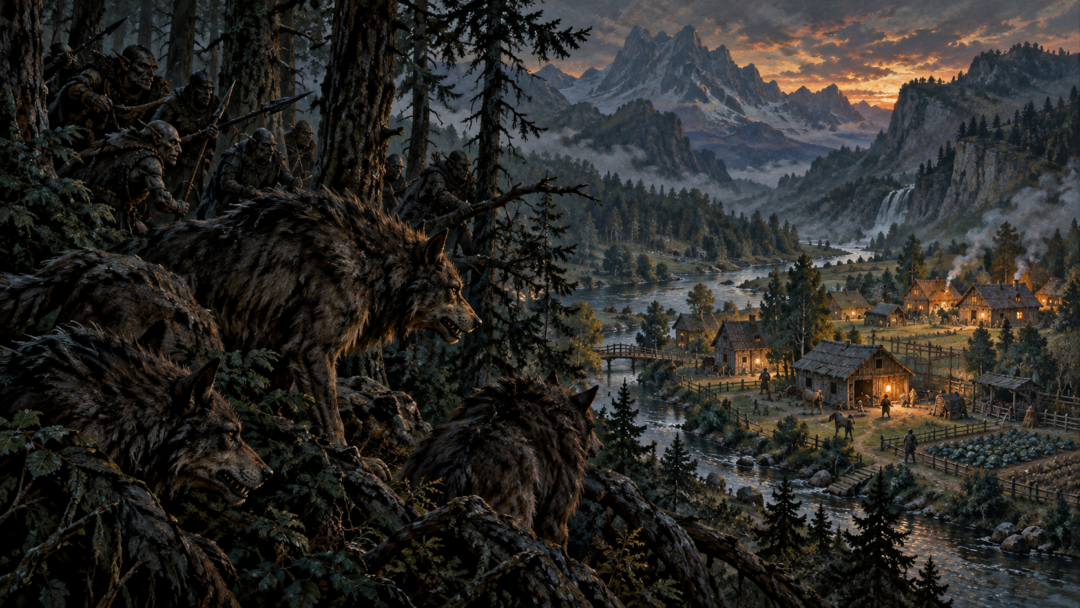
In the valleys east of the mountains, Men have been returning to settle the land.
They have cleared trees, built homes, and established villages in places that are more pleasant and fertile than the surrounding wilderness.
Their presence creates a dangerous situation for the Wargs.
The men are brave and armed. When gathered in sufficient numbers, they are formidable enough that even the wolves hesitate to attack them.
Daylight also makes the Wargs less willing to risk an assault.
The planned solution is a nighttime attack with goblin assistance.
The chapter makes clear that the Wargs intend to strike villages near the mountains, where the inhabitants would be vulnerable to a combined assault.
The attackers intend to kill the inhabitants, with the goblins preserving some captives to carry back to their caves.
The wolves and goblins are not joining forces to defend territory against an invading army. Their immediate purpose is an attack upon settlements containing ordinary people, including families.
For the goblins, captives and supplies are valuable. For the Wargs, the attack offers an opportunity to overcome humans whom they would otherwise hesitate to confront.
The chapter does not tell us that every Warg everywhere shares an identical attitude toward every human settlement.
Why Riding a Warg Does Not Make It a Domestic Animal
One detail can easily create the wrong impression.
The goblins sometimes ride wolves, much as Men ride horses.
It is tempting to take this as proof that the Wargs are simply the goblins' equivalent of domesticated mounts.
But the chapter places wolf-riding within a much broader description of cooperation.
Riding is one activity within a relationship that also involves joint raids and shared plunder. It is not a complete explanation for that relationship.
A creature capable of carrying a rider does not necessarily lack independent judgment.
In this case, the wolves' ability to speak, organize, and plan has already been demonstrated.
Nor does the book describe a process by which goblins breed, raise, train, or domesticate Wargs.
Such practices cannot be established from the fact that wolf-riding occurs.
It is therefore more accurate to describe the Wargs as intelligent allies who can also serve as mounts.
That does not mean every interaction between a goblin and a wolf must be friendly or equal. The text does not provide enough evidence to define every possible relationship between them.
The Wargs in the pine-tree episode possess their own agency, and their cooperation with goblins cannot be reduced to animal obedience.
The word species in this discussion is best understood in an ordinary descriptive sense: wolves and goblins are presented as different kinds of beings.
The episode is not a biological investigation into their origins or classification.
Its evidence concerns behavior, intelligence, and cooperation.
What Happens When the Goblins Arrive Late?
The delay in the goblins' arrival offers another revealing detail.
The Wargs have reached the appointed place, but their allies have not appeared.
The narrative suggests that the delay is connected with the death of the Great Goblin and the confusion caused by Bilbo's company escaping from the mountain.
The wolves are therefore waiting for partners whose movements have been disrupted by events elsewhere.
The two groups are expected to assemble at the same location, but they do not travel together throughout the episode.
Finding strangers in their meeting place angers and puzzles them.
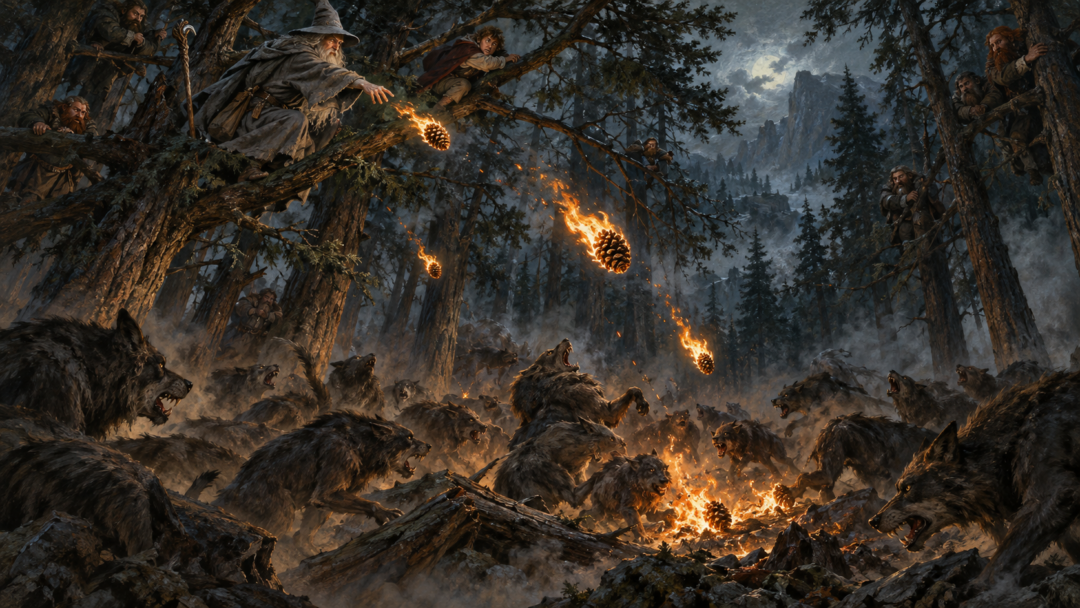
They surround the trees and prevent the travelers from escaping.
Gandalf then attacks them with burning pinecones.
The wolves suffer burns and panic as fire spreads among them. Their anger intensifies, and the confrontation becomes increasingly dangerous.
When the goblins finally appear, the situation changes again.
The newcomers initially believe that fighting has begun in the clearing.
They soon discover the travelers trapped above the wolves and turn the fire into a weapon.
Some extinguish flames, while others feed the fires near the trees, threatening to burn the company alive.
Here the goblins contribute something the Wargs could not accomplish simply by surrounding the trunks.
The wolves have trapped the fugitives, but the goblins can manipulate the fire to make their refuge deadly.
This improvised cooperation is not evidence of a perfectly coordinated command structure. The goblins arrive late and initially misunderstand the disturbance.
The Eagles Reveal the Limits of the Alliance
The arrival of the Eagles transforms the encounter.
The Lord of the Eagles notices the commotion below and comes with other Eagles to investigate.
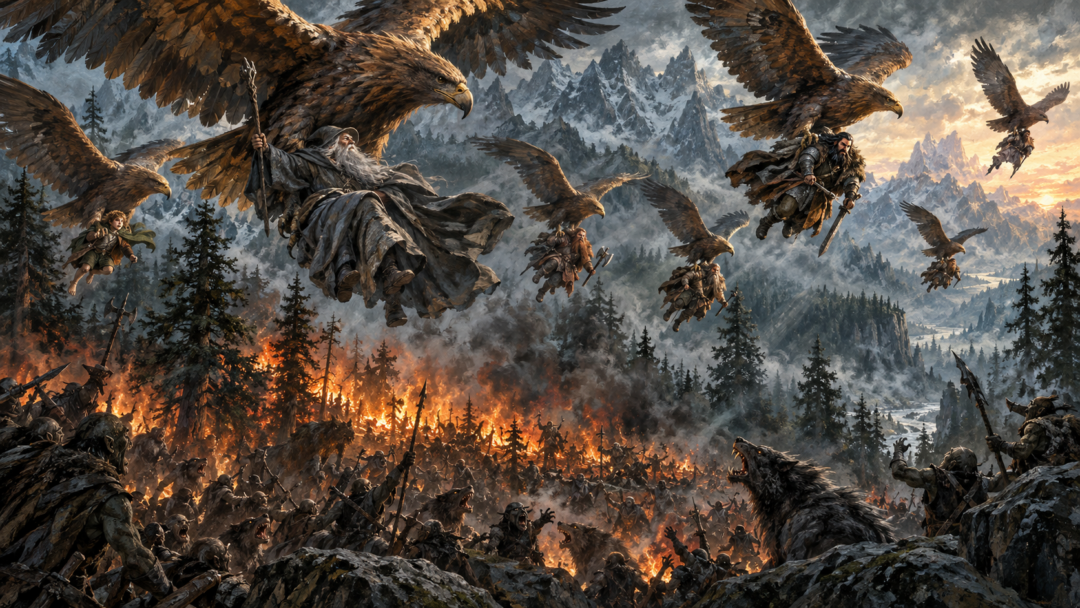
As flames threaten the trees, the Eagles intervene and carry Gandalf, Bilbo, and the dwarves away from danger.
The wolves and goblins are left below, unable to prevent the rescue.
The Wargs can surround enemies on the ground. The goblins can exploit fire and threaten those who have climbed beyond the wolves' reach.
Together, they nearly destroy the travelers.
But neither group can stop the Eagles from approaching through the air and removing their intended victims.
Their cooperation is formidable within the circumstances of the clearing, but it is not unlimited.
The True Meaning of the Warg–Orc Alliance
The pine-tree episode answers the central question without requiring an elaborate theory about the origin of Wargs.
The wolves and goblins cooperate because they can help one another accomplish violent purposes.
The goblins sometimes ride wolves, but the Wargs also speak, organize, plan, and act under their own leadership.
Their relationship is therefore best understood as an alliance of separate groups rather than a simple arrangement between masters and domesticated animals.
Nothing in this episode establishes the complete biological history of the Wargs, the precise terms of their cooperation, or an unchanging relationship between every wolf and every Orc in Middle-earth.
Its most important evidence is already visible beneath Bilbo's pine tree.
A grey wolf addresses his followers. The pack answers. Their goblin allies are expected to arrive, and together they intend to descend upon human villages.
The terrifying discovery is not that the goblins have learned to command wolves.
It is that the wolves have plans of their own—and that those plans can become even more dangerous when the goblins join them.
Sources & Notes
- Tolkien Gateway — The Hobbit. https://tolkiengateway.net/wiki/The_Hobbit
- Tolkien Gateway — Out of the Frying-Pan into the Fire. https://tolkiengateway.net/wiki/Out_of_the_Frying-Pan_into_the_Fire
- Tolkien Gateway — Wargs. https://tolkiengateway.net/wiki/Warg
- Tolkien Gateway — Wolves. https://tolkiengateway.net/wiki/Wolves
- Tolkien Gateway — Orcs (Goblins). https://tolkiengateway.net/wiki/Goblins
- Tolkien Gateway — Great Goblin. https://tolkiengateway.net/wiki/Great_Goblin
- Tolkien Gateway — Goblin-town. https://tolkiengateway.net/wiki/Goblin-town
- Tolkien Gateway — Misty Mountains. https://tolkiengateway.net/wiki/Misty_Mountains
- Tolkien Gateway — Great Eagles. https://tolkiengateway.net/wiki/Eagles
Primary text: The Hobbit, and specifically its sixth chapter, 'Out of the Frying-Pan into the Fire', the episode the article is built on. Tolkien Gateway's chapter entry fixes the episode's place and content: Thorin and Company escape Goblin-town and are taken by the Eagles, an event dated Thursday 12 July T.A. 2941, following 'Riddles in the Dark' and preceding 'Queer Lodgings' — the sequence in which Bilbo, Gandalf and the dwarves come down the eastern slopes of the Misty Mountains and are treed by wolves before the goblins arrive. Its Hobbit entry supplies the work itself: Tolkien's 1937 novel, set in Middle-earth and following Bilbo's quest, which is the text every claim in the article rests on. Tolkien Gateway's Warg entry carries the nature of the wolves: Wargs, or Wild Wolves, are described as a race of evil wolves so called by the Northmen of Rhovanion, an evil breed of demonic wolves with an unknown origin — perhaps among creatures bred by Morgoth in the Elder Days — and Gandalf is said to have listed the Wargs among Sauron's servants in the late Third Age, with Anduin Vale and the Misty Mountains given as their locations and Sauron and Orcs as allies. Its Wolves entry supports the article's point that riding is not the same as domestication and that wolf–Orc cooperation is old: wolves were of old allied with the Dark Lord and were often used as steeds by the Orcs, and wolves appear in all three ages. Its Orcs entry (to which 'Goblins' redirects) establishes that 'goblins' and 'Orcs' name the same people, with Goblins among the recorded other names, the Misty Mountains and High Pass among their locations, and Morgoth and Sauron as their affiliations — the basis for the article's reading of goblins and Wargs as two separate, organised groups rather than one species and its keeper. Tolkien Gateway's Great Goblin entry grounds the explanation the article offers for the allies' late arrival: the Great Goblin was the chief of the Orcs of Goblin-town beneath the High Pass and presumably of all the Orcs of the Misty Mountains, described as 'tremendous', and he died in T.A. 2941 when Thorin and Company were captured by his people after taking refuge in a cave while crossing the mountains. Its Goblin-town entry places the escape that disrupts the goblins: an Orc dwelling under the Misty Mountains ruled by the Great Goblin, a series of tunnels and caverns running through the mountains with a 'back door' near the Eagle's Eyrie in Wilderland, used as the means of escape. Its Misty Mountains entry supplies the setting in which Orcs, Eagles, Giants and others inhabit the same range. Its Great Eagles entry and Lord of the Eagles entry cover the rescue that the article treats as the limit of the alliance: immense sentient Eagles that served as messengers of Manwe, with the Eagle's Eyrie among their locations, and 'Lord of the Eagles' recorded as a title borne by the Great Eagle, called lord of the eagles of the Misty Mountains, and by Thorondor. Its Rhovanion entry (reached at Wilderland) locates the human settlements the raid targets: the lands on the east side of the Misty Mountains, inhabited by Northmen, Orcs and Eagles among others, with Lake-town, Dale and Erebor among their settlements. The Encyclopedia of Arda's Wargs entry independently characterises the creatures as monstrous wolves of the northern lands — a ferocious and intelligent race of wolves living in the northern Vales of Anduin and probably elsewhere in the north of Middle-earth, named Wild Wolves, with a name derived from Old Norse vargr, meaning both 'wolf' and 'outlaw' — which is why the article treats their speech, council and leadership as evidence of intelligence rather than training. Its Goblins entry confirms the terminology and habitat: goblins are the race of Orcs, the name being almost synonymous with Orcs, with the Orcs called 'Goblins' particularly associated with the Orc-holds of the Misty Mountains. Together these sources support the article's central distinctions — that the Wargs are a distinct intelligent race with their own speech and leadership, that goblins are Orcs and not a separate master species, that wolf-riding is one activity within an older alliance rather than proof of domestication, and that the goblins' late arrival is tied to the Great Goblin's death — while leaving the article's own caution intact: the chapter does not document breeding, training or a formal command structure, and no source here supplies a complete biology of the Wargs.