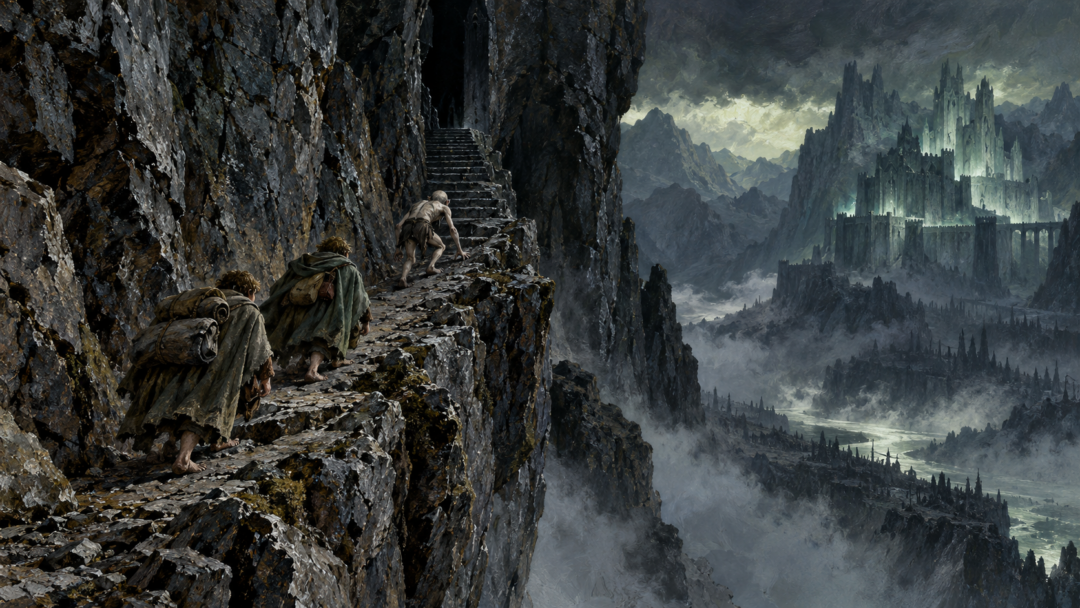
Above Minas Morgul, Frodo and Sam face a challenge that cannot be overcome by courage alone. Before they can enter Mordor through Cirith Ungol, they must climb two ancient stairways cut into the Mountains of Shadow. One rises with frightening steepness. The other winds along the mountainside, stretching the journey through turn after turn.
The Straight Stair demands an intense, almost continuous struggle against gravity. The Winding Stair makes the hobbits endure a longer ascent, with changing directions, exposed places, and the knowledge that the summit remains somewhere ahead. Between them lies a passage that briefly changes the physical demands without offering the rest they desperately need.
In The Two Towers, particularly the chapter "The Stairs of Cirith Ungol," this sequence turns the landscape into a test of endurance. Each part of the climb requires something different from Frodo and Sam, and each changes how they experience the danger surrounding them.
Their problem is not simply getting higher. It is finding enough strength to continue when reaching the top of one terrible staircase only reveals another.
Leaving Minas Morgul Behind
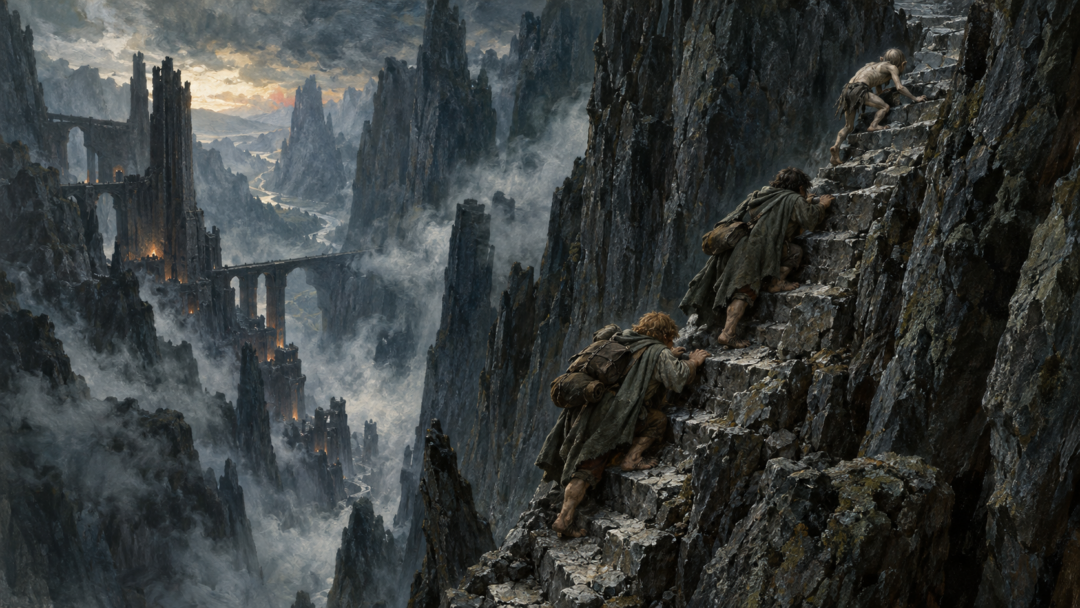
Minas Morgul stands within its shadowed valley, illuminated by an unnatural radiance. Once Minas Ithil, the city has become a stronghold of the Nazgûl. Its presence makes the surrounding terrain dangerous even before the hobbits reach the stairs.
Frodo is already struggling beneath the growing burden of the One Ring. The journey through Ithilien has given way to harsher country, and the approach to Mordor seems to increase the weight pressing upon him.
Then the Witch-king's army emerges from Minas Morgul.
Frodo, Sam, and Gollum must remain concealed while the forces of the Enemy move outward. The danger is immediate, but waiting cannot become their permanent solution. Their route leads away from the main road and upward through the mountains.
Gollum knows a way that avoids passing directly through the city. Yet his knowledge does not make the route comfortable or safe.
The path first follows a climbing ledge above the valley. It eventually reaches a narrow opening between walls of rock, where the Straight Stair begins.
The Straight Stair: A Climb That Uses the Whole Body
Its steps are cut between enclosing walls of rock and rise at an extraordinary angle. The ascent is so steep that it resembles climbing a ladder more than walking up an ordinary staircase.
The steps are narrow and irregularly spaced. Some are worn smooth, while others are damaged or broken. Their condition makes secure footing difficult, especially when the climbers are already exhausted.
The hobbits must increasingly use their hands.
They grasp the steps ahead of them and force themselves upward through repeated movements of their arms and legs. Knees must bend deeply and straighten again. Fingers become part of the effort of climbing.
Instead of merely carrying their bodies forward, Frodo and Sam must repeatedly raise their weight against the steep rock.
The staircase also offers little opportunity to establish an easy rhythm. Uneven steps interrupt the movement, requiring attention to where hands and feet are placed.
The labor is therefore both muscular and mental. The hobbits cannot simply walk while thinking about the road ahead. They must concentrate on the immediate problem of getting safely onto the next step.
The First Summit Is Not the End of the Work
Eventually, Frodo and Sam reach the top of the Straight Stair.
After such a punishing ascent, the change in terrain should feel like a release.
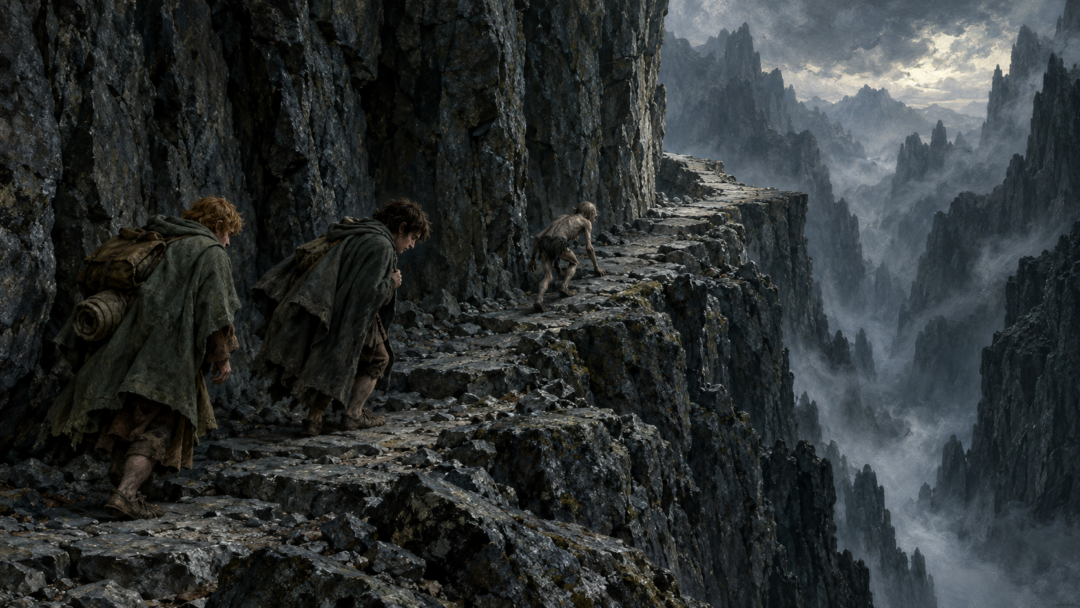
The steps give way to a dark passage that continues upward at a gentler slope. For the moment, the hobbits no longer have to climb with their hands in the same way.
But Gollum does not allow them a long rest.
He explains that another staircase lies ahead. The Winding Stair is longer, though he says it is less difficult.
The hobbits have just completed an exhausting climb, only to discover that the larger task is unfinished.
The passage between the stairways is important because it divides the physical labor without ending it.
Its gentler incline offers a different kind of movement. The travelers can proceed without the same near-vertical effort, but they are still gaining height and covering difficult ground.
The route continues through a long, dark corridor between rocks. Later, one enclosing wall gives way, leaving the path beside a deep drop.
The cramped security of the first staircase is replaced by a more open awareness of the mountainside.
The passage does not restore them to their condition before the climb. It carries their exhaustion forward into the next obstacle.
The Winding Stair: Less Steep, but Longer
The Winding Stair introduces a different problem.
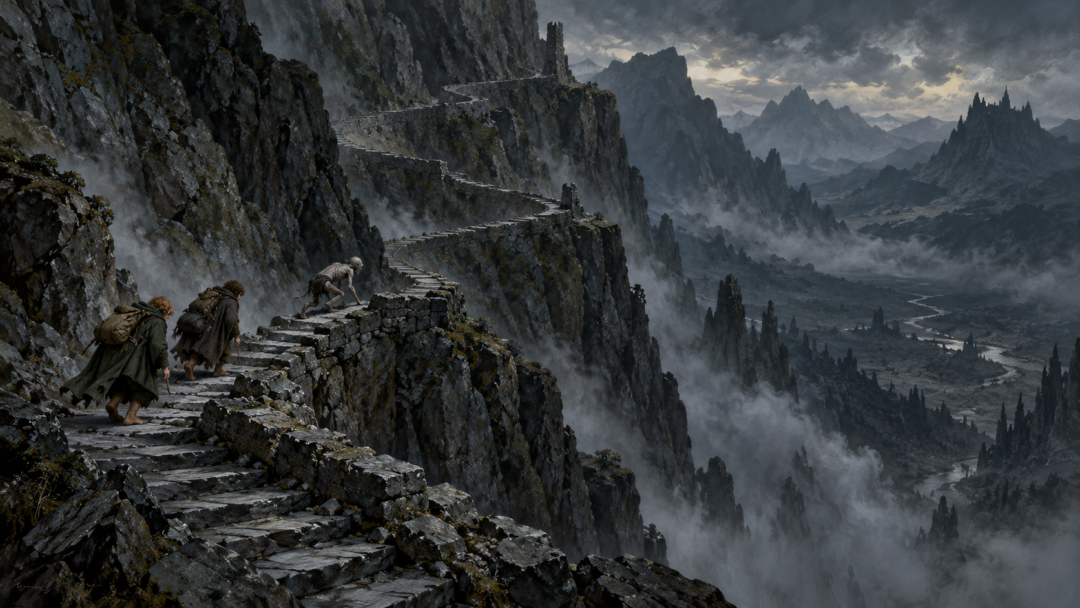
Rather than rising almost directly upward between close walls, it follows the sloping face of the mountain in repeated turns.
The cliff retreats, and the steps wind back and forth across its surface.
The hobbits no longer face the same relentless ladder-like ascent that characterized the Straight Stair. The path gains height through a succession of traverses and turns.
The staircase is longer, and its winding course prolongs the effort. Instead of confronting one seemingly direct ascent, Frodo and Sam must continue through a route whose turns repeatedly alter the direction of travel.
The difference is between intensity and duration.
The Straight Stair imposes exceptionally strenuous movements over its steep steps. The Winding Stair extends the work through a longer sequence that cannot be completed in one brief effort.
This distinction explains why Gollum can describe the second staircase as less difficult while Sam still finds the news discouraging.
Difficulty is not determined by steepness alone.
A route can be physically less severe at any particular moment while demanding more persistence overall.
Exposure Becomes a Different Kind of Burden
The Winding Stair is not simply a longer version of the first.
Its position along the mountainside exposes the travelers to a different relationship with the landscape.
At one of its turns, the route overlooks the great ravine at the head of the Morgul Valley.
Far below lies the country through which they have traveled.
The sight emphasizes how much height they have gained, but it also reveals the scale of the drop beside their route.
On the Straight Stair, fear is concentrated behind the climbers. On the Winding Stair, the danger of height becomes part of the surrounding view.
The first forces attention toward hands, knees, and individual steps. The second allows more awareness of the surrounding precipices, even as its continuing turns demand movement.
The hobbits must still negotiate the steps beneath their feet. But the exposed setting gives them another reason to fear mistakes.
The narrative does not need an invented accident to make this dangerous. The described steepness, broken stone, and open drops are sufficient.
The Final Steps Lead to a Different Kind of Trial
The Winding Stair eventually ends with a final, comparatively short straight flight.
Beyond it, the route enters a cleft among the rocks.
Frodo and Sam have now overcome both named stairways.
Their achievement is substantial, but the passage toward Cirith Ungol remains unfinished.
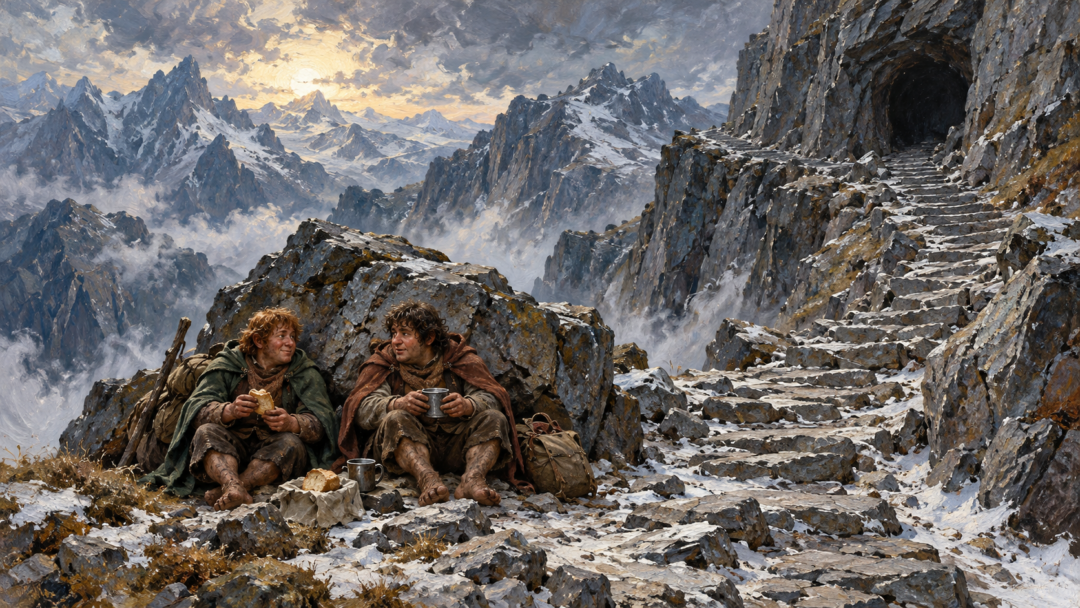
At last, they are able to stop in a sheltered crevice and eat a little of their remaining food.
After so much effort, the hobbits can sit, speak, and think about matters beyond the next foothold.
Their conversation turns toward stories and the possibility that their own journey might someday become part of a tale remembered by others.
The climb has reduced their world to physical necessities: footing, balance, movement, and endurance. The pause allows their larger hopes and fears to return.
Sam considers how stories continue beyond the moments when their characters feel overwhelmed. Frodo listens, and the two briefly recover something of the companionship that has sustained them throughout the journey.
The tunnel ahead belongs to Shelob's domain, and Gollum's guidance has brought them toward a peril they do not fully understand.
Yet the rest after the stairways gives the travelers a moment in which their humanity matters more than their physical weakness.
What the Two Stairways Reveal About Endurance
The Straight Stair and Winding Stair form one continuous ordeal, but they divide its labor in a remarkably precise way.
The first demands strength through steepness. Its irregular steps force the hobbits to use hands and legs together, while the drop behind them makes every movement consequential.
The passage beyond changes the strain without ending the journey.
The second staircase demands endurance through length, turnings, and exposure. Its less severe incline does not remove the exhaustion already accumulated, and the surrounding precipices create their own fears.
Finally, the sheltered pause beyond the stairs allows the hobbits to recover enough composure to speak of stories, hope, and what might lie beyond their present troubles.
And there is a final irony in their achievement.
The top of the Winding Stair is not the end of their danger. It brings them closer to the darkness of Shelob's tunnel, where the strength they have struggled to preserve will soon be tested again.
The two stairways have carried them upward, but upward does not mean toward safety.
Their greatest accomplishment is therefore not simply gaining height above Minas Morgul.
It is continuing together through two different kinds of exhaustion, without knowing whether the next stage of the journey will offer relief or something worse.
Sources & Notes
- Tolkien Gateway — Straight Stair. https://tolkiengateway.net/wiki/Straight_Stair
- Tolkien Gateway — Winding Stair. https://tolkiengateway.net/wiki/Winding_Stair
- Tolkien Gateway — The Stairs of Cirith Ungol. https://tolkiengateway.net/wiki/The_Stairs_of_Cirith_Ungol
- Tolkien Gateway — Cirith Ungol. https://tolkiengateway.net/wiki/Cirith_Ungol
- Tolkien Gateway — Minas Morgul. https://tolkiengateway.net/wiki/Minas_Morgul
- Tolkien Gateway — Morgul Vale. https://tolkiengateway.net/wiki/Morgul_Vale
- Tolkien Gateway — Ephel Dúath. https://tolkiengateway.net/wiki/Ephel_Duath
- Tolkien Gateway — Torech Ungol. https://tolkiengateway.net/wiki/Torech_Ungol
- Tolkien Gateway — Shelob. https://tolkiengateway.net/wiki/Shelob
Primary text: The Lord of the Rings, The Two Towers, Book IV, chapter 'The Stairs of Cirith Ungol' — the passage through the Morgul Vale, the climb of the two stairways above Minas Morgul, the sheltered crevice where Frodo and Sam eat and talk of old songs and of becoming figures in a tale, and the approach to the tunnel ahead. Tolkien Gateway's Straight Stair and Winding Stair entries carry the physical detail the article rests on: the path from Morgul Valley rising by a climbing ledge to a narrow opening in the rock wall, steps cut between two walls 'almost as steep as a ladder,' steps narrow, unevenly spaced and treacherous — some worn smooth at the edges, some broken, some cracked underfoot — the hobbits grasping the steps with their fingers and forcing their knees to bend and straighten, and the unnerving sense of the long black fall behind them; then the deeper dark passage climbing without steps at a gentle slope, the path between cliff and chasm, the Winding Stair snaking to and from across a cliff-face that had sloped back rather than delving into the mountains, a turn overlooking the vast ravine at the head of Morgul Valley, and a final flight, short and straight, beyond which a cleft led on to Cirith Ungol. Its Winding Stair entry also records the crevice where the two hobbits sat and ate before facing the tunnel, which is the pause the article reads as the return of larger hopes and fears. Tolkien Gateway's chapter entry supplies the narrative order — Gollum's guidance out of the valley of Minas Morgul past the Tower of the Moon, the hobbits dizzy and forced onward up the stairs, the dark crevice, the discussion of songs and prophecies and of Gollum's trustworthiness, and Sam's promise to keep watch. Its Cirith Ungol entry places the pass in a cleft on the north-east side of the Morgul Vale and describes the route up the Stairs of Cirith Ungol, through a tunnel and up a long flight of broad shallow steps to the cleft, noting that the pass was the swiftest way over the mountains despite Shelob; its Ephel Dúath entry identifies Cirith Ungol as one of only two passes through the Mountains of Shadow and states that the pass is 'extremely inaccessible' precisely because of the Straight Stair and the Winding Stair, which is the basis for the article's claim that these stairways are what make the route impractical for armies, horses and wagons. Its Minas Morgul entry covers Minas Ithil as the twin city that fell and became the Tower of Sorcery, the pale corpse-light and the reek of the valley, and the noxious influence that presses on Frodo before the climb; its Morgul Vale entry covers the valley of the Morgulduin, the Poisoned Meads, the three travellers entering from the western end to reach the stairway to Cirith Ungol, and their leaving the reek behind as they climbed. Tolkien Gateway's Torech Ungol (Shelob's Lair) entry describes the tunnel beyond the pass from which a foul reek issued, with still and heavy air that deadened sound and with openings branching off the main line — the basis for the article's insistence that the top of the Winding Stair is not safety — and its Shelob entry identifies the dweller of that tunnel, the last offspring of Ungoliant. The Encyclopedia of Arda's Cirith Ungol entry corroborates the pass's location in the high Ephel Dúath on the western borders of Mordor guarded by the Tower of Cirith Ungol, and its Minas Morgul entry corroborates the fortress's origin as Minas Ithil built for Isildur and its later occupation by the Nazgûl. Caveats honoured rather than smoothed over: the article deliberately offers no measured height or distance for either stairway, because the narrative gives none and the sources give none — the comparison is between kinds of exertion, not figures; Tolkien Gateway's Straight Stair entry dates the climb to 12 March T.A. 3019 while its Ephel Dúath entry dates the start of the ascent to 10 March, and its 12 March date page places the entry into Shelob's Lair on 12 March, so no single day is asserted here; nothing from the film adaptations or The Lord of the Rings Online is treated as canon, and the article's readings of exposure, rhythm and divided labour are marked as interpretation rather than stated fact.