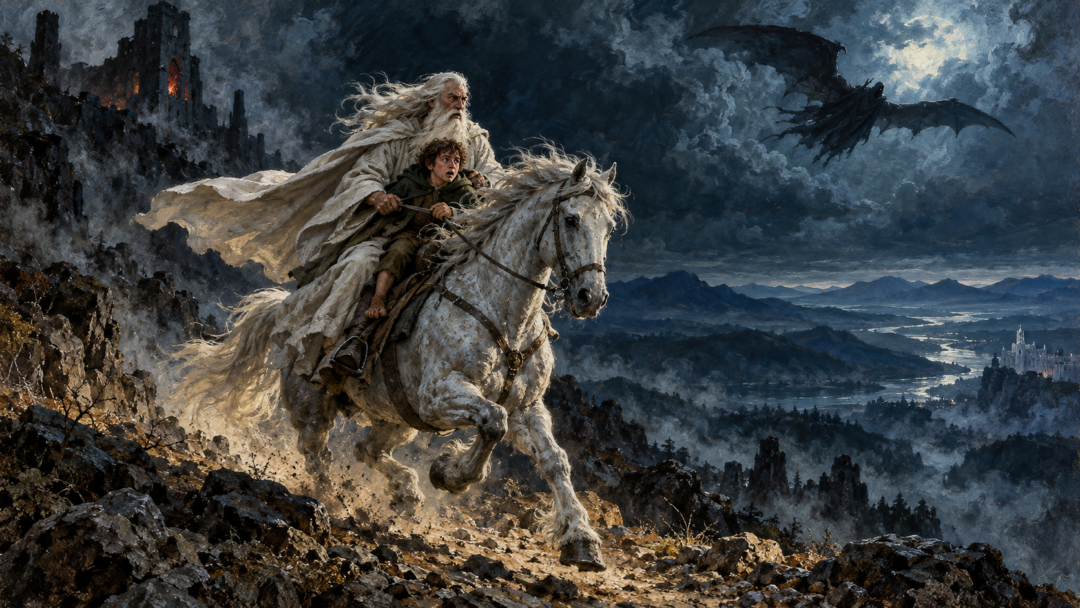
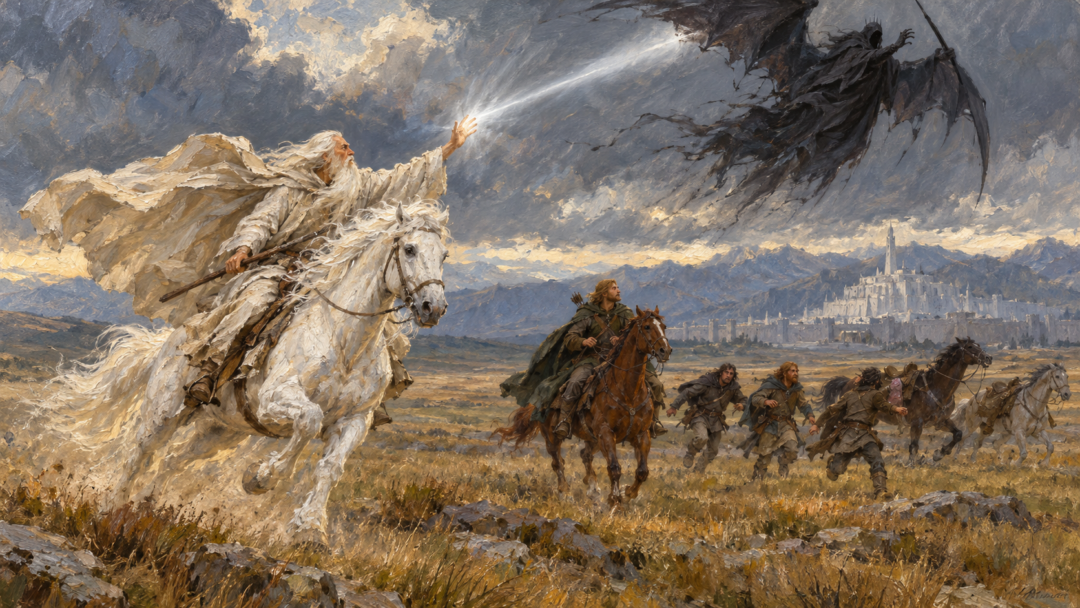
When Gandalf rides toward Minas Tirith with Pippin clinging behind him, Shadowfax is carrying more than two travelers. He is bringing a dangerous piece of news toward a city already preparing for war.
The journey begins after Pippin looks into the palantír of Orthanc and encounters Sauron. Gandalf understands that the Enemy has drawn a mistaken conclusion from the encounter, and the appearance of a winged Nazgûl makes the situation more urgent.
Yet an important distinction is easily missed. Gondor is not waiting in ignorance for Gandalf to arrive. Denethor already knows that Mordor threatens his realm. His soldiers have fought the Enemy, his defenses are being prepared, and his own sources of information extend beyond ordinary messengers.
So what does Shadowfax's extraordinary pace actually change?
The answer is not that he saves Gondor by delivering its first warning. He allows Gandalf and Pippin to reach Minas Tirith at a critical point in the developing crisis, bringing knowledge from the west, a witness connected to the Fellowship, and Gandalf's personal assistance before the great assault begins.
The difference lies in the timing of their arrival, the information they carry, and what Gandalf can still do once he reaches the city.
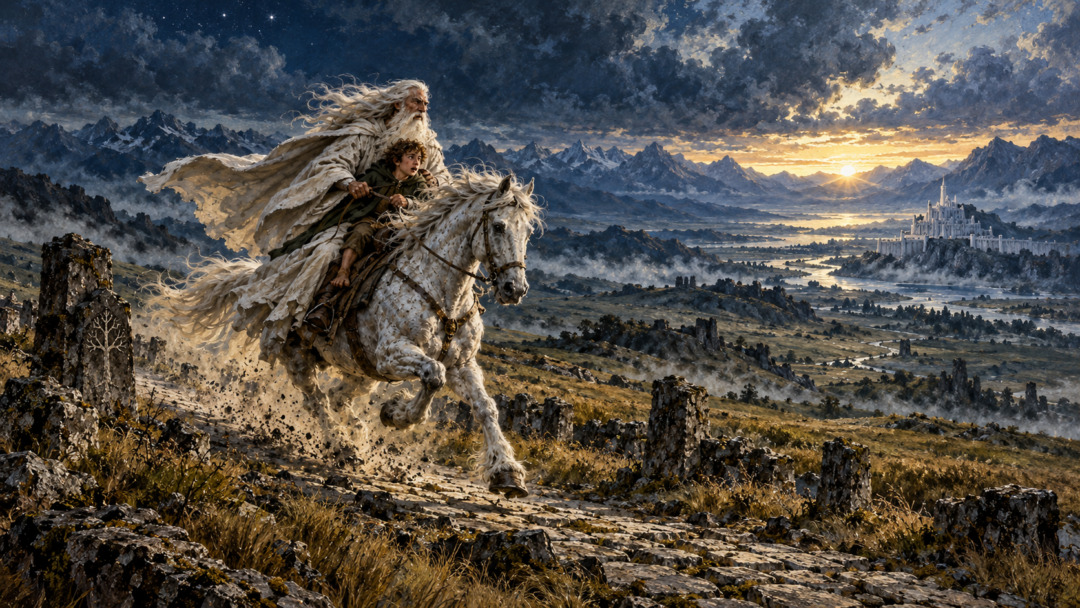
The Night That Turns Shadowfax Toward Gondor
The decisive journey begins on March 5, 3019, after the confrontation with Saruman at Orthanc.
During the company’s night halt at Dol Baran, Pippin's curiosity overcomes his caution. He takes the palantír and looks into it, finding himself confronted by Sauron.
When Gandalf questions him afterward, the wizard recognizes that Sauron has misunderstood what he has seen. The Dark Lord apparently believes that the hobbit has fallen into Saruman's hands, and Gandalf sees a possible advantage in this mistaken assumption.
Then a winged Nazgûl passes overhead.
That sight brings an immediate change of plans. Gandalf leaves the others and takes Pippin south on Shadowfax.
This is the important starting point for understanding the horse's role. Shadowfax does not simply make an ordinary journey more comfortable. His exceptional ability enables Gandalf to respond promptly to an unexpected development without waiting for the movements of Théoden's company.
The palantír incident explains why Gandalf's departure becomes so pressing. Shadowfax makes that departure practical.
Four Days Between the Palantír and Minas Tirith
According to Appendix B of The Lord of the Rings, Gandalf sets out with Pippin on March 5 and reaches Minas Tirith on March 9.
Those dates do not, however, provide a measured average speed or tell us exactly how much time another horse would have required. Any precise claim about hours saved would depend on assumptions that the narrative does not establish.
Gandalf and Pippin travel through the changing landscape of Rohan and toward the lands of Gondor, pressing onward while the military situation becomes increasingly serious.
Shadowfax is no ordinary mount. As the greatest of the horses of Rohan, descended from the line of the Mearas, he possesses extraordinary speed and endurance. His abilities have already allowed Gandalf to travel with remarkable urgency during earlier events.
Arriving on March 9 places Gandalf inside Minas Tirith before the events of March 10, when the darkness from Mordor spreads and the danger to Gondor becomes more immediate.
The timing matters because Gandalf is not merely carrying a warning that can be delivered and forgotten.
He is bringing himself.
Once he reaches Minas Tirith, his judgment, knowledge, and abilities become available to those defending the city. Shadowfax's pace therefore affects not only when information arrives, but when Gandalf can begin acting on it.
Gondor Was Already Watching the Shadow
Gondor has lived under the threat of Mordor for generations.
Its eastern defenses have already been tested. Osgiliath remains a contested position, and the approaches from Ithilien are of immense strategic importance.
Denethor understands military affairs, maintains Gondor's defenses, and possesses knowledge unavailable to many of the people around him. The later revelation of his use of the Anor-stone, the palantír kept in Minas Tirith, makes clear that his information is not limited to reports carried by soldiers and messengers.
Gandalf's arrival does not erase these existing sources of knowledge.
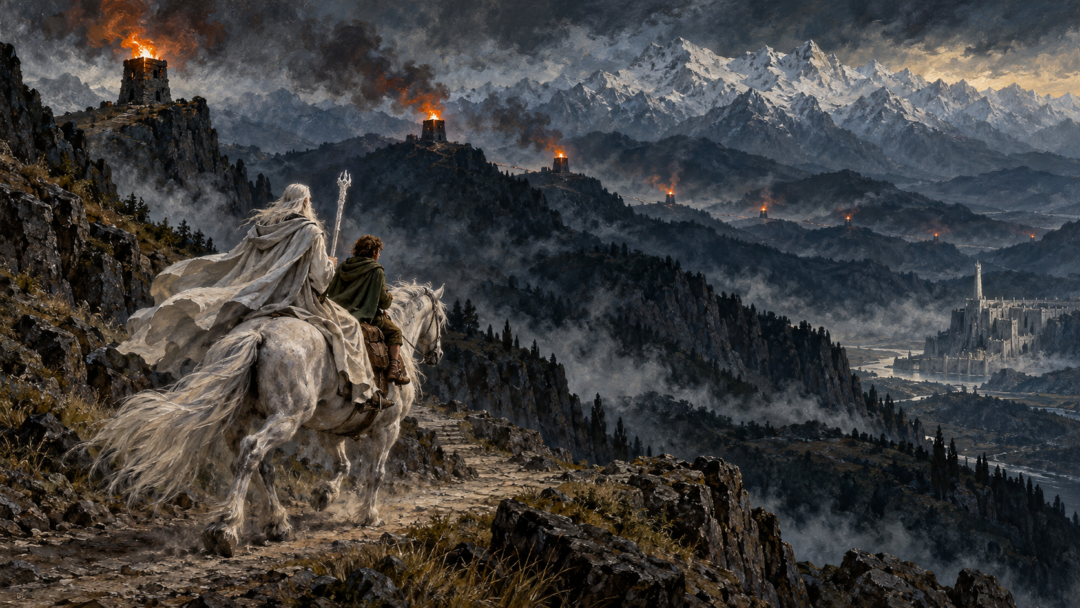
Indeed, while Gandalf and Pippin are still traveling, Gondor's own warning system is already in motion.
In The Return of the King, Pippin sees the warning beacons burning as Shadowfax carries him through the night. The fires signal the gathering danger and the call for aid.
Shadowfax carries a different kind of message: a knowledgeable participant in the struggle against Sauron, together with a hobbit who has recently encountered the Enemy through a seeing-stone.
Gondor knows that an attack is approaching. Gandalf brings knowledge about the wider struggle in which that attack is taking place.
Those are related, but not identical, kinds of warning.
Why Pippin's Presence Changes the Meeting
Pippin might seem an unlikely person to bring before the Steward of Gondor.
He is young, inexperienced in war, and unfamiliar with the customs of the great city. Yet his presence becomes important almost immediately.
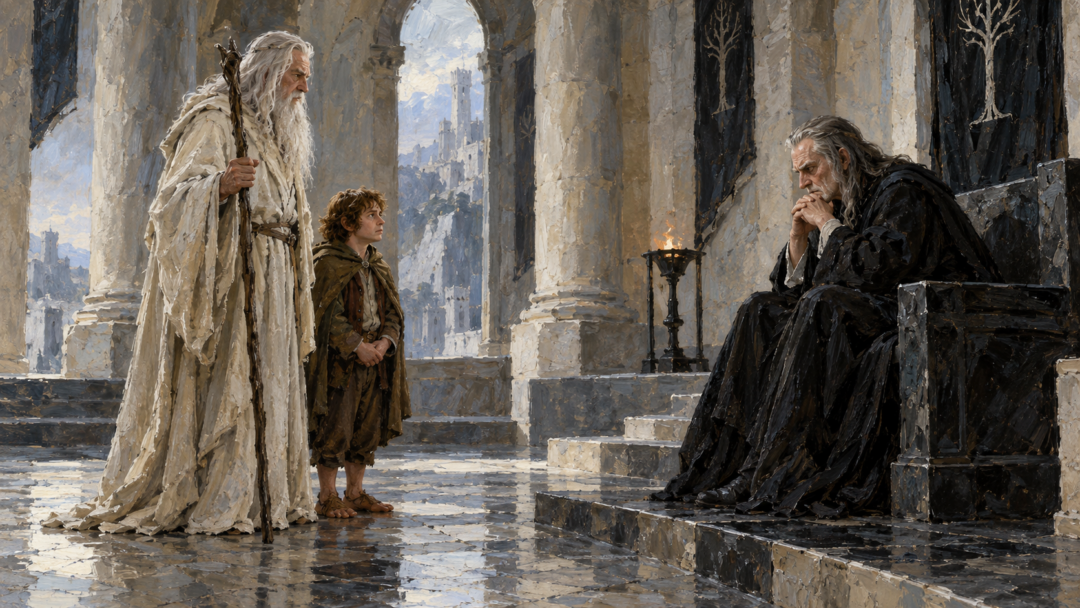
When Gandalf and Pippin are admitted to Denethor, the Steward is particularly interested in the hobbit.
Pippin knew Boromir.
He traveled with the Fellowship and witnessed the circumstances surrounding Boromir's final stand, although he cannot provide a complete account of everything that happened after the company was scattered.
Denethor's questioning is therefore deeply personal as well as political.
His eldest son has died far from home. Now a small companion of that son stands before him, able to speak about part of the journey that led to his death.
Pippin's response to Boromir's sacrifice also leads him to offer his service to Gondor.
That decision brings him into the Citadel Guard and places him near Denethor during the city's approaching crisis.
There is another distinction worth preserving. Although Pippin has looked into the palantír of Orthanc, the audience with Denethor is not presented as a formal report in which he reveals the full meaning of that encounter.
The actual conversation centers heavily on Boromir, the Fellowship, and the information Denethor hopes to obtain.
Pippin's importance is not that he arrives carrying a complete military intelligence briefing.
He arrives as a living connection between Denethor's lost son, the broken Fellowship, and Gandalf's larger concerns.
What Gandalf Can Do Because He Arrives Before the Assault
The clearest consequence of Shadowfax's journey appears after the travelers reach Minas Tirith.
Gandalf is present when the city's situation rapidly worsens.
On March 10, Faramir returns from Ithilien, pursued by winged Nazgûl. Gandalf rides out on Shadowfax and helps drive the attackers away, allowing Faramir and his companions to reach safety.
The horse that carried Gandalf to Gondor also carries him into an immediate act of defense.
Faramir's return is particularly significant because he possesses information about the movements of the Enemy and has encountered Frodo and Sam in Ithilien.
Through Faramir, Gandalf learns more about the Ring-bearer's recent progress.
That knowledge does not remove the uncertainty surrounding Frodo's mission. Gandalf still cannot know exactly what will happen in Mordor.
But it gives him a more recent understanding of events than he possessed when he left Rohan.
Shadowfax brings Gandalf to Minas Tirith. Gandalf is then present to help Faramir return. Faramir brings news connected to the secret mission on which the fate of the war ultimately depends.
None of this means Shadowfax alone determines the outcome. It does show how the timely arrival of one traveler can place him at the meeting point of several important developments.
As the defense of Minas Tirith continues, Gandalf also becomes a crucial source of leadership and resistance.
The story does not allow us to calculate how Gondor would have fared had Gandalf arrived later. It does, however, show that he performs essential actions during the crisis, and Shadowfax is the means by which he reaches the city in time to perform them.
The True Importance of Shadowfax's Ride
Shadowfax is often remembered for his unmatched pace, his noble bearing, and the extraordinary bond he shares with Gandalf.
He carries Gandalf away from the aftermath of the palantír incident and toward the place where the next great crisis is about to unfold.
He carries Pippin as well, bringing a witness to Boromir's last journey into the presence of Boromir's father.
He passes through a land where warning fires are already burning, reminding us that Gondor has its own means of recognizing and responding to danger.
And he brings Gandalf to the city before Faramir's desperate return and the beginning of the darkest days of its defense.
The importance of that ride cannot be reduced to an invented speed record or an exact number of hours gained.
Gondor was warned before Gandalf arrived. Its leaders knew that war was coming. What they did not possess was complete knowledge of the struggle taking place beyond their borders, or certainty about how that struggle would end.
Shadowfax could not provide those answers.
What he could do was carry Gandalf and Pippin into the heart of the crisis while their presence could still matter.
In a war where armies, messages, and individual choices continually converged, that was no small service.
Shadowfax did not bring Gondor its first warning.
He brought Gandalf to Gondor in time to act upon the danger it already knew was coming.
Sources & Notes
- Tolkien Gateway — Shadowfax. https://tolkiengateway.net/wiki/Shadowfax
- Tolkien Gateway — Mearas. https://tolkiengateway.net/wiki/Mearas
- Tolkien Gateway — Dol Baran. https://tolkiengateway.net/wiki/Dol_Baran
- Tolkien Gateway — 5 March. https://tolkiengateway.net/wiki/5_March
- Tolkien Gateway — 9 March. https://tolkiengateway.net/wiki/9_March
- Tolkien Gateway — 10 March. https://tolkiengateway.net/wiki/10_March
- Tolkien Gateway — Palantíri. https://tolkiengateway.net/wiki/Palant%C3%ADri
- Tolkien Gateway — Anor-stone. https://tolkiengateway.net/wiki/Anor-stone
- Tolkien Gateway — Denethor. https://tolkiengateway.net/wiki/Denethor_II
Primary text: The Lord of the Rings, The Two Towers, 'The Palantír' and Appendix B, 'The Great Years' (5 March 3019: the company camps at Dol Baran after the parley with Saruman, Pippin looks into the Orthanc-stone and a winged Nazgûl passes over the camp, and Gandalf sets out with Pippin for Minas Tirith), with The Return of the King, 'Minas Tirith' (Gandalf and Pippin reach the city on 9 March, Pippin is brought before Denethor, offers his sword in service, and sees the beacons of Gondor already alight) and 'The Siege of Gondor' (10 March, the Dawnless Day, when Gandalf rides out on Shadowfax and rescues Faramir from the Nazgûl, after which Faramir reports to Denethor on Ithilien and on letting the Ring-bearer go). Tolkien Gateway's Shadowfax entry supplies the horse's standing — chief of the Mearas, speed 'like an arrow', ground speed that rivalled the winged fell beasts of the Nazgûl, and enough will to stand before the Witch-king at the gate — and its Mearas entry gives the line's descent from Felaróf and the kings of the Mark, with Gandalf as the notable exception. Tolkien Gateway's date pages (5 March, 9 March, 10 March) provide the chronology used throughout; its Dol Baran entry places the palantír incident and the Nazgûl flyover on that hill on 5 March. Its Palantíri and Anor-stone entries establish the two stones the article relies on: the Orthanc-stone that Pippin looked into, and the Anor-stone kept secretly in Minas Tirith, which Denethor used to watch his realm and in which he eventually contested Sauron's will without being corrupted. Its Denethor entry covers his independent access to knowledge and his earlier strategic experience; its Faramir entry covers the Ithilien command and his father's judgement of him. Its Warning beacons of Gondor entry describes the beacons as Gondor's own alarm network of signal fires and courier posts along the White Mountains — a system distinct from anything a rider carries — and its Siege of Gondor entry supplies the 10–12 March sequence. The Encyclopedia of Arda's Shadowfax entry corroborates the horse's identity as the chief of the Mearas granted to Gandalf by Théoden. Caveats honoured rather than smoothed over: the narrative gives no measured speed for the ride, so the article's refusal to convert 5–9 March into hours saved is deliberate rather than an omission; and Tolkien Gateway records that the beacons are seen already alight in the book, whereas the films show them being lit on Gandalf's instruction, so no cinematic detail is treated as canon here.