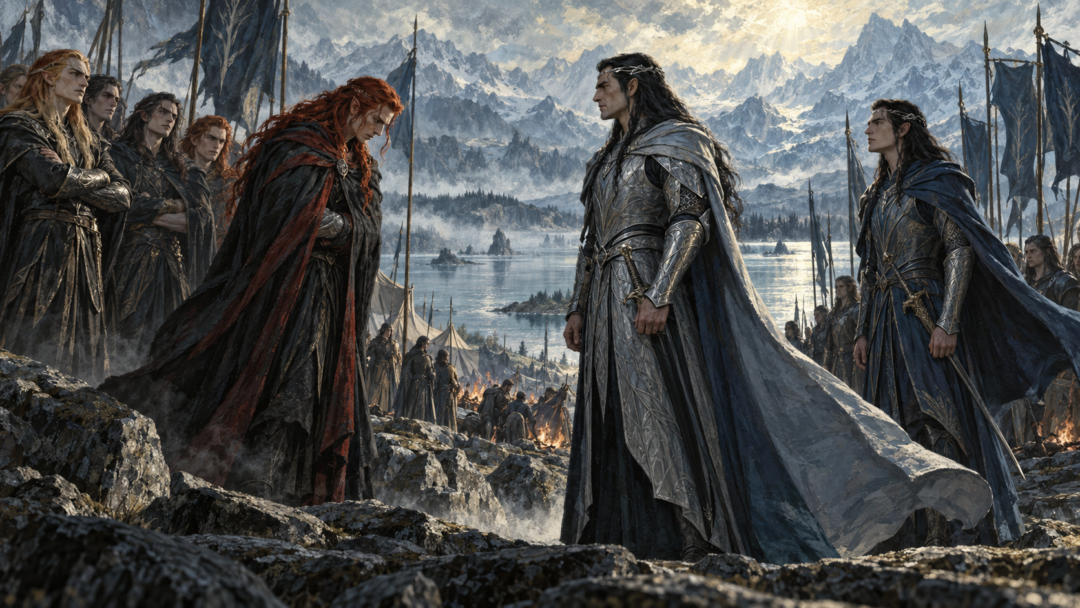
When Fingon rescued Maedhros from the cliffs of Thangorodrim, he did more than save the life of Fëanor's eldest son. His extraordinary act of courage helped change the political future of the Noldor in Middle-earth.
Maedhros had inherited his father's position as the foremost prince of the House of Fëanor. Yet after his rescue, he acknowledged Fingolfin as High King, surrendering the claim that might otherwise have kept the two branches of Finwë's family divided.
What makes this decision remarkable is what happened afterward.
Maedhros remained powerful. His brothers commanded territories across eastern Beleriand. His fortress at Himring became one of the great strongholds against Morgoth. Eventually, he organized an alliance ambitious enough to challenge Angband itself.
But the High Kingship never returned to his house.
Even when Fingolfin died, even when Fingon fell in battle, and even when Maedhros became the central organizer of the Noldor's greatest military coalition, he did not reclaim the crown.
The distinction matters because the House of Fëanor did not surrender its strength, its princely identity, or its ambitions. It surrendered something more particular: its claim to stand above the other Noldorin houses.
And the consequences endured long after the original reconciliation.
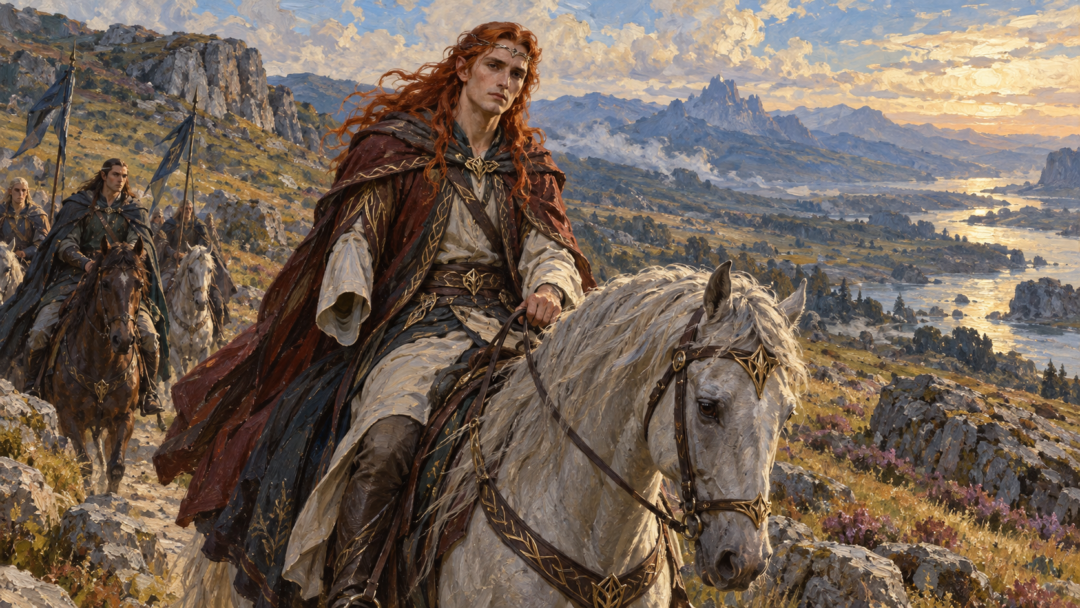
The Decision That Changed the House of Fëanor
Fëanor's departure from Aman had already divided the Noldor. After the seizure of the ships at Alqualondë, his followers crossed the Sea, leaving Fingolfin and his people behind. The burning of the ships at Losgar made that abandonment unmistakable.
Fingolfin's followers eventually reached Middle-earth by crossing the deadly Helcaraxë. They arrived carrying losses and grievances that could not easily be forgotten.
Meanwhile, Fëanor had been slain, and Maedhros had fallen into Morgoth's captivity.
Fingon's rescue changed their relationship. By reaching Maedhros on Thangorodrim, with the aid of Thorondor, Fingon saved his cousin from a torment that had seemed inescapable. The rescue cost Maedhros his right hand, which Fingon had to sever to free him.
In The Silmarillion, "Of the Return of the Noldor," the reconciliation culminates in Maedhros yielding the kingship to Fingolfin.
This was not simply an acknowledgment of Fingolfin's military strength. Maedhros recognized the wrongs committed against Fingolfin's followers and stepped aside from a claim that threatened to prolong their division.
Fingolfin became High King of the Noldor in Middle-earth, while Maedhros continued as the leader of Fëanor's sons.
The two positions were no longer the same.
His Brothers Did Not Welcome the Surrender
One of the most revealing details in the account is the reaction of Maedhros's brothers.
They were displeased by his decision.
Yet the narrative does not describe a successful challenge to Maedhros's decision.
Instead, he acted to prevent further hostility.
Knowing the danger posed by his brothers' temperaments, Maedhros took them away from the main settlements of Fingolfin's followers and established their power farther east.
It reduced the immediate possibility of conflict between rival Noldorin princes.
But it also created a lasting geographical division.
Fingolfin's house held the High Kingship, while Fëanor's sons developed their own strongholds and territories.
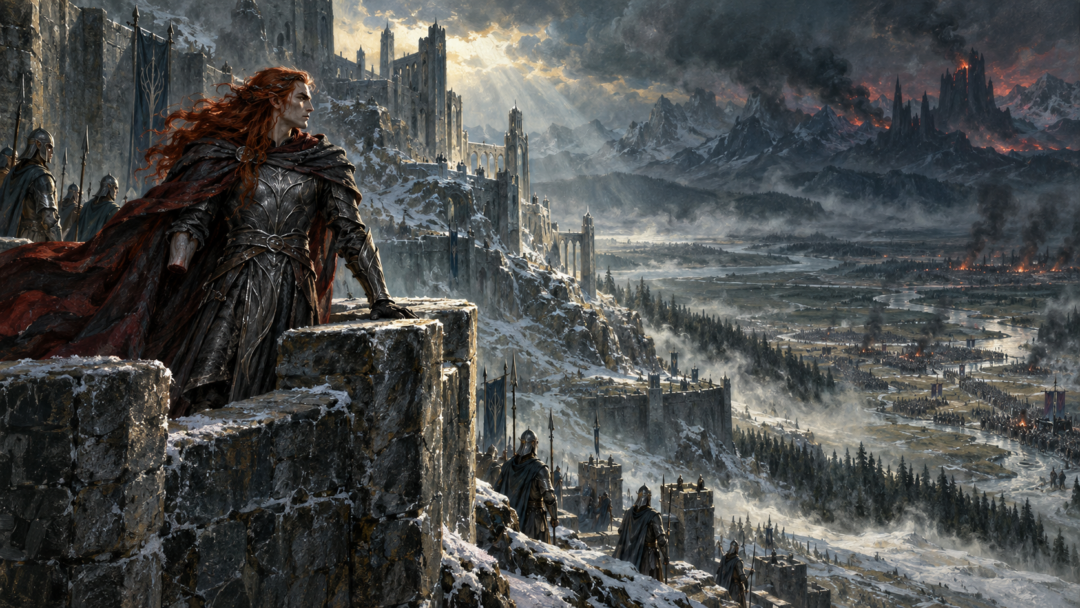
Himring: A Prince Without the High Crown
The clearest evidence that Maedhros retained considerable authority is the March of Maedhros.
From the great hill of Himring, he guarded the northeastern approaches of Beleriand against the forces of Morgoth.
His fortress occupied a strategically important position, overlooking lands threatened by enemies descending from the north.
Other sons of Fëanor established themselves across the eastern regions. Maglor guarded the vulnerable country later known as Maglor's Gap. Celegorm and Curufin held the Pass of Aglon, while Caranthir established his power farther east.
Together, these territories formed a substantial part of the defensive arrangement that helped contain Morgoth during the long Siege of Angband.
He commanded warriors, maintained a fortress, directed the affairs of his followers, and exercised authority within his own lands.
But none of this restored his claim to the High Kingship.
A prince could possess considerable territorial and military power without being High King of all the Noldor.
The House of Fëanor remained formidable, but its strength operated alongside the kingship of Fingolfin rather than replacing it.
Why Fingolfin's Death Did Not Restore the Crown
The next great test came during the Dagor Bragollach, the Battle of Sudden Flame.
Morgoth shattered the long Siege of Angband, devastated northern Beleriand, and overturned much of the defensive order maintained by the Noldor.
Fingolfin eventually rode alone to Angband and challenged Morgoth. He wounded the Dark Lord but was killed.
Maedhros was still alive. He remained the eldest son of Fëanor. His fortress at Himring survived the catastrophe, although the surrounding lands suffered terribly.
Yet the High Kingship did not pass to him.
It passed to Fingon, the son of Fingolfin.
The narrative does not present Fingolfin's death as an opportunity for the House of Fëanor to recover its former claim. Nor does it describe Maedhros contesting Fingon's succession.
It would be too much to claim that the texts establish a comprehensive, unchangeable constitutional rule governing every possible Noldorin succession.
They do, however, establish what happened in this particular case.
The High Kingship was not treated as reverting automatically to Fëanor's descendants when Fingolfin died.
Maedhros's claim remained relinquished, and Fingon's kingship stood.
The Union of Maedhros Was Not a New Kingship
Perhaps the most compelling evidence comes later, when Maedhros organized the alliance remembered as the Union of Maedhros.
After the devastation of the Dagor Bragollach, Morgoth's enemies faced an increasingly desperate situation.
The recovery of a Silmaril by Beren and Lúthien helped inspire hope that Morgoth was not beyond challenge.
Maedhros sought to bring together the scattered strength of the Elves and their allies for a great offensive against Angband.
The proposed alliance involved the forces of the sons of Fëanor, cooperation with Fingon, and support from other peoples, including Men and Dwarves.
Yet this coalition was not a restoration of Fëanorian High Kingship.
Fingon remained High King.
Maedhros was the organizer of a major military alliance, not the acknowledged replacement for the existing royal authority.
This distinction becomes particularly clear in the account of the Nirnaeth Arnoediad, the Battle of Unnumbered Tears.
The allied armies were to act through coordinated movements. Fingon's forces waited in the west, while Maedhros's forces were to advance from the east.
Their cooperation required military planning, trust, and a shared enemy.
It did not require one cousin to take the other's crown.
Naming the alliance after Maedhros does not mean he became its High King. The events described in The Silmarillion, "Of the Fifth Battle: Nirnaeth Arnoediad," preserve that distinction.
Maedhros exercised leadership through coordination and alliance. Fingon retained the High Kingship.
The Noldor could cooperate under a common strategy without undoing the political settlement made after Maedhros's rescue.
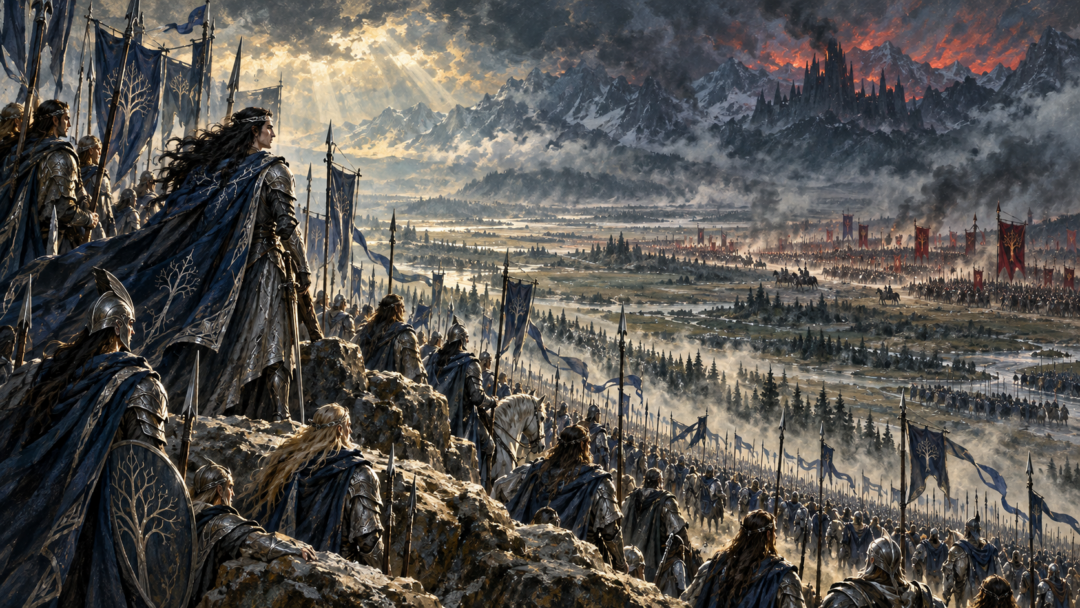
The Limits of Maedhros's Influence
The Union also reveals the limits of Maedhros's authority.
He could organize a great military undertaking, but he could not compel every Elven realm to join it.
Doriath remained outside the alliance, and Nargothrond did not commit its full strength.
Their refusal was connected, at least in part, to the actions of Fëanor's sons and the distrust those actions had created.
The history of Celegorm and Curufin in Nargothrond, and the continuing hostility between the sons of Fëanor and Thingol over the Silmaril, made unity difficult.
The Oath of Fëanor remained a source of division even when Maedhros attempted to unite Morgoth's enemies.
He possessed enough influence to assemble a formidable coalition, but not enough to overcome every grievance between the Elven realms.
Turgon, for example, brought a force from Gondolin to the great battle, but his participation did not make Gondolin a possession of Maedhros.
The Union was an alliance against Morgoth, not a new kingdom encompassing all its members.
Its failure was catastrophic.
The betrayal of the Easterlings under Uldor contributed to the destruction of Maedhros's eastern assault, while Fingon was slain in the western fighting.
The armies of the Noldor suffered a defeat from which their power in Beleriand never fully recovered.
For Maedhros, the disaster meant the collapse of his greatest effort to defeat Morgoth through united military strength.
Yet even after Fingon's death, the crown did not return to the House of Fëanor.
The Crown Passes On, but the Oath Remains
After Fingon fell, the High Kingship passed to Turgon of Gondolin.
Maedhros survived the battle, but his political and military position had been severely weakened.
The distinction between the two houses nevertheless continued.
Turgon represented the continuation of the kingship established through Fingolfin. Maedhros remained the foremost surviving son of Fëanor, burdened by his family's oath and the consequences of its pursuit.
Maedhros's earlier willingness to surrender the crown therefore stands in sharp contrast to his inability, in the end, to escape his father's oath.
He could relinquish political supremacy to preserve peace among his people.
But he could not finally abandon the demand that brought his house into renewed conflict with them.
Why the High Kingship Never Returned
The later High Kingship of Gil-galad confirms the broader outcome: no son of Fëanor recovered the office.
Gil-galad's precise parentage differs among the surviving versions of the legendarium. The published Silmarillion identifies him as Fingon's son, while later genealogical material discussed in The Peoples of Middle-earth associates him with Orodreth.
Those variations should not be used to invent a single rigid law of inheritance.
For this question, the important point is simpler.
Neither account makes Gil-galad a descendant of Fëanor, and neither describes a restoration of the High Kingship to Maedhros or his brothers.
His brothers' displeasure did not reverse that decision. Their territorial power did not reverse it. The survival of Himring did not reverse it. Even the creation of the Union of Maedhros did not reverse it.
The eldest son of Fëanor remained capable of great courage, military leadership, and political initiative. He did not cease to be one of the most important Noldorin princes of the First Age.
But he no longer claimed the crown above them all.
The tragedy is that surrendering the High Kingship did not save his house from its deeper ruin.
Maedhros succeeded in yielding a disputed royal claim for the sake of reconciliation, yet the oath inherited from his father continued to govern the fate of his family.
The crown passed away from the House of Fëanor and never returned.
The oath remained until almost everything else was lost.
Sources & Notes
- Tolkien Gateway — Maedhros. https://tolkiengateway.net/wiki/Maedhros
- Tolkien Gateway — High King of the Noldor. https://tolkiengateway.net/wiki/High_King_of_the_Noldor
- Tolkien Gateway — Himring. https://tolkiengateway.net/wiki/Himring
- Tolkien Gateway — Union of Maedhros. https://tolkiengateway.net/wiki/Union_of_Maedhros
- Tolkien Gateway — Nirnaeth Arnoediad. https://tolkiengateway.net/wiki/Nirnaeth_Arnoediad
- Tolkien Gateway — Dagor Bragollach. https://tolkiengateway.net/wiki/Dagor_Bragollach
- The Encyclopedia of Arda — Maedhros. https://www.encyclopedia-of-arda.com/m/maedhros.html
Primary text: The Silmarillion, "Of the Return of the Noldor" (Fingon's rescue of Maedhros from Thangorodrim with Thorondor's aid, the loss of Maedhros's right hand, and the council at Mithrim where Maedhros yields the High Kingship to Fingolfin), "Of the Ruin of Beleriand and the Fall of Fingolfin" (the Dagor Bragollach, Fingolfin's death before Angband, and Fingon's succession) and "Of the Fifth Battle: Nirnaeth Arnoediad" (the Union of Maedhros, the Easterlings' betrayal, Fingon's death and Turgon's succession). Tolkien Gateway's Maedhros entry records the specific act at the council in Mithrim — Maedhros relinquishing his claim as High King of the Noldor to Fingolfin, an action his brothers did not approve of — and notes that he afterwards moved his brothers east and ruled the lands around the Hill of Himring. Its High King of the Noldor entry supplies the succession framework: the office was the nominal overlordship of all Noldorin realms but carried limited practical authority, passing Fingolfin to Fingon, then to Turgon, and finally out of the House of Fingolfin to Gil-galad of the House of Finarfin. Tolkien Gateway's Himring entry ties the fortress's founding directly to the waiver of the kingship; its Union of Maedhros entry shows the alliance split into an eastern army under Maedhros and a western army under High King Fingon, i.e. coalition command without any transfer of the crown; and its Nirnaeth Arnoediad and Dagor Bragollach entries supply the battle outcomes (destruction of the Siege of Angband, Fingolfin's fall, Fingon's death, the disbanding of the Union). The Encyclopedia of Arda's Maedhros entry corroborates the titles and setting (Lord of Himring, March of Maedhros, House of Fëanor). Two caveats are honoured rather than smoothed over: the sources do not establish a rigid constitutional rule of Noldorin succession — Tolkien Gateway records what happened in each case — and Gil-galad's parentage differs between versions, the published Silmarillion making him Fingon's son while later material (and Tolkien Gateway's entry) associates him with Orodreth; both readings keep him outside the House of Fëanor, which is the point the article actually relies on. The article's wider reading — that the House of Fëanor surrendered a claim to precedence rather than its strength, and that this distinction is what makes the later history intelligible — is interpretation of that material, not a claim asserted by the cited sources.