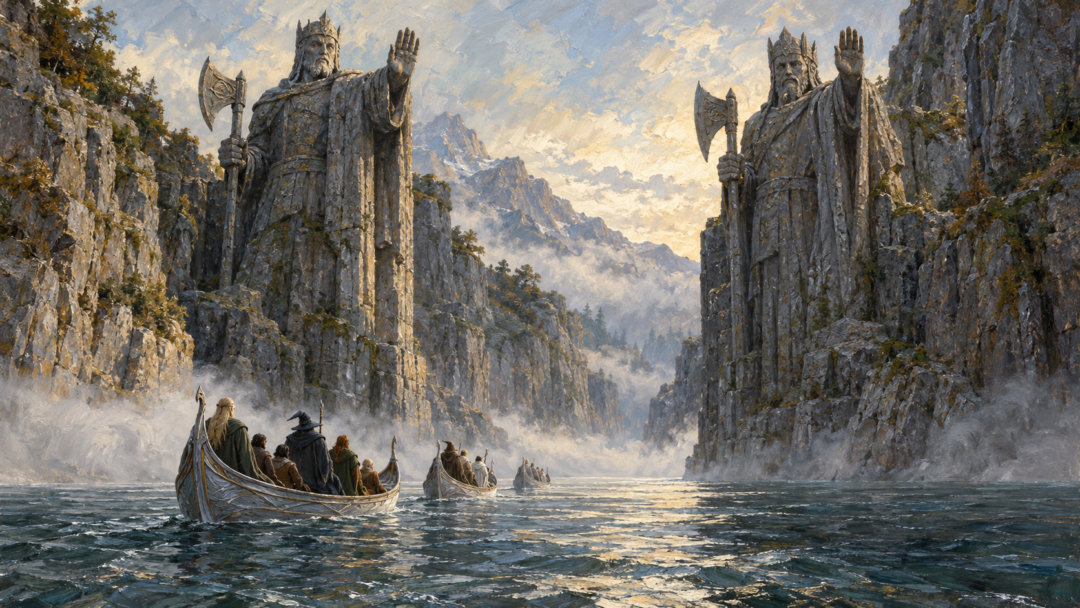
When the Fellowship comes down the Great River and sees the Argonath, Aragorn has no crown.
He has not entered Minas Tirith as king. He has not been acclaimed by Gondor. The War of the Ring has not even reached its final battles. Yet suddenly the Company is confronted by two immense stone figures of Gondor’s royal past, standing on either side of the Anduin like guardians of an older political world.
They are Isildur and Anárion.
Their hands are raised in warning. Their faces look northward. And the river itself carries the travellers between them.
That is what makes the Argonath so interesting. They do not need Aragorn to be king in order to possess meaning. Their authority is inherited rather than newly created. Long before Aragorn’s coronation, these monuments already announce that the Company is passing a threshold associated with Gondor’s ancient realm.
And for Aragorn, the encounter is more than impressive scenery. For a brief moment, the heir who has spent much of the journey as a weather-beaten Ranger sees the kingship of his ancestors made physically enormous.
The River Becomes a Political Boundary
The Argonath appear in “The Great River,” as the Fellowship travels south on the Anduin toward the Falls of Rauros.
The approach matters.
This is not a monument encountered in a city square, where political authority is already obvious. The Company is travelling through a vast river landscape. The Anduin is carrying them southward through country where settlements and institutions are not constantly visible.
Then stone itself takes over the work of proclamation.
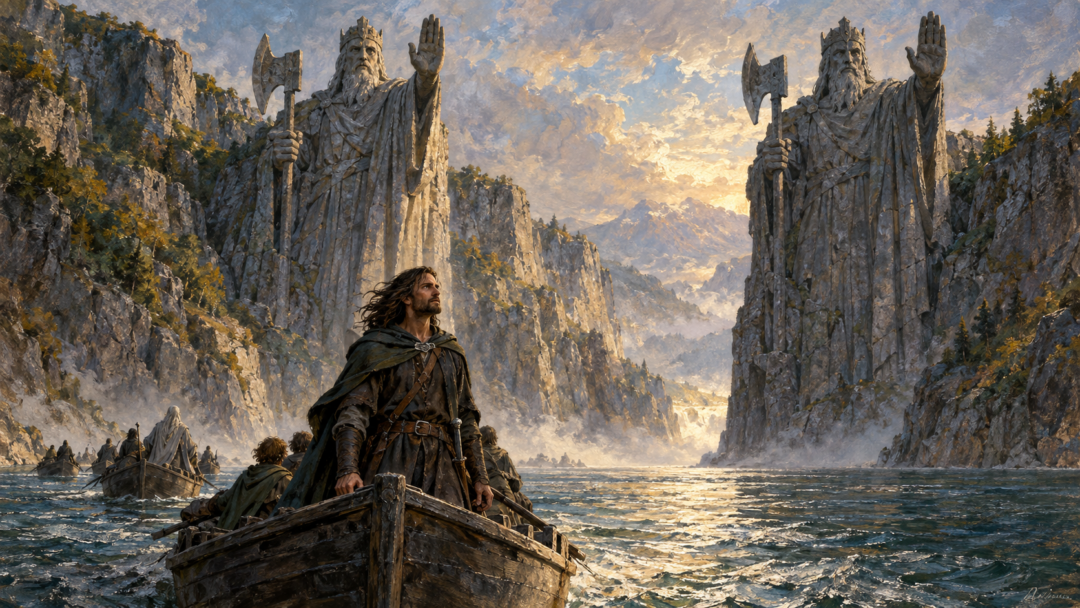
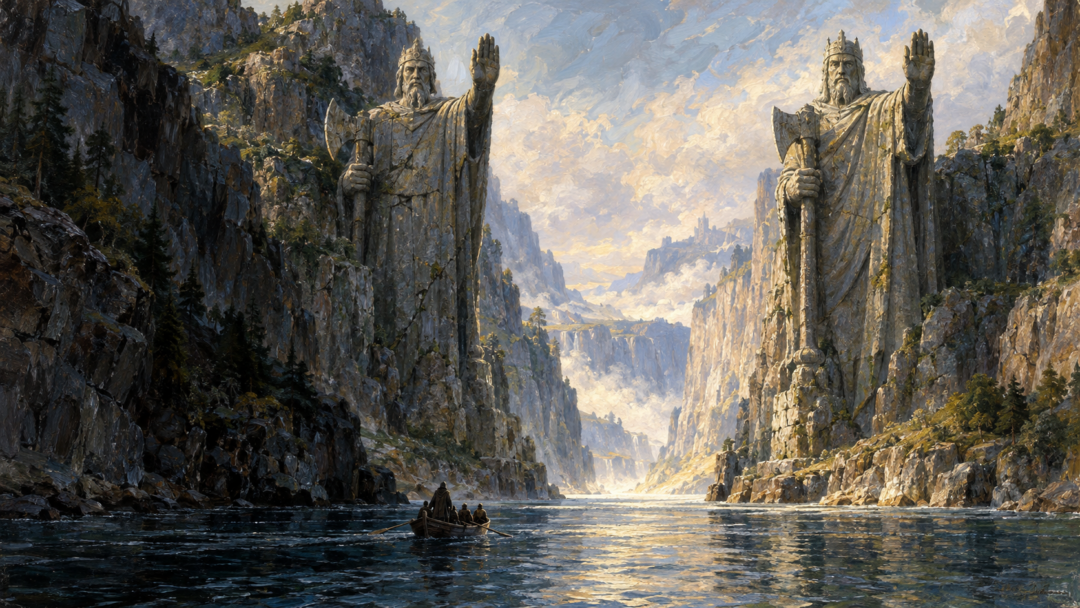
On either side of the river rise enormous carved figures. They represent Isildur and Anárion, Elendil’s sons and the founders of Gondor in exile. Each wears a crown and helm, and each raises a hand in a gesture of warning.
The statues are therefore not merely memorials to dead rulers. Their placement makes them territorial.
The Company cannot simply glance at them from a distance and continue along an unrelated road. Their route passes between the figures. Geography, memory, and kingship converge at one narrow point.
Aragorn identifies the place as the Argonath, the Pillars of the Kings, and says that they will soon pass into the North Marches of Gondor in the days of old.
That qualification matters: “in the days of old.” The Fellowship is not crossing into a perfectly preserved ancient kingdom whose institutions still extend unchanged across every former frontier. The monument survives while the political geography around it has altered.
The boundary marker has outlived the full strength of the realm whose reach it once announced.
Why Isildur and Anárion Stand There
The identity of the figures gives the monument its force.
Isildur and Anárion were not arbitrary Gondorian heroes. They were Elendil’s sons, survivors of Númenor’s downfall, and central figures in the establishment of the Realms in Exile. In Gondor, their memory belongs to the deepest layer of the kingdom’s royal legitimacy.
So when the Argonath confront travellers coming down the Anduin, the message is not simply that Gondor once possessed powerful kings.
It is dynastic.
The realm is represented through the brothers who founded Gondor. Their enormous stone likenesses connect territory to ancestry. A traveller approaching from the north encounters not an abstract emblem but royal persons carved into the landscape.
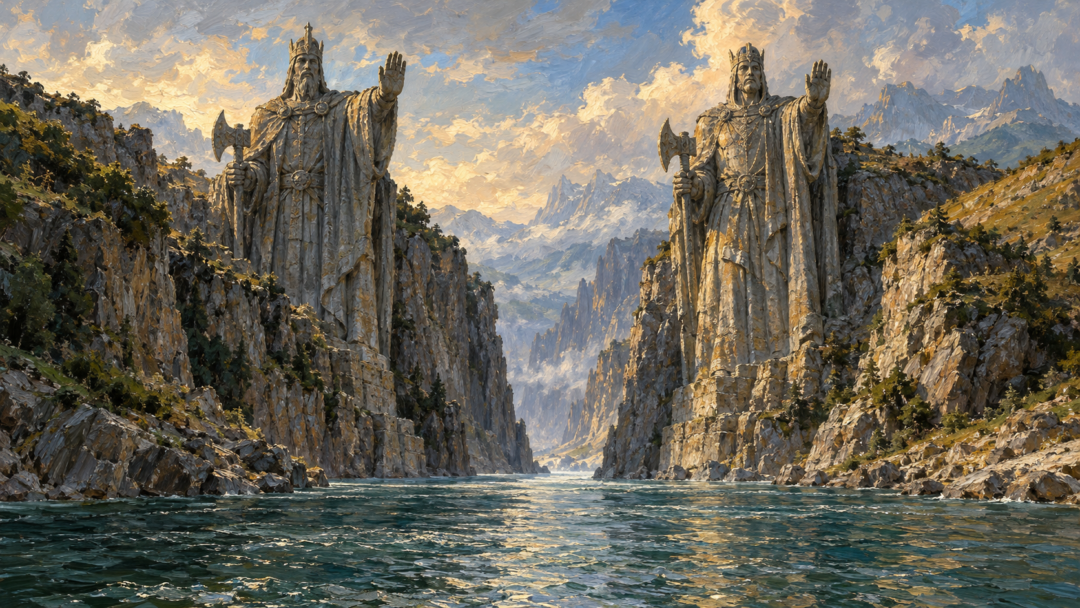
The raised hands intensify that effect. In “The Great River,” the gesture is unmistakably forbidding. The figures face north, and their left hands are lifted palm outward.
Nothing in the scene requires the statues to be magical. Tolkien does not present them as moving, speaking, or supernaturally interrogating travellers. Their power is monumental and symbolic.
That distinction makes them more interesting, not less.
A carved warning can continue to communicate long after the people who ordered it have vanished. Anyone travelling south on the river can understand the basic language of the monument: beyond this point lies—or once lay—a realm conscious of its borders and strong enough to mark them on a colossal scale.
The Argonath therefore “work” because landscape becomes memory.
The mountain walls, the narrowing river, and the enormous kings all reinforce one another. The traveller does not merely learn that Gondor claimed this frontier. The traveller physically passes beneath the gaze of Gondor’s remembered rulers.
Aragorn Changes When He Sees Them
The most revealing part of the episode may be Aragorn’s reaction.
Throughout much of The Fellowship of the Ring, other characters encounter him first as Strider: the mysterious Ranger from the North. His lineage is real, but his outward circumstances are deliberately far removed from the visible grandeur of ancient kingship.
At the Argonath, that contrast briefly collapses.
As the boats pass between the Pillars of the Kings, Frodo looks at Aragorn and sees him transformed in bearing. Aragorn sits proudly, his hood thrown back, his dark hair moving in the wind. Frodo perceives him in a moment of kingly stature, and Aragorn declares that he has come to the Argonath of his people.
This is not his coronation.
It does not make him king of Gondor by itself, nor does the monument somehow recognize him through enchantment. Nothing in the text suggests that the stone figures confer authority upon him.
Instead, the scene reveals something that was already true about Aragorn’s identity.
He is Isildur’s heir.
The ancient royal landscape therefore has a personal meaning for him that it cannot have for the other members of the Company. Boromir is a man of Gondor and deeply attached to his country, but Aragorn’s relationship to the monument runs through lineage as well as loyalty.
For a moment, the Ranger appears visually suited to the world represented by the statues.
That is powerful precisely because his kingship remains unresolved.
The Argonath Does Not Need a Living King
Gondor at this point has no crowned king.
Its rulers are Stewards, governing in the absence of the royal line. Aragorn’s future claim has not yet reached its resolution. Yet the Argonath still stands.
That gives the monument a strange political durability.
A living monarch can die. A dynasty can fail. Borders can retreat. Administrative control can weaken. But a monument built into a major landscape can continue carrying the memory of authority long after the circumstances that produced it have changed.
The Argonath therefore separates kingship as immediate government from kingship as inherited memory.
The statues do not administer Gondor. They cannot defend the frontier. They cannot command soldiers or collect tribute. They are not substitutes for functioning political institutions.
But they can preserve an idea of the realm.
They say, in stone, that Gondor once understood this passage as belonging within its northern sphere and that royal authority stood behind that claim.
By the time Aragorn arrives, that memory has become especially significant because the kingly office itself has been empty for centuries.
The kingdom has continued without a king.
The image of kingship has continued too.
Why the Warning Gesture Matters
It is easy to focus on the size of the Argonath, but the posture of the statues is arguably more important.
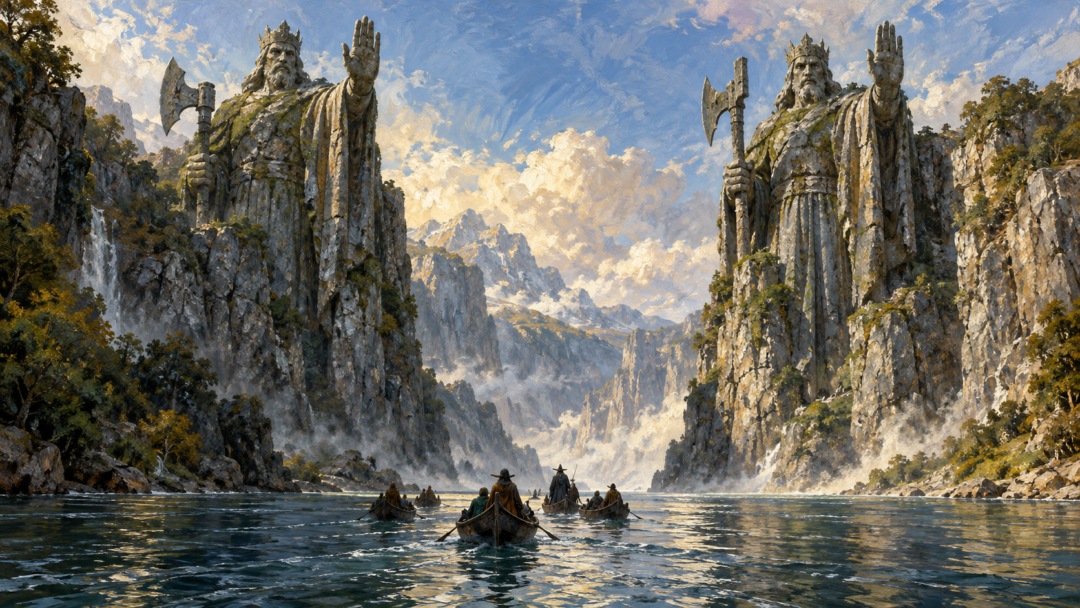
Their hands are raised against those approaching from the north.
That makes them active symbols rather than merely commemorative portraits. They are positioned to address movement through the landscape.
A tomb looks backward. A statue in a hall may celebrate ancestry. The Argonath does something different: it confronts the traveller.
The implication is territorial caution—an announcement that the person entering this river passage is approaching a realm whose rulers claimed the power to establish and defend boundaries.
The text does not provide a detailed legal formula for what the gesture meant to every traveller, and it would be unsafe to invent one. We are not told of some specific universal rule by which every boat had to stop, identify itself, or pay a toll.
The monument’s message is broader and more durable than that.
Beware. You are crossing into the remembered dominion of kings.
And because the warning is embodied by Isildur and Anárion, it ties territorial authority to Gondor’s founding royal past.
The Irony of Aragorn Passing Beneath Them
There is a beautiful historical irony in the scene.
The Argonath was not built for Aragorn’s return. He did not commission it, and the Company’s passage was not the event for which the monument existed.
Yet when Aragorn finally comes beneath those figures, the old boundary acquires a new dramatic meaning.
The heir of Isildur is travelling south beneath an image of Isildur.
He is not yet riding at the head of a victorious army. He is not dressed for a coronation. He is travelling in a small boat with a Fellowship that is already close to breaking apart.
Even his immediate future is uncertain.
That contrast prevents the scene from becoming simple royal triumph. The ancient kings are colossal, permanent, and commanding. Their heir is still mortal, vulnerable, and moving toward choices whose outcome he cannot know.
The monument shows what kingship once looked like when translated into stone.
Aragorn still has to prove what restored kingship will mean in action.
A Kingdom Can Survive in Its Landmarks
The Argonath belongs to one of the deepest patterns in Middle-earth: political power fades, but the world remembers.
Memory survives in names, roads, graves, ruins, swords, bloodlines, songs, and places. Sometimes it survives so completely in a landscape that characters can walk directly into the past.
That is what happens on the Anduin.
Before Aragorn becomes king, before the crown is restored, and before the War of the Ring is decided, he enters a landscape already marked by royal authority.
The Argonath does not predict his coronation.
It does something subtler.
It reminds the reader that Aragorn’s future is connected to a past far larger than Strider’s outward appearance suggests. The statues belong to an old Gondor, to Isildur and Anárion, and to a frontier remembered from the kingdom’s greater days.
Aragorn does not create that inheritance.
He passes beneath it.
And for one brief moment on the Great River, the weathered Ranger and the monumental kings seem to belong to the same story.
That is how the Argonath works before Aragorn ever wears a crown: not as enchanted guardians awaiting their rightful heir, but as royal memory made geographical—an old warning at an old boundary, still powerful enough to make the returning heir look like the king he may become.
Sources & Notes
- Tolkien Gateway — Argonath. https://tolkiengateway.net/wiki/Argonath
- Tolkien Gateway — The Great River (chapter). https://tolkiengateway.net/wiki/The_Great_River
- Tolkien Gateway — Isildur. https://tolkiengateway.net/wiki/Isildur
- Tolkien Gateway — Anárion. https://tolkiengateway.net/wiki/Anárion
- Tolkien Gateway — Rauros. https://tolkiengateway.net/wiki/Rauros
- The Encyclopedia of Arda — Argonath. https://www.encyclopedia-of-arda.com/a/argonath.html
Primary text: The Fellowship of the Ring, Book II, Chapter 9, “The Great River,” for the passage of the Company down the Anduin, the Argonath, and Aragorn's declaration that he has come to the Argonath of his people. Tolkien Gateway documents the monument itself — two enormous rock pillars carved in the likenesses of Isildur and Anárion, facing north, each with an axe in the right hand and the left hand raised in a gesture of defiance to the enemies of Gondor — records that they were built after Minalcar's victory over the Easterlings in T.A. 1248 (the Encyclopedia of Arda dates them to about III 1250 and treats the builder as open to question), and situates them at the northern end of Nen Hithoel. Tolkien Gateway's chapter synopsis and the Isildur and Anárion entries supply the dynastic background: the sons of Elendil, survivors of Númenor's downfall and founders of the Realms in Exile. The article's reading of the statues as inherited royal memory rather than enchanted guardianship, and its account of what the scene reveals about Aragorn's unresolved kingship, is interpretation of that material, not a claim made by the sources.